- The paper presents a history-dependent neural model (CPL) that resolves ambiguous supervision by dynamically suppressing incompatible outputs through learned pairwise interactions.
- It leverages a hybrid factorization combining parallel parameterization with autoregressive decoding to achieve efficient structured selection with improved runtime and accuracy.
- Experiments on path prediction and representative subset selection demonstrate CPL’s robust performance and reduced computational costs compared to traditional methods.
Contextual Plackett–Luce: Efficient Neural Sequence Selection Under Ambiguity
Introduction and Motivation
The "Contextual Plackett–Luce" (CPL) model addresses a foundational problem in structured prediction: selecting a coherent subset or sequence from a large pool of candidates where the supervision is inherently ambiguous. Such ambiguity arises in cases where each input admits multiple valid outputs, but training supervision provides only a single sampled instance per input. This single-sample ambiguity regularly emerges in domains like future trajectory prediction in autonomous driving or subset selection tasks, making robust learning both theoretically challenging and practically consequential.
Conventional structured prediction paradigms either rely on independent per-element scoring, set-level matching objectives (e.g., Hungarian matching), or fully autoregressive sequence models. Each design exhibits critical incompatibilities with ambiguous supervision: locality and lack of coordination in independent methods, mode-averaging in matching-based methods, or impractical computational costs for full autoregression. CPL unifies the favorable computation properties of parallelism with the expressivity and mode-commitment of sequential models by leveraging a history-dependent Plackett–Luce factorization, augmented with a context-aware, interaction-based neural parameterization.
CPL extends the classical Plackett–Luce model by introducing context-dependent utilities via unary and pairwise interaction terms. For a candidate set X, with embeddings qi, CPL computes unary relevance θi=fθ(qi) and interaction matrix Wij=fW(qi,qj) in parallel. During decoding, subset construction is performed autoregressively:
ℓj(St)=θj+i∈St∑Wji,P(j∣St)=∑k∈/Stexp(ℓk(St))exp(ℓj(St))
The next candidate is chosen greedily or via stochastic sampling, with efficient incremental updates since W is precomputed. This yields fast, history-dependent decoding that supports both sequence and unordered subset construction with practical runtime.
Resolution of Ambiguity and Mode Commitment
A defining capability of CPL is its robustness to multimodal output ambiguity, enforced by history-conditioned pairwise interactions. Upon selection of a candidate, CPL's interaction matrix can suppress incompatible alternatives (e.g., different branches of a junction) and promote compatible subsequent choices. This ensures that, under ambiguous supervision, CPL does not average across mutually exclusive options but instead commits to a coherent structural mode—a property that eludes parallel and matching-based methods.
This core mechanism is visualized in structured selection tasks over latent clusters:
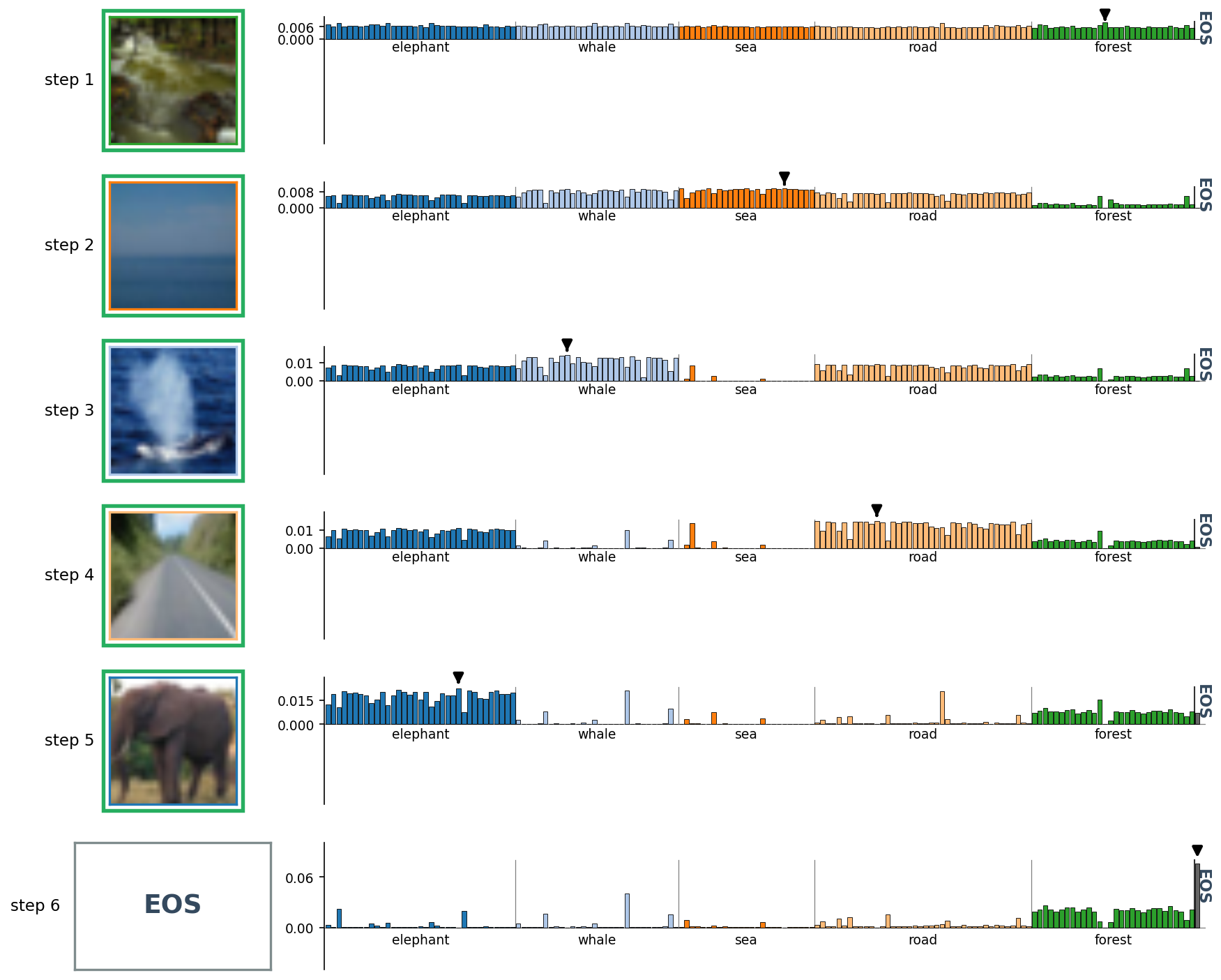
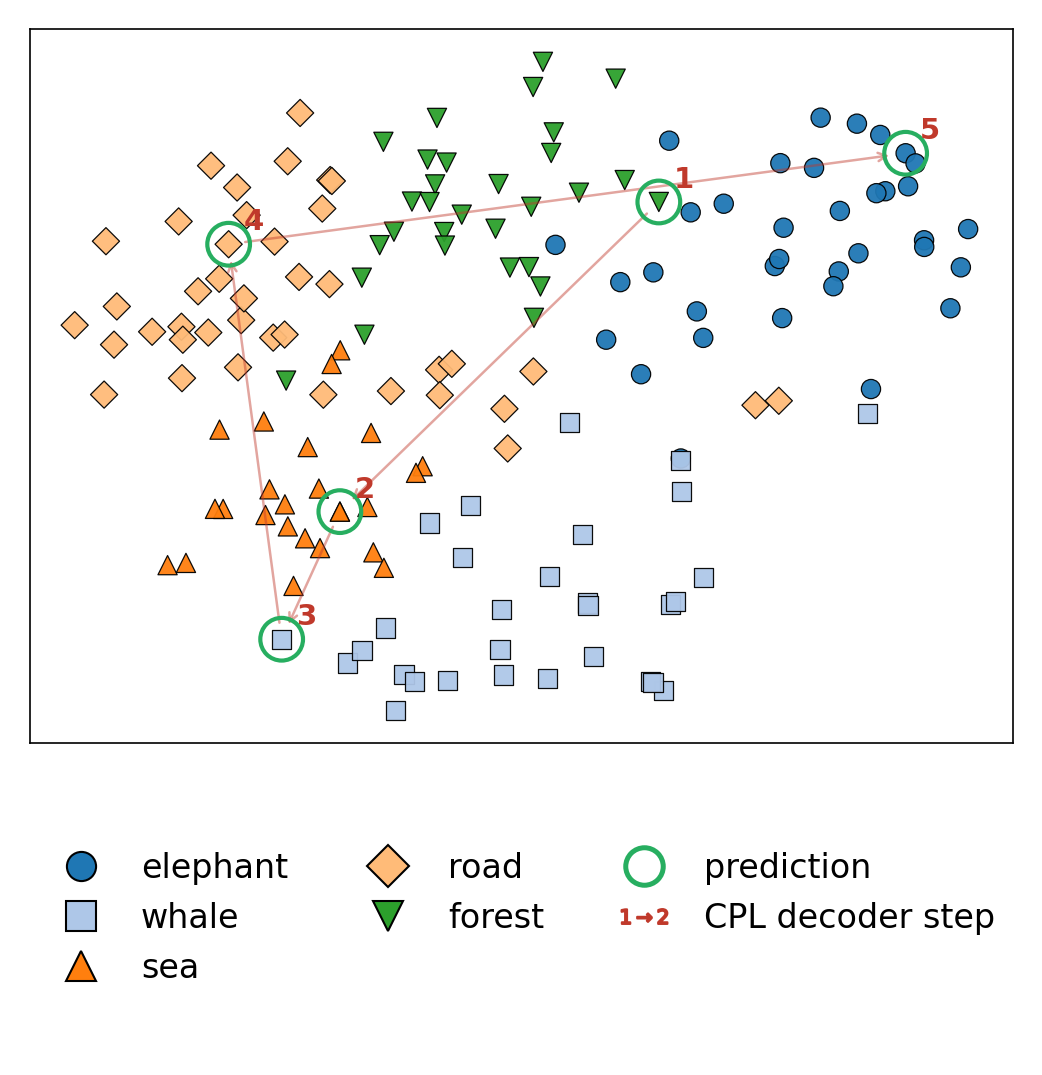
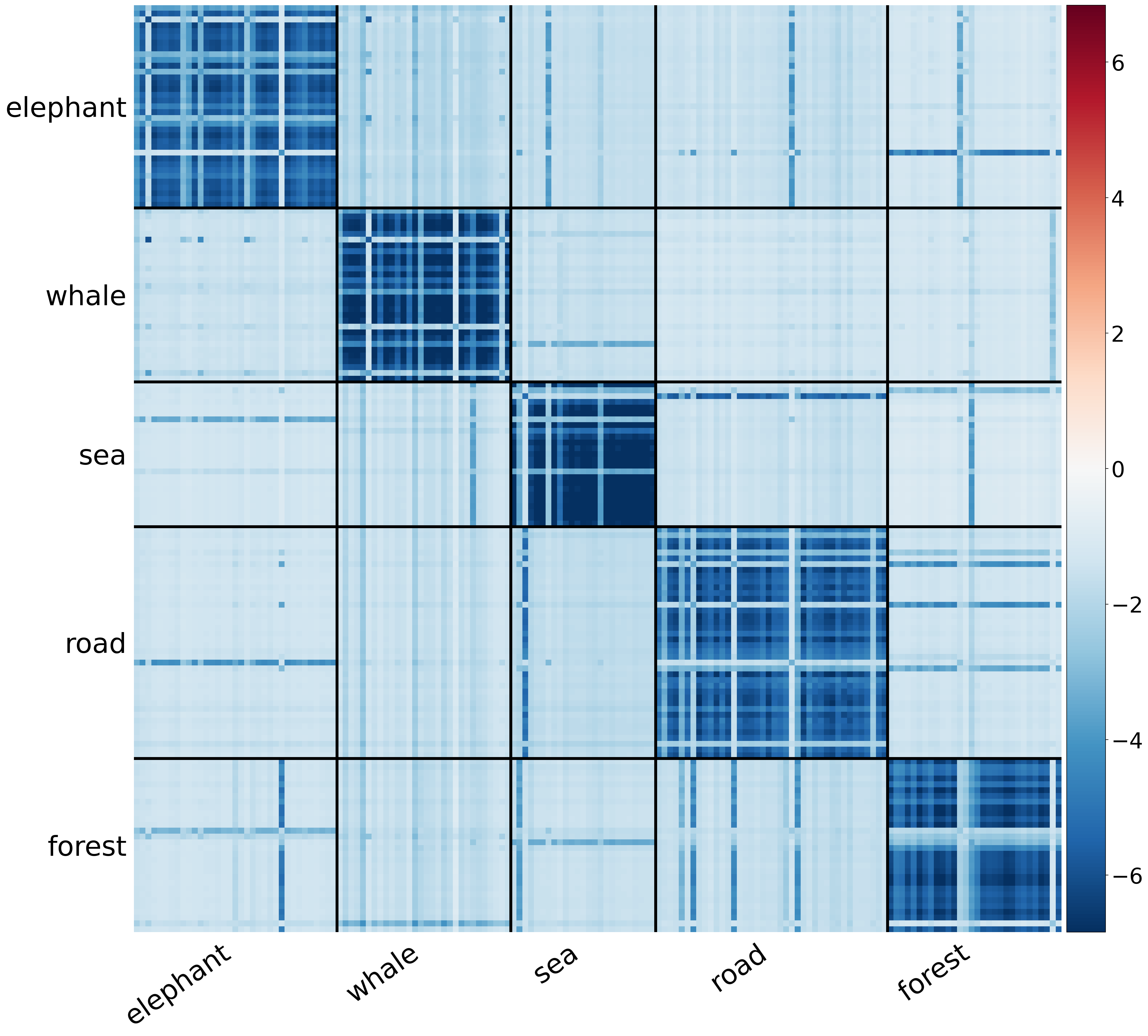
Figure 1: Example 1: A selection example consisting of five semantic clusters: elephant, whale, sea, road, forest.
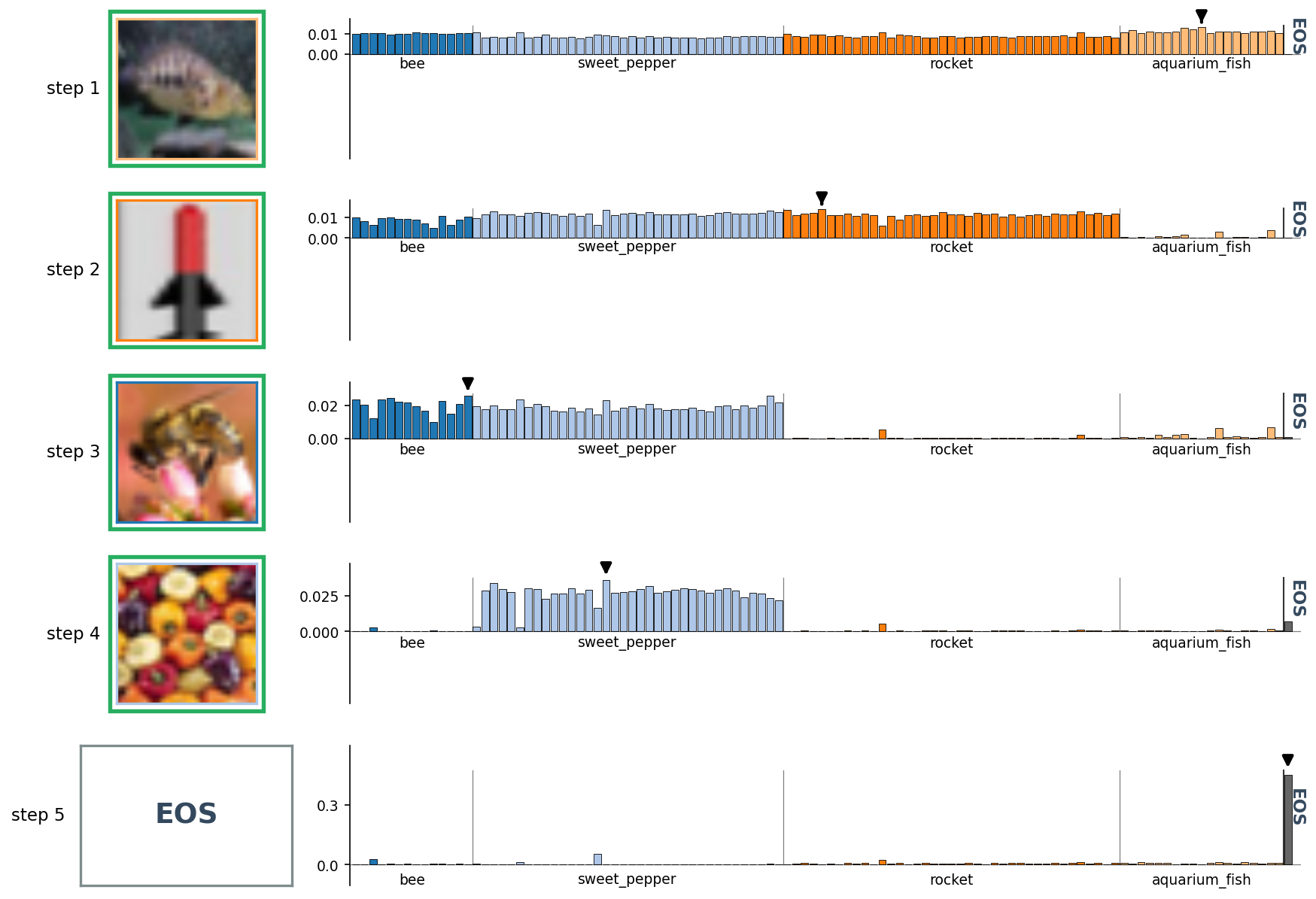
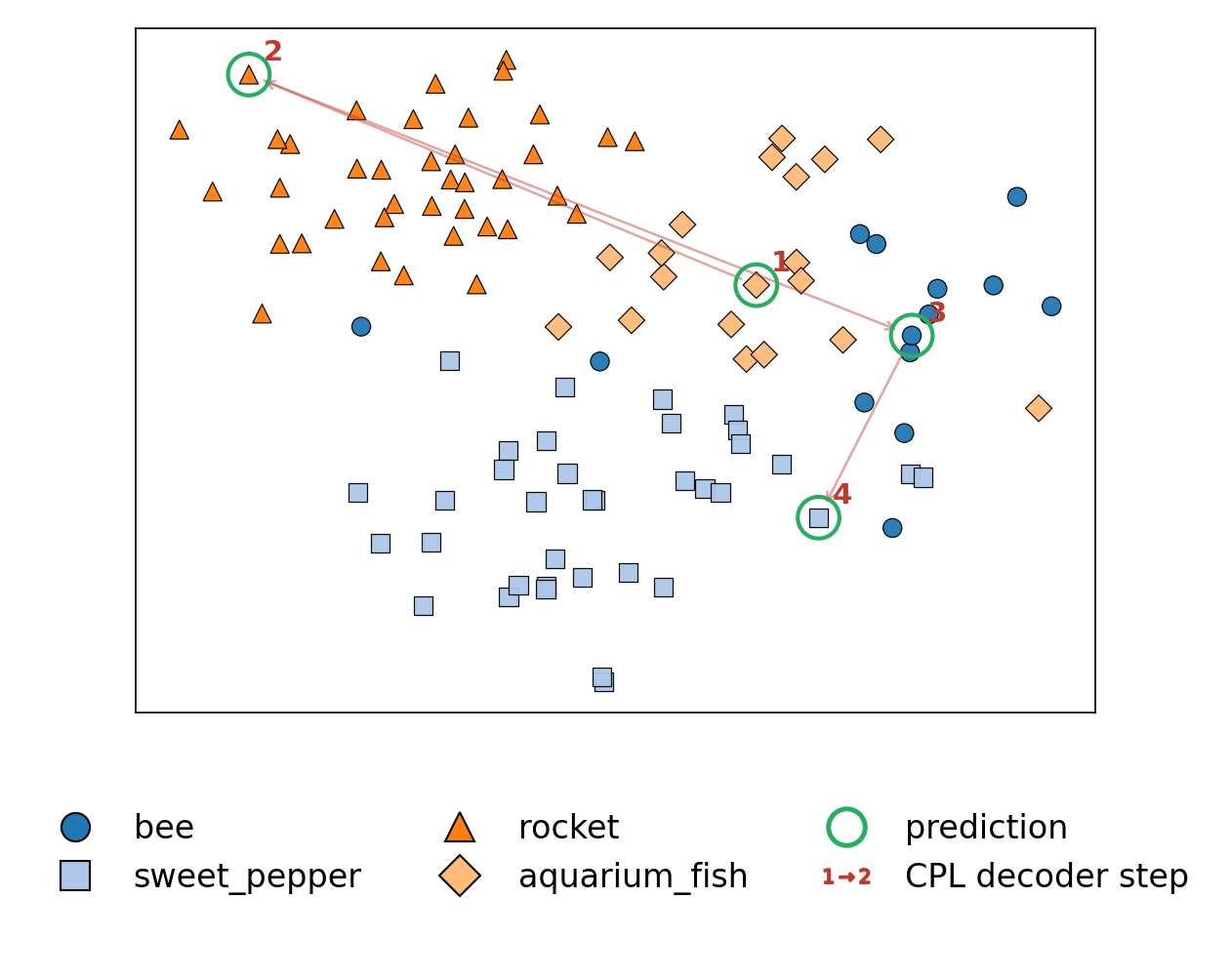
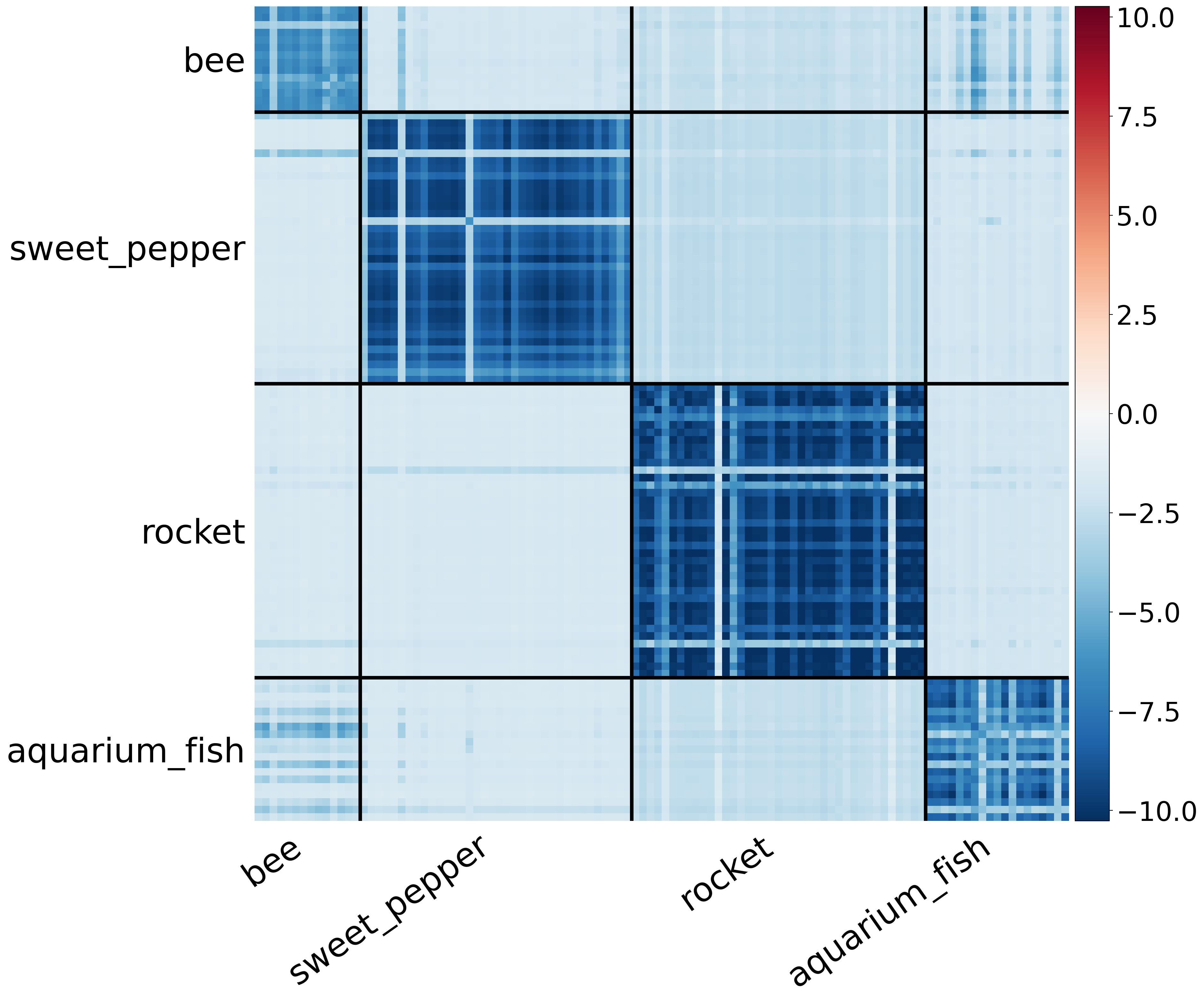
Figure 2: Example 2: A selection example consisting of four semantic clusters: bee, sweet pepper, rocket, aquarium fish.
Experimental Evaluation
Ordered Structured Selection: Path Prediction
CPL is evaluated on a multimodal path prediction benchmark using the nuScenes maps, requiring selection of a single valid future driving trajectory from multiple plausible candidates. Compared to four strong baselines—independent scoring, Hungarian matching, multi-hypothesis (independent per-path), and an autoregressive pointer network—CPL delivers the best performance in average displacement error (ADE) and Hausdorff distance (HD) with substantially improved runtime over the AR pointer.
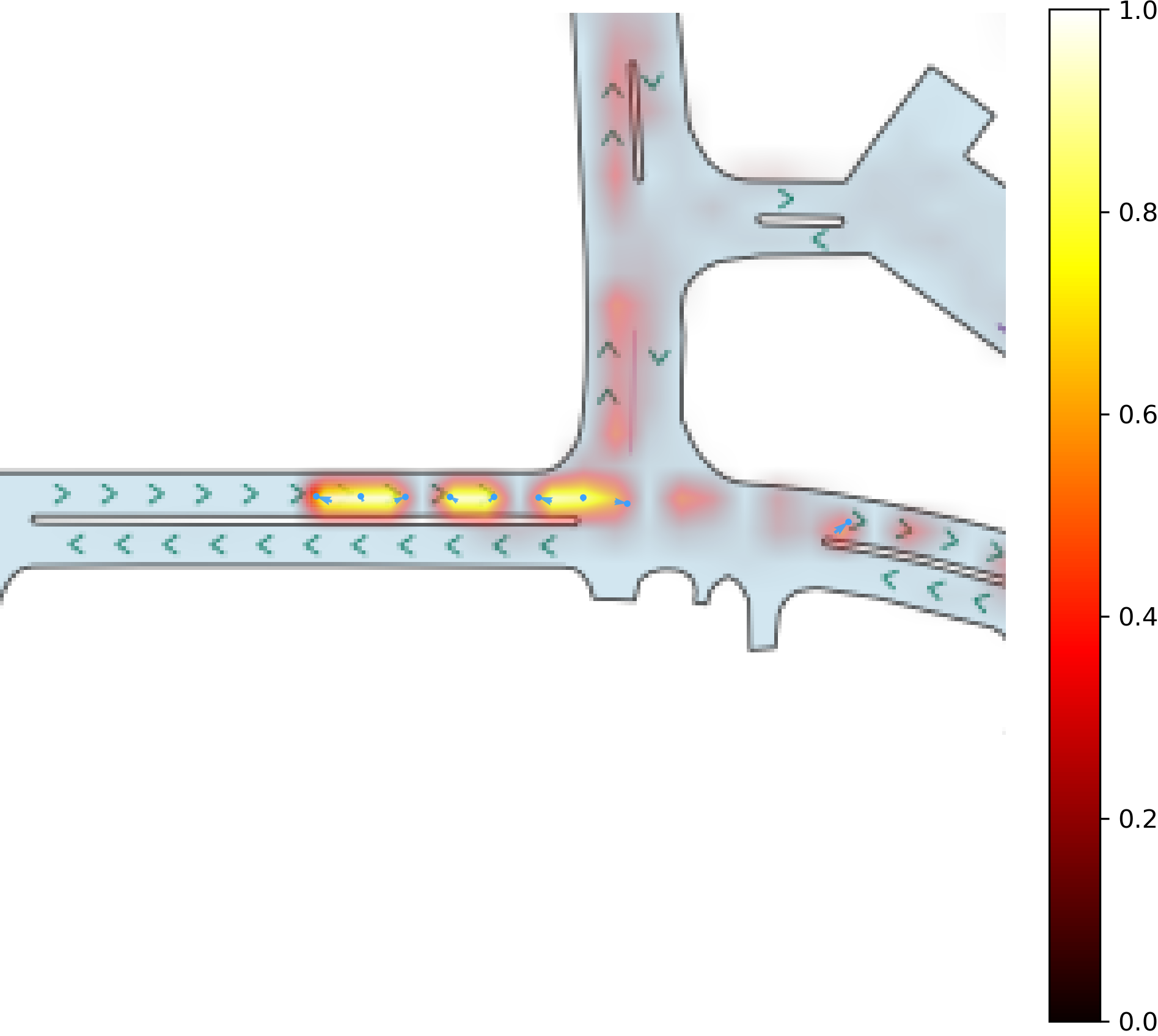
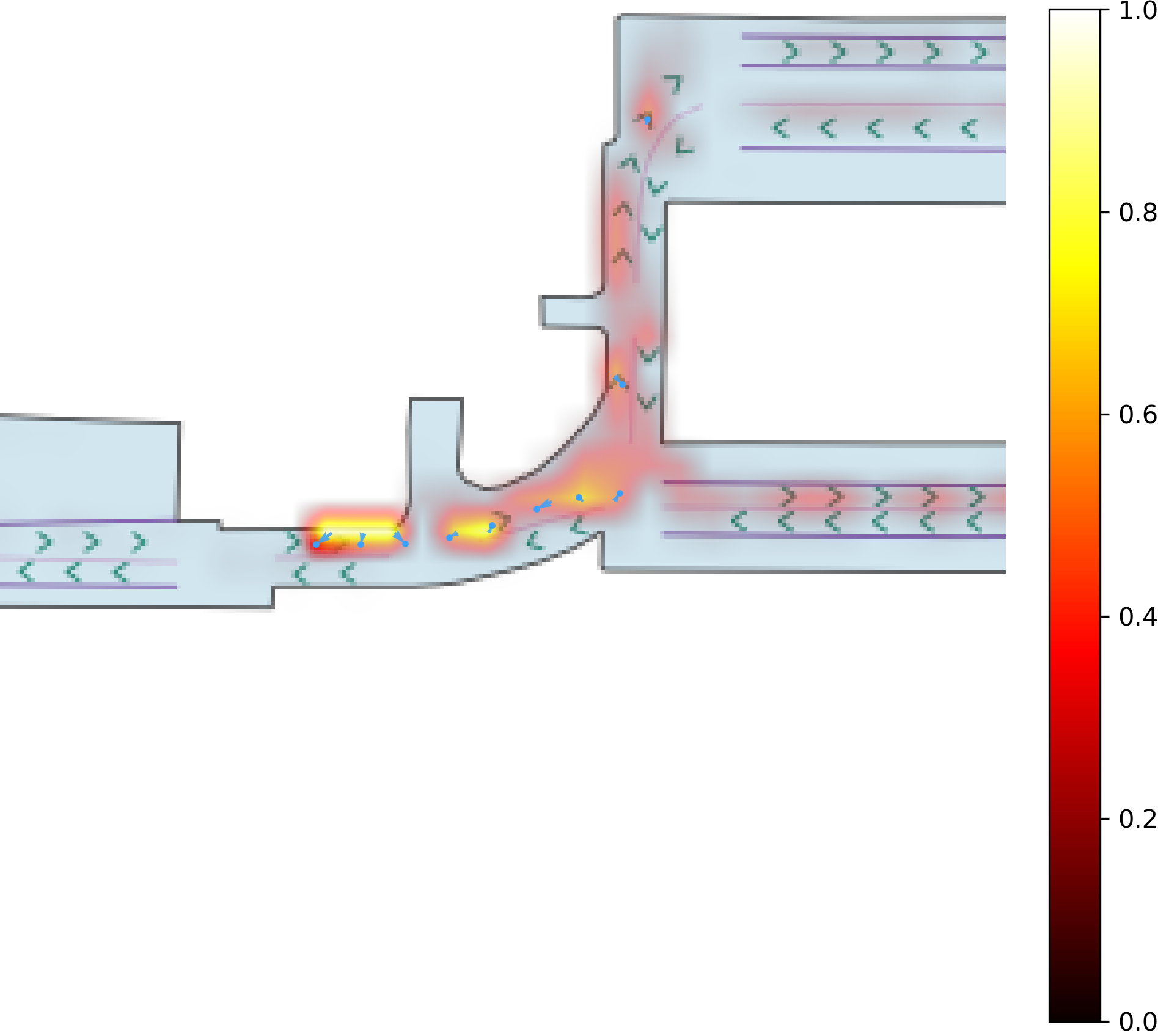
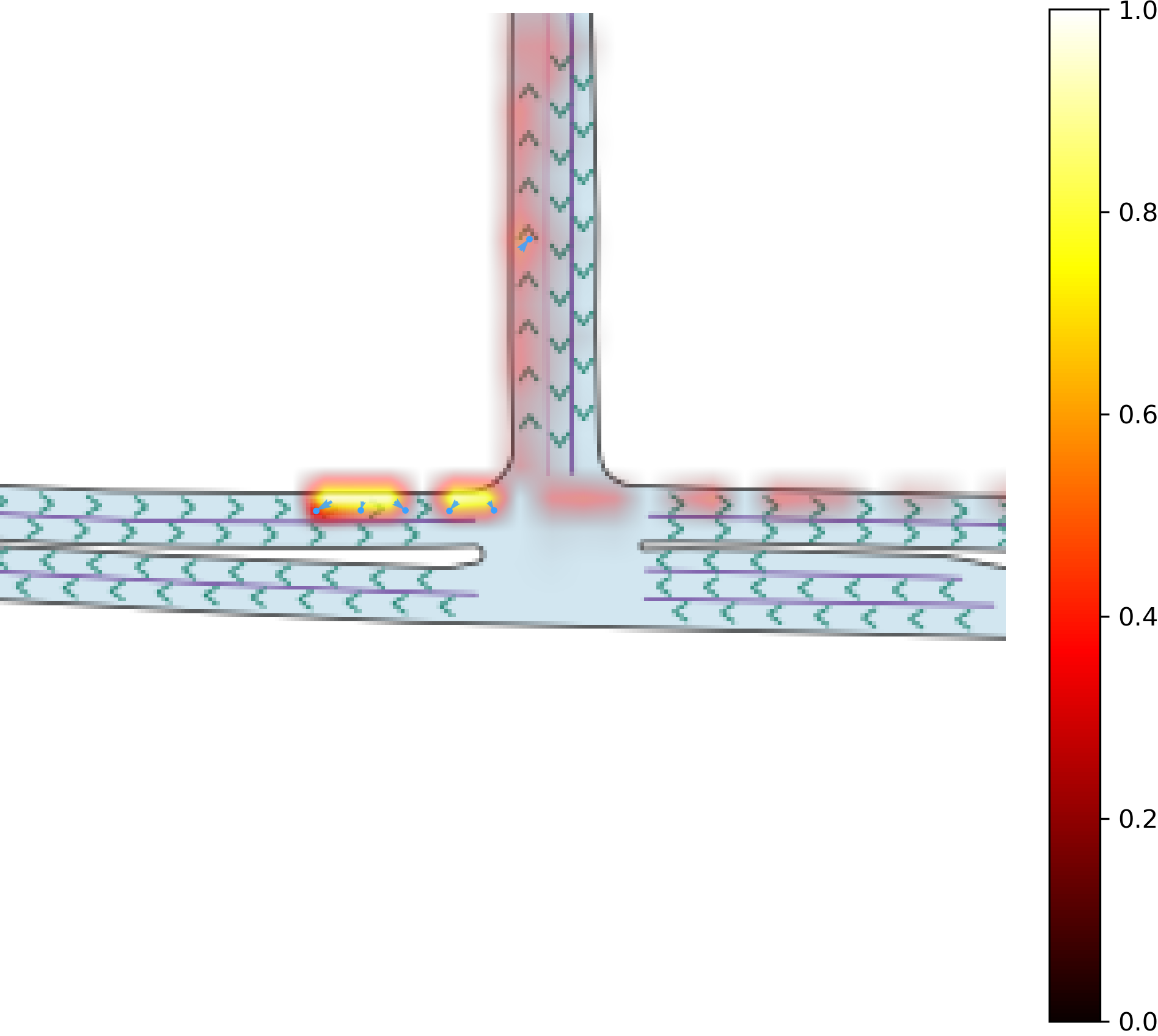
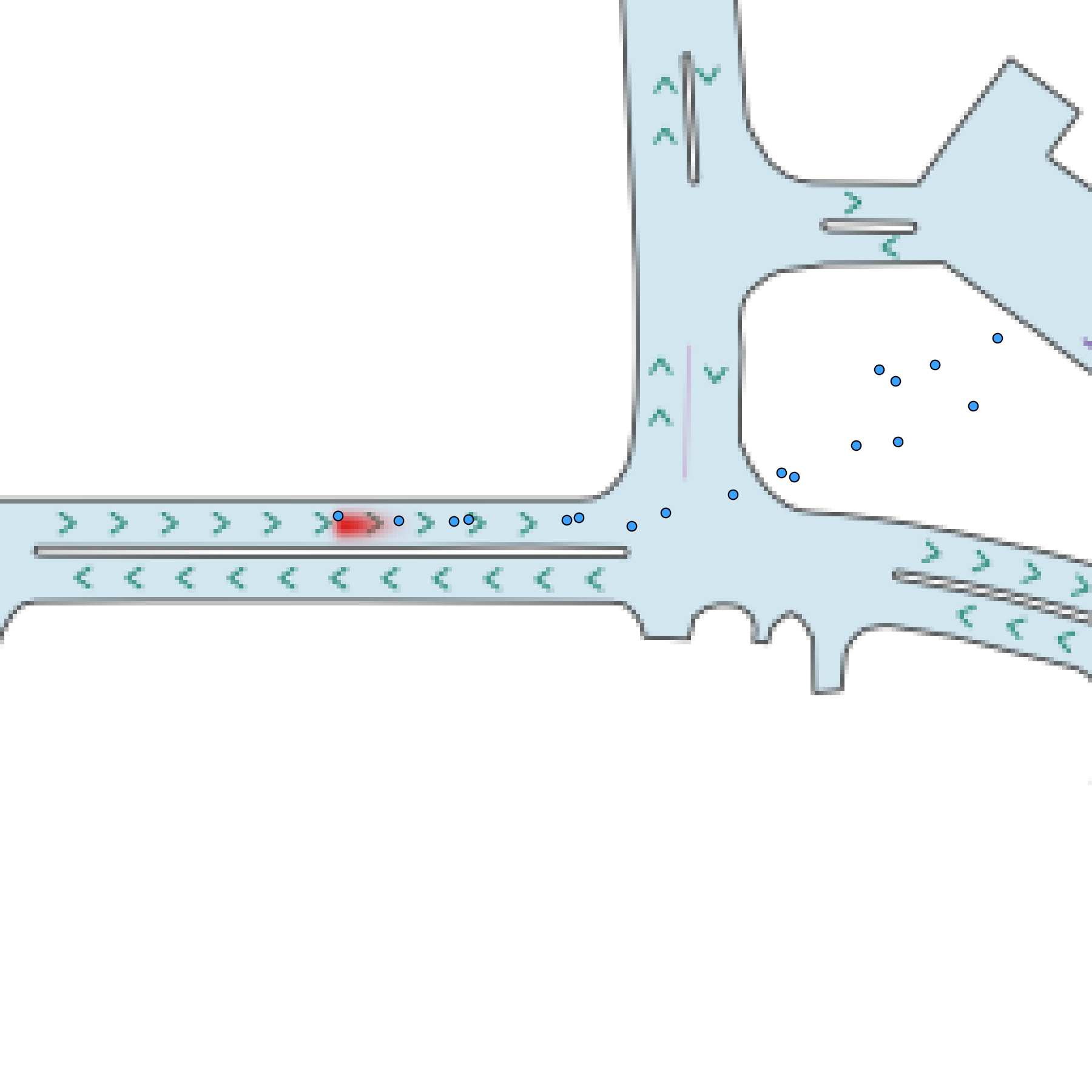
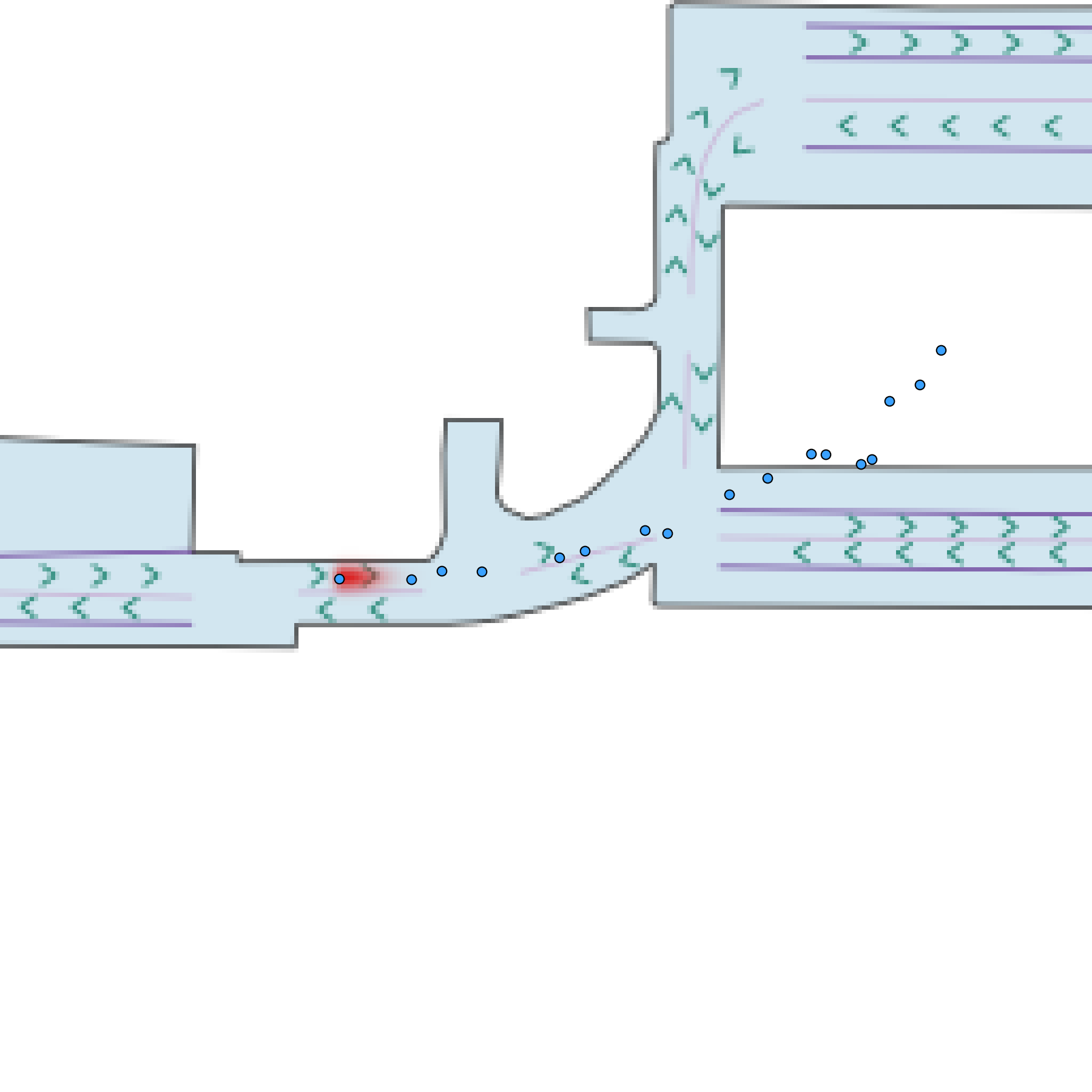
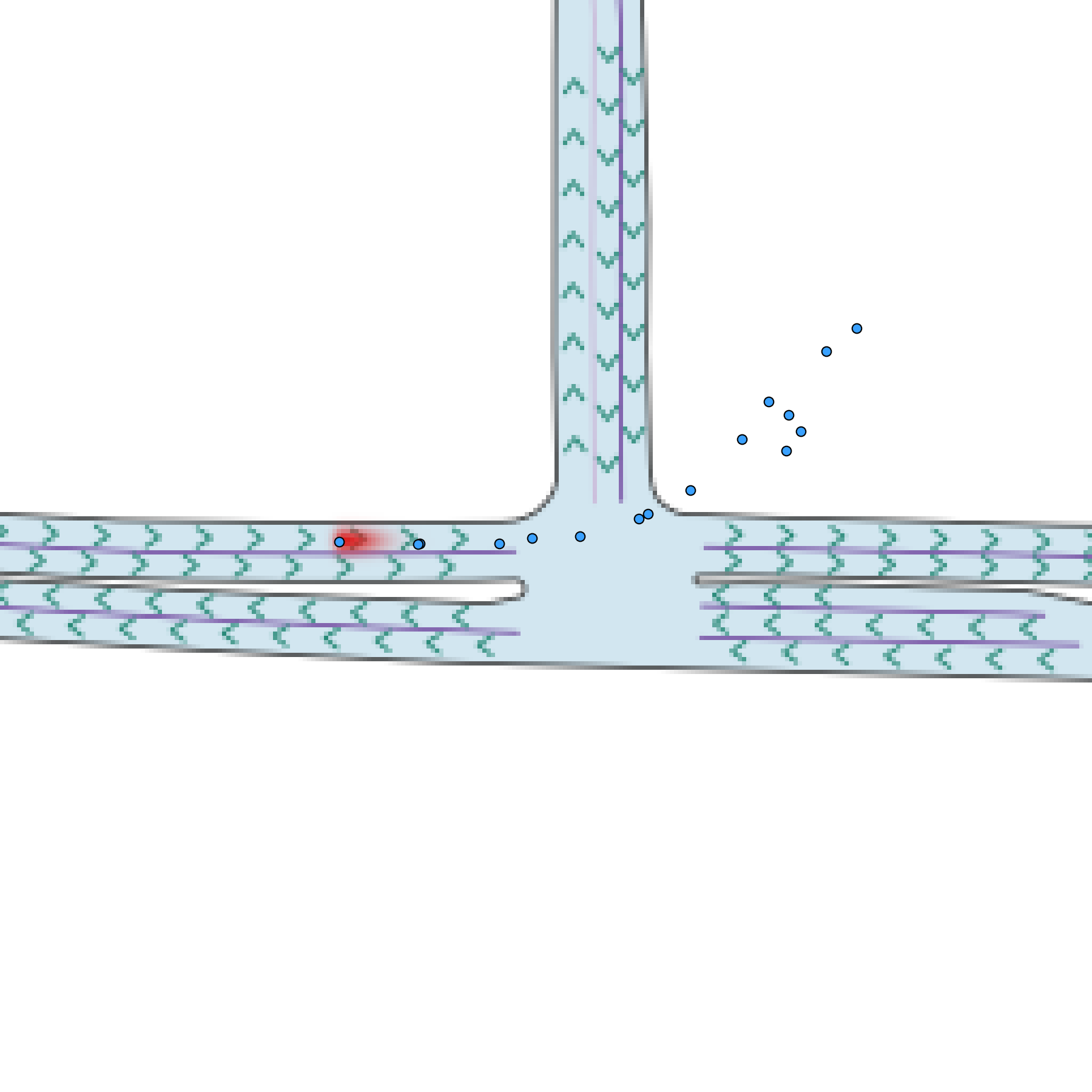
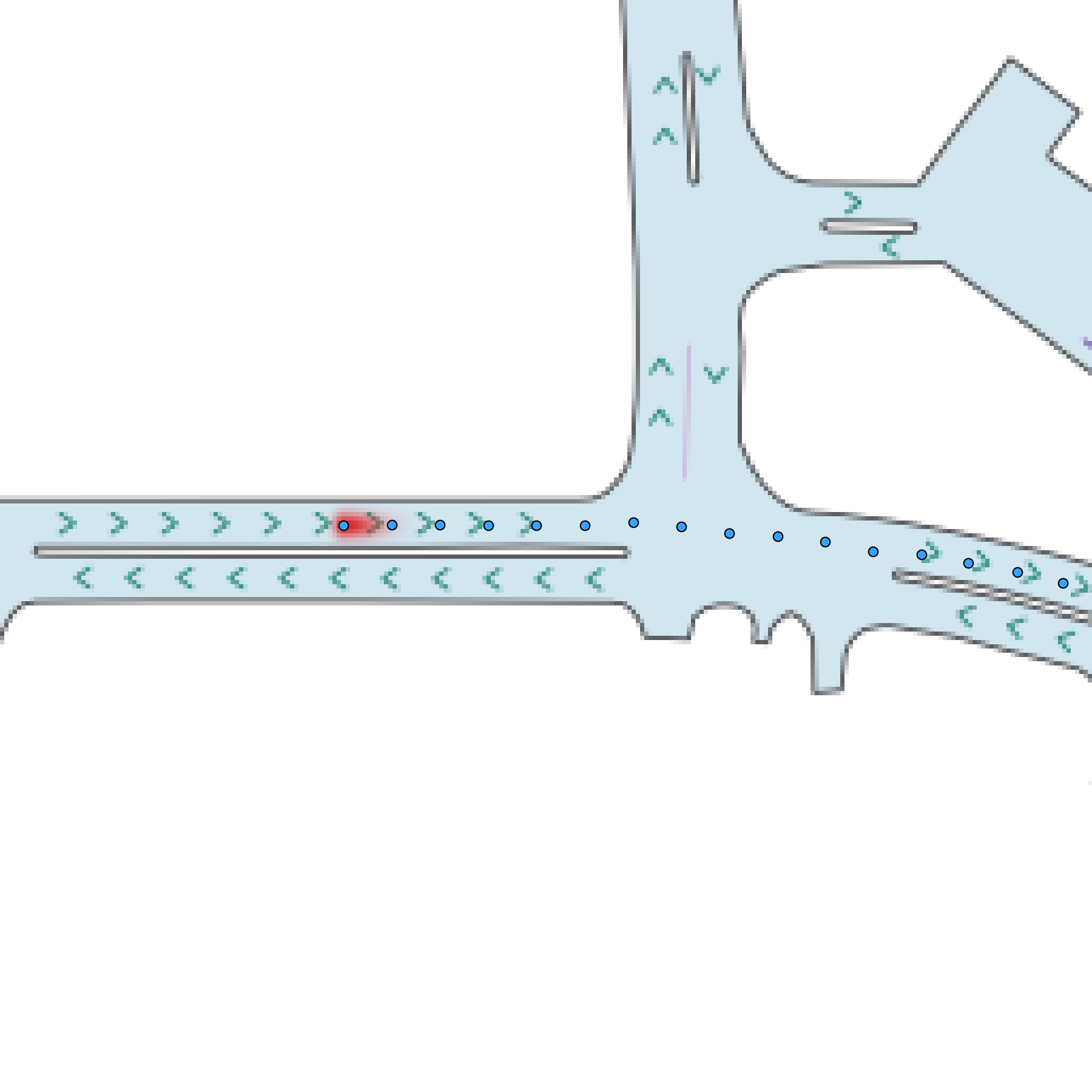
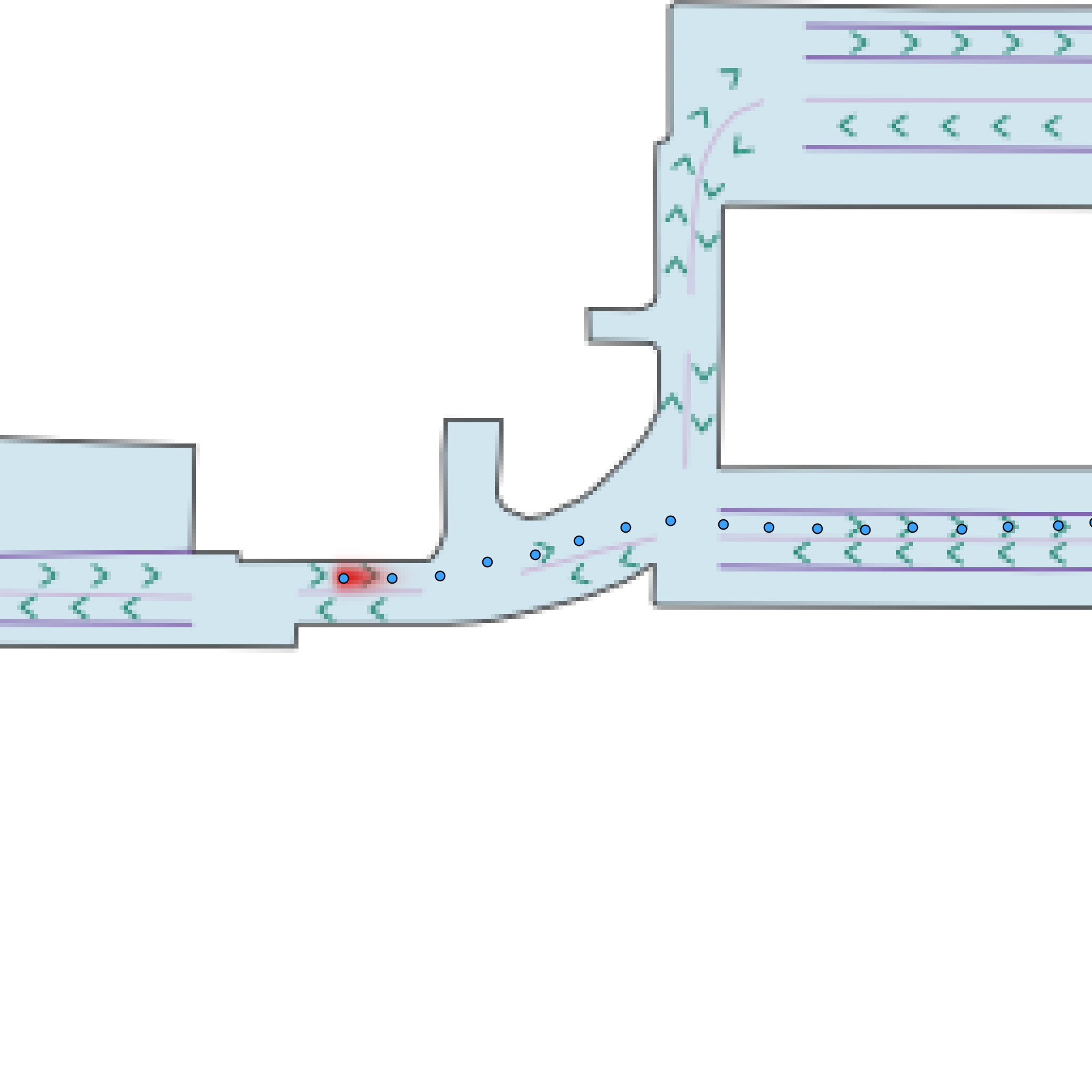
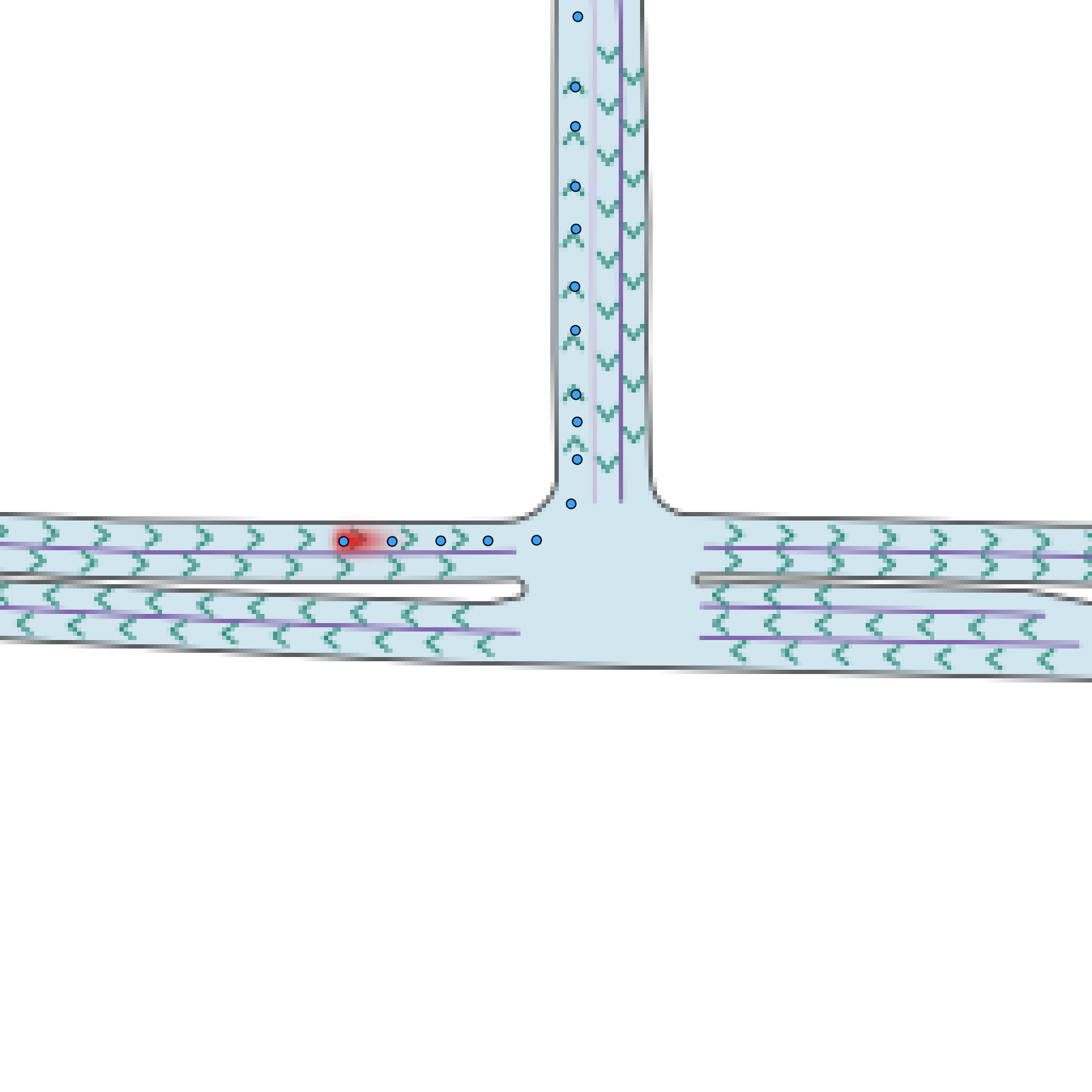
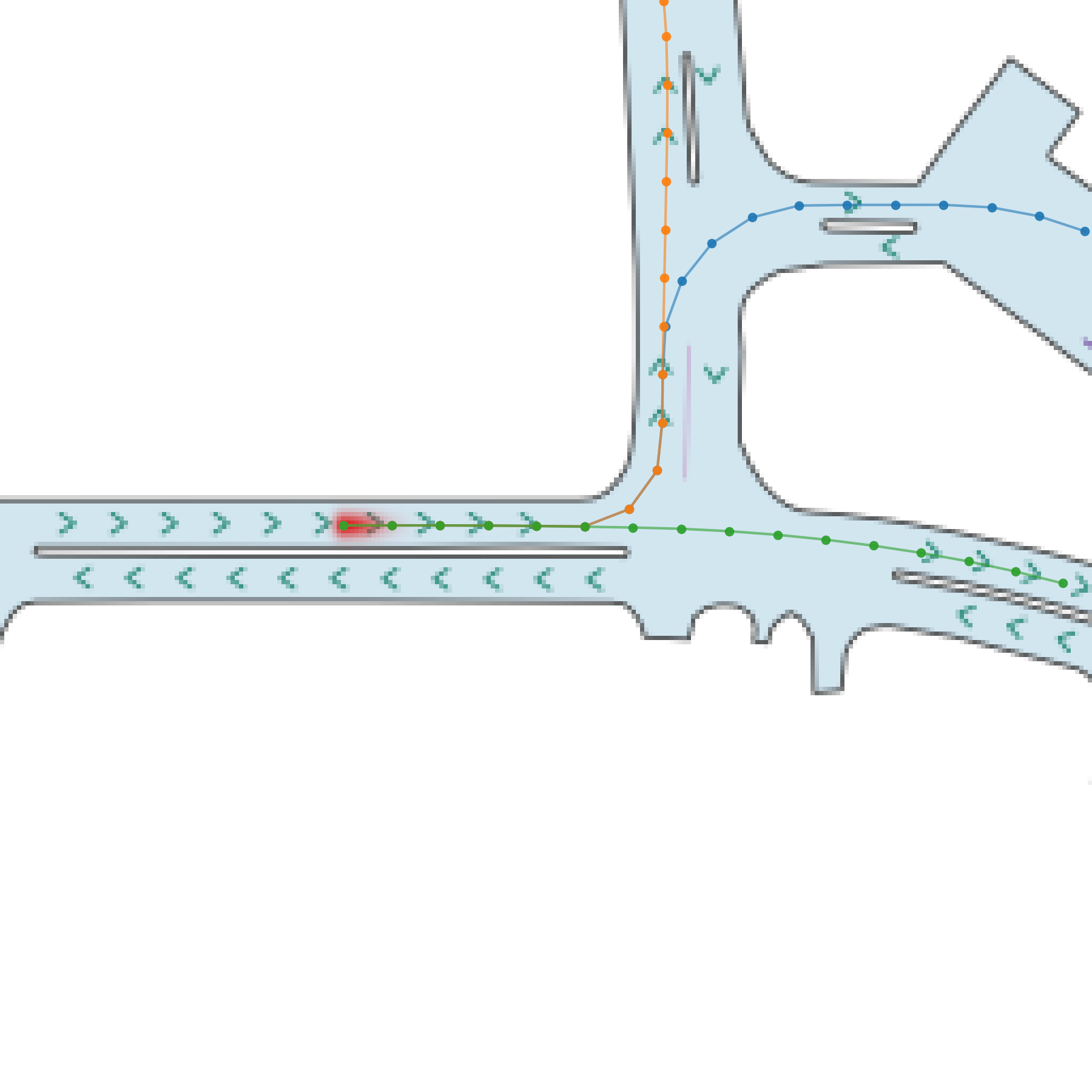
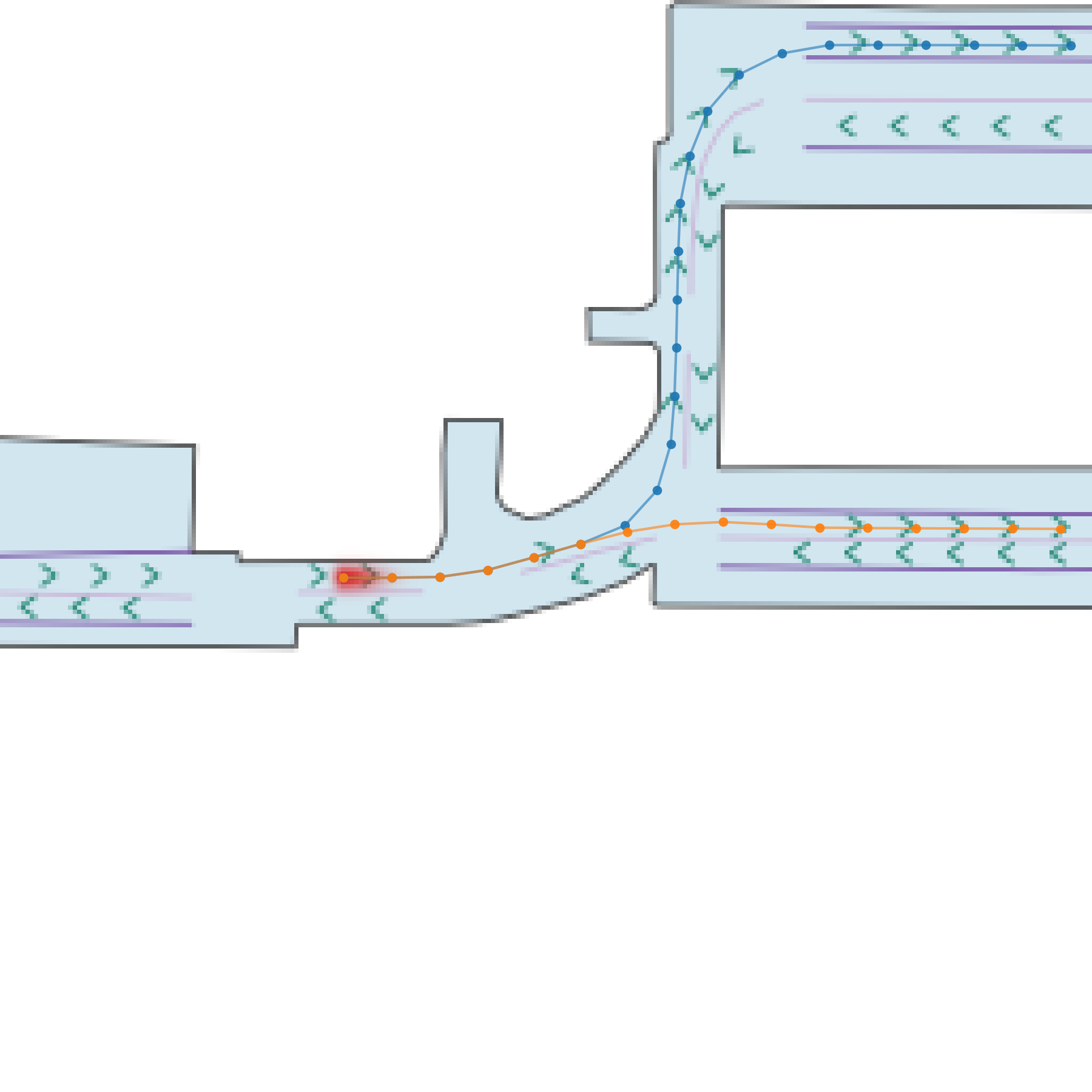
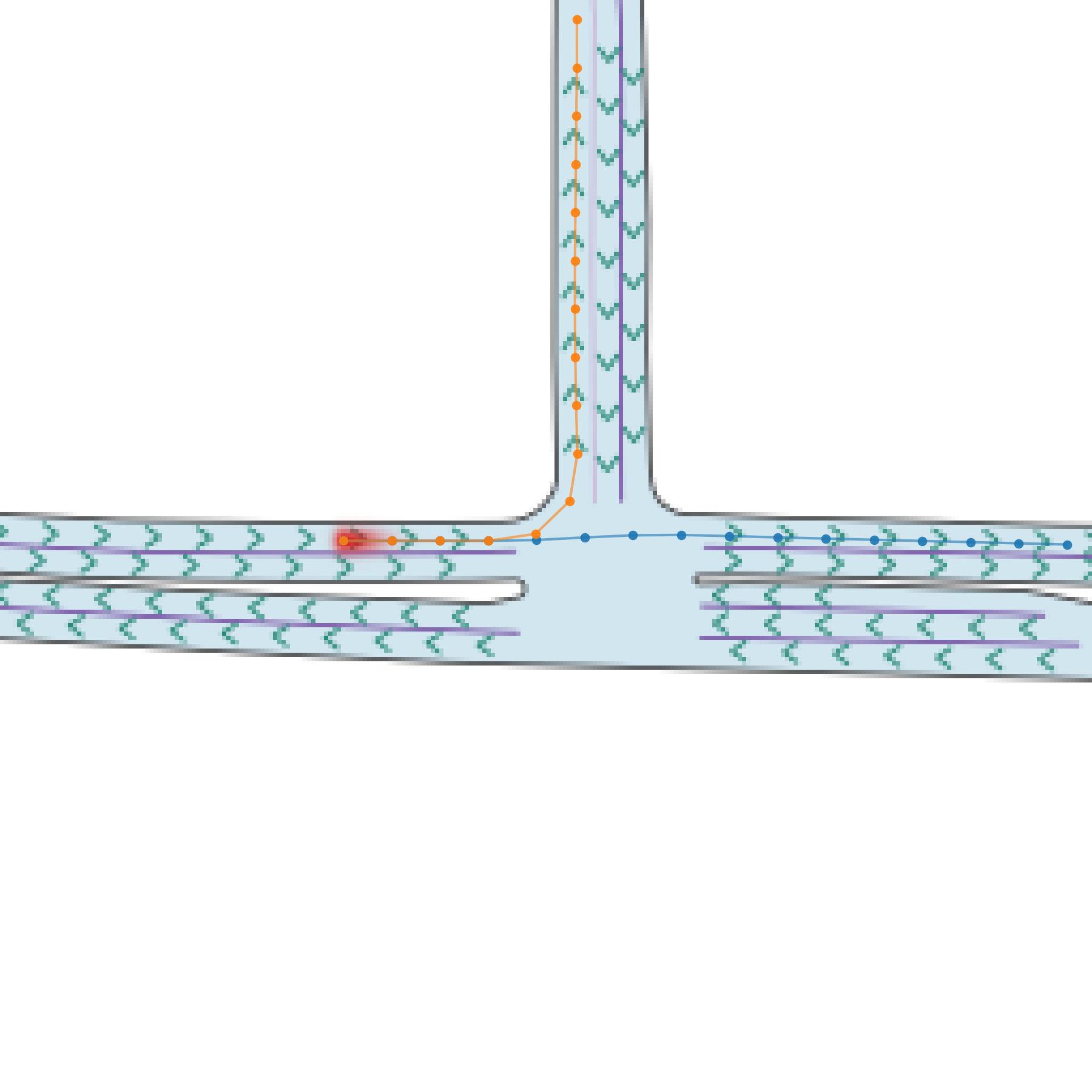
Figure 3: Path prediction visualization. Each column shows (a) all valid ground-truth paths, (b) independent-scoring predictions (often fragmented), (c) Hungarian-matched predictions (typically smoothed/averaged across modes), and (d) CPL predictions (commit to one mode).
Critically, as mode multiplicity increases (i.e., more valid trajectories per scene), CPL maintains stable, low error whereas parallel baselines degrade, demonstrating effective ambiguity resolution through sequential commitment.
Unordered Structured Selection: Representative Subset Selection
For unordered set selection (e.g., selecting representatives per semantic cluster in CIFAR-100 image bags), CPL approaches the final cluster-level F1 of an autoregressive pointer network while being over 9× faster at inference. Parallel baselines (BCE and Hungarian matching) exhibit high redundancy or insufficient coverage due to lack of history-dependent suppression. Oracle k-Means, even with correct cardinality, is inferior, confirming the necessity of learned context-driven interactions.
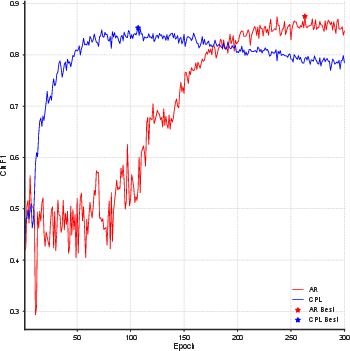
Figure 4: Training convergence on the subset selection task; CPL attains high CluF1 faster than the AR pointer, reflecting efficient training via lightweight contextual updates.
Theoretical and Practical Implications
CPL provides a hybridization of strengths: it retains history-aware expressivity critical for mode-commitment under ambiguous, single-sample supervision, while leveraging parallelizable parameter construction for practical deployment. Its factorization, grounded in the Plackett–Luce family, admits efficient sampling and likelihood evaluation, distinguishing it from costly iterative inference in full CRFs, EBM approaches, or diffusion-based structured prediction.
Additionally, CPL's pairwise context can readily be extended to structured, non-exchangeable problems. However, limits remain—higher-order interactions and scalability to extremely large candidate sets require further innovation. CPL does not natively capture diverse multiple-hypothesis outputs (though sampling is feasible under the model's conditional distribution), and dense context matrices may pose memory/runtime bottlenecks at extreme scale.
Future Research Directions
- Higher-order extensions: Enabling richer structural dependencies via higher-order interactions or hierarchical context.
- Scalable parameterizations: Sparse or locality-aware schemes for efficient decoding with thousands of candidates.
- Distributions over outputs: Leveraging the model’s explicit sequence distribution for sample-efficient diverse hypothesis generation in ambiguous domains.
- Downstream integration: Embedding CPL into perception–action pipelines for online decision-making, or as structured priors in probabilistic programming.
Conclusion
CPL introduces a practical solution to probabilistic structured selection under ambiguous supervision, navigating the tradeoff between computational tractability and expressivity. Across ordered and unordered settings, CPL demonstrates that lightweight, history-aware contextual logit updates can close the gap to fully autoregressive models in both accuracy and robustness—without incurring their sequential computational burden. This establishes a new standard for scalable, mode-committed structured prediction in ambiguous real-world scenarios.

