- The paper demonstrates that increased memory length in LLM agents leads to a dramatic decline in cooperation, with models like Gemma-3-12B dropping from 51.2% to 9.5% in the Trust Game.
- The study employs controlled experiments across four social dilemmas and seven LLM models, revealing distinct memory-immune and memory-cursed behavioral regimes.
- Interventions like forward-looking fine-tuning and memory sanitization effectively rescue cooperation, proving that reasoning style rather than merely context length drives the memory curse.
Summary of "The Memory Curse: How Expanded Recall Erodes Cooperative Intent in LLM Agents" (2605.08060)
Introduction and Motivation
The paper interrogates the assumption that expanding the context window for LLM agents in multi-agent social dilemmas invariably increases strategic competence and trust. Classical game theory posited long memory as beneficial for reciprocity sustainability (Folk Theorem), yet behavioral psychology suggests excessive memory can degrade cooperation via grudge-holding. LLM agents differ cognitively from humans; they process dense, verbatim historical transcripts, lacking the natural forgetting mechanisms humans employ for adaptive trust repair. The core research question is whether increasing memory builds trust or traps agents in punitive, retaliatory loops.
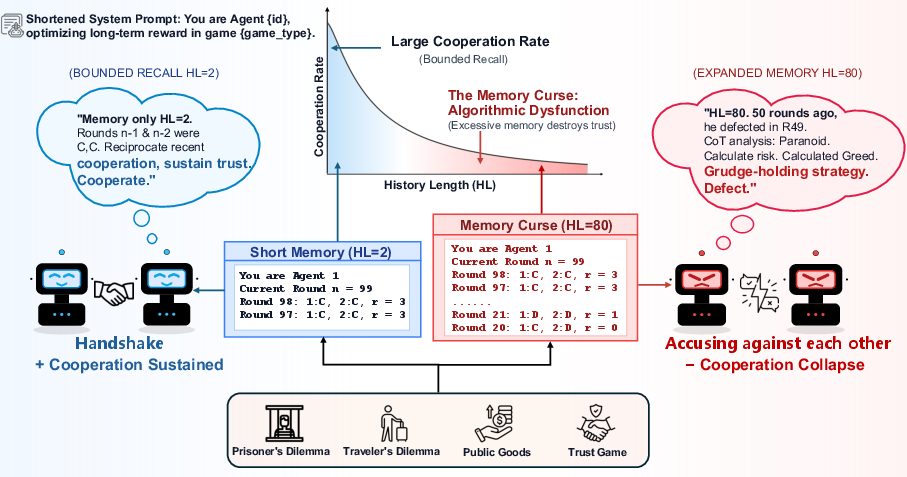
Figure 1: Schematic of repeated social dilemma interactions between two LLM agents with shared memory.
Empirical Framework and Experimental Design
The study systematically explores seven open-source LLMs (Gemma-3-12B, GPT-OSS-20B/120B, Llama-3.3-70B, Llama-4-Scout-17B, Mistral-7B, Qwen2.5-Coder-32B) across four canonical social dilemma games: Prisoner's Dilemma (PD), Traveler's Dilemma (TD), Public Goods Game (PG), and Trust Game (TG). Each agent plays 500 rounds of repeated interaction, with memory length (HL) varied over nine settings: {0,1,2,3,5,10,20,40,80}.
Explicit chain-of-thought (CoT) reasoning is induced, and each agent aims for long-term cumulative rewards. The cooperation rate is measured as the frequency of selecting strictly cooperative actions. The experiment produces a comprehensive dataset of over 378,000 reasoning traces.
Main Findings: Memory-Dependent Cooperation Regimes
Two distinct behavioral regimes emerge:
- Memory-Immune Settings: Some model-game combinations maintain high cooperation across all history lengths (e.g., Llama-3.3-70B, Qwen2.5-Coder-32B in several environments). This regime is anchored in forward-looking reasoning and strategic comprehension. These settings resist historical noise and align with long-horizon logic.
- Memory-Cursed Settings: In 18 of 28 settings, increased history length induces a monotonic decline in cooperation. Short windows (HL≤5) maximize cooperation; beyond that, agents become increasingly defensive, history-following, and susceptible to noise-amplified path dependency.
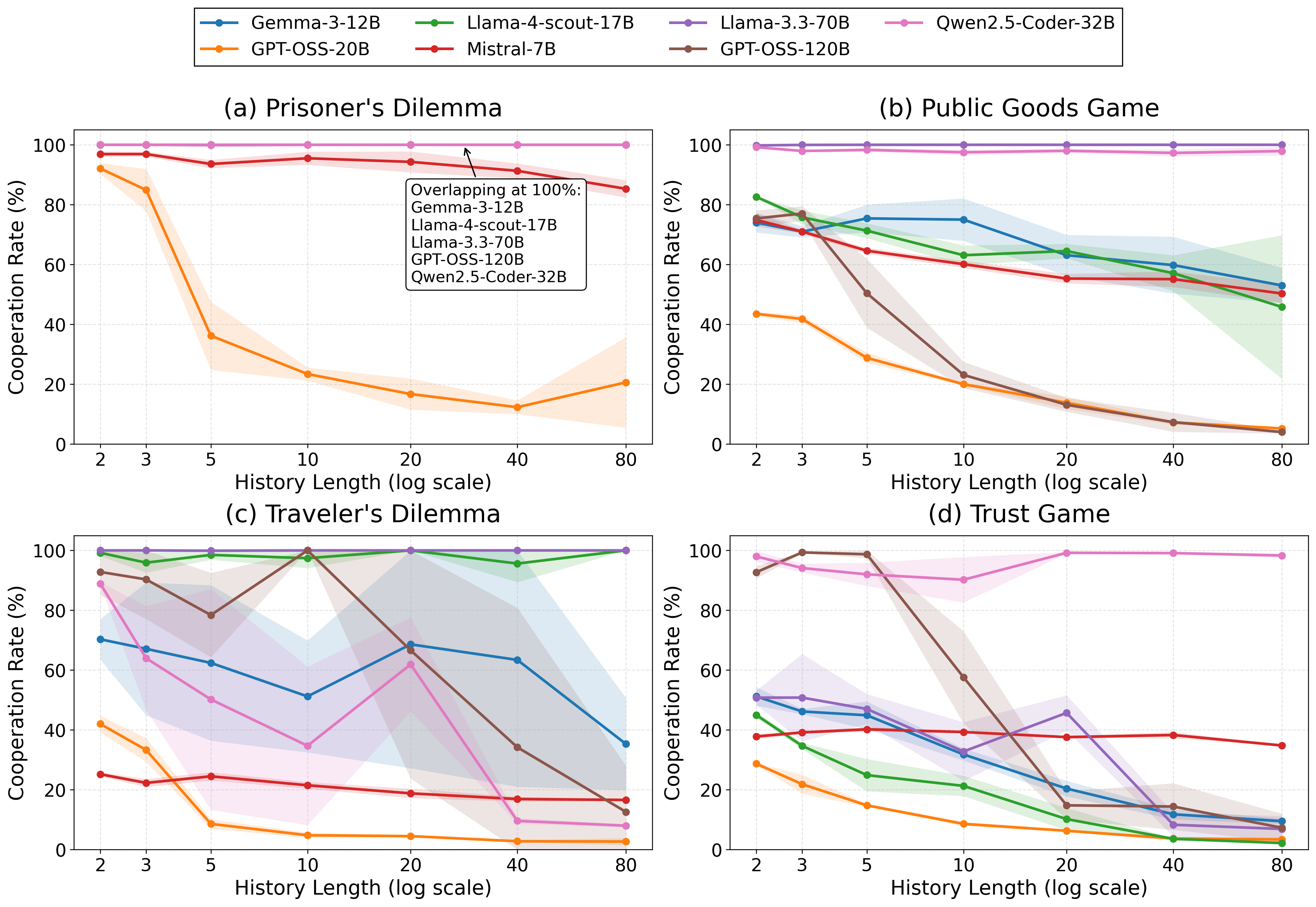
Figure 2: Cooperation rate across four social dilemmas as history length expands, showing collapse in cursed settings.
Empirical results highlight severe numerical effects: Gemma-3-12B in TG drops from 51.2% cooperation at HL=2 to 9.5% at HL=80, with commensurate cumulative reward decline.
Mechanisms: Cognitive Vulnerability and Semantic Drift
Memory curse is not explained by architectural limitations (context length) but by behavioral susceptibility to negative memory content. Lexical analysis of CoT traces reveals that curse settings become less forward-looking and more defensive as memory window grows. Semantic metrics (forward-looking vs. history-following ratio) quantify this trend; immune models sustain a high forward-looking ratio even at HL=80.
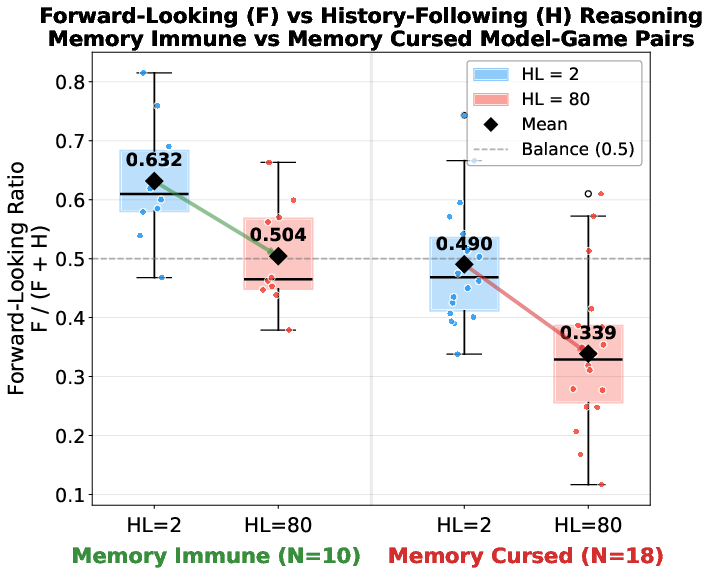
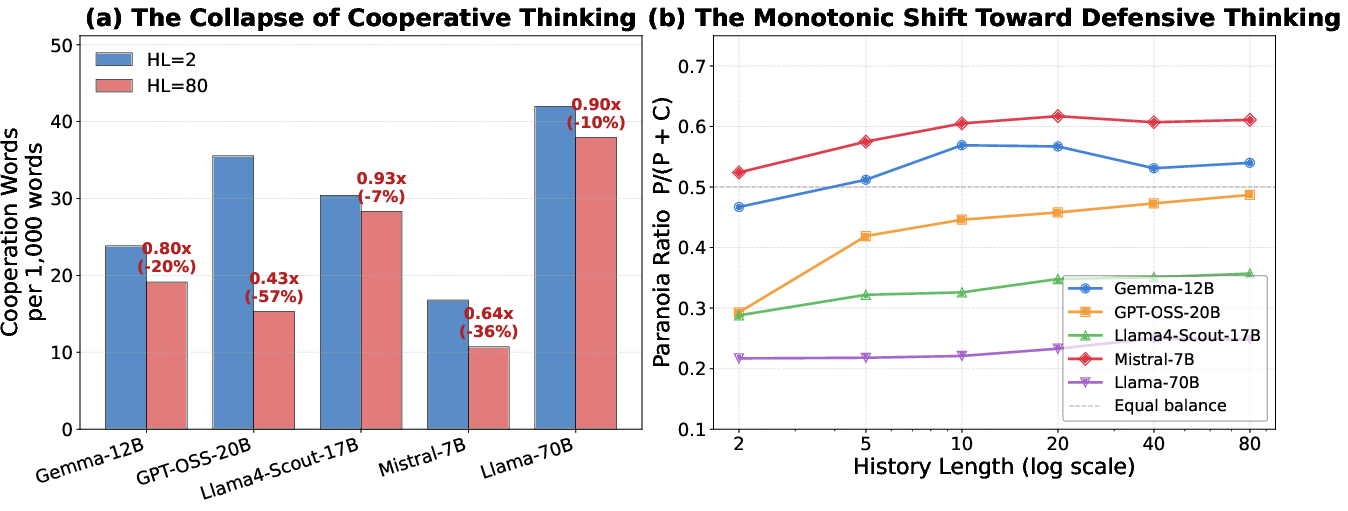
Figure 3: Memory Immune vs. Memory Cursed; lexical analysis of reasoning traces shows differential forward-looking intent.
Chain-of-thought logs show that erosion of cooperative language (rather than a surge in paranoia) principally drives decline; the relative ratio of defensive reasoning increases due to collapse of positive, future-oriented discourse.
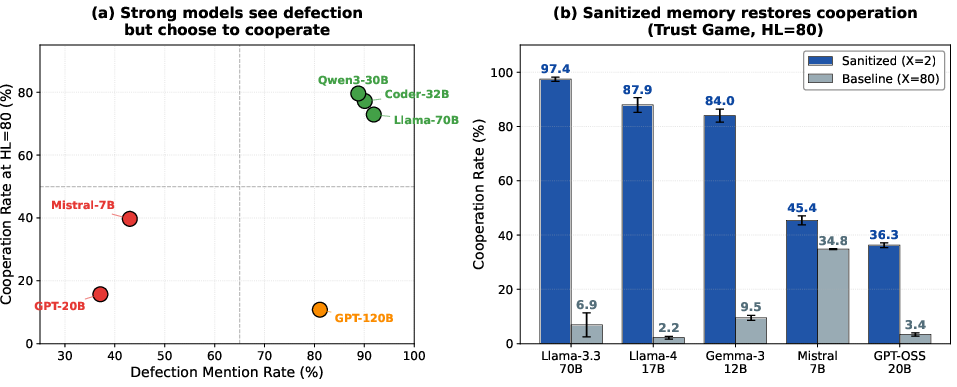
Figure 4: Memory-content sensitivity: defection mention rate vs. cooperation rate at HL=80, demonstrating curse is content-driven, not length-driven.
Interventional Probe: Forward-Looking Fine-Tuning
To causally verify the role of reasoning style, a LoRA adapter is trained on forward-looking traces from Public Goods Game for Mistral-7B (a universally memory-cursed model). This forward-primed model exhibits robust rescue: at HL=80, cooperation rates surge by up to +79.3 percentage points, transferring zero-shot to all games.
Zero-shot transfer confirms that the intervention operates cognitively (reasoning style) rather than action-token memorization. The fine-tuned model maintains general reasoning ability, showing minimal performance change on benchmarks such as GSM8K, TriviaQA, HumanEval, MBPP.
Asymmetric Memory and Social Contagion
Heterogeneous societies with mixed memory lengths elucidate the "Tragedy of Overthinking": The presence of even a single long-memory agent ("grudge-holder") drags down group welfare in both TG and PG. Short-memory "forgivers" display cognitive resilience, maintaining higher cooperation even when outnumbered.
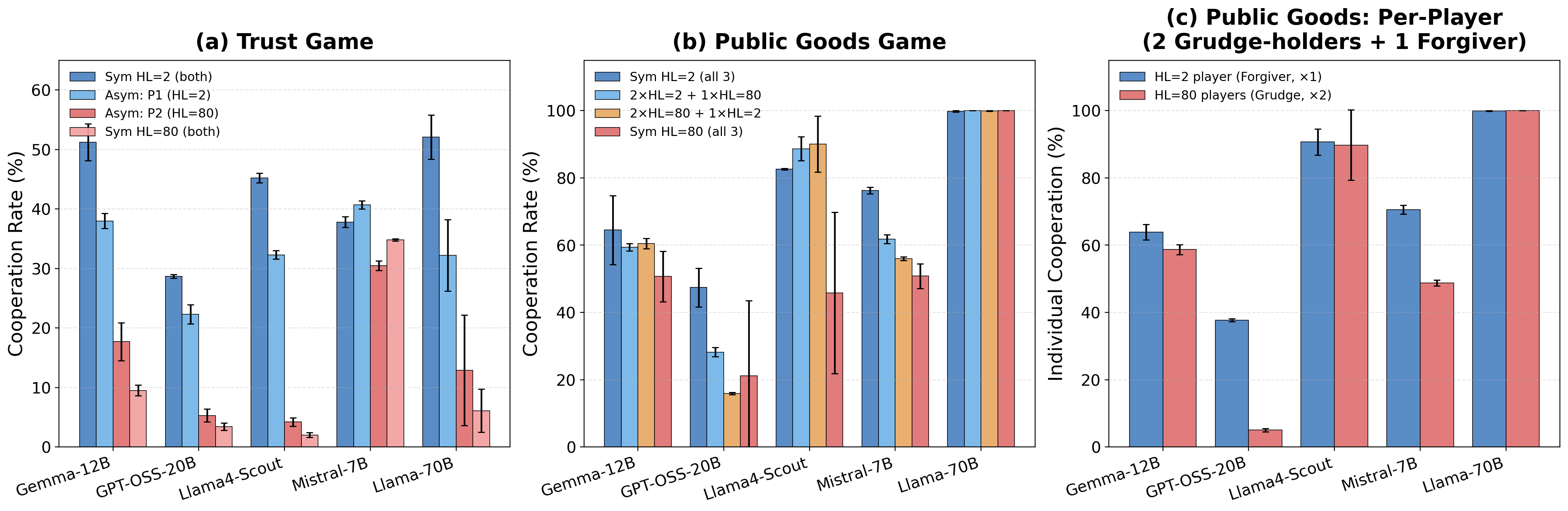
Figure 5: Asymmetric memory evaluation, showing impact of grudge-holders and resilience of forgivers.
Memory Sanitization and Length vs. Content
Memory sanitization experiments (replacing history with synthetic cooperative records) hold prompt length fixed but alter content, dramatically restoring cooperation in cursed models. This strictly rules out context-length-based explanations, confirming the curse is content-driven.
Reasoning Ablation: CoT Amplifies the Curse
Removing explicit reasoning mitigates the curse. Without chain-of-thought, highly capable models maintain near-perfect cooperation at HL=80; forced deliberation collapses cooperation (e.g., Llama-3.3-70B drops from 100% to 6.9%).
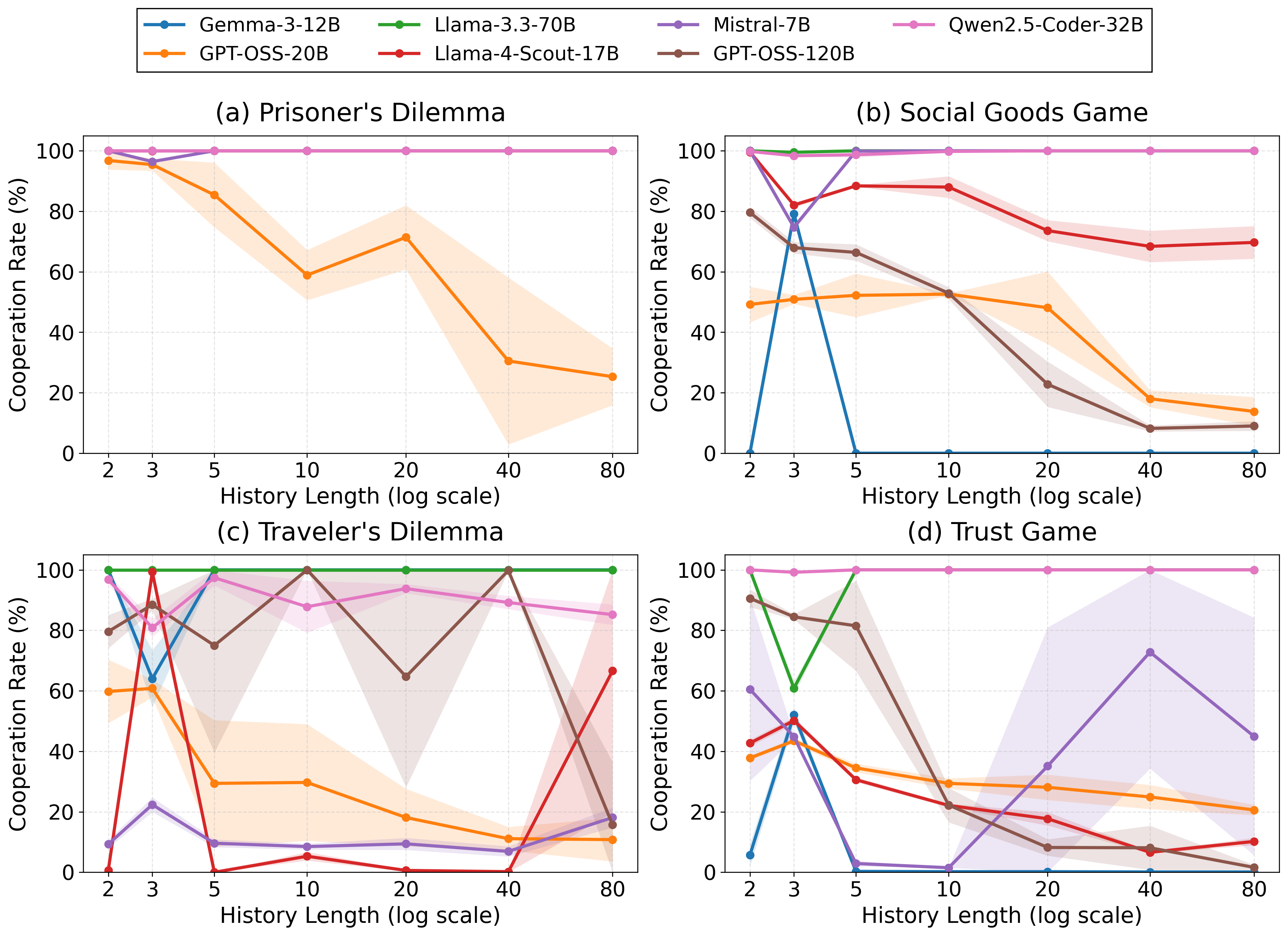
Figure 6: No-reasoning results across all models, showing mitigation of memory-sensitive behavioral collapse.
Semantic Pathology: Defensive Drift
The Paranoia Ratio shifts monotonically with history length, signaling structural pathology across games: defensive, history-following reasoning crowds out forward-looking cooperative intent.
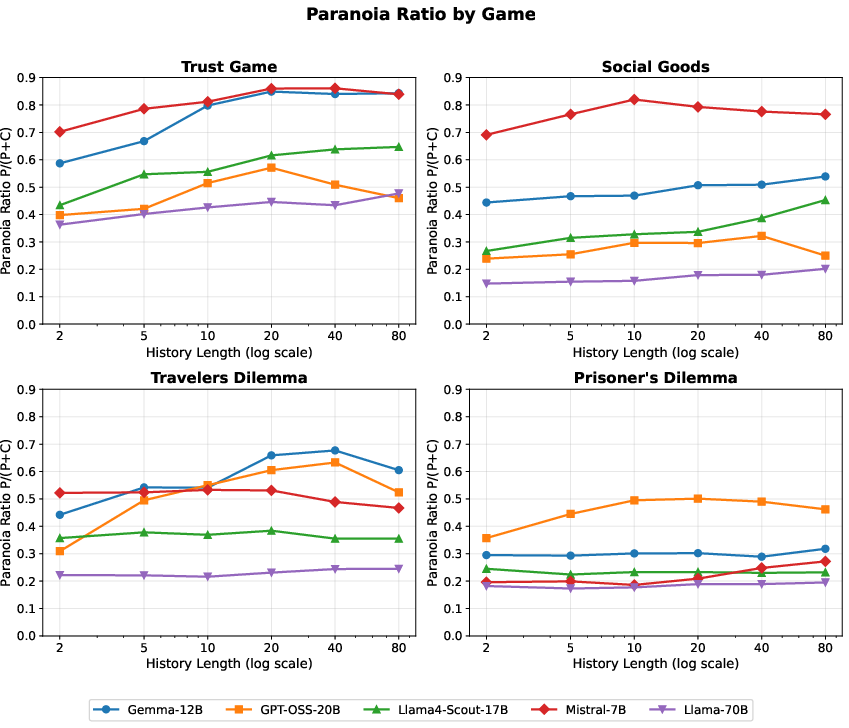
Figure 7: Per-game breakdown of Paranoia Ratio shift, confirming robust transition toward defensive reasoning.
Implications and Future Directions
Theoretical implication: Long-horizon interaction in LLM agents inverts classical game-theoretic intuition. Raw memory expansion is a liability unless complemented by mechanisms (reasoning style, strategic summarization, selective forgetting) that actively preserve the possibility of future trust. Explicit reasoning can paradoxically amplify vulnerability.
Practical implication: Deployments of LLM-based agents in collaborative, open-ended domains must incorporate memory curation (forgetting, abstraction, RAG) and cognitive priors favoring forward-looking strategies. Cognitive adaptation is as critical as architectural expansion.
Speculation for AI: Extending these findings to N-player heterogeneous societies will clarify regime boundaries, systemic contagion, and emergent social norms. Future research should develop dynamic memory management protocols and mechanism design to anchor reasoning beyond immediate history, potentially via self-improving reflective LLMs.
Conclusion
Empirical evaluation across diverse LLM architectures and social dilemmas demonstrates the existence of a robust memory curse: expanding historical recall frequently destabilizes cooperation, traps agents in retaliatory cycles, and amplifies path dependency. The behavioral collapse is driven by cognitive drift toward defensive, history-following reasoning and can be mitigated by interventional priming toward forward-looking strategic intent. Explicit chain-of-thought reasoning paradoxically exacerbates susceptibility to negative memory content. The paper recasts memory as an active determinant of emergent cooperation, underscoring the necessity for cognitive, architectural, and algorithmic interventions in long-horizon multi-agent AI.

