- The paper presents a Fisher-matrix forecast quantifying DECIGO and LISA’s ability to constrain key parameters of first-order cosmological phase transitions.
- It employs combined sound-wave and turbulence models to simulate gravitational wave spectra, highlighting a strong degeneracy between transition strength and duration.
- The findings indicate that high SNR observations yield precise parameter measurements, but breaking intrinsic microphysical degeneracies requires complementary data.
Fisher-Matrix Constraints on Gravitational Wave Signatures of First-Order Phase Transitions in the Early Universe
Introduction
This paper presents a quantitative forecast of the detectability and parameter inference prospects for a stochastic gravitational wave (GW) background generated by first-order cosmological phase transitions, using signal models tailored to the upcoming DECIGO and LISA missions. The stochastic background is modeled as the superposition of sound wave and turbulence-induced contributions, parameterized by the transition strength α, the duration β/H∗, transition temperature T∗, and bubble wall velocity vw. The analysis focuses on a Fisher-matrix approach in the (lnα,ln(β/H∗)) parameter subspace, quantifying the precision with which each detector could constrain fundamental phase transition parameters in benchmark scenarios.
Gravitational Wave Source Modeling
The GW spectrum is constructed as the sum of sound-wave and magnetohydrodynamic turbulence components, neglecting the short-lived bubble collision term (Ωenv), in accord with current numerical studies indicating sound waves as the dominant GW source over most of parameter space except for runaway wall cases. For both Ωsw(f) and Ωturb(f) components, analytically motivated parameterizations are used, with peak frequencies and spectral shapes depending on α, β/H∗, β/H∗0, and β/H∗1.
This formulation enables efficient mapping between microscopic (model) parameters and observable frequency-domain GW spectra. The analysis imposes that β/H∗2 and β/H∗3 are fixed for each instrument such that the GW spectrum peaks optimally within the frequency window of the respective detector, ensuring maximal sensitivity. β/H∗4 and β/H∗5 are then the free parameters probed by the Fisher analysis.
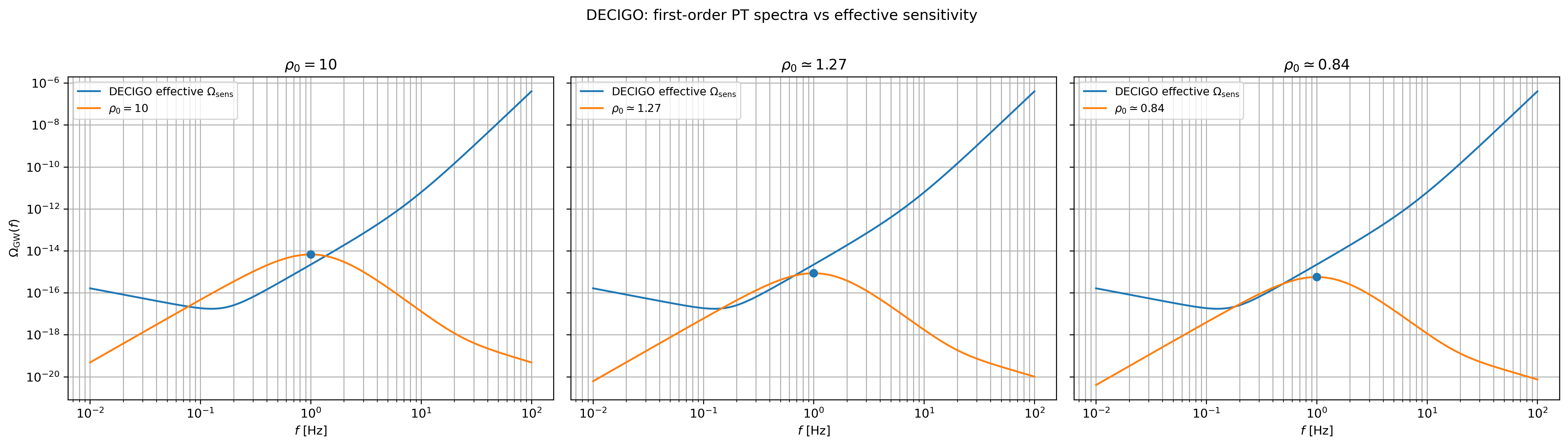
Figure 1: Gravitational wave spectra in the DECIGO band for three choices of transition strength β/H∗6 at fixed β/H∗7 and β/H∗8; the DECIGO sensitivity is overplotted.
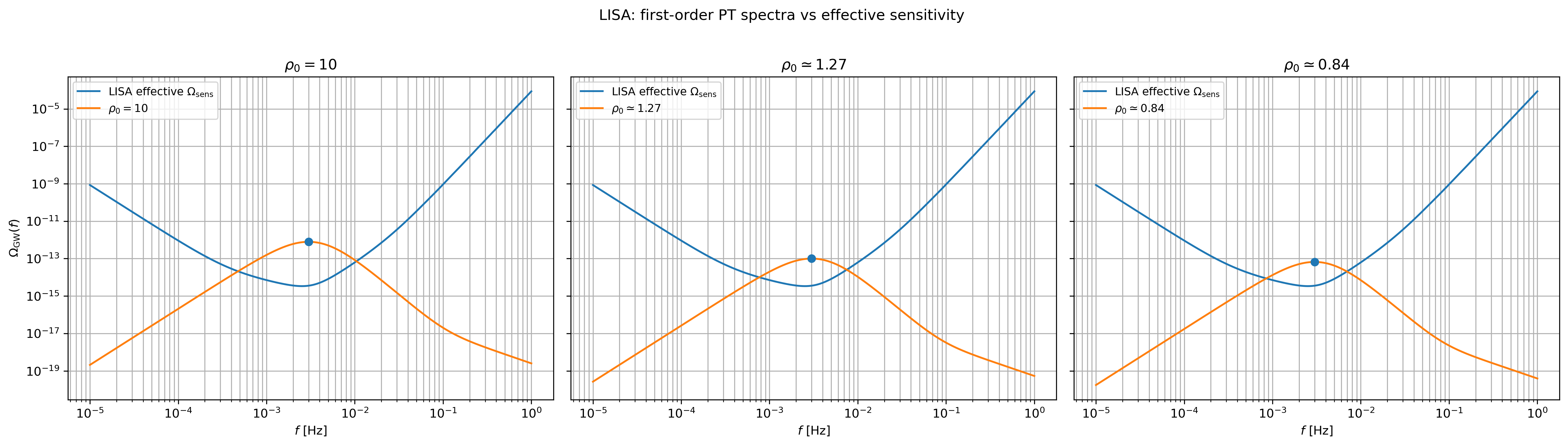
Figure 2: Gravitational wave spectra in the LISA band for three choices of transition strength β/H∗9 at fixed T∗0 and T∗1; the LISA sensitivity is overplotted.
Detector Sensitivity Treatment
DECIGO sensitivity is modeled via an analytic fit for its noise spectral density, and a cross-correlation SNR is computed under the assumption of two statistically independent channel pairs with fully coherent overlap (T∗2), which yields an optimistic upper bound on detectability and parameter precision. The LISA sensitivity is modeled following established effective-strain methods, including both optical metrology and acceleration noise, mapped into frequency-dependent sensitivity curves for stochastic backgrounds.
For each detector, fiducial parameter choices are made by fixing T∗3 via inversion of the characteristic frequency relation to ensure the spectral peak is in-band, then adjusting T∗4 to match desired benchmark SNR levels (T∗5), explicitly constructing models with T∗6, T∗7, and T∗8 to sample the regimes of robust detection, marginal detection, and non-detection, respectively.
Fisher Matrix Methodology
The Fisher matrix is computed for the parameters T∗9, with other parameters held fixed. This approach is motivated by singularity and parameter correlation issues in the full parameter space: at fixed vw0 and vw1, most of the spectral variation is encoded by vw2 (which sets the amplitude) and vw3 (which controls both amplitude and frequency position).
Parameter uncertainties and their covariance are extracted from the inverse Fisher matrix, allowing for quantitative vw4 (and vw5) forecasts in the space of physically meaningful, fractional uncertainties, taking into account the non-Gaussian transformation between logarithmic and physical parameter spaces for finite errors. The analysis demonstrates explicitly that the fractional parameter errors scale as the inverse SNR for sufficiently high SNR, providing a cross-check for consistency.
Results and Interpretation
At high SNR (vw6) and for DECIGO, marginalized vw7 uncertainties vw8 and vw9 are obtained, with a very strong correlation coefficient ((lnα,ln(β/H∗))0). For LISA, the constraints are slightly tighter for (lnα,ln(β/H∗))1 ((lnα,ln(β/H∗))2) but slightly broader for (lnα,ln(β/H∗))3 ((lnα,ln(β/H∗))4), with less extreme but still significant correlation ((lnα,ln(β/H∗))5). These values degrade steeply as SNR is lowered, with uncertainties inflating roughly (lnα,ln(β/H∗))6.
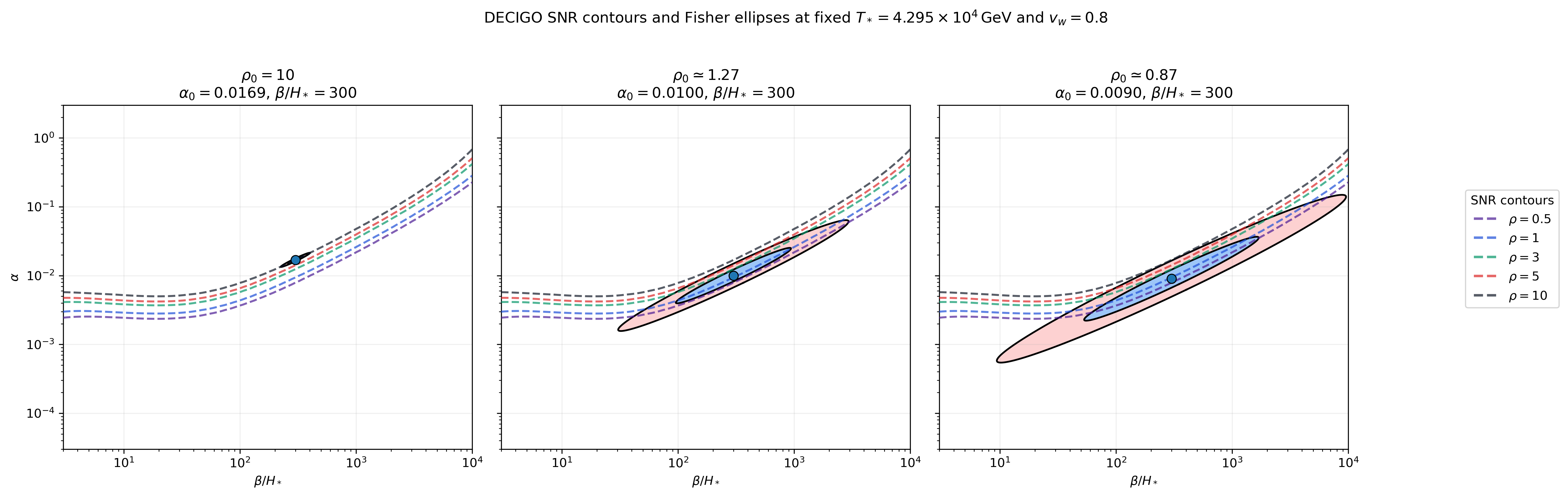
Figure 3: SNR isocontours and Fisher (lnα,ln(β/H∗))7, (lnα,ln(β/H∗))8 ellipses for DECIGO, showing strong degeneracy and scaling of error regions with SNR at fixed (lnα,ln(β/H∗))9.
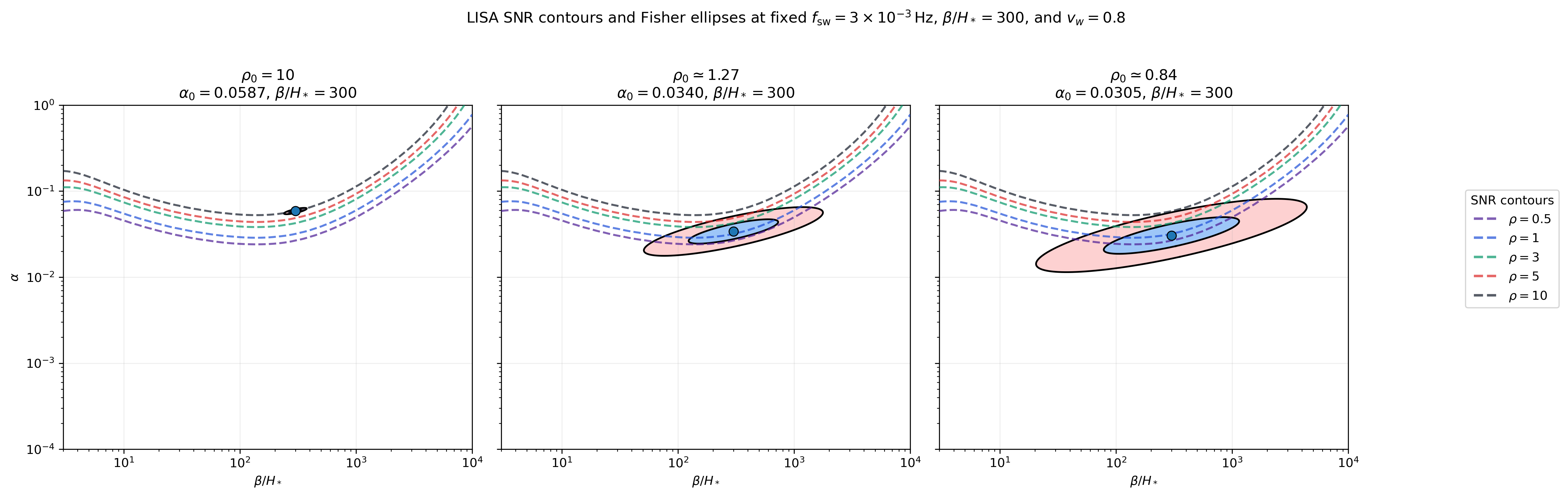
Figure 4: SNR contours and Fisher ellipses for LISA; as SNR decreases, the error ellipses expand and exhibit characteristic curvature due to frequency-dependent sensitivity and parameter correlation.
A robust outcome is the persistence of strong local degeneracy between Ωenv0 and Ωenv1 for both instruments, with error ellipses oriented along a tradeoff direction: increases in Ωenv2 can partially compensate for increases in Ωenv3 due to their opposite effects on amplitude and frequency location. This degeneracy persists when lowering SNR, widening the ellipses but not their orientation. The degree of curvature (non-alignment with axes) in the error ellipses is detector-dependent: LISA, having stronger frequency-dependent sensitivity near the peak, exhibits more pronounced curvature, while DECIGO's broader band yields error contours closer to power-law relations.
Importantly, these results are specific to the idealized instrumental and physical scenario adopted: overlap reduction function is assumed optimal, only two parameters are allowed to vary, and the instrumental noise is approximated by analytic sensitivity curves rather than a full simulation of time-delay interferometry channel structure.
Practical and Theoretical Implications
This work establishes the scale and structure of expected parameter constraints on early universe phase transition parameters from future GW observatories, affirming that amplitude and duration of the transition are strongly, but not perfectly, degenerate in their GW imprint for ground and space-based detectors. Thus, inference of underlying microphysics from detected stochastic GW backgrounds will generically require external or theoretical priors to break degeneracies, unless future detectors can provide both high SNR and multi-band or multi-messenger constraints.
From the practical detector design perspective, the analytic methods here clarify how spectral sensitivity and response influence not just overall detectability but also the error orientation and tradeoff structure, which may recommend future upgrades targeting broad, flat-band sensitivity. Theoretical implications are also clear: phase transition model-building must consider that GW observables will only weakly break degeneracy between Ωenv4 and Ωenv5 in the absence of independent measurements of Ωenv6 or Ωenv7, and model discrimination must exploit such auxiliary information.
Future developments could include the application of full Bayesian inference incorporating Ωenv8 and Ωenv9 as additional parameters, non-Gaussian likelihood modeling for low-SNR regimes, and inclusion of instrument configuration systematics such as finite separation and non-optimal overlap functions. Multi-detector, multi-band, and multi-source (e.g., combining with collider or CMB probes) studies are likely avenues for improving parameter disentanglement.
Conclusion
Through Fisher-matrix analysis of first-order phase transition GW signals, this study quantifies the ability of DECIGO and LISA to extract key physical parameters, subject to strong parameter degeneracy along the amplitude-duration tradeoff direction. The resulting marginalized uncertainties and their SNR dependence place quantitative bounds on the scientific return of future space-based GW detectors in probing early universe physics, emphasizing both the promise of stochastic GW backgrounds as cosmological probes and the necessity of complementary measurements or enhanced detector designs to fully break parameter degeneracies (2605.05019).