- The paper presents a SIGW formalism that incorporates arbitrary reheating equations of state and primordial non-Gaussianity up to the trispectrum level.
- The analysis demonstrates that variations in the sound speed and EoS critically affect the IR slope and resonance peak of the SIGW spectrum, with Fisher forecasts predicting precise constraints.
- The study highlights that enhanced GW amplitudes for w > 1/3 enable robust separation of non-Gaussian and reheating effects, opening avenues for early-universe exploration.
Probing Primordial Non-Gaussianity during Reheating with Scalar-Induced Gravitational Waves in the LISA Band
Introduction
This work ("Probing non-Gaussianity during reheating with SIGW in the LISA band" (2604.08493)) presents a comprehensive analysis of how non-Gaussianity (NG) and the post-inflationary expansion history — specifically, the equation of state (EoS) and sound speed during reheating — imprint on the scalar-induced gravitational wave (SIGW) spectrum in the millihertz regime targeted by LISA and similar third-generation interferometers. The investigation goes significantly beyond the standard scenario (radiation domination, w=1/3), generalizing the SIGW calculation to arbitrary w∈[0,1] and cs2, including primordial local-type NG. The detectability prospects of these signals, and the associated capability to probe microphysics in the early universe via LISA, are quantified with Fisher forecasts over a broad parameter space.
Scalar-Induced GW Formalism with General Expansion History and Non-Gaussianity
The paper develops the formalism for the calculation of the SIGW spectrum induced at second order by enhanced primordial scalar perturbations, accounting for general w and cs2 during a reheating stage of arbitrary duration. The cosmic background is parametrized by w and cs2, which can range from near matter-dominated, through standard radiation, up to stiff or kinetic-dominated phases. Several well-motivated microphysical models are mapped to benchmark w values: e.g. cannibal dark matter (w≈0.1), post-chaotic inflation preheating (w∼0.2−0.3), power-law inflaton oscillations (w∈[0,1]0), and quintessential or stiff phases (w∈[0,1]1).
Crucially, the evolution of the scalar sources and the corresponding second-order tensor modes, and the matching conditions at the radiation-reheating transition, are treated analytically with constant w∈[0,1]2 and w∈[0,1]3. The impact of primordial NG, modeled via local w∈[0,1]4, is incorporated up to the trispectrum level, and the full expression for the SIGW energy density, including all Gaussian and non-Gaussian connected/disconnected contributions, is provided.
Spectral Signatures of Reheating Parameters and Non-Gaussianity
Numerical evaluation of the SIGW spectrum reveals several key dependencies:
- The infrared (IR) slope is highly sensitive to w∈[0,1]5, controlled by an analytic exponent w∈[0,1]6 or w∈[0,1]7 with w∈[0,1]8, and is independent of w∈[0,1]9. The IR scaling, if reconstructed, constitutes a robust probe of the EoS during reheating.
- The location and prominence of the resonance peak reflect cs20: larger sound speeds shift the peak to higher frequencies and decrease its sharpness, with the resonance disappearing for cs21.
- As cs22 increases above cs23, the overall amplitude of the SIGW spectrum is enhanced due to less dilution of GW energy, while for cs24 the spectrum is suppressed.
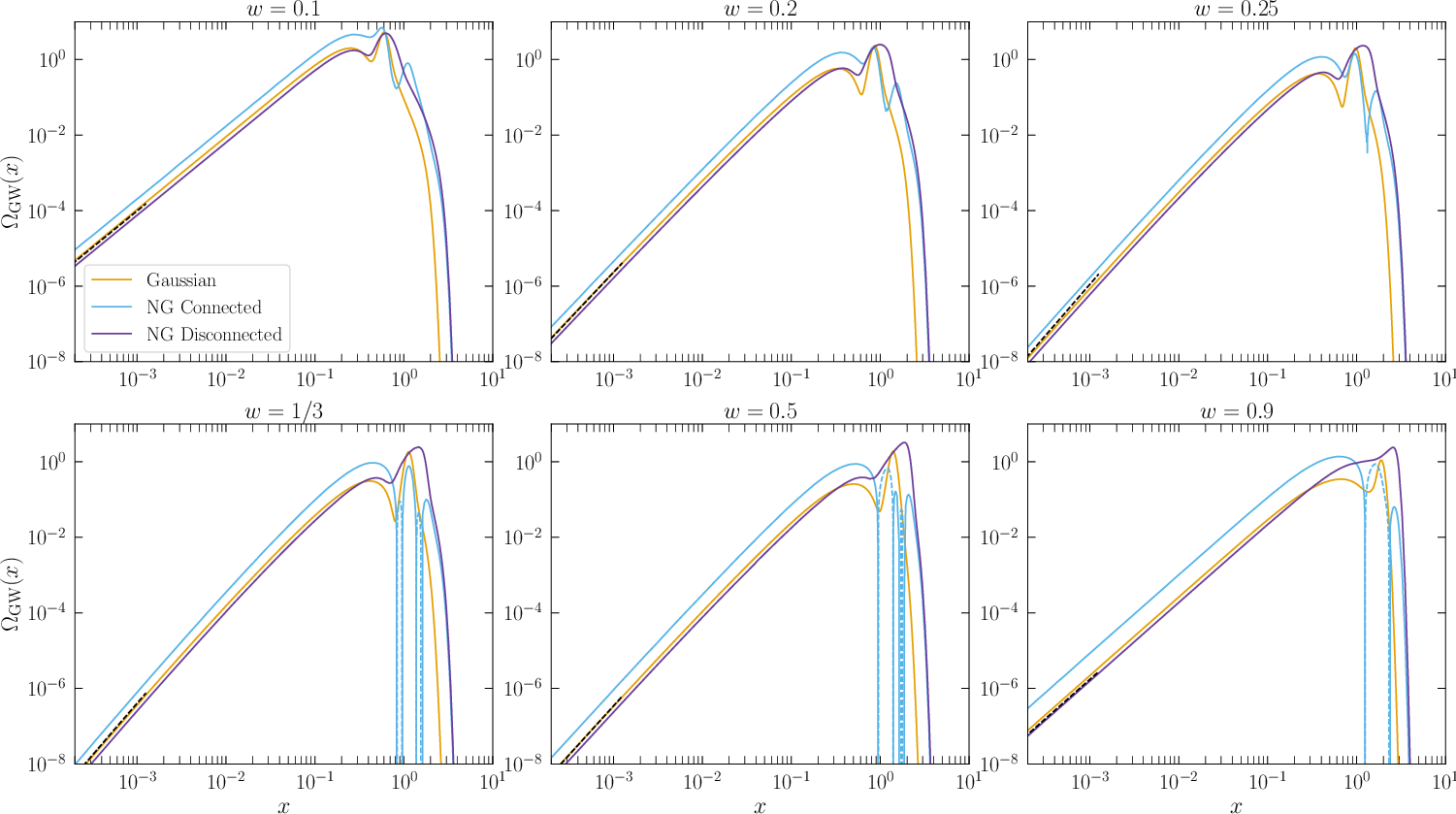
Figure 1: SIGW spectral shapes for different values of cs25 and cs26. The amplitude and structure of Gaussian and non-Gaussian contributions are displayed, with the IR analytic behavior (dashed black) indicated for reference.
The inclusion of local primordial NG modifies the spectral shape in the following ways:
- Non-Gaussian connected trispectrum components can introduce additional peaks (notably in the UV), and contribute negative-valued portions due to the sign structure of the generalized kernel, though the total GW energy density remains manifestly positive.
- For fixed cs27 and cs28, the interplay of NG amplifies distinctive features enabling separation of the background EoS and NG signatures, provided sufficient experimental precision.
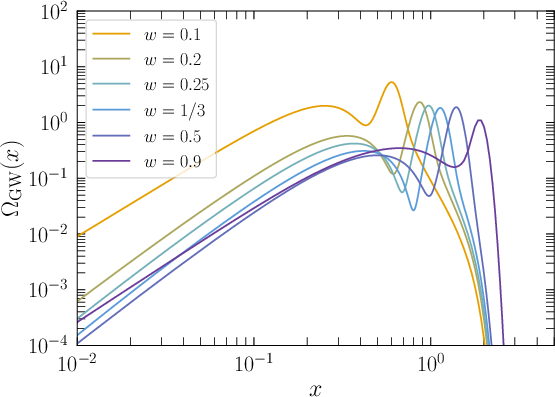
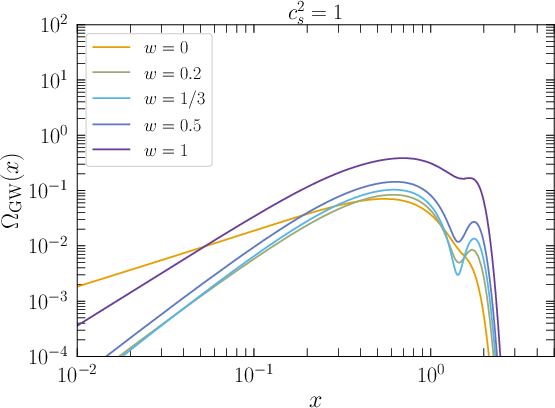
Figure 2: Left: Gaussian SIGW spectra for varying cs29, demonstrating systematic evolution of shape. Right: Variation with w0 at fixed w1; even in the absence of resonant features, w2 imprints observable deviations.
Detectability Forecasts and Parameter Constraints with LISA
A suite of Fisher matrix forecasts is performed, assuming a lognormal input primordial spectrum and four years of LISA integration time. Analyses span the w3 parameter space for three representative reheating scenarios (w4, w5, w6).
- For w7 (w8), the SIGW signal is suppressed compared to radiation domination, degrading the achievable constraints on all parameters unless the amplitude is very large. Parameter degeneracies remain prominent, particularly involving w9, cs20, and cs21, while the IR tail still offers leverage for cs22.
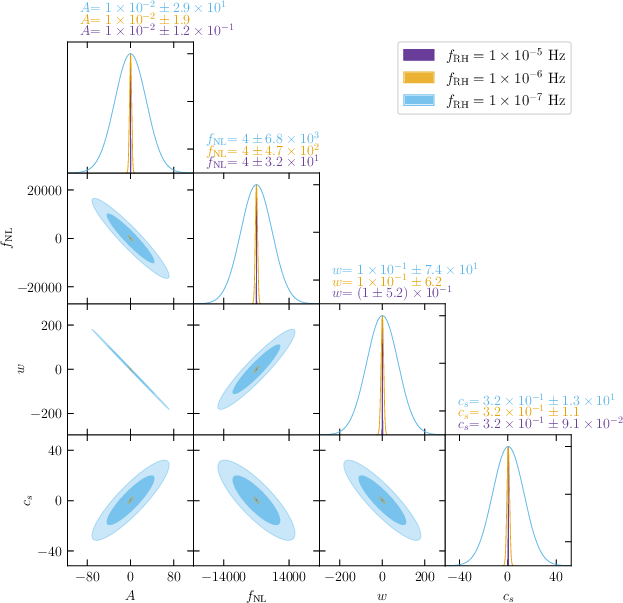
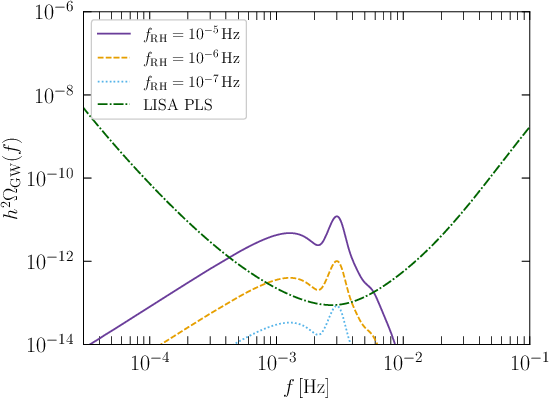
Figure 3: Fisher forecast for cs23, showing weak parameter constraints and strong degeneracies, due to suppressed GW production during this reheating scenario.
- For cs24 (cs25), the GW amplitude is enhanced, and all parameters, including cs26 and cs27, can in principle be determined to high fidelity (fractional errors below cs28 or better), even for moderate primordial amplitudes. The boost grows with larger cs29 and lower reheating transition frequency.
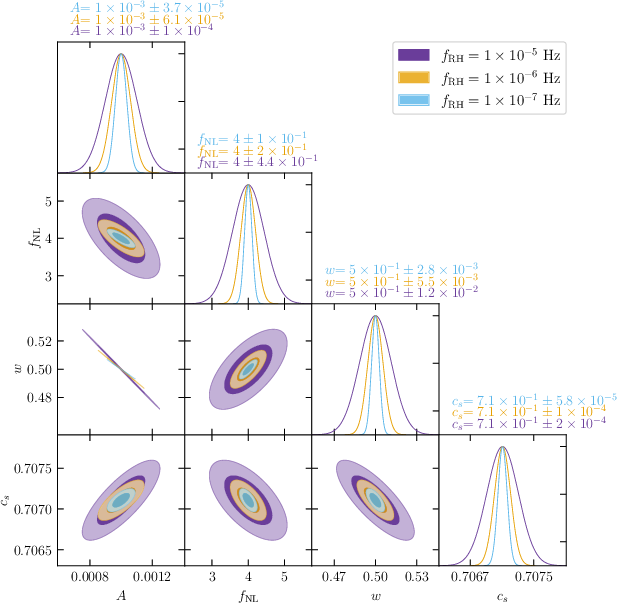
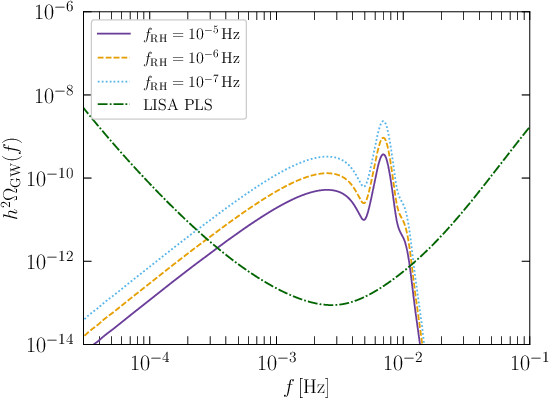
Figure 4: Fisher forecast for w0, showing greatly improved constraints as GWs are enhanced for such expansion histories.
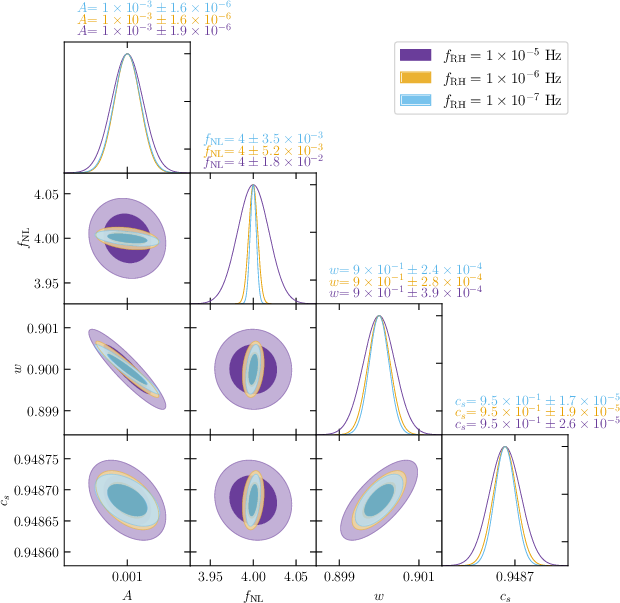
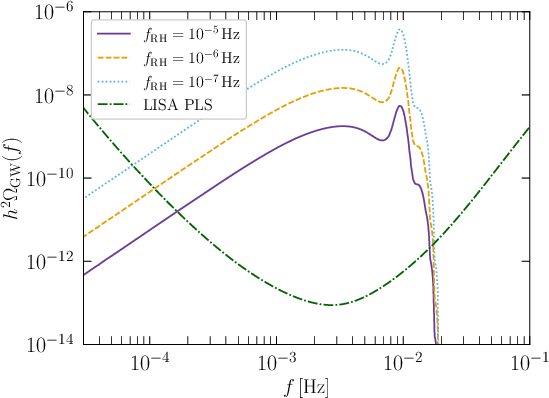
Figure 5: Fisher forecast for w1, illustrating even more precise reconstruction enabled by the significant GW amplitude boost in this regime.
The Signal-to-Noise Ratio (SNR) is mapped over the full w2 plane for each w3. The detectability region, subject to Big Bang Nucleosynthesis constraints, is maximized for large w4 and optimal reheating frequencies.
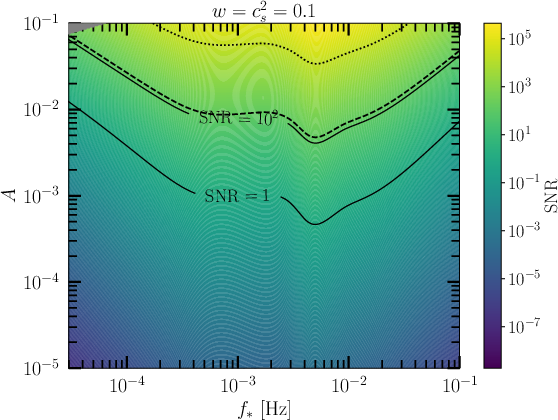
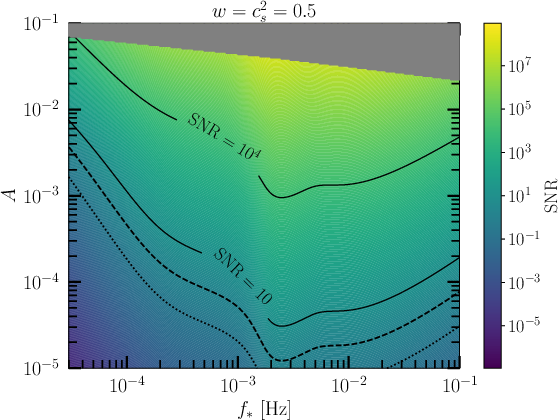
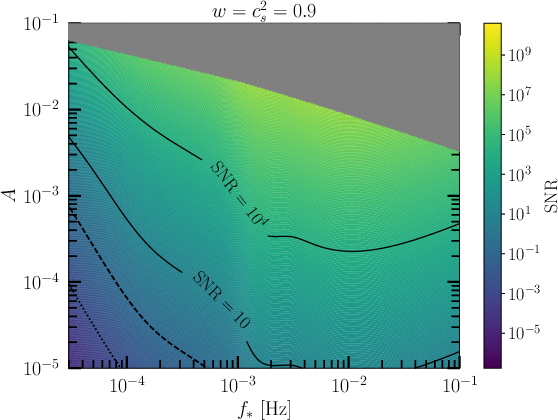
Figure 6: SNR scan in the w5 parameter space for w6 with fixed w7. The GW signal detectability is delineated for multiple reheating scenarios, with BBN limits shaded.
Implications and Outlook
This study demonstrates that SIGW observations in the LISA band can constrain the EoS and NG of the primordial universe during reheating. The spectral features induced by w8 and w9 (specifically, the IR tail and resonance structure), and the modulation from cs20, provide orthogonal handles for disentangling early-universe physics. Crucially, it is shown that parameter inference for NG is not strongly degenerate with that for cs21; allowing cs22 to float in the analysis does not erase sensitivity to NG, contrary to some suggestions in the literature.
From a practical perspective, in scenarios where cs23, SIGWs can be detected with high SNR for much lower primordial amplitude compared to the standard scenario. This enables SIGW probes even in regimes where primordial black hole (PBH) overproduction is not expected, decoupling GW and PBH observational constraints for a broad class of models.
The theoretical ramifications are notable: the methodology outlined is extendable to arbitrary trispectrum shapes and backgrounds with nontrivial reheating histories, making it a framework for model-independent early-universe inference from GW experiments. Future studies incorporating model-specific NG, varying cs24, and extended reheating profiles (rather than sharp transitions) are a natural extension.
Conclusion
The paper delivers a rigorous generalization of the SIGW phenomenology to arbitrary post-inflationary thermal histories and local-type primordial non-Gaussianity, demonstrating that third-generation GW experiments will have the capability to reconstruct key properties of the early universe — EoS, sound speed, and primordial NG — with high precision, contingent on the underlying scenario. The work sets a benchmark for the use of gravitational wave backgrounds in reconstructing microphysics immediately after inflation and provides the theoretical underpinning for SIGW-targeted analyses of future GW data.