- The paper demonstrates that a radiatively broken ALP model triggers a supercooled first-order phase transition which naturally generates primordial magnetic fields with strengths up to 10⁻⁹ G.
- It employs detailed analytical and numerical methods to correlate phase transition parameters, such as bubble dynamics and nucleation temperature, with PMF amplitude and coherence length.
- The study reveals a direct link between the properties of primordial magnetic fields and the stochastic gravitational wave background, offering clear targets for upcoming GW detectors.
Primordial Magnetogenesis and Gravitational Waves from ALP-assisted Phase Transition
Theoretical Framework and Motivation
This work analytically and numerically investigates the simultaneous production of primordial magnetic fields (PMFs) and a stochastic gravitational wave background (SGWB) sourced by a strong first-order phase transition (FOPT) in the early universe, triggered within a scale-invariant axion-like particle (ALP) model. The context is well-motivated by emerging observational signals: recent high-significance gamma-ray blazar observations indicate a nonzero intergalactic magnetic field (IGMF), and future gravitational wave (GW) interferometers will have unprecedented reach for cosmological signals in the mHz–Hz range. The manuscript's central claim is that a radiative symmetry-breaking scenario with a Higgs-portal ALP sector generically connects FOPT dynamics to both the PMF properties and SGWB amplitude and frequency.
The model realizes a minimal setup in which a global U(1) symmetry is radiatively broken via the Coleman-Weinberg mechanism, resulting in a strongly supercooled FOPT. The ALP sector communicates with the Standard Model (SM) through a Higgs-portal (quartic) coupling. The phase transition generically proceeds at low nucleation temperature, with bubble dynamics dominated by vacuum energy, which is efficiently converted to bubble wall acceleration and consequently to both magneto-hydrodynamic turbulence and gravitational wave production.
PMF Generation and Evolution
The generation of PMFs during the FOPT is thoroughly treated, including both helical and non-helical cases. The initial field configuration is set by the fraction of vacuum energy released in the transition and converted into bulk plasma motion, with subsequent MHD turbulence evolving the spectrum. For maximally helical configurations, inverse cascades transfer spectral energy to larger scales, yielding a scaling B∼η−1/3, λ∼η2/3 during the radiation epoch. For non-helical fields, the decay is more rapid due to the absence of conserved helicity.
The present-day (z=0) amplitude and comoving coherence length of the magnetic field are derived as functions of the FOPT parameters, including the percolation temperature, duration β/H, and efficiency coefficients. The calculations include the redshift of both amplitude and scale, as well as the impact of partial energy transfer to the visible sector in the Higgs-portal scenario.
The main result is that, for typical parameter choices, maximally helical fields can realize B0∼10−9 G at coherence lengths λ0∼10−3−10−1 Mpc, consistent with the lower bounds obtained by MAGIC, H.E.S.S., and Fermi-LAT given relevant blazar activity timescales.
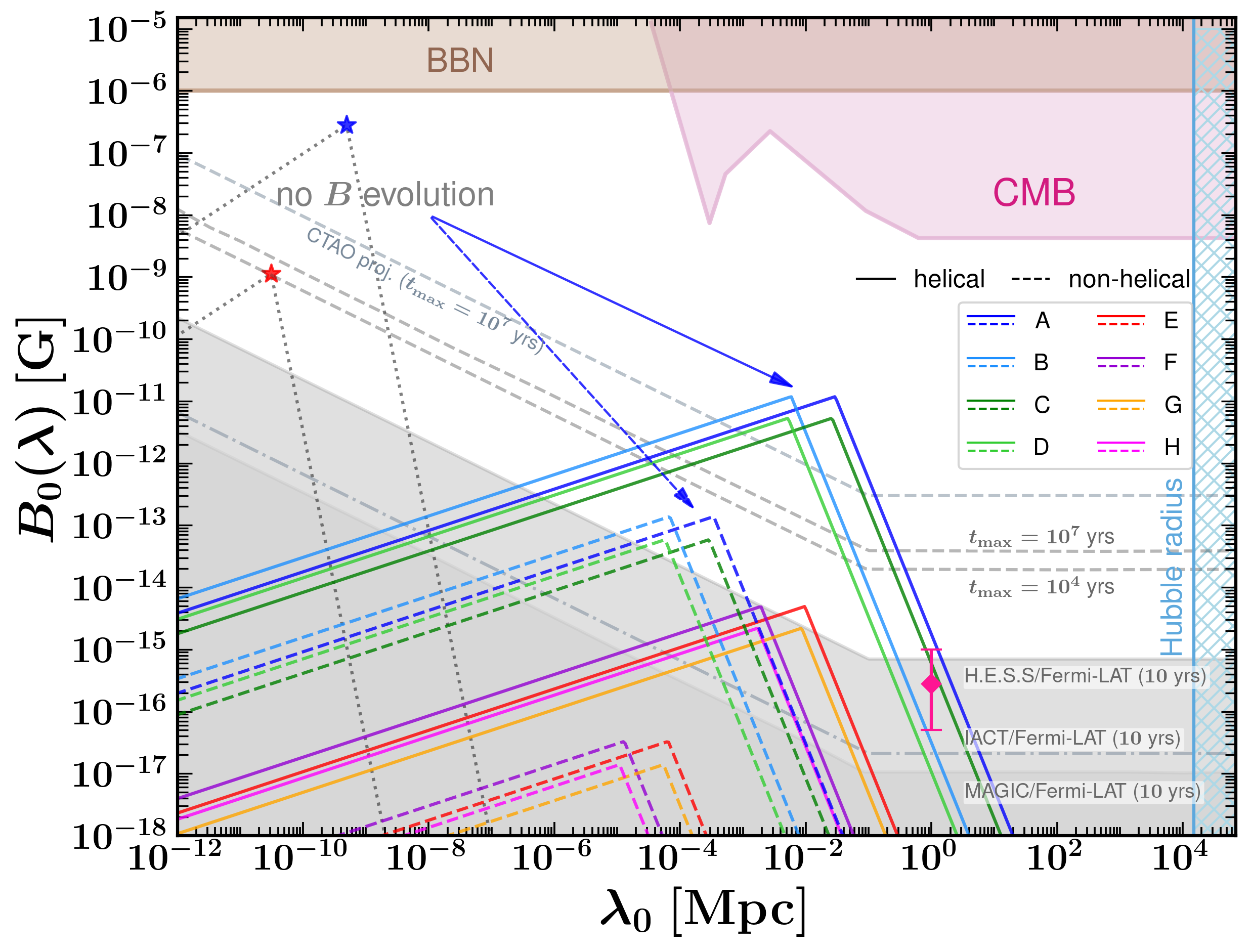
Figure 1: Predicted present-day PMF strength B0 as a function of coherence length λ0, for various model benchmarks, showing (solid/dashed) helical and non-helical evolution scenarios and comparison to IGMF observations and constraints.
This scenario can reproduce the direct measurement by Fermi-LAT (B0=2.8−2.3+7.2×10⁻¹⁶ G at 1 Mpc; 97% CL) and is compatible with upper bounds from CMB anisotropy and BBN constraints for a characteristic range of parameters.
Gravitational Wave Background from FOPT
The GW spectrum produced by such a supercooled FOPT is computed using recent analytical templates. The SGWB peak energy density and peak frequency are determined by the phase transition's inverse timescale B∼η−1/30 and the reheating temperature, directly related to the ALP decay constant B∼η−1/31 and hidden-sector gauge coupling B∼η−1/32. Space-based interferometers such as LISA, DECIGO, BBO, and B∼η−1/33ARES are found to have substantial reach for the parameter range motivated by cosmological PMFs.
A critical result, confirmed via detailed parameter scans, is the correlation between regions in parameter space that yield strong PMFs (matching blazar-derived IGMF lower bounds) and those producing detectable SGWB at upcoming GW facilities. For the maximally helical case and for B∼η−1/34 GeV, GW signatures are well within LISA and DECIGO's future sensitivity.
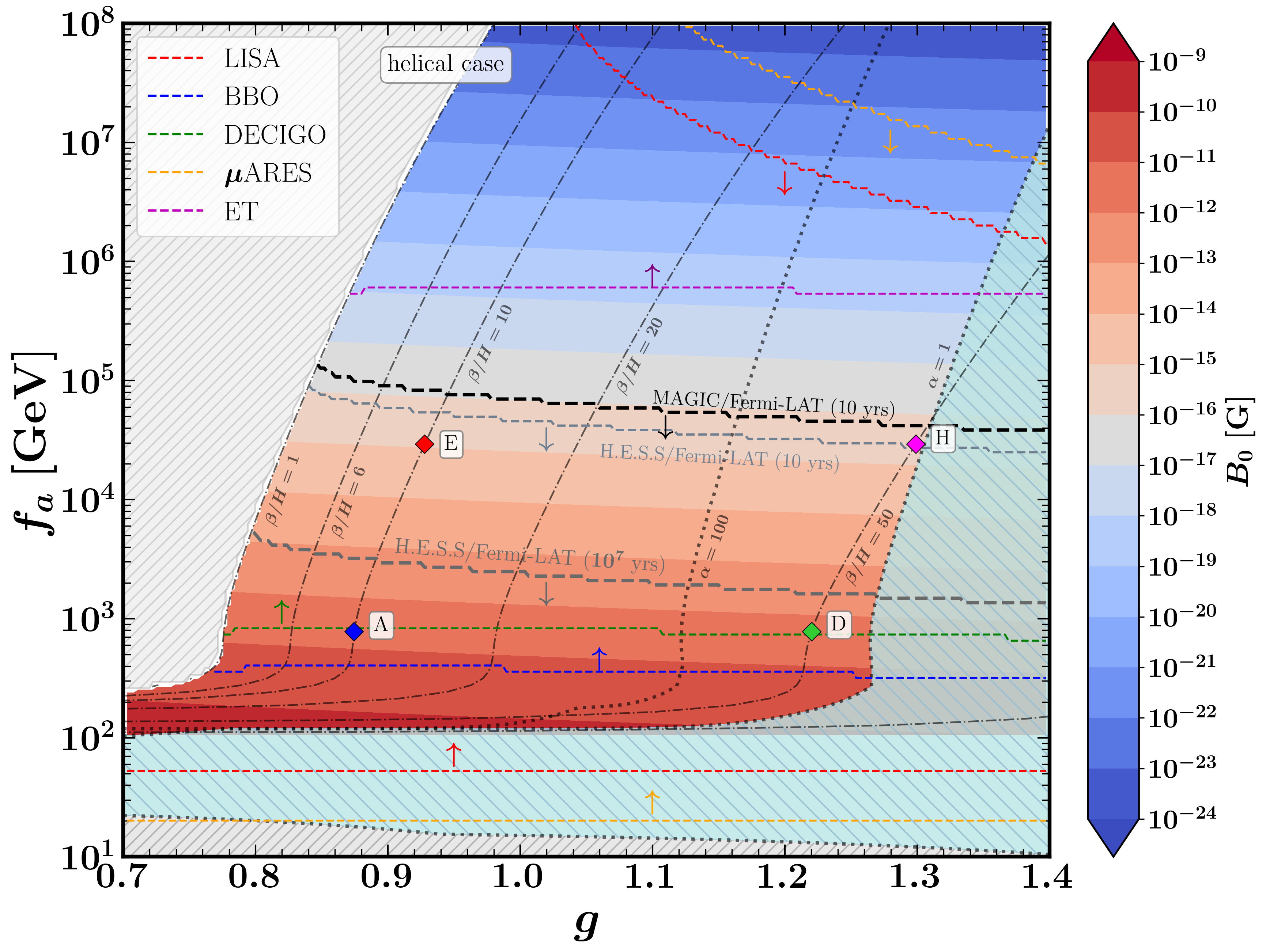
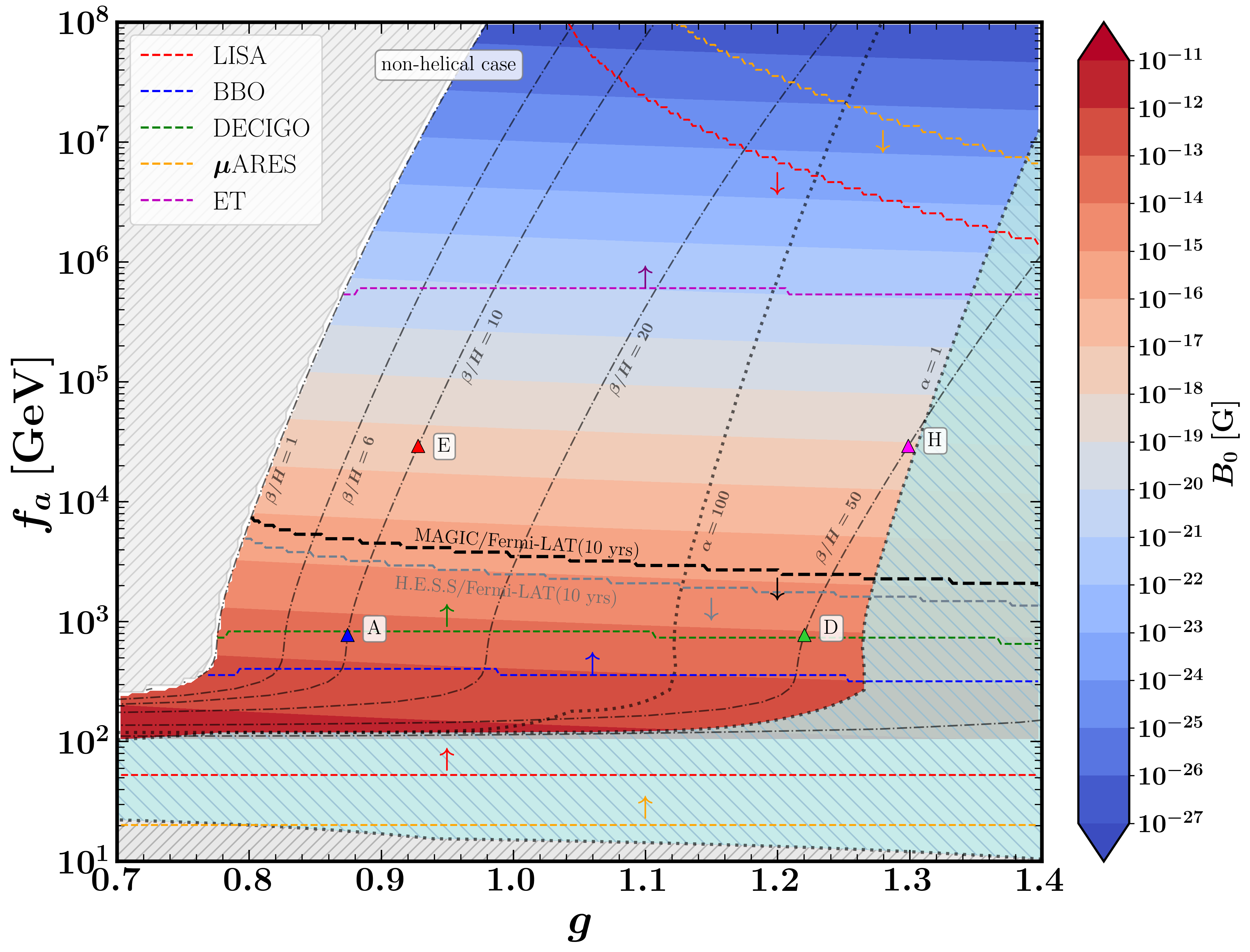
Figure 2: Regions in the B∼η−1/35 plane yielding sufficient PMF strength for blazar observations, with overlays of projected reach for future GW experiments under both helical (upper) and non-helical (lower) assumptions.
The analysis quantifies how the maximum allowed B∼η−1/36 is set by the need to generate IGMF strong enough to match PMF observational bounds, while the lower bound arises from the completion of the FOPT (avoiding inflationary trapping).
Complementarity with Particle and Astrophysical Probes
The multi-messenger reach of this scenario is emphasized by translating cosmological bounds into limits on effective ALP couplings to SM photons, gluons, and fermions. The parameter region favored by PMF and SGWB arguments is mapped onto the B∼η−1/37 plane and its analogs, demonstrating substantial complementarity with astrophysical, laboratory, and collider searches.
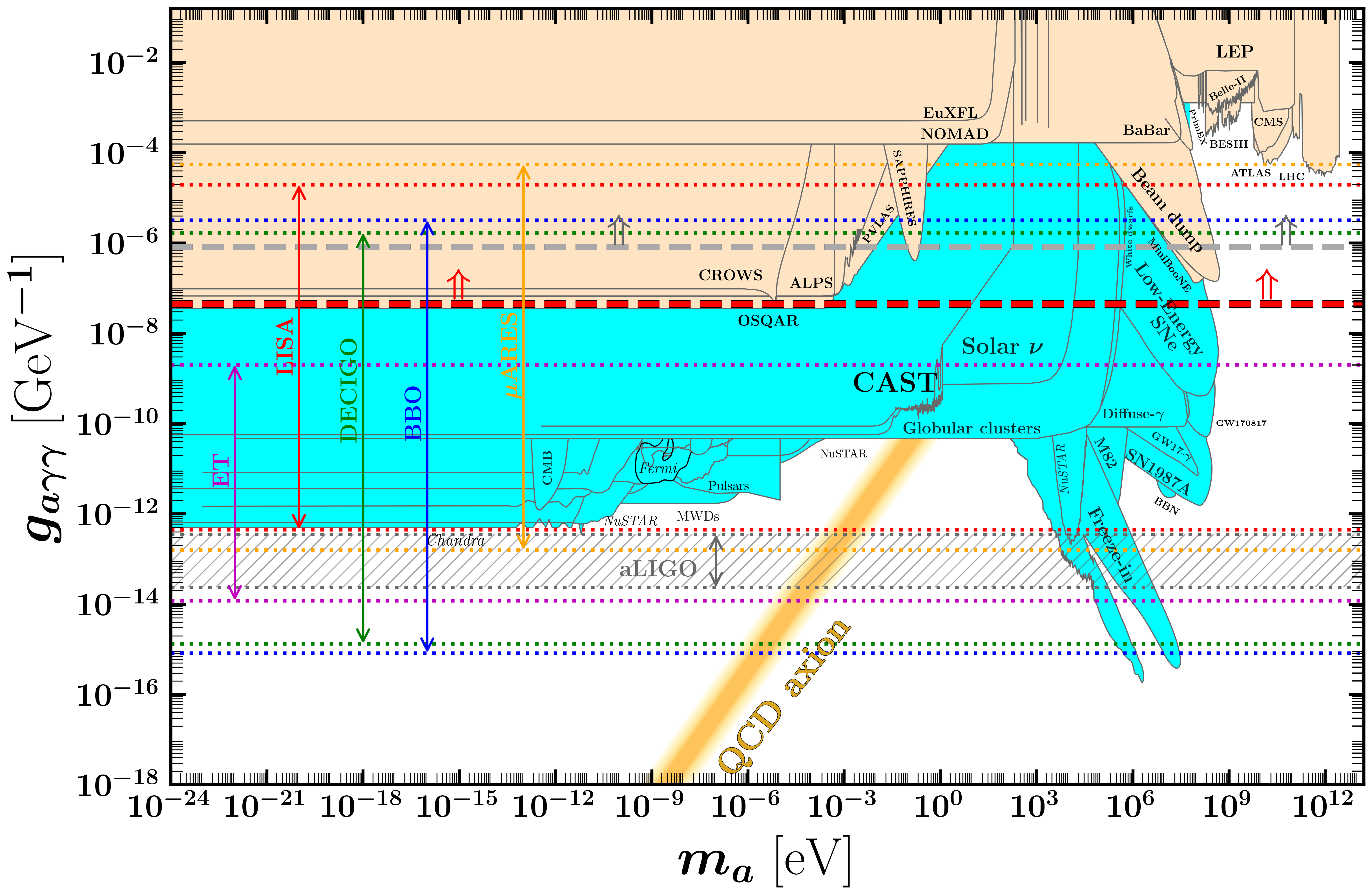
Figure 3: Existing and projected limits on the ALP-photon coupling, highlighting the band favored by blazar-derived PMF observations and the prospective exclusion reach of GW detectors.
A key feature is that the cosmic observables probe relatively heavy ALPs (B∼η−1/38 GeV), a regime that is becoming accessible with present and future flavor factories, proton and lepton beam-dump facilities, and energy-frontier colliders. The scenario is thus testable with a combination of laboratory, astrophysical, and GW observations.
Higgs Portal and Collider Implications
The model predicts a deviation in the Higgs trilinear self-coupling, scaling as B∼η−1/39. However, the parameter region of cosmological interest exhibits deviations λ∼η2/30, well below the sensitivity of both the LHC and upcoming hadron/electron colliders.
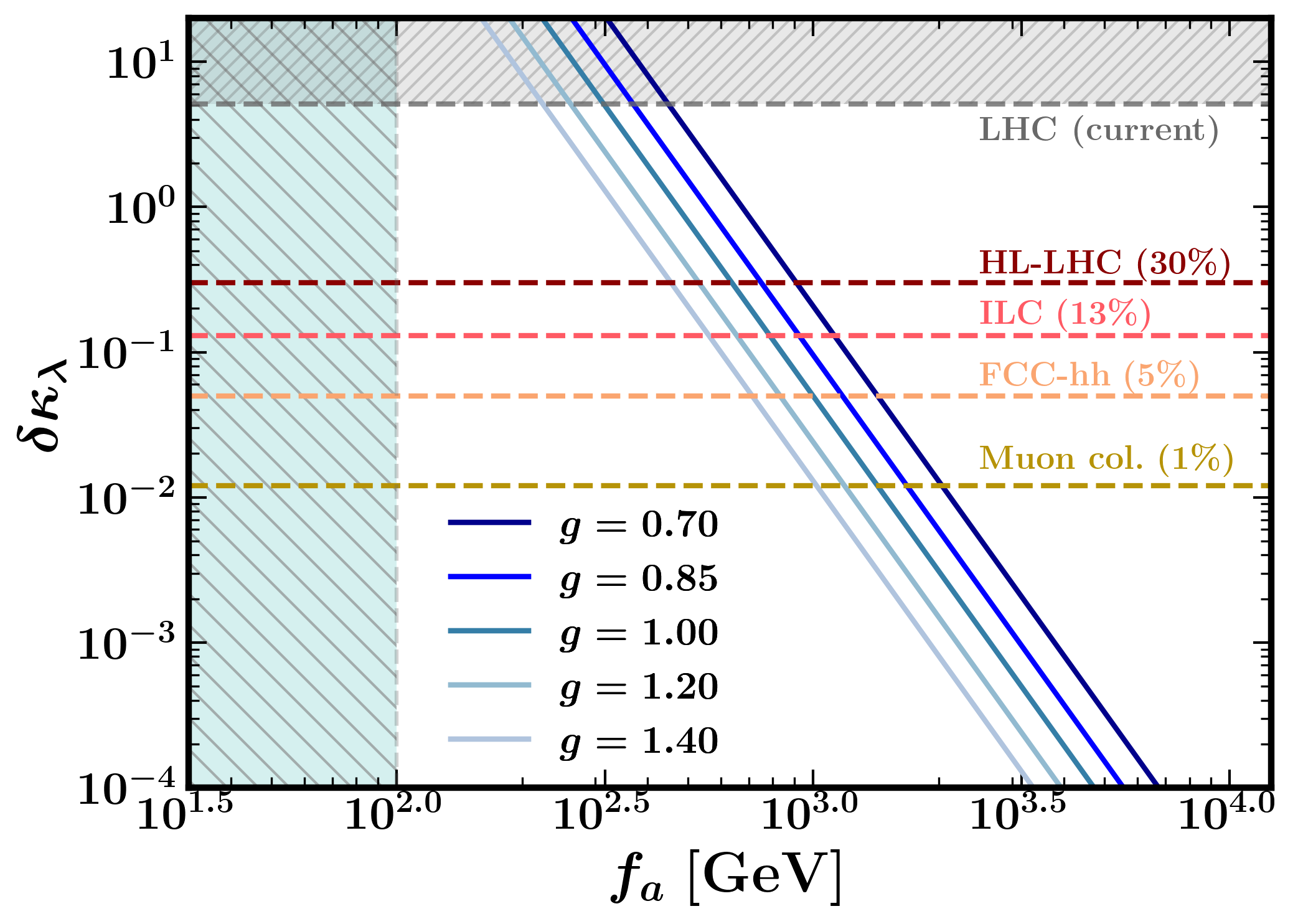
Figure 4: Deviation in the SM Higgs trilinear self-coupling λ∼η2/31 vs λ∼η2/32, with projection sensitivities from current and future collider facilities.
Thus, while precision Higgs data can exclude low-λ∼η2/33 scenarios, collider measurements offer no practical constraints for the parameter space relevant to PMF and SGWB production in this framework.
Implications and Outlook
- Strong Correlation: The results reinforce that in radiatively broken ALP frameworks, PMF observations and GW signals are inextricably linked—a rare concrete example of predictive complementarity between multi-messenger observables.
- Heavier ALP Window: For λ∼η2/34 in the λ∼η2/35–λ∼η2/36 GeV range, the scenario targets ALP masses and couplings that are beyond the reach of the solar axion and low-energy LSW regime, but accessible to GW interferometers and future colliders.
- Theory Development: Should stronger IGMF measurements at λ∼η2/37 G for Mpc-scale coherence be confirmed, it becomes difficult to attribute a cosmological origin of IGMF to any mechanism other than a strong, low-λ∼η2/38 FOPT, as inflationary magnetogenesis scenarios are adequately constrained by isocurvature and baryogenesis requirements.
- Parameter Inference: Null results in the GW domain or blazar analysis will immediately constrain portions of the ALP effective theory currently out of reach by direct terrestrial probes.
Conclusion
The authors provide a detailed, parameter-complete analysis demonstrating that ALP-induced radiatively broken phase transitions naturally produce observable PMFs and detectable GW backgrounds. Both cosmological histories and collider constraints are incorporated self-consistently. The resulting testable predictions strongly motivate coordinated observation of the IGMF, continued GW searches in the sub-Hz regime, and future heavy ALP searches at high-intensity and high-energy colliders. The study consolidates a data-driven pathway for probing early universe symmetry breaking at intermediate scales with multi-messenger signals.