- The paper introduces an analytic framework for isolating the kinematic dipole in the gravitational-wave background using LISA.
- It develops a quadratic estimator based on Fisher matrix analysis to quantify peculiar velocity and set detection thresholds.
- The study shows that dipole measurements can break degeneracies between cosmic signals, galactic foregrounds, and instrument noise.
Analytical Probes of the Kinematic Dipole with LISA
Introduction and Motivation
This paper presents an analytical framework for detecting the kinematic dipole in the stochastic gravitational-wave background (GWB) using the Laser Interferometer Space Antenna (LISA), and assesses its efficacy as a probe of cosmic anisotropies and a tool for breaking degeneracies in the presence of strong galactic foregrounds or instrument noise (2604.08968). The kinematic dipole arises from the peculiar velocity of the Solar System with respect to the cosmic rest frame, inducing a Doppler modulation in the observed GWB, analogous to the dipolar anisotropy in the cosmic microwave background (CMB) temperature. Independent measurement of this dipole with LISA would not only provide verification of our velocity inferred from the CMB but also distinguish between cosmological, astrophysical, and instrumental contributions.
Previously, studies have primarily relied on numerical or simulation-based analyses. Here, a fully analytic treatment is presented, yielding direct insight into the underlying symmetries of the LISA response and the role of detector geometry and motion, advantageous for generalization to future space-based interferometers.
Analytic Treatment of LISA’s Response to the Kinematic Dipole
The response of LISA to a GWB dipole is characterized by developing the formalism in the Fourier domain for the phase differences at each vertex, with GW propagation treated via direction-dependent response tensors. The key analytic innovation is the explicit separation of the contributions from the isotropic (monopole) GW background, the dipolar modulation induced by the observer’s motion, and the noise. The total covariance matrix of the interferometric data thus acquires physically transparent structure, where symmetry requirements dictate that the dipolar response is governed by a single, frequency-dependent function.
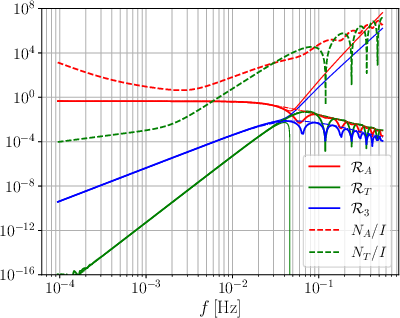
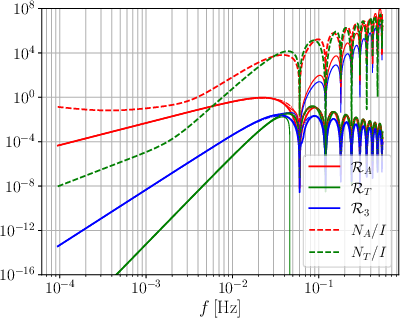
Figure 1: Response functions R of LISA for monopole (A, T) and dipole (R3) contributions, illustrating frequency and channel dependence.
The analytic approach elucidates that, to leading order in β, the GWB intensity observed is related to its rest-frame value as
Iˉ(f)I(f,n)≈1+(n⋅β)(1−nI),
with spectral slope nI(f). The dipole response function, R3(f), is constrained by geometrical symmetries of the constellation and orbital motion, and vanishes as f3 for low frequencies—highlighting the necessity of both arm configuration and annual motion for full three-dimensional velocity reconstruction.
The paper constructs an optimal, quadratic estimator for the kinematic velocity, leveraging the Fisher matrix formalism. Analytical expressions for the variance and sensitivity of the estimator are provided. It is rigorously demonstrated that a static LISA can only probe the velocity components within its plane; full reconstruction requires incorporation of LISA’s orbital dynamics. This is codified in the Fisher information, whose invertibility (and thus estimator variance) critically depends on annual reorientation.
Strong numerical thresholds are established: for a flat (scale-invariant) GWB spectrum, detection of the kinematic dipole with “fiducial” LISA requires h2ΩGW≳5×10⁻⁸, while an instrument with noise improved by an order of magnitude would reach A0 (see Figure 2 and associated analysis).
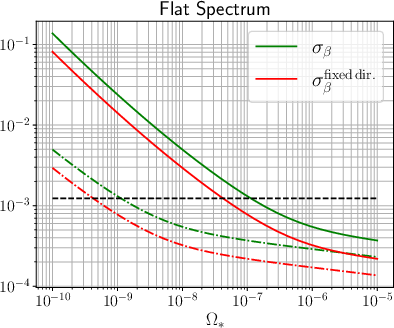
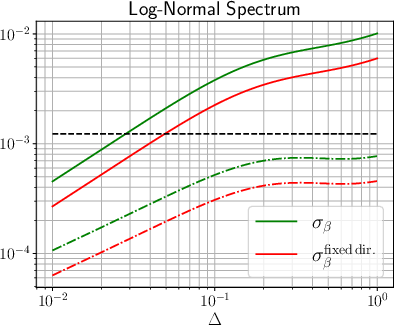
Figure 2: Error on the peculiar velocity modulus vs. A1 for a flat and log-normal GWB spectrum, contrasting fiducial and improved LISA configurations.
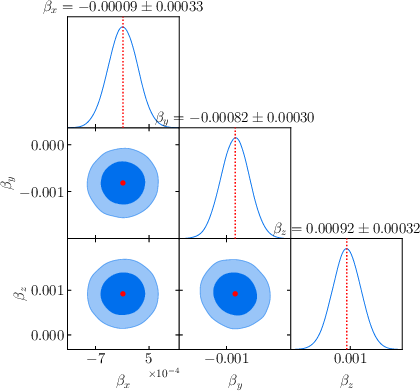
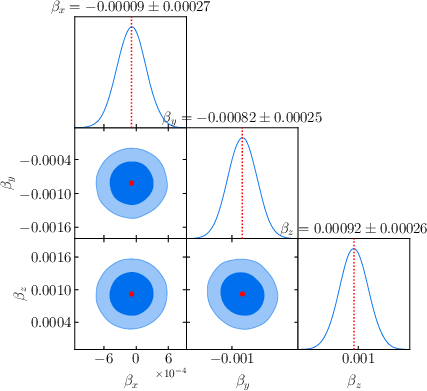
Figure 3: Posterior constraints on the components of the peculiar velocity in Galactic coordinates, for representative GWB signal models.
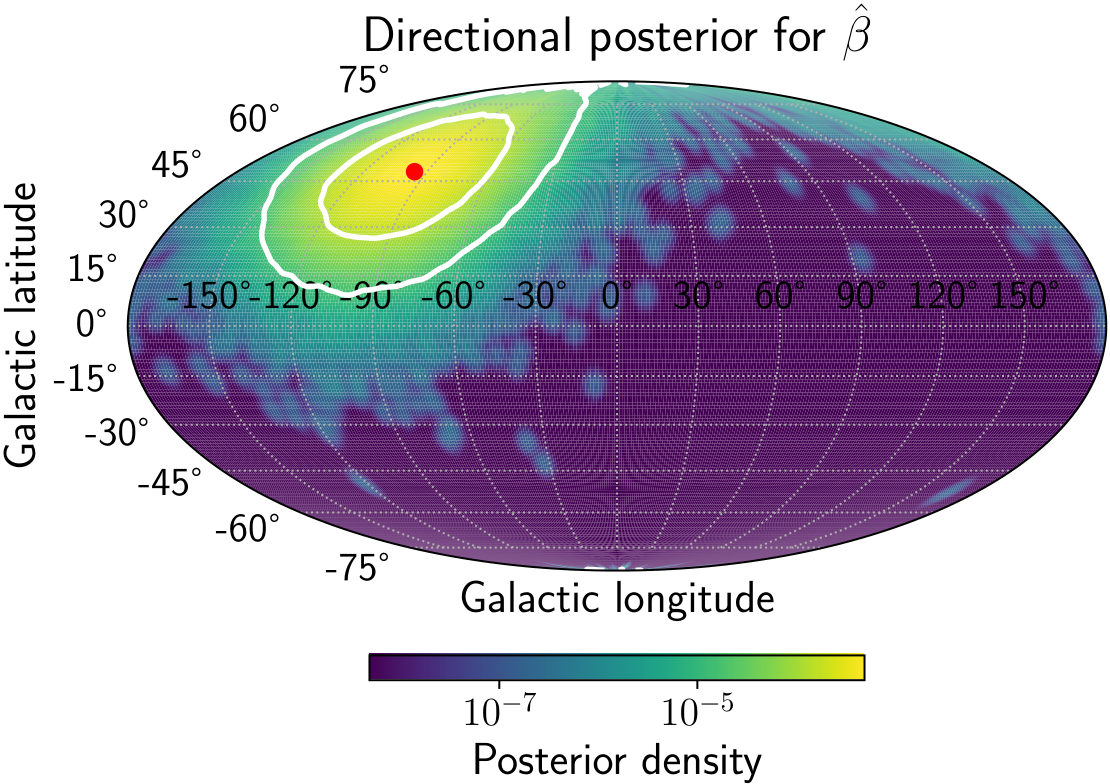
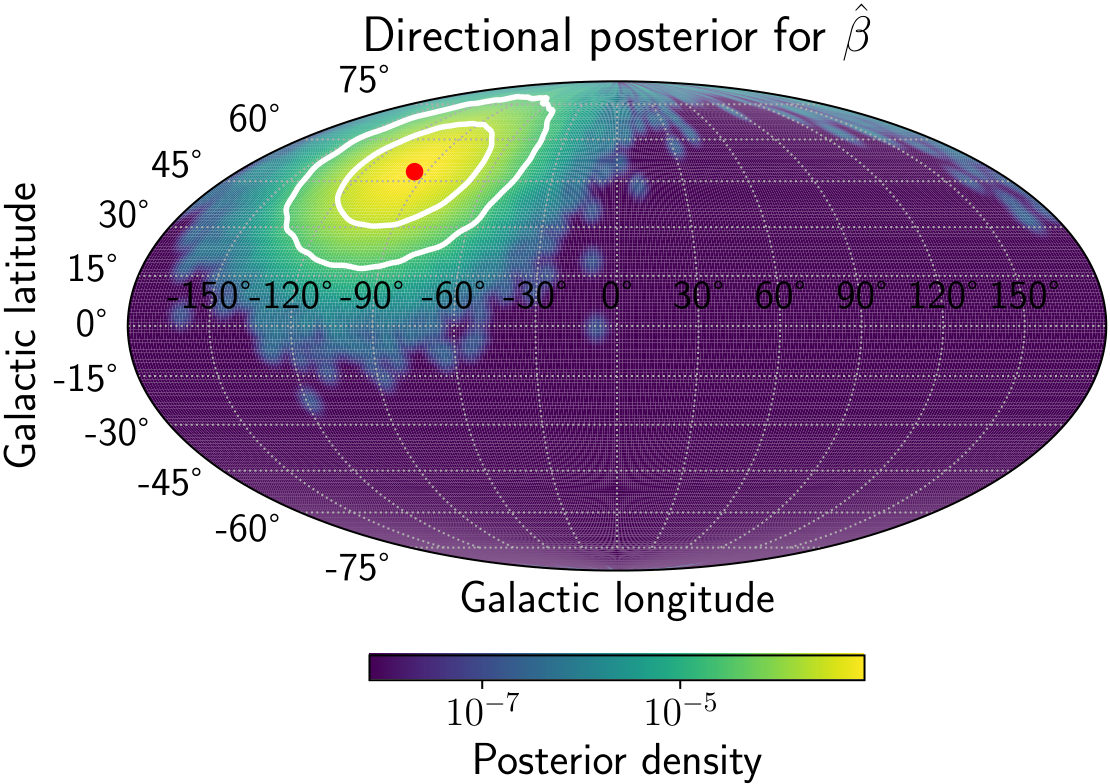
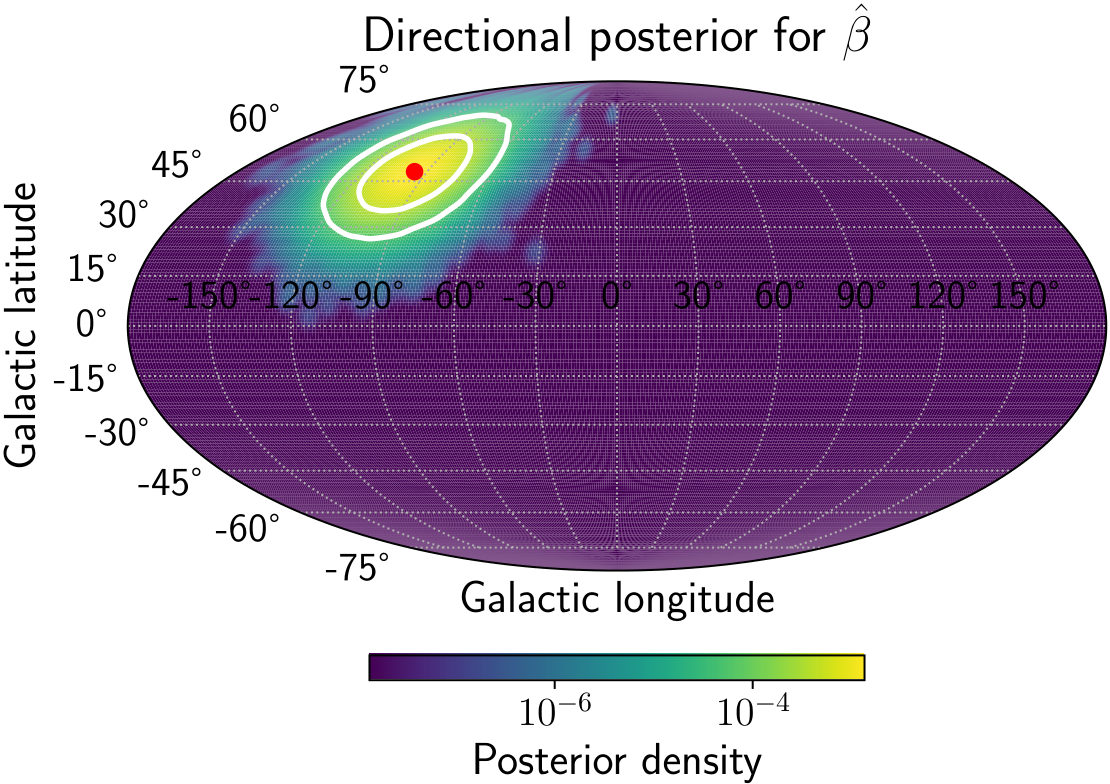
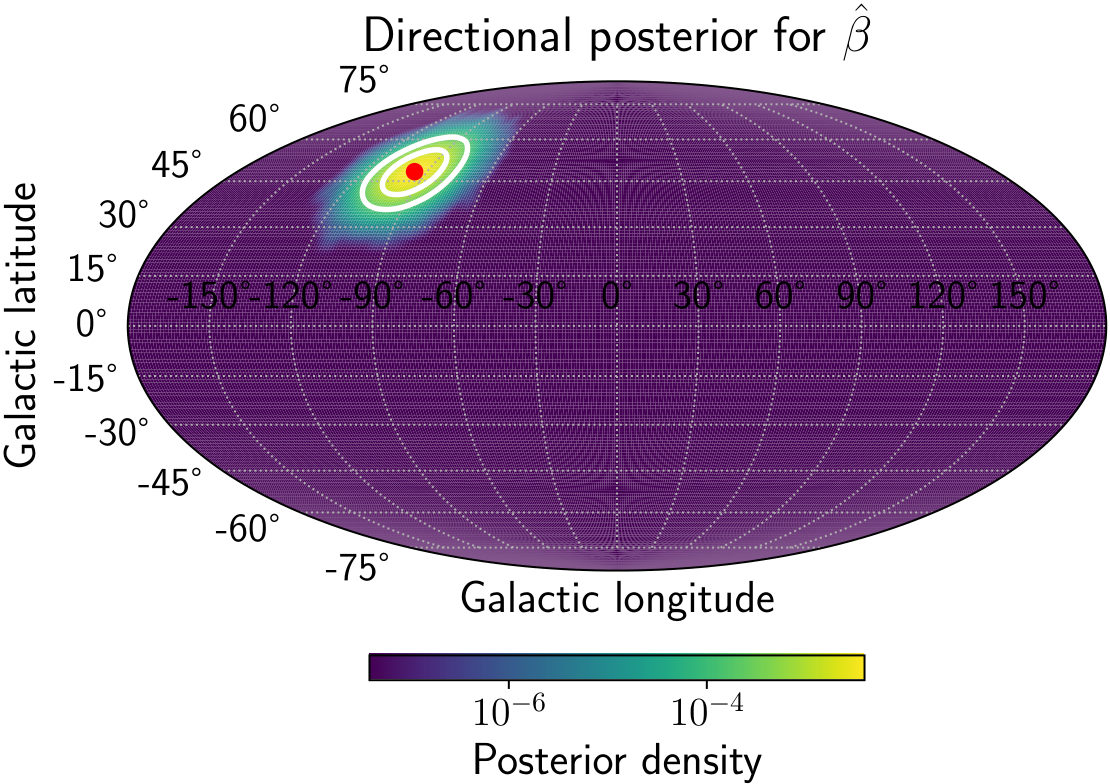
Figure 4: Directional reconstruction of the peculiar-velocity unit vector A2, revealing dependence on GWB spectral shape and amplitude.
A robust lower bound on reconstructable dipole amplitudes of order A3 is established, controlled by SNR and observation duration (assuming realistic mission scenarios). Sharper spectral features in the GWB improve reconstruction due to non-trivial spectral index contributions.
Kinematic Dipole as a Degeneracy-Breaking Observable
A core focus is the role of the kinematic dipole in breaking degeneracies between extragalactic/cosmological backgrounds, strong galactic foregrounds, and noise. Unlike foregrounds and noise, the cosmological GWB is uniquely modulated by our velocity, making the dipole a discriminant observable.
The Fisher matrix analysis, bolstered by analytic geometry decompositions, demonstrates that even if galactic and primordial signals are spectrally identical in the monopole, the inclusion of the dipole—orthogonal in parameter space—generically regularizes the estimator and suppresses degeneracy. Marginalized variances on cosmological parameters receive non-vanishing contributions proportional to the dipole information, even with weak priors on foreground models.
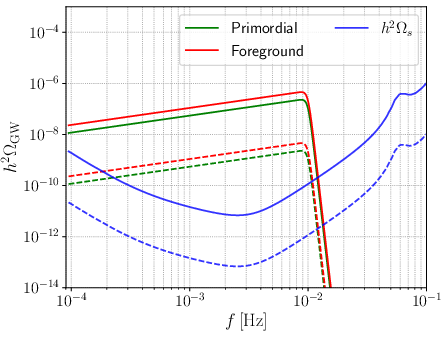
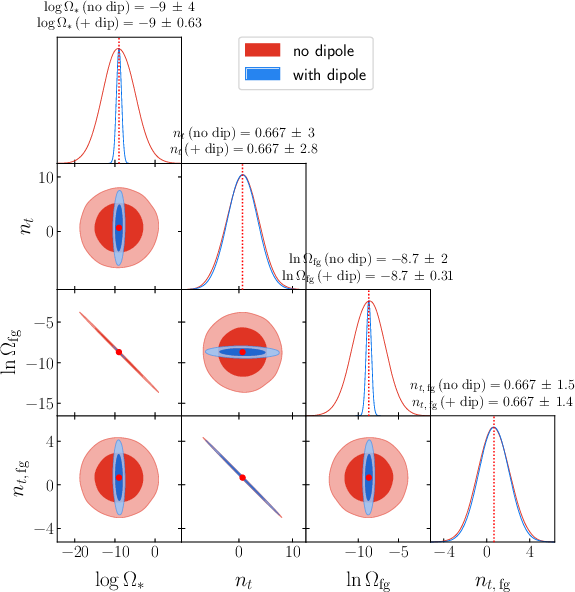
Figure 5: Illustration of signal-plus-foreground component degeneracy and the impact of kinematic dipole terms in realistic and improved sensitivity regimes.
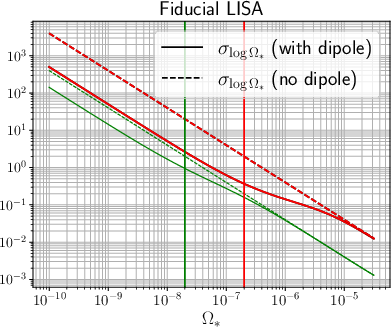
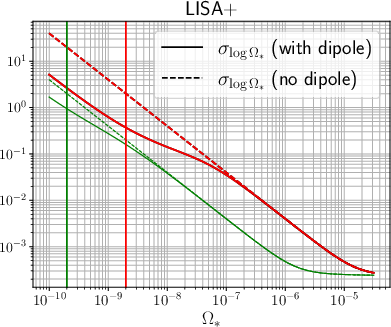
Figure 6: Marginalized variance of the logarithmic primordial GW amplitude as a function of amplitude and foreground strength, with and without the kinematic dipole.
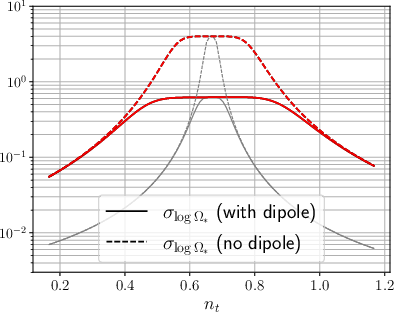
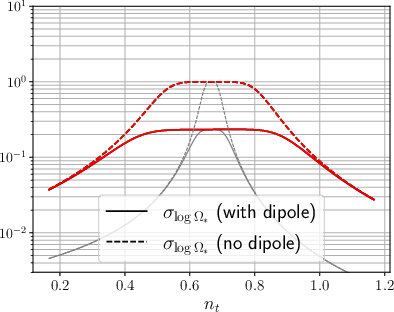
Figure 7: Variance dependence on primordial spectral index, demonstrating increased efficacy of the dipole with broad or uncertain foreground priors.
Similar analytic and numerical procedures are shown to suppress degeneracies with noise features that mimic signal templates, again leveraging the fact that only cosmological backgrounds encode the kinematic signature.
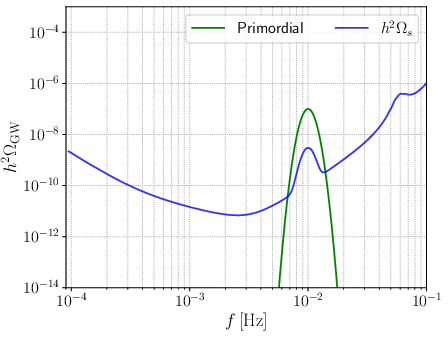
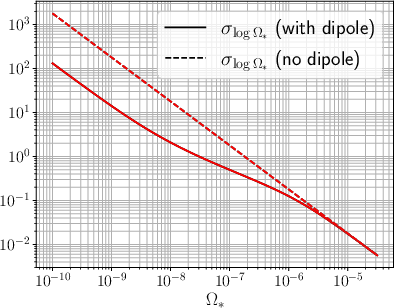
Figure 8: Degenerate noise contribution parametrically aligned with the signal, and the breaking of this degeneracy by dipole observables.
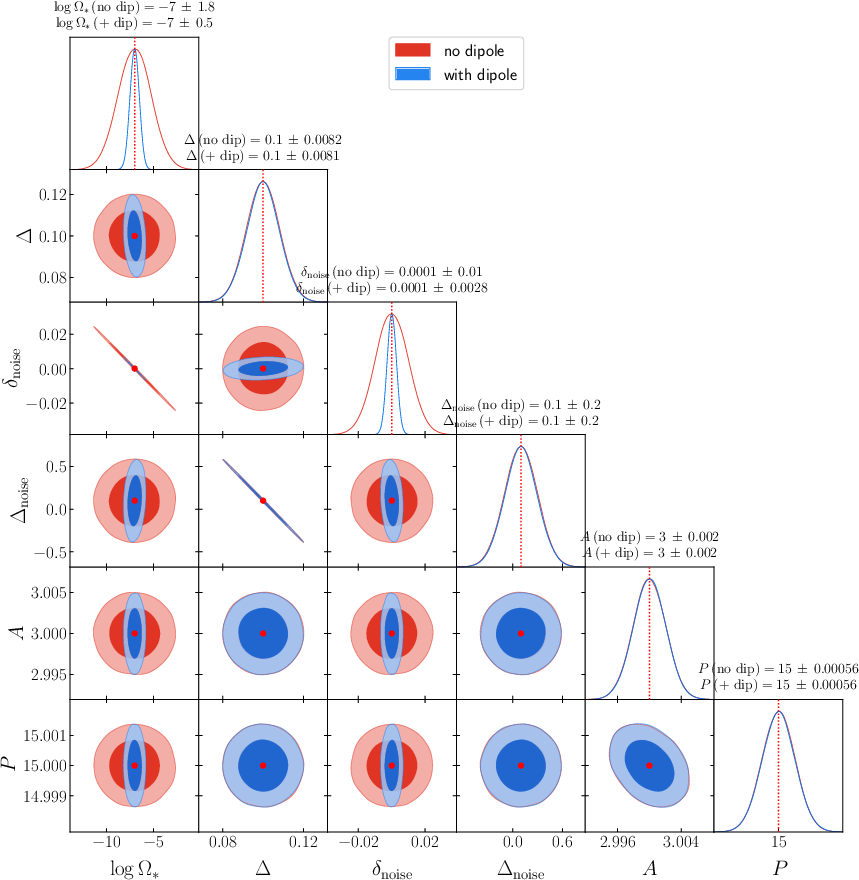
Figure 9: Joint parameter constraints for models including noise deformations, highlighting improvements when the dipolar response is utilized.
Implications and Outlook
The main implication is that space-based GW detectors, specifically LISA and its successors, can use the analytically tractable kinematic dipole as a probe of observer velocity, directly test the isotropy of the Universe at redshifts distinct from those probed by the CMB, and, crucially, as a discrimination tool to enhance robustness of cosmological inference in the GWB.
The formalism developed is explicitly extensible to advanced mission concepts with altered sensitivity or mission length, and highlights the fundamental role of geometrical and dynamical symmetries. The analytic machinery for decomposing detector response functions by multipole, and quantifying their behavior under realistic instrument noise, is broadly applicable to CMB-LSS-GWB cross-correlations as well as next-generation GW instrumentation.
Conclusion
This work provides a comprehensive analytic investigation of LISA’s capability to measure the kinematic dipole in the GWB, establishing rigorous detectability thresholds, estimator performance, and the critical role of detector motion. The analysis confirms that the kinematic dipole provides both an independent probe of peculiar velocity and a uniquely robust observable for discriminating cosmological GWB signals from foreground and noise contaminants in future GW cosmology. The methodology constitutes a foundation for future mission forecasts and for the development of data analysis pipelines targeting anisotropic features in GW backgrounds.
(2604.08968)