Reward-Guided Semantic Evolution for Test-time Adaptive Object Detection
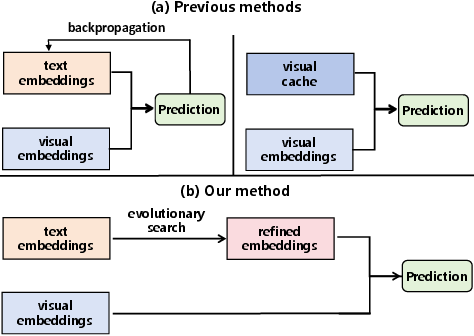
Abstract: Open-vocabulary object detection with vision-LLMs (VLMs) such as Grounding DINO suffers from performance degradation under test-time distribution shifts, primarily due to semantic misalignment between text embeddings and shifted visual embeddings of region proposals. While recent test-time adaptive object detection methods for VLM-based either rely on costly backpropagation or bypass semantic misalignment via external memory, none directly and efficiently align text and vision in a training-free manner. To address this, we propose Reward-Guided Semantic Evolution (RGSE), a training-free framework that directly refines the text embeddings at test time. Inspired by evolutionary search, RGSE treats text embedding adaptation as a semantic search process: it perturbs text embeddings as candidate variants, evaluates them via cosine similarity with current and historical high-confidence visual proposals as a reward signal, and fuses them into a refined embedding through reward-weighted averaging. Without any backpropagation, RGSE achieves state-of-the-art performance across multiple detection benchmarks while adding minimal computational overhead. Our code will be open source upon publication.
Paper Prompts
Sign up for free to create and run prompts on this paper using GPT-5.
Top Community Prompts
Explain it Like I'm 14
Overview
This paper is about helping AI object detectors keep working well when the world looks different from what they were trained on. Think of a detector that learned from clear, sunny photos, but now has to recognize things in fog, blur, or snow. Many detectors struggle in these new conditions. The authors propose a simple, fast way—called Reward-Guided Semantic Evolution (RGSE)—to quickly “tune” the words the model uses (like “car,” “person,” “bus”) so they better match what the camera is seeing right now, without doing any new training.
What questions were the researchers asking?
They focused on three main questions:
- Can we adapt an “open-vocabulary” detector (a model that can find objects described by words) on the fly, when test images look different from training images?
- Can we fix the mismatch between the model’s understanding of words (text) and what it sees in pictures (vision) without doing slow, heavy training during testing?
- Can a lightweight, training-free method improve accuracy across many tough, real-world shifts like fog, blur, or noise?
How did they do it? (In simple terms)
The key idea
Open-vocabulary detectors (like Grounding DINO) match “text embeddings” (the model’s internal representation of words like “car” or “bicycle”) with “visual embeddings” (the model’s internal representation of image regions). Under fog or blur, the visual side changes, but the text side doesn’t, so the match becomes worse.
RGSE acts like a quick, clever “search” for better word meanings that fit the current image. It tries small variations of each word’s internal representation, checks which ones line up best with what the image shows, and then blends the best ones together. No training, just smart tweaking.
A step-by-step picture (with everyday analogies)
Here’s the process for each test image:
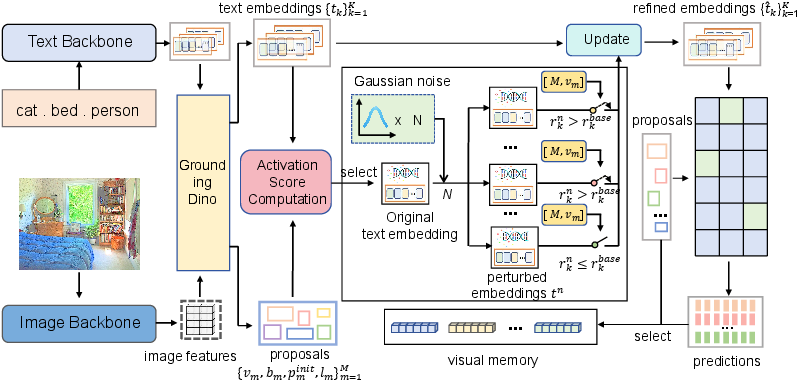
- Pick likely classes: The model first makes a guess about which categories might be present (like noticing “car” might be in the scene). It does this by checking which current detections look confident.
- Try small variations: For each likely class, it creates many tiny changes to that class’s “word meaning” (like testing slightly different versions of what “car” means). Think of it as brainstorming synonyms or shades of meaning.
- Score the variations (the “reward”): Each variation is scored by how well it matches:
- The image’s current object proposals (regions that might be objects), and
- A small memory of past, high-confidence visual examples from earlier images.
- This “reward” is just a similarity score—like checking how close two arrows point in the same direction (cosine similarity).
- Keep and blend the best: Only the variations that score better than the original meaning are kept. These are merged into a refined word meaning, giving more weight to the best-scoring ones.
- Update memory: The method also updates a tiny memory bank per class, keeping only a few of the most helpful visual examples. This memory helps future scoring be more stable.
Important: This whole process uses only forward passes (no backpropagation or training), so it’s fast and practical.
What did they find?
The authors tested RGSE on three widely used, tough benchmarks that simulate real-world changes:
- FoggyCityscapes: city scenes with heavy fog
- PASCAL-C: images corrupted by things like blur, noise, low contrast, or compression
- COCO-C: similar corruptions on COCO images
Across different model sizes (Swin-T and Swin-B backbones), RGSE:
- Consistently got the best accuracy (state-of-the-art) compared to other methods, including some that do test-time training.
- Improved mean AP@50 by noticeable margins (often several points) over strong baselines.
- Stayed efficient: It added only a small amount of extra time and memory compared to the original model, and was faster and lighter than methods that do backprop during testing.
- Was robust: Results stayed strong across many settings, with little need for fine-tuning the method’s knobs (like how many variations to try, how big the memory is, or how strong the noise is).
In short: higher accuracy, low overhead, and stable behavior.
Why is this important?
- Practical for real-world shifts: Cameras often face fog, rain, blur, or weird lighting. RGSE helps detectors adapt right when they need it, without retraining.
- Training-free and fast: Because there’s no backpropagation at test time, RGSE is easier to deploy on devices with limited compute or in time-sensitive applications (like robots, cars, or drones).
- Directly fixes the problem: Instead of sidestepping the mismatch between words and visuals, RGSE directly realigns them, making the model’s “language” and “vision” agree again.
- General strategy: The idea—evolving text meanings by testing many small changes and keeping the best—could be adapted to other vision-language tasks beyond detection.
Overall, RGSE shows a simple, smart way to make modern, language-aware detectors more reliable in the messy, changing conditions of the real world.
Knowledge Gaps
Knowledge gaps, limitations, and open questions
The following list synthesizes concrete limitations and open questions left unresolved by the paper, focused on what is missing, uncertain, or unexplored. Each point is phrased to guide actionable future research.
Methodological assumptions and design choices
- Text-only adaptation: RGSE adapts only text embeddings while keeping visual features, proposal selection, and the decoder fixed. It remains unclear how much additional benefit (or stability risk) would come from co-adapting visual features, queries, or the cross-modal fusion module at test time without backpropagation.
- Dependence on high-confidence pseudo-labels: Reward computation assumes reliable pseudo-labels and confident proposals. There is no analysis of robustness when initial detections are low-confidence or wrong (cold-start images, severe shifts), nor mechanisms to mitigate confirmation bias (e.g., confidence-weighted rewards, robust aggregation, or outlier rejection).
- Local perturbation search: Gaussian perturbations with fixed variance () and a single-step “evolution” are used. The paper does not explore adaptive step sizes, anisotropic perturbations (covariance learning), iterative multi-step search, or CMA-ES–style updates that could escape local neighborhoods under large misalignment.
- Reward function design: Rewards use only cosine similarity with current and historical proposal embeddings. The impact of incorporating other signals (proposal confidence, entropy, IoU-based quality, localization uncertainty, or detector-specific logits) is not examined.
- Survival and fusion strategy: The “survivor-only” reward-weighted averaging is not compared to alternatives (e.g., top-k selection, trimmed means, soft weighting by uncertainty), nor is the sensitivity to the number of survivors analyzed.
- Active class selection: Active classes are determined by a fixed threshold on the max per-class score (). There is no exploration of adaptive thresholds, class-dependent calibration, or strategies for cases where no classes exceed the threshold.
- Memory update policy: Memory replacement relies on similarity to the current (drifting) global text embedding, risking loss of diversity and exacerbating drift. Alternatives like diversity-aware selection (e.g., k-center, reservoir sampling), temporal decay, age-based eviction, or hybrid criteria are not evaluated.
- Drift and long-horizon stability: The global text embedding is updated as a running average without any forgetting or reset mechanism. The method’s stability under long streams, nonstationary or switching domains, and mixed corruptions is unstudied.
- Class interaction modeling: Adaptation is performed per-class independently; cross-class relationships (synonyms, co-occurrence, hierarchy) are not leveraged, which could improve robustness in ambiguous or crowded scenes.
Evaluation and benchmarking gaps
- Limited metrics: Results are reported primarily in mAP@50. There is no evaluation on COCO-style AP@[.5:.95], AP at higher IoU thresholds, localization-specific metrics, calibration (ECE), or error decomposition (classification vs. localization errors).
- Proposal-stage effects: RGSE recomputes class scores for fixed proposals but does not re-run proposal/query selection or the decoder with refined text embeddings. The potential gains (or costs) from a lightweight re-decoding pass are not investigated.
- Dataset scope: Experiments focus on synthetic shifts (PASCAL-C, COCO-C) and FoggyCityscapes. There is no evaluation on real-world domain shifts (e.g., night/day, weather, surveillance-to-egocentric, different sensors), nor on streaming video benchmarks with temporal dynamics.
- Open-vocabulary generality: Although aiming for open-vocabulary detection, evaluations use fixed, closed category sets (VOC/COCO, Cityscapes). Performance on genuinely open sets (hundreds/thousands of categories), long-tail distributions, or novel categories unseen in training prompts is not studied.
- Prompt variations: Only one prompt template is used. The sensitivity to prompt phrasing (singular/plural, synonyms, attributes, multi-word phrases), formatting (list order, separators), multilingual prompts, or prompt ensembles is not assessed.
- Order effects: Because memory and global embedding updates are sequential, outcomes may depend on test-image order. The paper does not analyze order sensitivity or provide order-robust strategies.
- Baseline breadth and parity: Comparisons are centered on Grounding DINO-based TTA methods. There is no evaluation with other VLM detectors (e.g., GLIP, OV-DETR, YOLO-World) or with text encoders beyond BERT (e.g., CLIP text, DeBERTa), limiting claims of generality.
Scalability, efficiency, and deployment
- Computational budget vs. N: Though RGSE avoids backprop, using N=1000 perturbations increases latency and memory. Scaling behavior with much larger K (number of classes) and high-resolution inputs, and feasibility on edge devices or real-time robotics, are not evaluated.
- Memory capacity scaling: The memory capacity per class is tuned small (e.g., ). The method’s performance/efficiency trade-offs with larger class vocabularies (hundreds/thousands) and larger memories (and how to bound memory growth) are not fully characterized.
- Batch size and parallelism: All experiments use batch size 1. Effects of micro-batching, online batching, and parallel perturbation evaluation on throughput and latency under deployment constraints are not reported.
- Failure modes and safeguards: There is no analysis of failure cases (e.g., when rewards systematically degrade, no active classes selected, or memory contains mostly noisy entries) or safeguards (e.g., reset conditions, early stopping, budgeted adaptation).
Theory and analysis
- Lack of convergence or improvement guarantees: The paper provides no theoretical analysis of why one-step reward-weighted averaging should consistently improve alignment or avoid drift, especially under noisy rewards and nonstationary distributions.
- Misalignment quantification: Beyond t-SNE, there is no quantitative measure of semantic misalignment and its reduction (e.g., intra-class alignment, inter-class margins, contrastive alignment metrics), nor correlation of such measures with AP improvements.
- Uncertainty handling: There is no probabilistic treatment of reward uncertainty, proposal noise, or embedding variance; Bayesian or bootstrapped variants could offer better robustness, but are unexplored.
Extensions and broader applicability
- Joint adaptation with vision-side signals: Incorporating lightweight visual adaptation (e.g., affine normalization, adapter re-weighting, or EMA updates without backprop) alongside text evolution is untested.
- Multi-step or continual evolution: Iterative adaptation over consecutive frames/images, annealing schedules for , or curricula that escalate/de-escalate perturbation budgets are not explored.
- Hybrid training-free + minimal-update methods: Combining RGSE with tiny, efficient updates (e.g., LoRA on text layers, prompt vectors) under strict compute budgets remains an open direction.
- Hard negative prompts and suppression: The interaction with negative prompts or suppression tokens to reduce false positives, and how refined embeddings affect precision/recall trade-offs, are not studied.
- Multi-lingual and cross-domain text: Robustness to non-English labels, code-switching, or domain-specific nomenclature (e.g., medical, industrial) remains untested.
These gaps highlight opportunities for advancing training-free test-time adaptation by strengthening robustness to noisy supervision, broadening evaluation to realistic and open-vocabulary settings, improving scalability and stability, and deepening theoretical understanding.
Practical Applications
Immediate Applications
Below are concrete, deployable use cases that can leverage RGSE’s training-free, backpropagation-free test-time adaptation to improve VLM-based object detection under real-world distribution shifts (e.g., weather, lighting, camera noise), with minimal latency and memory overhead.
- Robust on-camera video analytics and smart city monitoring
- Sectors: public safety, transportation, facility management
- Potential tools/products/workflows:
- Drop-in “RGSE plugin” for Grounding DINO-based inference stacks (e.g., integrated with NVIDIA DeepStream, OpenVINO, TensorRT, ONNX Runtime)
- Edge appliance firmware updates that add an RGSE adaptation stage between proposal extraction and final classification
- Camera network pipelines that cache small per-class embedding memories on-device
- Assumptions/dependencies:
- Existing VLM detector (e.g., Grounding DINO) deployed with a curated category list
- Sufficient initial confidence on some proposals to identify “active” categories
- Edge compute headroom for a few additional forward operations (no backprop)
- Adverse-weather perception for autonomous vehicles and ADAS
- Sectors: automotive, mobility, logistics
- Potential tools/products/workflows:
- ROS2 node wrapping RGSE for in-vehicle perception (fog, snow, low contrast)
- Real-time activation heuristics (e.g., only enable RGSE under low-visibility detectors or “snow/fog” flags)
- Continuous running average of embeddings with tiny class memories (Mmax ≈ 2–4)
- Assumptions/dependencies:
- Integration with Grounding DINO or similar VLM detectors in the perception stack
- Strict latency budgets; choose N (number of perturbations) to fit timing
- Safety fallback: revert to base embeddings if no candidate improves reward
- Field robotics and UAVs in dynamic environments
- Sectors: agriculture, construction, inspection, environmental monitoring
- Potential tools/products/workflows:
- Onboard RGSE-enabled detection pipelines for drones/UGVs to stabilize recognition under glare, blur, dust, or motion
- ROS nodes that share the small visual-embedding memory across mission segments
- Assumptions/dependencies:
- Prompt set aligned with mission objects (e.g., “weed,” “crack,” “scaffold”)
- Power/compute constraints suggest moderate perturbation counts (e.g., N=100–500)
- Retail shelf and warehouse monitoring under varying lighting and camera conditions
- Sectors: retail, supply chain, inventory management
- Potential tools/products/workflows:
- On-premises inference with RGSE to adapt to daily lighting changes and camera drift without retraining
- Store-specific prompt lists for SKUs and categories; automatic adaptation from “active” items
- Assumptions/dependencies:
- High-quality category naming and prompt engineering
- Embedding memory kept small to scale to large vocabularies
- Industrial visual inspection with changing optics or noise
- Sectors: manufacturing, utilities, energy
- Potential tools/products/workflows:
- Production-line detector that adapts on-the-fly to lens contamination, vibration-induced blur, or sensor drift
- RGSE embedded in PLC-connected vision modules as a forward-only step
- Assumptions/dependencies:
- Stable list of defect/part classes; conservative memory updates to avoid drift
- AR/VR and mobile perception in challenging scenes
- Sectors: consumer apps, gaming, assistive tech
- Potential tools/products/workflows:
- On-device RGSE stage for improved detection under dim lighting or motion blur
- SDK-level control to trade off quality vs. power (tuning N, σ)
- Assumptions/dependencies:
- Mobile VLM detector port (e.g., quantized Grounding DINO/YOLO-World-like models)
- Tight compute budgets may require N<<1000 and tiny per-class memory
- Content moderation and UGC analysis under filter/corruption effects
- Sectors: social media, online marketplaces
- Potential tools/products/workflows:
- Server-side RGSE to stabilize object detection in filtered, low-quality, or compressed images and videos
- Monitoring using reward metrics to detect when adaptation fails or drifts
- Assumptions/dependencies:
- Clear compliance around embedding storage (only vector embeddings retained, not raw images)
- Cross-lingual deployments with multilingual prompts
- Sectors: global platforms, public-sector analytics
- Potential tools/products/workflows:
- Swap BERT for a multilingual text encoder (e.g., mBERT/XLM-R) and run RGSE to adapt embeddings to local contexts
- Region-specific prompt lists in local languages
- Assumptions/dependencies:
- Availability of multilingual text encoders integrated into the VLM detector
- MLOps add-on for test-time adaptation governance
- Sectors: enterprise AI, platform teams
- Potential tools/products/workflows:
- RGSE as a toggleable “TTA module” with metrics: time, memory, reward uplifts, AP proxies
- Canary strategies: enable RGSE in low-risk segments; roll out via feature flags
- Assumptions/dependencies:
- Observability hooks to track reward distributions and survivor rates; automated fallback if no improvement
- Privacy-preserving on-device adaptation
- Sectors: healthcare-adjacent consumer devices, regulated industries
- Potential tools/products/workflows:
- Keep raw data local; store only small embedding vectors per class for adaptation
- Documented data flows for compliance audits
- Assumptions/dependencies:
- Organizational acceptance that storing embeddings (not pixels) meets privacy requirements
- Energy-efficient adaptation on edge devices
- Sectors: IoT, smart cameras, drones
- Potential tools/products/workflows:
- Replace backprop-based TTA with RGSE to cut energy/time consumption at inference
- Dynamic N and memory size policies based on device thermal headroom
- Assumptions/dependencies:
- Profiling to set device-appropriate perturbation counts
Long-Term Applications
These opportunities build on RGSE’s core ideas and demonstrated robustness but require additional research, engineering, scaling, or validation.
- Extension to other tasks: open-vocabulary segmentation and phrase grounding
- Sectors: autonomy, medical imaging, creative tools
- Potential tools/products/workflows:
- Adapt RGSE’s reward to pixel-level masks or per-pixel embeddings (e.g., grounding with segmentation models)
- Evolve text embeddings for pixel/region alignment in real time
- Assumptions/dependencies:
- Availability of segmentation-capable VLMs and efficient extraction of region/mask embeddings
- Video-level adaptation for tracking and multi-object tracking (MOT)
- Sectors: surveillance, sports analytics, AVs
- Potential tools/products/workflows:
- Temporal memory that spans frames; reward functions using track consistency
- Joint adaptation of class embeddings with track identities
- Assumptions/dependencies:
- Robust track management to avoid drift; new reward designs that penalize identity switches
- Federated or fleet-wide adaptation without sharing raw data
- Sectors: smart city camera networks, AV fleets, retail chains
- Potential tools/products/workflows:
- Devices share compressed statistics or refined text embeddings instead of images
- Central aggregator merges updates with privacy-preserving mechanisms
- Assumptions/dependencies:
- Communication protocols for embedding updates; methods for conflict resolution and drift control
- Safety-critical certification and verification for AV/ADAS use
- Sectors: automotive, aerospace
- Potential tools/products/workflows:
- Formal verification of adaptation bounds; runtime monitors using reward thresholds
- Scenario catalogs demonstrating consistent gains under specific hazards (fog, snow)
- Assumptions/dependencies:
- Regulatory frameworks and test suites to validate dynamic test-time adaptation
- Robustness to adversarial or spurious signals
- Sectors: security-sensitive applications
- Potential tools/products/workflows:
- Defense-oriented reward shaping (e.g., outlier-resistant similarities, uncertainty estimation)
- Memory auditing to prevent accumulation of poisoned embeddings
- Assumptions/dependencies:
- Threat modeling and new robustness benchmarks targeting test-time adaptation
- Hardware/firmware acceleration for embedded NPUs/ISPs
- Sectors: mobile, IoT, automotive
- Potential tools/products/workflows:
- Implement RGSE’s perturbation, cosine similarity, and weighted fusion as NPU kernels
- Firmware-level memory management for per-class embedding queues
- Assumptions/dependencies:
- Vendor support for custom kernels and low-level APIs; co-design with detector architectures
- Continual open-set adaptation with vocabulary growth
- Sectors: retail (new products), industrial (new defects), autonomy (new hazards)
- Potential tools/products/workflows:
- Combine RGSE with LLMs to suggest new class names when repeated high-reward “unknown” patterns emerge
- Human-in-the-loop workflows to validate and add new prompts
- Assumptions/dependencies:
- Reliable novelty detection and safe mechanisms for adding/curating new classes
- Domain-specific adoption in healthcare and scientific imaging
- Sectors: radiology, pathology, microscopy
- Potential tools/products/workflows:
- Use medically curated vocabularies and multilingual encoders; RGSE refines embeddings per scanner/protocol
- Integration in PACS viewers for on-the-fly adaptation to patient- or device-specific artifacts
- Assumptions/dependencies:
- Availability of VLM-based detectors validated for medical images; strict regulatory and safety testing
- Document and form understanding under scanner/capture variability
- Sectors: finance, government, enterprise back office
- Potential tools/products/workflows:
- Open-vocabulary detection of document elements (stamps, signatures) with RGSE handling blur/compression
- Workflow plugins for RPA/IDP platforms
- Assumptions/dependencies:
- Suitable VLM detectors for document layouts; robust prompt sets for domain terminology
- Auto-tuning and self-diagnosis of adaptation parameters
- Sectors: enterprise AI platforms
- Potential tools/products/workflows:
- Controllers that adjust N, σ, τ based on live reward statistics and latency constraints
- Health dashboards using reward distributions and survivor counts as KPIs
- Assumptions/dependencies:
- Policy engines and telemetry pipelines; guardrails to prevent oscillations
- Cross-model generalization beyond Grounding DINO
- Sectors: any domain using VLM-based detectors
- Potential tools/products/workflows:
- Adapting RGSE to other open-vocab detectors (e.g., GLIP, YOLO-World) and multi-modal backbones
- Benchmarks assessing transferability across architectures
- Assumptions/dependencies:
- Access to proposal embeddings and text embeddings; minor API adjustments for each model family
- Human-robot interaction and context-aware assistants
- Sectors: service robotics, assistive devices
- Potential tools/products/workflows:
- RGSE-aligned embeddings updated from user-specific environments and objects
- Personalized class prompt sets (e.g., user’s items, tools)
- Assumptions/dependencies:
- Mechanisms to avoid overfitting to transient user contexts; privacy-preserving memory policies
Notes on feasibility and dependencies across applications:
- Core dependency: a VLM-based open-vocabulary detector that exposes text and region proposal embeddings (e.g., Grounding DINO). Closed-set detectors need architectural changes to benefit.
- Prompt quality and coverage matter; RGSE refines embeddings but cannot detect categories entirely absent from the prompt list.
- RGSE relies on high-confidence proposals for reward signals; extreme OOD cases may need conservative thresholds, fallback policies, or small seed memories.
- Compute budgets dictate perturbation count N and memory size; even modest N (100–500) yields gains with limited overhead.
- Embedding memories may be considered sensitive metadata in regulated sectors; adopt appropriate retention policies and encryption if required.
Glossary
- Ablation study: A diagnostic experiment that systematically removes or varies components to assess their impact on performance. "with ablation studies further demonstrating its efficiency and robustness."
- Activation score: A per-class confidence statistic used to decide which categories are likely present in the current image. "we compute an activation score for each class"
- Adaptive priors: Prior probabilities or statistics that are adjusted based on observed data to improve predictions. "derived from historical class embeddings, spatial scales, and adaptive priors."
- Average Precision@50 (mAP50): Detection accuracy at IoU threshold 0.5, averaged over classes. "mAP across all three benchmarks"
- Backpropagation: Gradient-based parameter update procedure used during training; costly at test time. "Without any backpropagation, RGSE achieves state-of-the-art performance"
- Bayesian framework: A probabilistic modeling approach that combines prior beliefs with observed data for inference. "which proposes a Bayesian framework that maintains a cache, then fuses cache-based predictions with the VLM outputs."
- Bounding box: A rectangle that localizes an object in an image, predicted alongside class scores. "to produce proposal visual embeddings { v_m } and bounding boxes { b_m }."
- Batch normalization statistics: Running mean/variance used by batch normalization layers, sometimes adapted at test time. "adapted batch normalization statistics by minimizing predictive entropy."
- Catastrophic forgetting: Degradation of previously acquired knowledge when adapting to new data. "to mitigate catastrophic forgetting"
- Channel pruning: Reducing the number of channels in neural network layers to save computation or improve robustness. "introduces a sensitivity-guided channel pruning strategy"
- CLIP: A large-scale vision-LLM trained with contrastive learning for zero-shot tasks. "aligns global image and text embeddings via contrastive learning"
- Contrastive learning: A training objective that pulls matching pairs together and pushes mismatched pairs apart in embedding space. "aligns global image and text embeddings via contrastive learning"
- Cosine similarity: A measure of alignment between two vectors based on the cosine of the angle between them. "evaluates them via cosine similarity with current and historical high-confidence visual proposals"
- Cross-attention-based feature enhancer: A module that refines features by attending across modalities (text-image). "through a cross-attention-based feature enhancer"
- Cross-modal alignment: The process of aligning representations across different modalities (e.g., text and image). "refine cross-modal alignment"
- Cross-modality decoder: A decoder that fuses multiple modalities to refine predictions (e.g., text-guided visual decoding). "refines them through a cross-modality decoder"
- DETR framework: A transformer-based detection architecture formulating detection as set prediction. "in the DETR framework"
- Distribution shift: A mismatch between training and test data distributions that degrades performance. "under test-time distribution shifts"
- Domain shift: A form of distribution change where the test domain differs from the training domain (e.g., weather, corruption). "Under domain shift, the text embeddings may misalign with the visual embeddings"
- Entropy minimization: A technique that encourages confident predictions by minimizing output entropy; often used in TTA. "IoU-weighted entropy minimization"
- Evolutionary search: Gradient-free optimization that perturbs candidates, evaluates fitness, and recombines survivors. "Inspired by evolutionary search, RGSE treats text embedding adaptation as a semantic search process"
- Feature distribution regularization: Constraints that align feature statistics across domains to stabilize self-training. "with feature distribution regularization to mitigate noisy pseudo-labels in dynamic environments."
- Forward pass: Computing model outputs without gradient updates; used for efficient test-time procedures. "This process is fully forward-pass based, requiring no backpropagation."
- Gaussian noise: Random perturbations drawn from a normal distribution used to explore embedding variants. "Gaussian noise is added to active text embeddings;"
- Grounding DINO: A vision-language detector that grounds text queries in images for open-vocabulary detection. "Grounding DINO is an open-vocabulary object detection model based on vision-language alignment."
- Hyperparameter sensitivity: Analysis of how performance varies with changes to key algorithm settings. "Hyperparameter sensitivity on PASCAL-C."
- Image-conditioned prompt selection: Choosing prompts based on an input image to improve adaptation. "image-conditioned prompt selection"
- IoU (Intersection over Union): Overlap measure between predicted and ground-truth boxes; used for evaluation or weighting. "IoU-weighted entropy minimization"
- IoU Filter: A technique that filters pseudo-labels by matching detections across iterations using IoU. "IoU Filter proposes a pseudo-label filtering"
- Knowledge distillation: Transferring knowledge from a teacher model to a student model. "Early efforts adopt knowledge distillation"
- Language-guided query selection: Selecting detection queries guided by language to focus on likely objects. "selects 900 region proposals via language-guided query selection"
- Latency-sensitive scenarios: Settings where inference speed is critical (e.g., real-time systems). "enabling deployment in latency-sensitive scenarios."
- Mean-Teacher framework: A semi-supervised setup where a teacher (EMA of student) guides learning. "adopts a multi-modal prompt-based Mean-Teacher framework"
- Memory bank: A store of historical features used to stabilize and inform adaptation. "a memory bank storing visual embeddings of historically high-confidence proposals"
- Open-vocabulary object detection: Detecting categories beyond those seen in training using language guidance. "Open-vocabulary object detection with vision-LLMs (VLMs) such as Grounding DINO"
- Phrase-region alignment: Matching text phrases with corresponding image regions for grounding/detection. "treating detection as phrase-region alignment."
- Prompt tuning: Adjusting text prompts or prompt embeddings to better steer model predictions. "applies prompt tuning with historical memory banks"
- Pseudo bounding-box labels: Synthetic box annotations generated from weak signals (e.g., captions) for training. "to generate pseudo bounding-box labels."
- Pseudo-label: A model-generated label treated as supervision during adaptation or self-training. "noisy pseudo-labels"
- Reward-weighted averaging: Combining candidate solutions by weighting them according to a reward signal. "fuses them into a refined embedding through reward-weighted averaging."
- Reparameterizable vision–language fusion: A fusion design enabling efficient deployment by reparameterization. "introduces reparameterizable visionâlanguage fusion for real-time open-vocabulary detection"
- t-SNE: A dimensionality reduction method for visualizing high-dimensional embeddings. "t-SNE visualization of text embedding trajectories"
- Test-time adaptation (TTA): Adjusting the model at inference using only test data to handle shifts. "test-time adaptation (TTA) has emerged as an effective strategy"
- Unlabeled test samples: Test inputs without ground-truth labels used to drive adaptation. "using only unlabeled test samples."
- Vision-language alignment: Aligning text and image representations into a shared semantic space. "based on vision-language alignment."
- Vision-LLMs (VLMs): Models jointly trained on image-text data to enable cross-modal tasks. "Vision-LLMs (VLMs), such as CLIP \cite{radford2021learning} and Grounding DINO \cite{liu2024grounding}, have enabled powerful open-vocabulary perception by aligning image and text representations in a shared semantic space."
- Zero-shot generalization: Performing on unseen categories/tasks without task-specific training. "This alignment facilitates zero-shot generalization to novel categories without task-specific training"
- Zero-shot inference: Making predictions for categories or tasks not present during training. "enable zero-shot inference across diverse tasks"
Collections
Sign up for free to add this paper to one or more collections.

