- The paper quantifies a median frontier lag of +10.85 eci, demonstrating that published evaluations use outdated or lower-tier models relative to current capabilities.
- It employs a preregistered, multi-index methodology on 18,574 empirical evaluations, using measures like eci, Chatbot Arena Elo, and AA to assess performance gaps.
- The research highlights pervasive reporting deficits and advocates for standardized disclosure practices to ensure accurate and auditable AI capability evaluations.
Frontier Lag: An Expert Analysis of Capability Misrepresentation in Academic AI Evaluation
Introduction
The paper "Frontier Lag: A Bibliometric Audit of Capability Misrepresentation in Academic AI Evaluation" (2605.04135) presents the most comprehensive, preregistered quantitative analysis to date of the systematic mismatch between what is reported in applied-domain LLM evaluation papers and the actual capabilities of frontier models contemporaneous with publication. The study deeply interrogates the literature in five domains (medicine, law, coding, education, scientific reasoning), leveraging a candidate corpus of over 112,000 LLM-relevant records filtered to 18,574 empirically admissible evaluations. Each paper’s primary model is mapped to Epoch AI Capabilities Index (eci), Chatbot Arena Elo, and Artificial Analysis Intelligence Index (AA), and the distance to the then-extant frontier is precisely quantified.
The central finding is that the typical paper describes LLM performance that is both temporally outdated and elicitation-incomplete, but generalizes the result in the abstract as applying to “AI” as a class. As such, downstream stakeholders receive a systematically misleading account of what current systems can do, a distortion compounded by substantial underspecification of test configurations and lack of evaluative disclosure.
Quantifying the Frontier Lag
The study operationalizes three key gap dimensions: (1) temporal lag (model evaluated vs. contemporaneous frontier), (2) tier lag (use of a lower-tier when a higher-tier was public and accessible), and (3) underreported configuration (elicitation) surface. The core metric, the "publication elicitation gap," captures the composite.
Across the corpus, the median paper lags the accessible frontier by +10.85 eci at evaluation time (IQR: 1.3–18.3), approximately 1.4x the transition from Claude 3.7 Sonnet to Opus 4.5—equivalent to multiple major generation increments and a vendor tier step. The lag is not static: the gap widens at +5.53 eci/year (CI: [5.03, 5.83]), meaning the literature is falling further behind the capability edge each year.
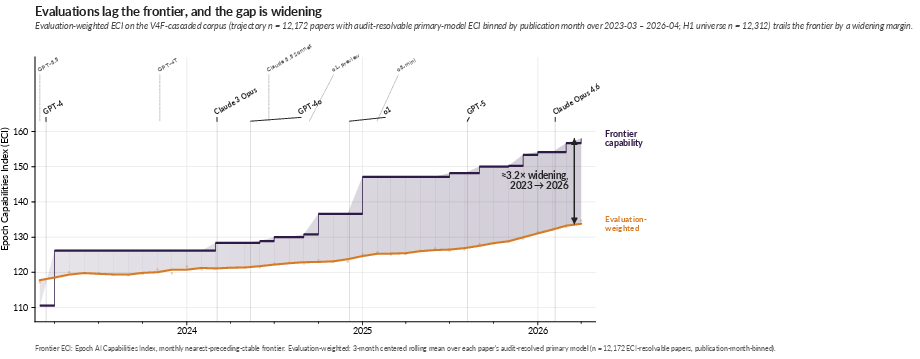
Figure 1: Monthly frontier eci trajectory (upper) vs. evaluation-weighted published-paper eci (lower); shaded gap widens >3x from 2023–2026.
A within-family tier analysis shows a median gap of +12.63 eci when a stronger sibling was public during evaluation. The result is robust under imputation window sensitivity and alternative capability scales (Chatbot Arena Elo, AA).
Elicitation & Reporting Deficits
Critically, merely reporting the model is insufficient; configuration details (elicitation conditions) determine realized capabilities. Reasoning-mode status is disclosed in only 3.2% of abstracts and 21.2% of full texts for reasoning-capable models. Evaluation dates, essential for frontier comparison, appear in only 18.4% of full-text papers. Disclosure of scaffolding, tool-use, and prompting strategy are uniformly rare, with a combined complete-disclosure rate of just 1.2% when required. These omissions mean that replication and proper interpretability of published numbers are typically intractable.
Interpretive Generalization & Framing
Overgeneralization is institutionalized: 52.5% of abstracts (95% CI: [48.2, 56.9]) state conclusions at the “AI” class level rather than specific to the tested model, with per-publication-year odds rising at OR = 1.23/year. This claim-propagation dynamic ensures that outdated, under-elicited, and lower-tier results are cited in regulatory, policy, and clinical contexts as valid for frontier AI capability.
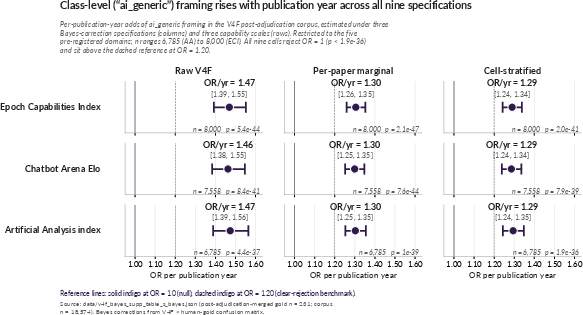
Figure 2: Odds of class-level (“AI”-framed) abstract conclusions increase consistently across domains and years.
Compound Failure Dynamics
The paper’s UpSet decomposition of compound failure across the three audit axes (capability gap ≥12 eci, elicitation gap, interpretive gap) shows that 9.2% of admissibility-expected papers fail on all three (95% CI: [8.6, 9.8]), with a further 38.3% failing by a more inclusive criterion. The dominant pattern is a capability+elicitation deficit without interpretive framing, illustrating the multiplicative attenuation in downstream evidence quality.
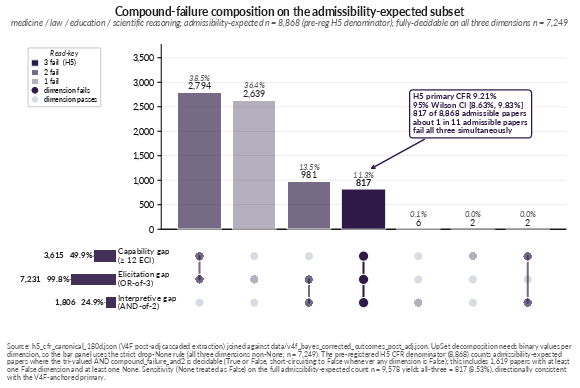
Figure 3: UpSet plot: 9.2% of papers jointly fail capability, elicitation, and interpretive norms; >38% fail under broader criteria.
Decomposition on a Benchmark: SWE-Bench-Verified
On SWE-Bench-Verified, an ablation cascading from properly scaffolded, reasoning-on, agentic use of the SOTA (80.8% pass@1 on Opus 4.6) to a zero-shot, tool-less lower-tier yields a compounded retained fraction of just 13%. This illustrates that configuration downgrades produce capability drops far larger than single generational model gaps, reinforcing the centrality of elicitation.
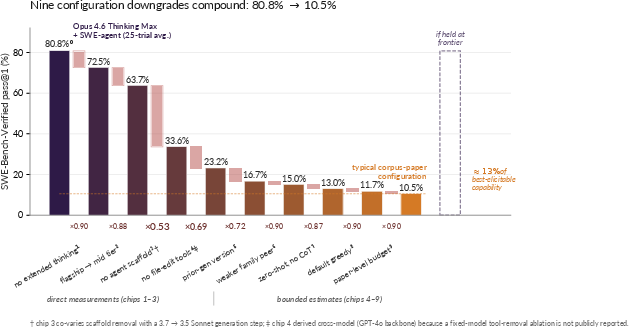
Figure 4: Waterfall of configuration downgrades on SWE-Bench-Verified; capability falls from 80.8% to 10.5%.
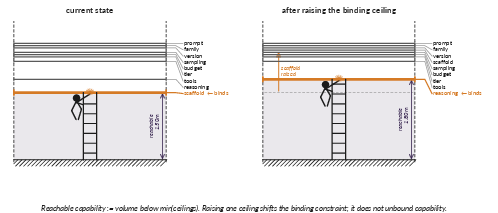
Figure 5: “Ceiling-stack” illustrates how the lowest axis (e.g., scaffolding, reasoning) binds effective reachable capability, foregrounding the risk of single-axis reporting.
Methodological Rigor
Key methodological features of the audit:
- Full preregistration of hypotheses, thresholds, and analysis pipeline.
- Massive-scale, cross-domain abstract and (where possible) full-text extraction via a validated high-reasoning LLM (V4F at 0 temperature; cross-family/dual-coder validation).
- Audit anchored in leading standardized capability scales and robust to alternative weightings and domain subpopulations.
- Specification curve and permutation-based nulls for sensitivity analysis.
Practical and Theoretical Implications
The paper’s findings have direct implications for authors, editors, funders, and downstream-AI-consuming domains:
- Few published findings in applied AI can, under current disclosure conventions, be interpreted as statements about actual current capabilities of available systems.
- Policy, procurement, and clinical decisions referencing the literature substantially misestimate frontier capability and risk—even when correctly summarizing abstracts.
- The “frontier lag” is not addressable solely by improved individual scientific conduct but requires structural change in methods disclosure norms and resource allocation.
The introduced versio-ai v1.2 checklist (Core 3: model version, coherent declared frame, reasoning-mode status) adds minimal methods-section burden but would enable robust bibliometric audits and ensure that findings are interpretable and auditable. Funder-side intervention to support evaluation at the actual frontier (API access budgeting) is essential to avoid an academic–industry reporting divide.
The study directly motivates automated per-DOI audit tools such as the released “frontierlag.org,” which enables real-time, corpus-wide gap mapping as the frontier shifts.
Outlook and Future Developments
Theoretical consequences include shaping the epistemology of “capability claims” in AI: evidence for what AI “can do” requires denotational accuracy across three axes (temporal, tier, elicitation), plus reproducible reporting. Replicable, large-scale audits of capability misrepresentation are now tractable with LLM extractors, and efficacy of reporting interventions can be tracked longitudinally (the 2028-Q2 follow-up is scoped for this purpose).
Practically, the likelihood of reliable regulatory, clinical, or societal deployment decisions being founded on miscalibrated capability evidence is high unless versio-ai-type reforms are widely adopted. The emergence of model-agnostic bibliometric audit infrastructure may standardize accurate “capability provenance” as a prerequisite for claim acceptance in high-impact AI deployment contexts.
Conclusion
The paper provides the most methodologically rigorous, large-scale evidence that academic papers on AI capability in high-stakes domains systematically report results on outdated, under-elicited, or lower-tier models, frequently generalize these results to class-level “AI” capability, and rarely disclose enough configuration detail for proper interpretation. The gap between published evidence and contemporaneous reality is both large and growing. The structural solution—a minimal reporting standard (versio-ai), enforced at the editorial and funder level and accompanied by resource alignment for frontier-tier access—is essential to correct the scientific record. The audit toolbox released (frontierlag, dataset, checklist) will enable field-wide tracking and, potentially, empirical assessment of ecosystem-wide improvement over the coming years.