- The paper introduces the Minimal Cognitive Grid (MCG) to quantify structural fidelity in analogy and metaphor models.
- It shows that while LLMs excel in generality and performance, they significantly lack mechanistic, structural alignment.
- The study emphasizes integrating architectural constraints in AI for improved explanatory power in cognitive modeling.
Introduction
This paper presents a rigorous operationalization of the Minimal Cognitive Grid (MCG) for evaluating the cognitive plausibility of artificial models of analogy and metaphor. The MCG is applied to benchmark systems: Structure-Mapping Engine (SME), CogSketch, METCL, and LLMs (LLMs, e.g., GPT-3.5/4/4o), with a focus on formalizing cognitive alignment across three principal dimensions—Functional/Structural Ratio, Generality, and Performance Match. The study emphasizes the necessity of moving beyond mere input-output functionalism to assess the explanatory, mechanistic adequacy of models with respect to human cognition, grounding the analysis in established theoretical frameworks from cognitive science.
Functional/Structural Ratio (FSR): Quantifying Structural Implementation
Central to the MCG is the Functional/Structural Ratio (FSRM), designed to distinguish between mere behavioral replication (functionalism) and process-level architectural fidelity (structuralism) in artificial models. Constraints are systematically derived from leading cognitive theories: Structure-Mapping Theory (SMT) and Categorization Theory of Metaphor (CTM). SMT's principles—one-to-one mapping, parallel connectivity, systematicity, inferential projection—define the necessary attributes for analogical reasoning, while CTM's categorization and property selection articulate requirements for metaphor comprehension.
Each model is evaluated for the binary presence (si=1) or absence (si=0) of each constraint, weighted according to theoretical centrality. SME and CogSketch exhibit strict structural correspondence to SMT; METCL operationalizes CTM constraints but not SMT’s; LLMs consistently fail to implement explicit structural mechanisms as defined by either theoretical tradition, despite achieving high functional task performance.
Sensitivity analyses confirm FSR's robustness under weight perturbations, with systematicity and categorization yielding the largest effects due to their theoretical prominence. Notably, the disparity in structural plausibility is pronounced, with LLMs exhibiting extremely low normalized FSR values (FSR′=0.109), while SME and CogSketch attain FSR′=0.606.
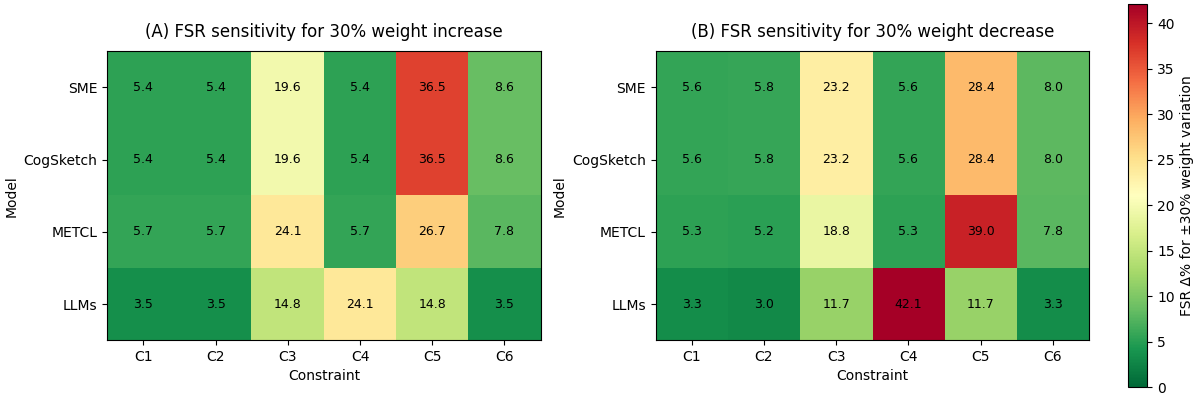
Figure 1: FSR metric sensitivity to ±30% constraint weight variations; systematicity and categorization exert high effects across evaluated models.
Generality: Breadth Across Cognitive Domains
Generality is assessed with respect to the model's ability to span a representative set of human cognitive domains, as structured by the Cattell-Horn-Carroll (CHC) taxonomy—encompassing Quantitative Knowledge, Fluid Reasoning, Visual Processing, Language/Verbal Knowledge, and Sensory/Motor Abilities.
SME and CogSketch are highly specialized, dominantly covering analogical reasoning and, in CogSketch’s case, visual-spatial reasoning. METCL is limited to metaphor generation and partially to language processing. In stark contrast, state-of-the-art LLMs (including multimodal systems) cover all four cognitive domains (excluding Sensory/Motor), achieving perfect task relevance scores in Quantitative, Fluid, Visual, and Language domains (LLMs: GM=0.5 using weighted scheme).
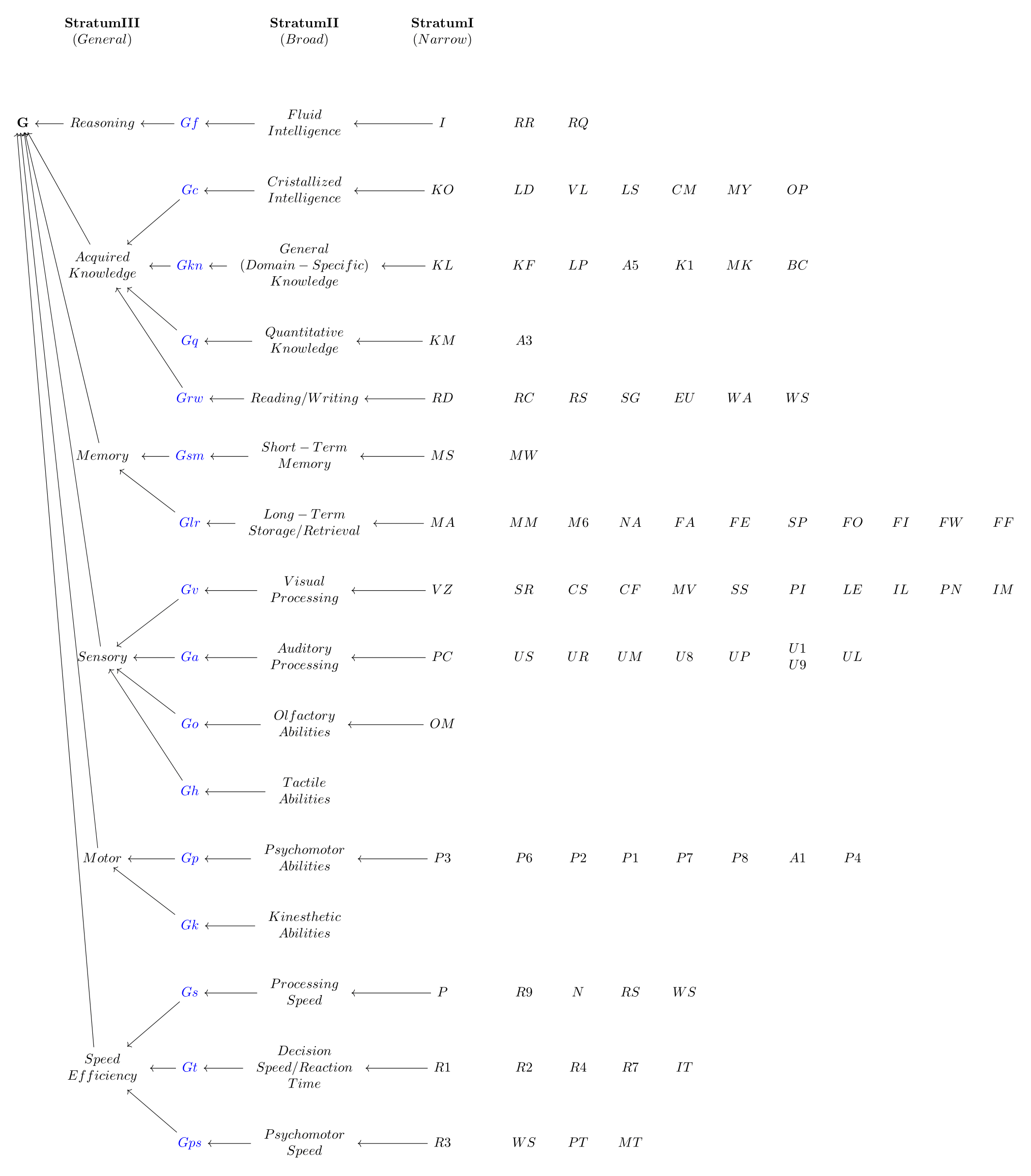
Figure 2: The Cattell-Horn-Carroll cognitive taxonomy organizes intelligence into general, broad, and narrow abilities, framing the foundation for model generality assessment.
The Performance Match dimension integrates three axes: accuracy deviations from human baselines, replication of human error patterns, and response time similarity. The metric emphasizes not only aggregate accuracy, but also fine-grained structure of errors and process latency, providing a composite alignment index.
SME/CogSketch demonstrate high performance match on standard human intelligence benchmarks (e.g., Raven’s Progressive Matrices), accurately emulating both correct and incorrect human problem-solving behaviors. LLMs showcase variable alignment: while achieving high average accuracies (e.g., GPT-4 >80% on mathematical reasoning; state-of-the-art VLMs for visual tasks), their behavioral divergence becomes evident in story analogies or structurally complex tasks, with greater error variability and a lack of invariance under prompt reforms or distractor conditions. METFSRM0 achieves moderate human-judged plausibility in metaphor generation yet lacks broad benchmark coverage.
Unified Cognitive Plausibility Metric
By synthesizing the above dimensions—prioritizing FSR for its mechanistic relevance, but integrating generality and performance match—the composite cognitive plausibility score FSRM1 is generated. The weighting scheme (FSRM2, FSRM3, FSRM4) reflects the primacy of structural fidelity in cognitive modeling. Under this scheme, SME and CogSketch lead (0.565, 0.549), with METFSRM5 next (0.413), and LLMs lowest (0.324).
Alternative (equal) weighting schemes adjust the comparative ranking, highlighting a tension between structural correspondence and behavioral generality: with equal weighting, LLMs outperform METFSRM6 due to their broader functional coverage, despite mechanistic misalignment. This result underscores the importance of theoretical commitments in selecting evaluation criteria and cautions against conflating behavioral equivalence with explanatory adequacy.
Implications and Theoretical Impact
The formalization and quantitative application of the Minimal Cognitive Grid provide a rigorous, extensible framework for ranking artificial systems by cognitive plausibility, disentangling functional replication from mechanistically adequate modeling. The sharp contrast between LLMs' high generality/behavioral performance and their minimal structural constraint implementation reaffirms the epistemic gap between current deep learning paradigms and those models intended as scientific abstractions of human cognition.
Practically, the results advocate caution in treating LLMs as cognitive models; their primary value lies in engineering, not scientific explanation. Conversely, structurally motivated models, despite their narrow domain, remain indispensable for theory-driven investigation of human-like reasoning.
Future development of AI systems intended for cognitive science should more deeply integrate architectural constraints from empirical psychology and neuroscience, or alternately, make explicit the trade-offs between general functional mimicry and explanatory power about underlying cognitive processes.
Conclusion
This paper provides a comprehensive, quantitative framework for the structural ranking of analogy and metaphor models in AI, demonstrating the critical importance of mechanism-level alignment in cognitive evaluation. The Minimal Cognitive Grid not only offers a standardized metric for cognitive plausibility but also exposes the domains in which current AI systems diverge most sharply from human cognition—both a diagnostic for future advances and a methodological foundation for disciplined interdisciplinary research.