- The paper proposes LAPITHS, a framework that distinguishes AI’s structural alignment from mere behavioral performance.
- It employs the Minimal Cognitive Grid to quantify structural plausibility, generality, and performance match across LLMs.
- Empirical analyses reveal that strong behavioral fit, measured by metrics like negative log-likelihood, does not equate to genuine cognitive equivalence.
A Theoretically-Grounded Framework for Interpreting Human-Likeness in AI: LAPITHS and the Critique of Centaur
Introduction
The paper proposes a principled framework, LAPITHS (Language‑model Analysis through Paradigm‑grounded Interpretations of Theses about Human‑likenesS), for critically evaluating claims that LLMs, particularly those like Centaur, exhibit human-like cognition. It does so by distinguishing between functionalist metrics—input/output performance—and structural metrics—alignment with mechanistic and representational constraints derived from cognitive science. This distinction is operationalized using the Minimal Cognitive Grid (MCG), which formalizes dimensions of structural plausibility, generality, and behavioral fit, moving beyond mere behavioral adequacy. The empirical analyses cast doubt on the sufficiency of current behavioral and neural benchmarks to substantiate claims of human-likeness or cognitive equivalence in systems like Centaur.
Functionalism, Structuralism, and the Ascription Fallacy
The theoretical core is a sharp critique of the default functionalist stance underpinning much contemporary evaluation of LLMs. Centaur, a Llama-3.1 70B model fine-tuned via QLoRA on human behavioral data (Psych-101), serves as the case study. The model’s behavioral fit is interpreted by its proponents as indicative of deep alignment with human cognition. However, the paper shows that such perspectives risk committing the "ascription fallacy": unjustifiably attributing cognitive or biological competence to artificial systems based solely on matched behavioral outputs, while overlooking the distinction between functional equivalence (what is computed) and structural/mechanistic equivalence (how it is computed).
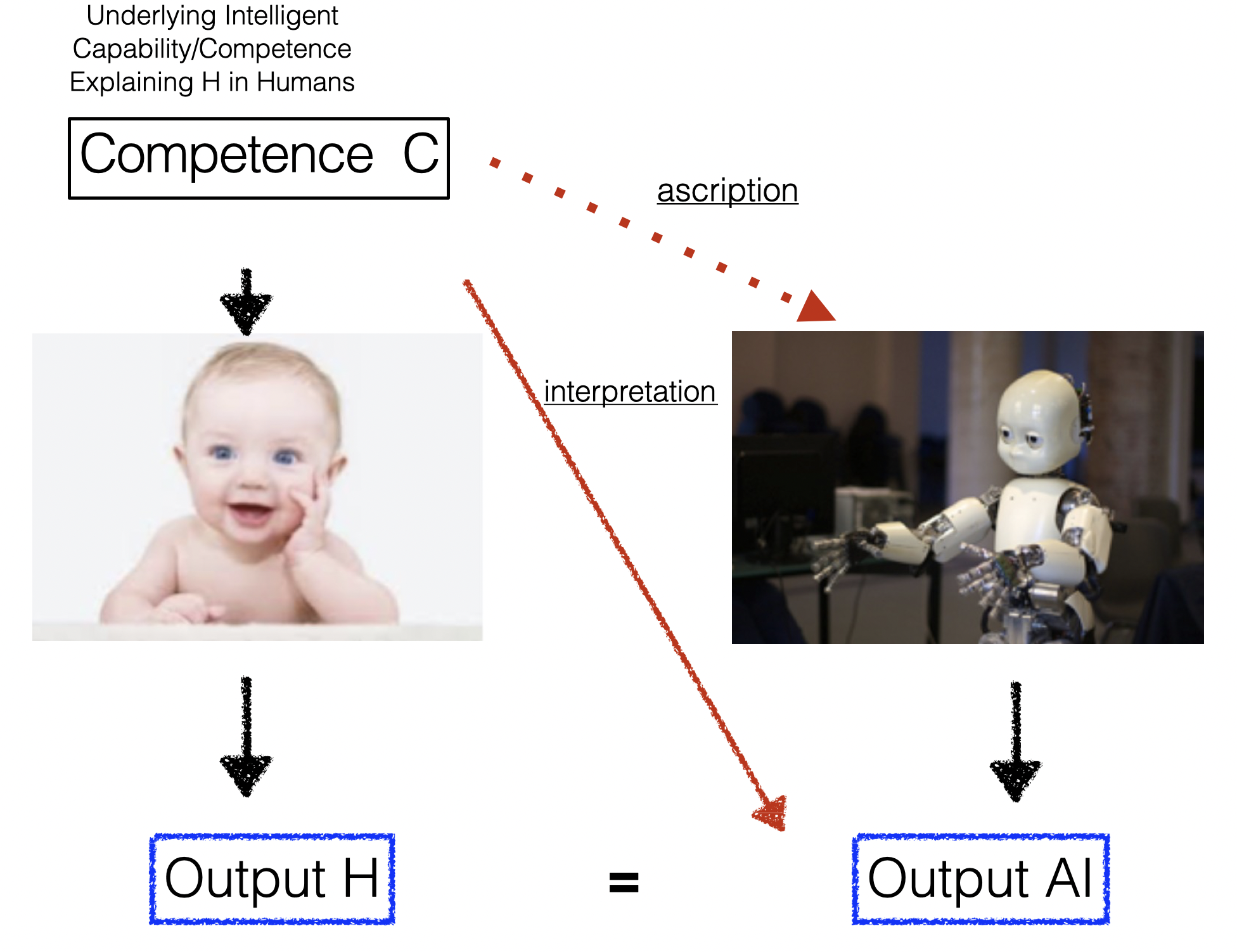
Figure 1: The ascription fallacy: humans and AIs can produce equivalent outputs with structurally divergent mechanisms, leading to unjustified cognitive attributions to the artificial system.
The paper enumerates paradigm constraints and points out that Centaur’s architecture and learning mechanism entail purely functional matching. LLMs lack the necessary architectural commitments to mechanisms such as biologically-plausible working memory, local synaptic plasticity, or genuine embodied cognition. Far from grounding explanatory advances in cognitive science, such architectures only support behavioral emulation.
The LAPITHS Framework and the Minimal Cognitive Grid
LAPITHS formalizes a model-agnostic, quantitative approach to cognitive plausibility via the Minimal Cognitive Grid. Three core dimensions are instantiated:
- Functional/Structural Ratio (FSR): The extent to which a system’s components are structurally aligned (implementing explicitly the mechanisms postulated by cognitive theories) versus only functionally adequate. This is computed against a formalized set of constraints weighted by their theoretical centrality.
- Generality (G): Breadth of coverage across domains, operationalized with reference to the Cattell–Horn–Carroll taxonomy. This ensures that the evaluation is not limited to a narrow set of tasks but reflects human-like versatility.
- Performance Match (PM): Behavioral fit, comprising accuracy, error-pattern match, and process-level metrics such as response time.
A composite cognitive plausibility score (PM) is computed, weighting these dimensions, with a principled justification for treating structural plausibility as primary.
Empirical Evaluation: Behavioral and fMRI Analyses
Behavioral Evaluation: Negative Log-Likelihood Comparison
The paper implements a rigorous comparison between Centaur, a range of RAG-enabled SOTA LLMs (Llama Maverick, GPT-4o, GPT-5.1, Gemini-2.5 Pro, DeepSeek-R1), and standard cognitive models, using the two-step decision-making task. The primary performance metric is per-decision Negative Log-Likelihood (NLL), which measures the alignment of model-predicted actions with empirical human data.
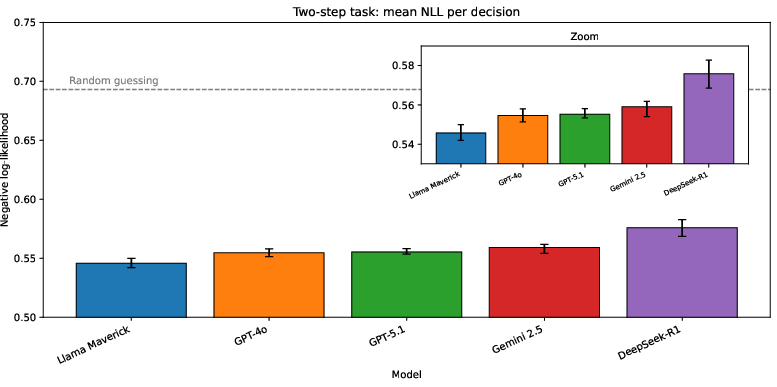
Figure 2: Average NLL per decision for each RAG+LLM system evaluated during the two-step task.
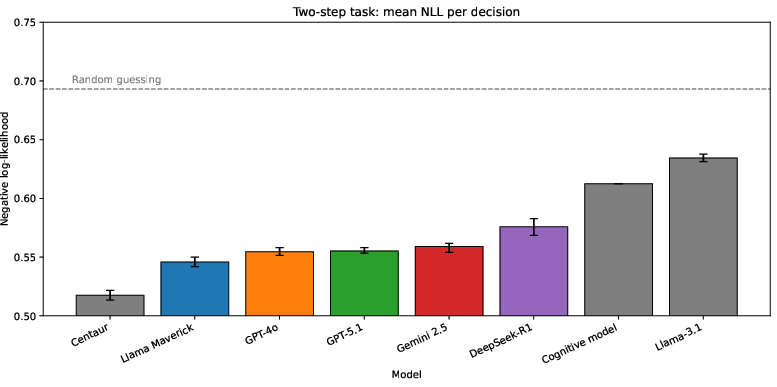
Figure 3: NLL per decision for each RAG+LLM model compared with Centaur, Llama 3.1, and the cognitive model.
Centaur demonstrates the lowest NLL, but the margin over Llama Maverick and other leading LLMs is non-significant or modest (ΔNLL ≈ +0.0282, p ≈ 0.095 vs Llama Maverick), while all far outperform a baseline cognitive model and Llama 3.1. Critically, this shows that performance parity with humans is not unique to Centaur or its fine-tuned protocol; it is readily achieved with task-agnostic SOTA LLMs employing simple retrieval augmentation, thus invalidating claims that such behavioral adequacy is evidence of deeper cognitive equivalence.
Structural, Generality, and Behavioral Plausibility Quantification
The MCG-based analysis quantifies Centaur's (and comparator models’) standings:
| Model |
FSRM (Structurality) |
GM (Generality) |
PMM (Performance Match) |
PM (Composite Plausibility) |
| Centaur |
0.18 |
0.37 |
0.83 |
0.39 |
Centaur’s high performance match and generality are substantially discounted by its low functional/structural congruence with cognitive constraints (i.e., it does not implement local, incremental online RL, nor bounded working memory effects), leading to a composite plausibility well below thresholds one would require for explanatory status in cognitive science.
fMRI-based Representational Analyses
The neural plausibility claim—central to the Centaur argument—receives parallel scrutiny. Both Centaur (via linear decoding of internal representations) and untrained RAG+LLMs (directly outputting ROI-wise beta vectors) are compared on their similarity, as measured by Pearson and cosine correlations, to human fMRI activation patterns during the two-step task. Strikingly, multiple RAG+LLMs (e.g., Gemini-2.5 Pro: Pearson ≈ 0.93, cosine ≈ 0.98) achieve higher correlational alignment with human neural data than Centaur itself (reported as ≈ 0.37) without fine-tuning or explicit architectural adaptation. However, these correlational metrics are shown to be permissive—capturing global pattern similarity but not amplitude, magnitude, or mechanistic realization—so that high neural alignment does not equate to neural plausibility.
Implications and Theoretical Consequences
The empirical findings and theoretical framework jointly underscore that performance on cognitive benchmarks and neural activation correlations provide weak and underdetermined evidence for cognitive plausibility. The risk of the ascription fallacy is acute: strong behavioral and neural fit, attainable with general-purpose systems, does not imply mechanistic or architectural kinship with natural cognition.
The authors advocate for a paradigm shift in evaluation methodology in cognitive AI. Structural constraints, process-level metrics (on-line learning, working memory limits, process timing, capacity constraints), and an explicitly specified minimal cognitive core are required to separate genuine mechanistic models from ever-more-capable statistical imitators. The Minimal Cognitive Grid, as formalized, provides an actionable framework to operationalize this demand; it enables quantification of cognitive relevance independent of raw performance fit.
The discussion also extends to the future design of AI systems. Only by imposing and quantifying architectural constraints that systematically map to cognitive theory can advances in AI be claimed to advance the science of cognition. This has technical ramifications for the development of embodied agents, world-model-based architectures, and the incorporation of process limitations into future LLMs and cognitive benchmarks.
Conclusion
The paper demonstrates, both theoretically and empirically, that current practices in evaluating human-likeness in LLMs—exemplified by Centaur—are insufficient for establishing cognitive or mechanistic equivalence. The achievements of systems like Centaur are best understood as instances of behavioral emulation, not explanatory models of cognition. The Minimal Cognitive Grid (within the LAPITHS framework) offers a reproducible, theoretically robust methodology for discriminating between functional adequacy and genuine cognitive plausibility.
By foregrounding the distinction between performance and explanation, the framework paves the way for more rigorous tests and for future models that can be meaningfully said to "instantiate" rather than merely "approximate" cognition. Only by adopting structural, process-oriented constraints as standard in evaluation and design can the discipline advance from performance engineering to genuine mechanistic understanding of intelligence, artificial or otherwise.