- The paper demonstrates a significant detection of linear alignments in transient candidates using machine learning classification and Monte Carlo simulations.
- The paper details confirmation of genuine transients through morphological comparisons with POSS-II and highlights an excess of close pairs.
- The paper identifies anomalous geographic clustering and ecliptic depletion, challenging conventional explanations for pre-Sputnik transient phenomena.
Statistically Significant Linear Alignments Among High-Confidence Transient Candidates on POSS-I Photographic Plates
Overview
This paper presents a formal analysis of spatially organized, high-confidence transient candidates detected on Palomar Observatory Sky Survey (POSS-I) photographic plates (1949–1957), utilizing machine learning-based classification from the VASCO catalog. The primary objective is to test for statistically significant linear alignments and anomalous clustering among confirmed transient events, and to evaluate their spatial, morphological, and geographic properties under rigorous statistical protocols, including Monte Carlo simulations and multiple-comparisons corrections. The results contradict conventional explanations (e.g., solar system bodies or artifacts) and imply the presence of transient phenomena with distribution patterns inconsistent with known pre-Sputnik satellite populations.
Data and Catalog Construction
The analysis leverages the VASCO v4 catalog, which contains 107,875 transient candidates identified via morphometric feature extraction on red-band FITS cutouts from 635 POSS-I plates. Machine learning probabilities, trained on 250 human-labeled sources, provide objective likelihoods of each candidate being a genuine transient versus a plate artifact. The spatial distribution of the parent sample uniformly tiles the northern sky (declinations 0∘ to +90∘, full RA range), minimizing selection bias and ensuring the robustness of ensemble-level statistical tests.
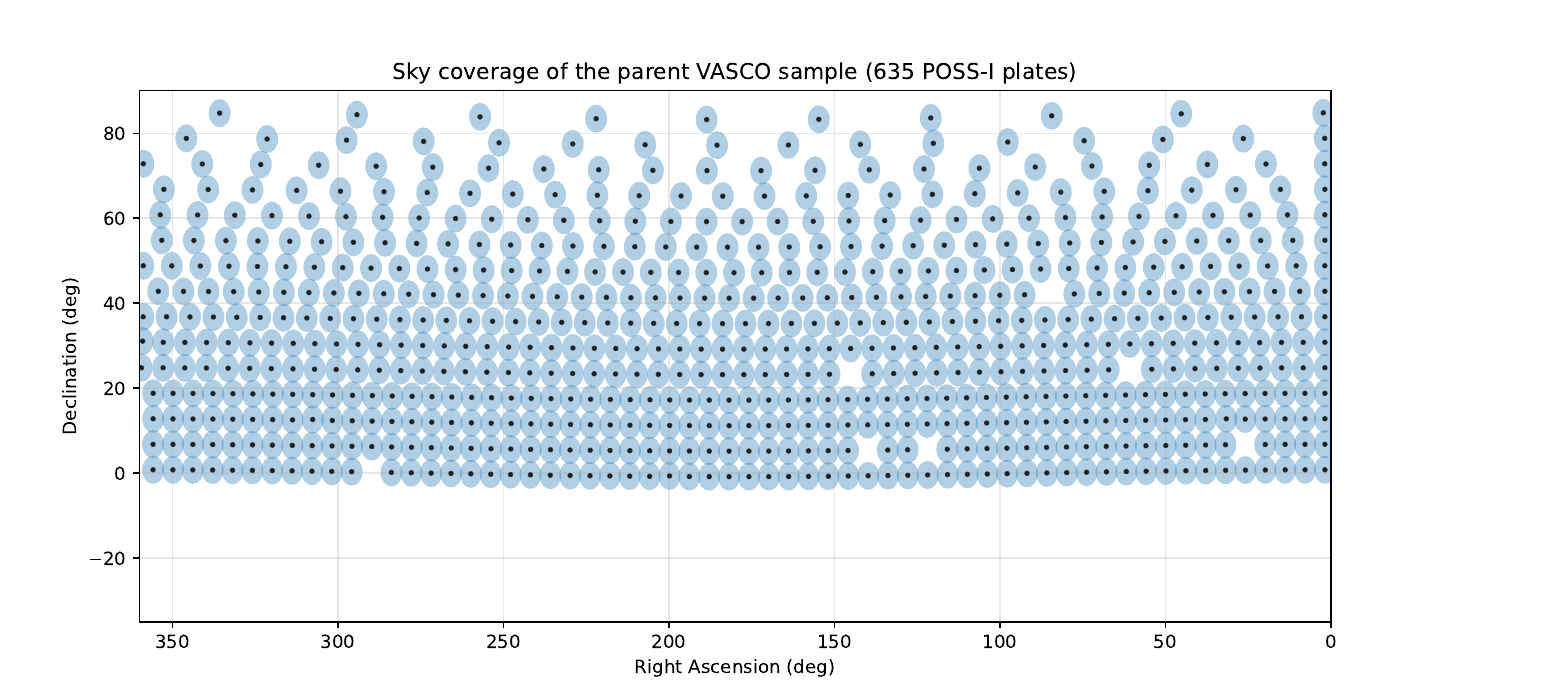
Figure 1: Sky coverage of the 635-plate parent VASCO v4 sample showing uniform tiling across the northern sky.
Alignment Detection and Significance
Linear alignments were detected by optimizing the grouping of high-confidence candidates (≥0.50 ML probability) within an arbitrarily oriented, narrow (≤3 arcsec) strip on each plate. Candidate alignments with ≥5 sources were subjected to Monte Carlo significance testing (10,000 random realizations per plate). Seven of eight tested plates exhibited statistically significant alignments (p<0.03).
Morphological verification against POSS-II plates confirmed genuine transients (80–100% confirmation rates for four plates), ruling out persistent stars and plate artifacts. Sources in alignments exhibit point-like morphology—no streaks—contradicting the hypothesis of continuously luminous moving objects.
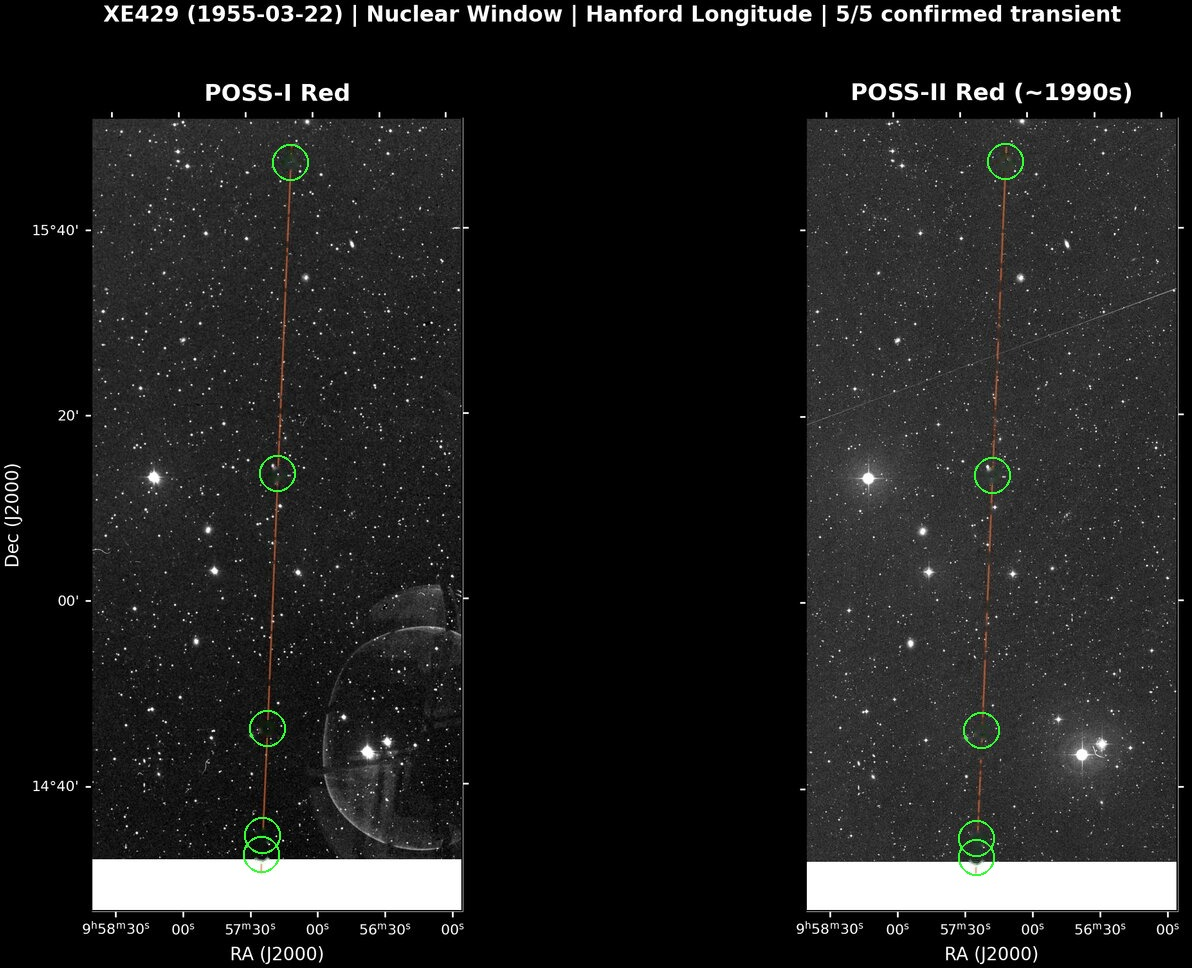
Figure 2: Plate XE429 (1955 March 22) — seven aligned sources on POSS-I red, five confirmed as genuine transients, all absent on POSS-II.
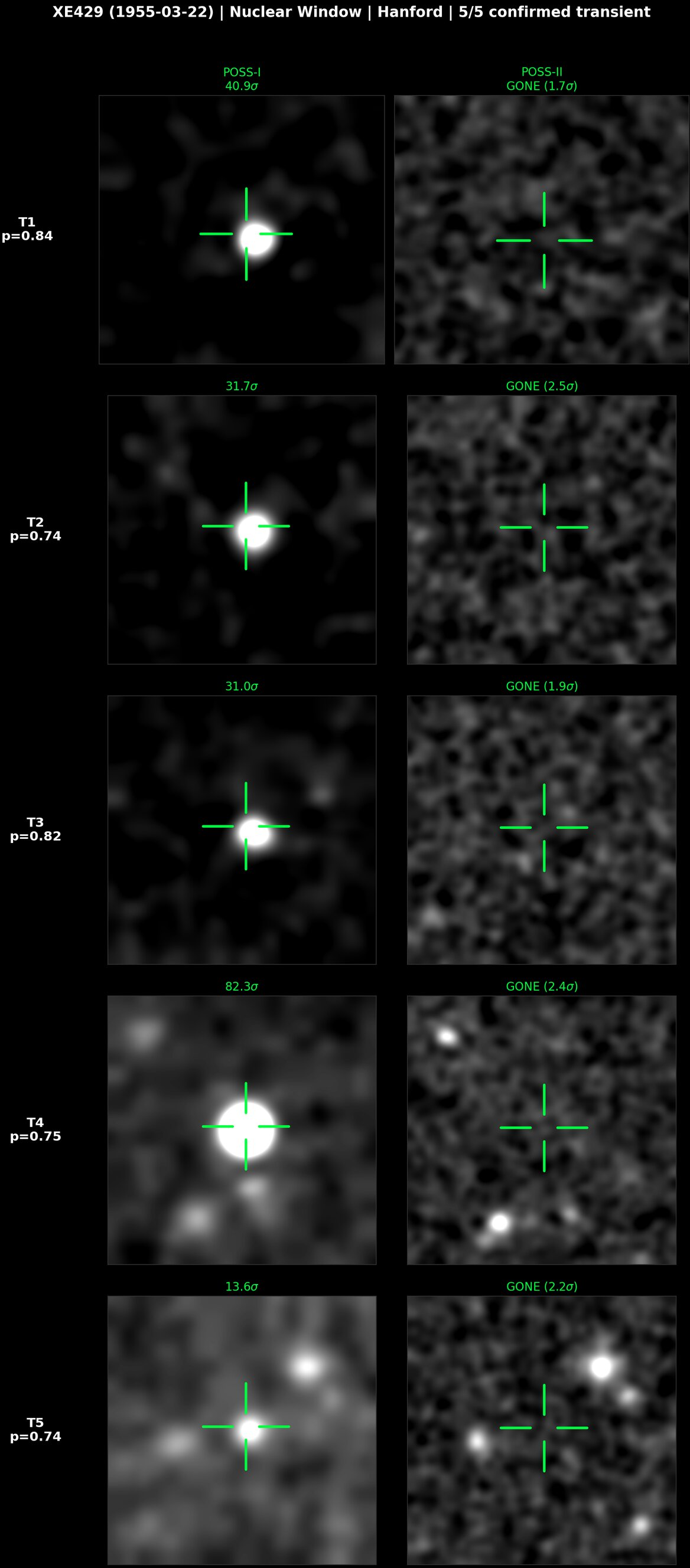
Figure 3: Zoomed cutouts for the five aligned sources on plate XE429, confirmed via absence in POSS-II.
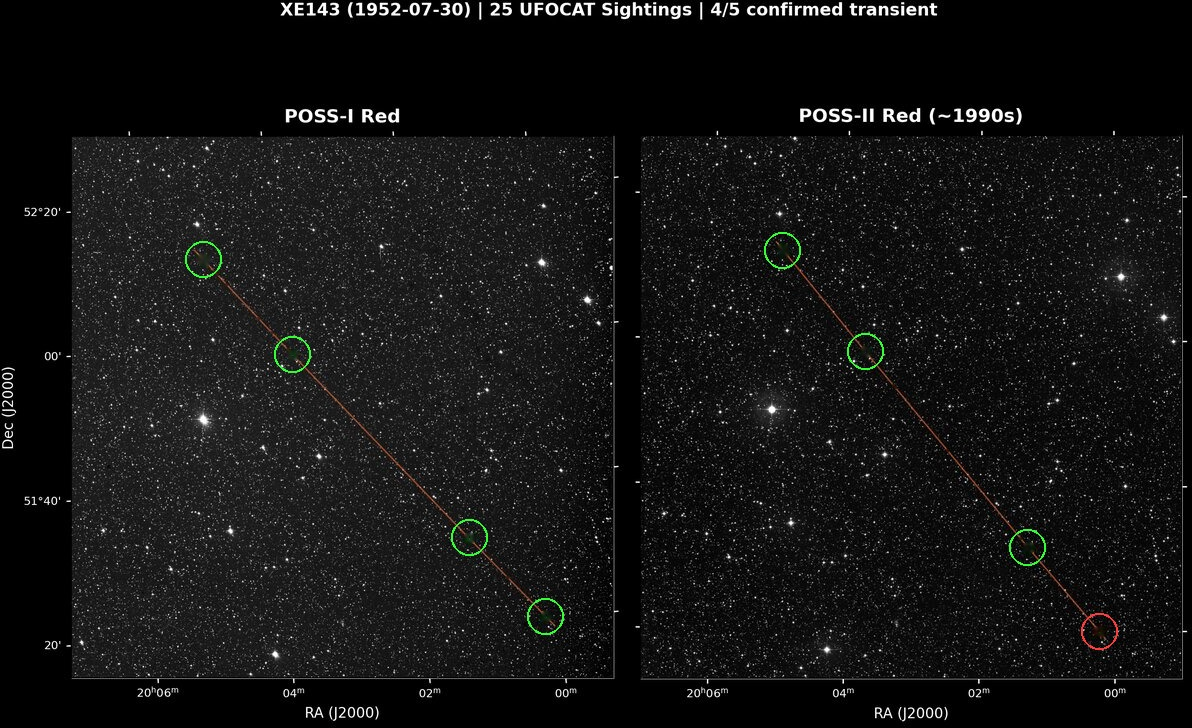
Figure 4: Plate XE143 alignment — five aligned sources, four confirmed transients, one persistent star.
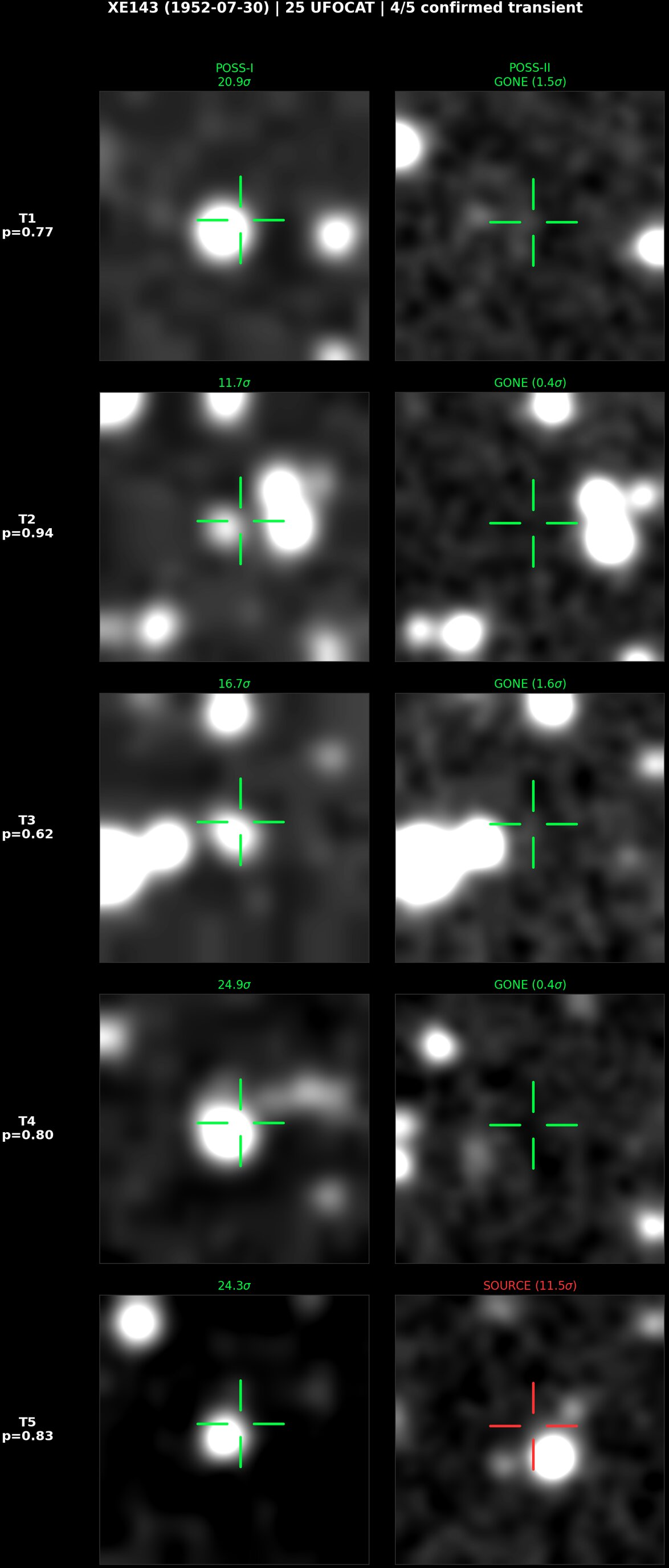
Figure 5: Zoomed cutouts from XE143, showing transient confirmation and persistent star identification.
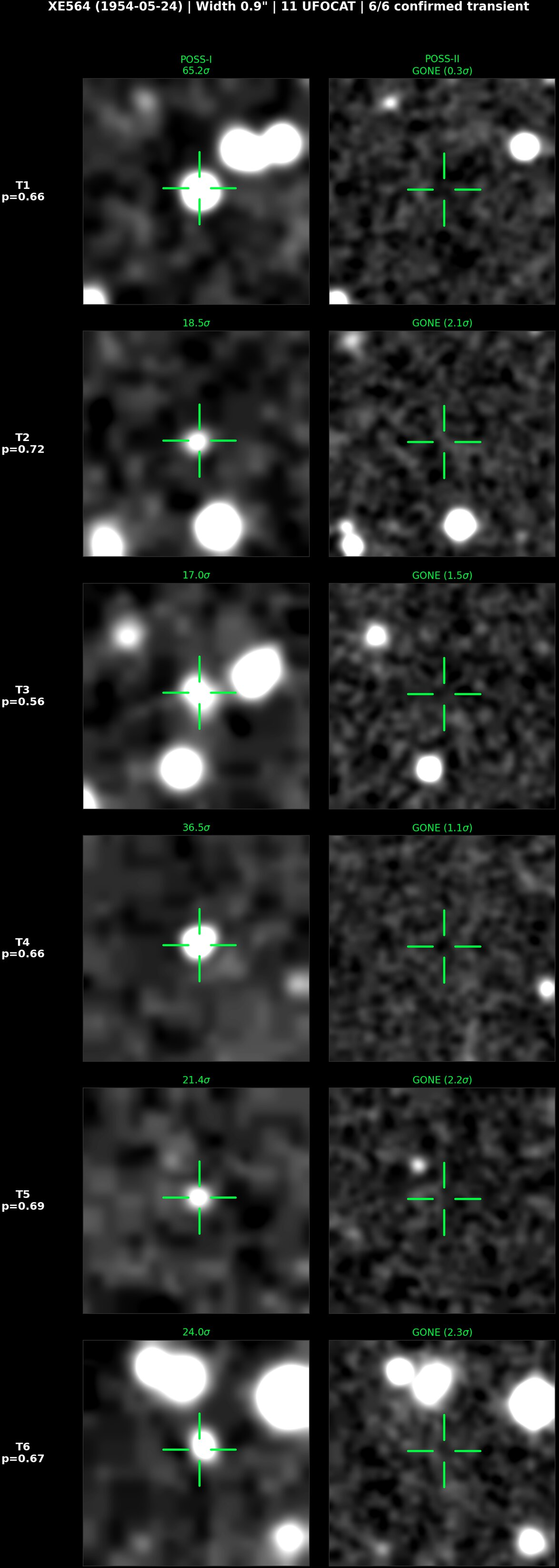
Figure 6: Cutouts of XE564 — all six sources confirmed genuine transients by comparison with POSS-II.
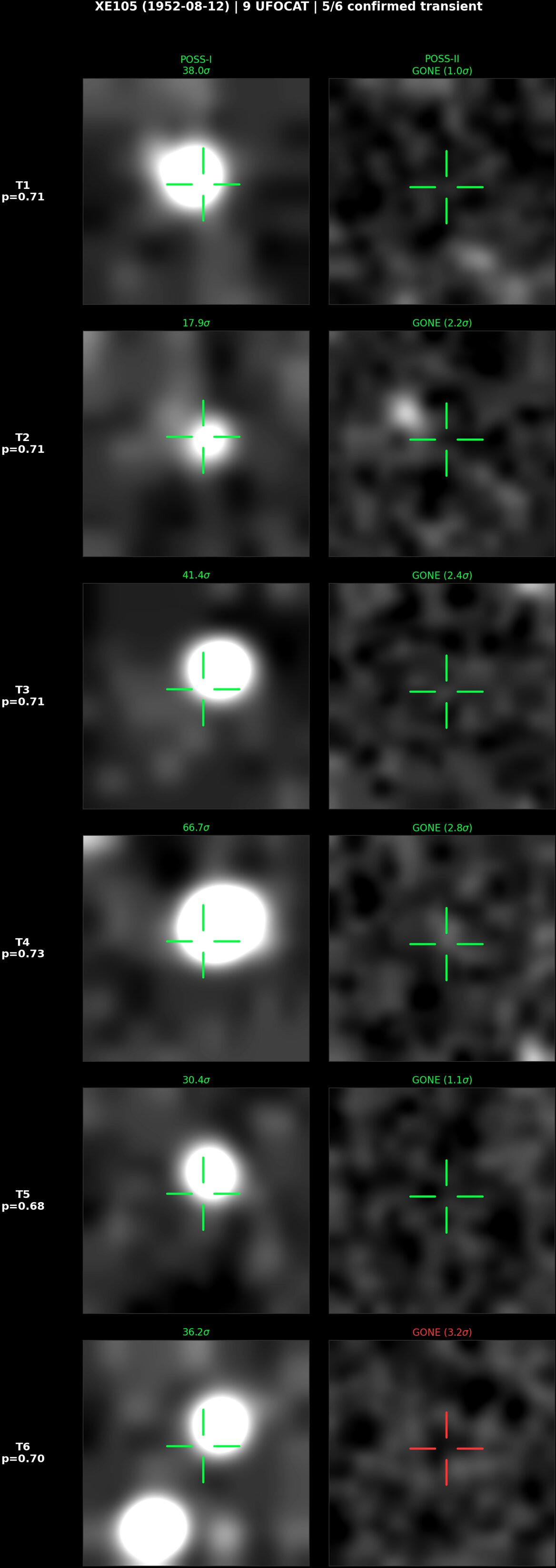
Figure 7: XE105 cutouts — five confirmed transient sources, one persistent.
Angular Rates and Geographic Projection
Observed angular rates of alignments (1–15 arcsec/s) fall within the geosynchronous regime but are discordant with low or medium Earth orbit rates. When projected onto Earth's geographic coordinates assuming high-altitude (GEO) origin, six of seven alignments maintain constant longitude with sub-degree spread—an ensemble-level feature highly improbable by chance (combined p∼3×10⁻¹⁰). Notably, four alignments cluster near −96∘ longitude (central U.S.), and one coincides within 0.3∘ of Hanford nuclear production complex on a nuclear test window date.
Close Pair Excess and Spatial Clustering
The catalog contains a substantial excess of close pairs (<30 arcsec), observed at 16.2× the random rate. Nights with significant alignments coincide with nights of multiple close pairs (Fisher exact test p<0.0001), implying a shared process driving both phenomena. Triplet clusters (three sources within 30 arcsec) occur at rates several times Poisson expectation, further distinguishing the high-probability population from artifacts.
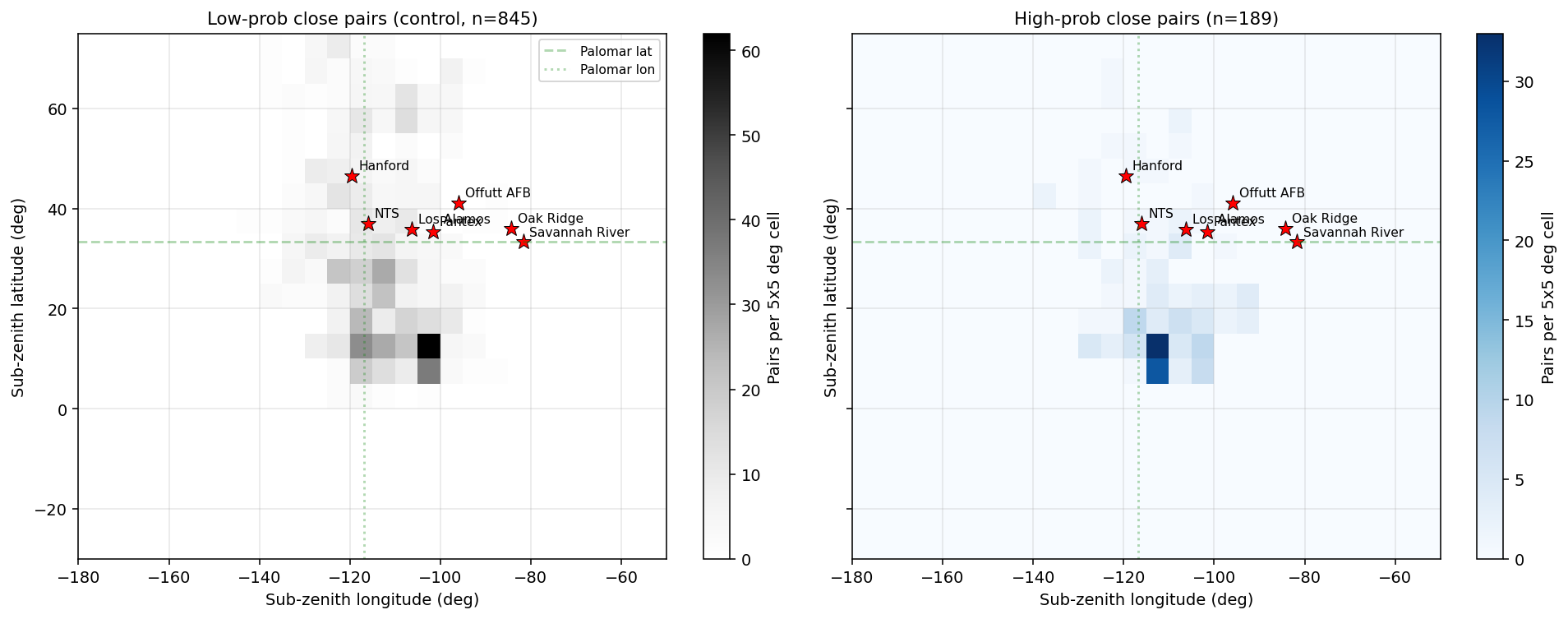
Figure 8: Sub-zenith projection of close pairs at GEO altitude; high-probability sample displays concentrated distribution near nuclear-relevant longitudes.
Ecliptic Latitude Depletion
High-confidence transients are depleted near the ecliptic (15.9% vs. 26.0% for low-probability artifacts, χ2 test +90∘0), with depletion strengthening monotonically with classifier score. This decouples the population from solar system minor bodies and rules out explanation via low-inclination orbital debris, given the classifier's independence from ecliptic coordinates.
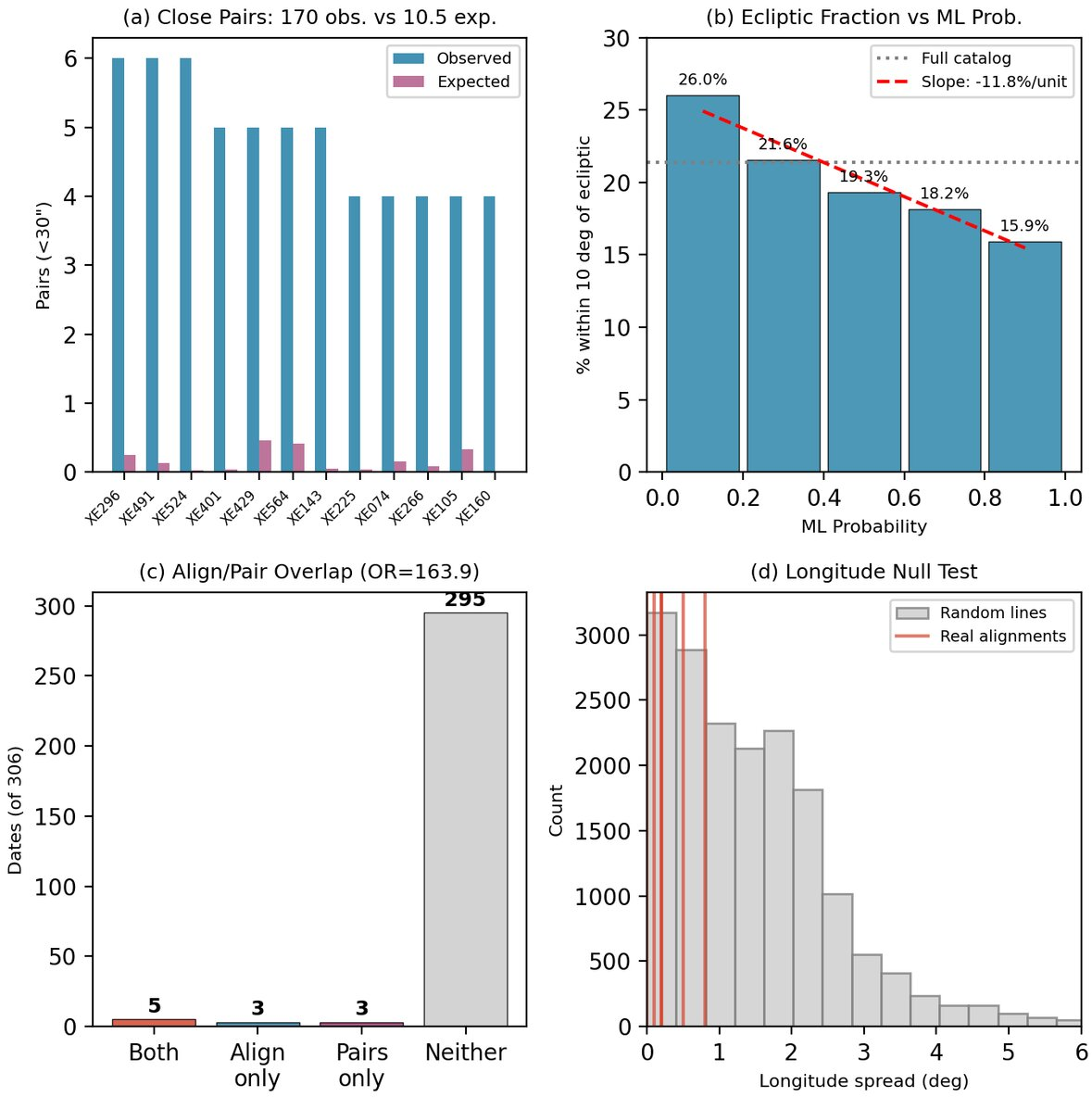
Figure 9: Spatial and statistical properties of high-probability transients — includes close pair counts, ecliptic fraction, alignment/multipair night overlap, and longitude spread null test.
Multiple-Comparisons Correction and Ensemble Robustness
Explicit and implicit family-wise corrections (Benjamini-Hochberg, Holm-Bonferroni) were applied across all plates and all tested alignments. The strongest alignments (XE296, XE524) remain robust under stringent correction; ensemble properties—clustering, overlap, ecliptic depletion—are unaffected by per-plate correction and do not depend on any single observation.
Implications
The statistical, morphological, and geographic properties documented here are inconsistent with known astrophysical transients, plate artifacts, and the contemporaneous (pre-Sputnik) satellite population. The ensemble signatures suggest a persistent, spatially correlated population of high-altitude, intermittently reflective objects present during the 1949–1957 POSS-I survey window, with implications for the historical orbital environment. Nuclear-meridian coincidences and geosynchronous regime rates are unreconciled with conventional explanations.
Replication on independent photographic archives is underway, and confirmation of alignment phenomena across multiple observatories would significantly strengthen the evidential case.
Conclusion
The paper establishes the existence of statistically significant, linear alignments and anomalous spatial clustering among high-confidence transient candidates on POSS-I plates, confirmed via machine learning classification and cross-epoch plate comparison. The results—point-source morphologies, geosynchronous regime angular rates, constant geographic longitude projections, close-pair excess, and ecliptic latitude depletion—collectively contradict conventional astrophysical and artifact-based explanations. Ensemble-level findings remain robust under stringent multiple-comparisons correction. These properties encourage further investigation into the origins and physical mechanisms of pre-Sputnik transient populations at high altitude, urging broader cross-archive validation and theoretical interpretation.