KinDER: A Physical Reasoning Benchmark for Robot Learning and Planning
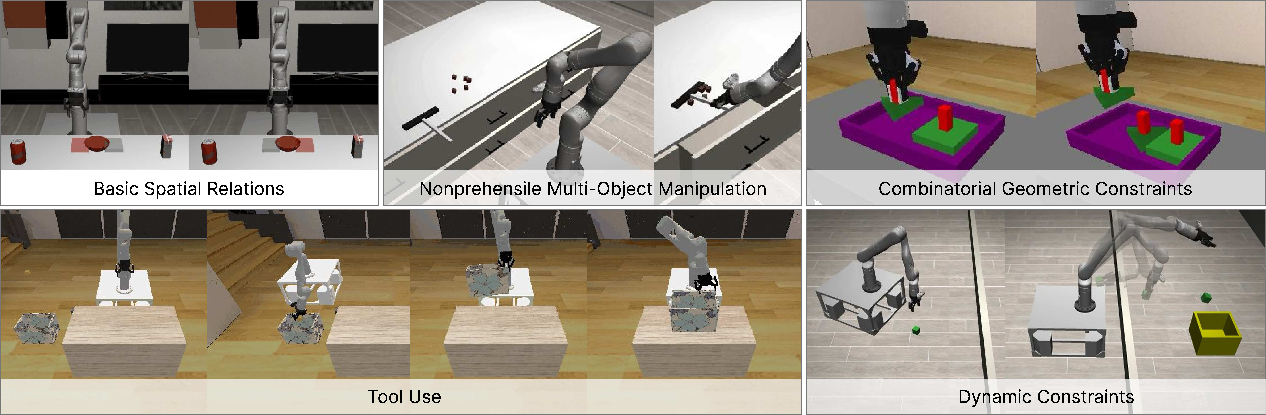
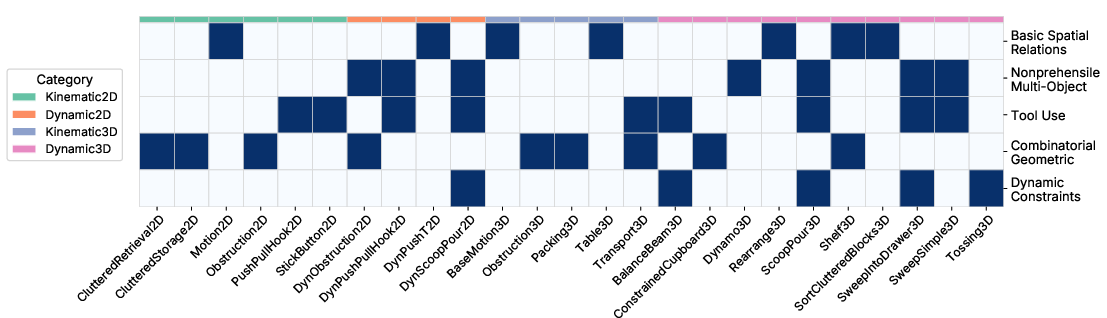
Abstract: Robotic systems that interact with the physical world must reason about kinematic and dynamic constraints imposed by their own embodiment, their environment, and the task at hand. We introduce KinDER, a benchmark for Kinematic and Dynamic Embodied Reasoning that targets physical reasoning challenges arising in robot learning and planning. KinDER comprises 25 procedurally generated environments, a Gymnasium-compatible Python library with parameterized skills and demonstrations, and a standardized evaluation suite with 13 implemented baselines spanning task and motion planning, imitation learning, reinforcement learning, and foundation-model-based approaches. The environments are designed to isolate five core physical reasoning challenges: basic spatial relations, nonprehensile multi-object manipulation, tool use, combinatorial geometric constraints, and dynamic constraints, disentangled from perception, language understanding, and application-specific complexity. Empirical evaluation shows that existing methods struggle to solve many of the environments, indicating substantial gaps in current approaches to physical reasoning. We additionally include real-to-sim-to-real experiments on a mobile manipulator to assess the correspondence between simulation and real-world physical interaction. KinDER is fully open-sourced and intended to enable systematic comparison across diverse paradigms for advancing physical reasoning in robotics. Website and code: https://prpl-group.com/kinder-site/
Paper Prompts
Sign up for free to create and run prompts on this paper.
Explain it Like I'm 14
What is this paper about?
This paper introduces KinDER, a big “test set” designed to check how well robots can think about and handle the physical world. Think of KinDER like a set of video game levels that challenge a robot’s understanding of how objects move, fit, and interact—without getting distracted by things like language or fancy visuals. The goal is to fairly compare different robot methods and help researchers build smarter robots that can plan and act in the real world.
What questions is the paper trying to answer?
The paper focuses on simple, practical questions like:
- Can robots understand where objects are and how to put them in the right place?
- Can robots move many items at once by pushing or sweeping instead of just picking things up?
- Can robots use tools (like hooks, trays, or boxes) to help with tasks?
- Can robots figure out how to fit objects into tight spaces without bumping into things?
- Can robots control motion carefully—like carrying coffee without spilling or tossing something over a barrier?
These questions are grouped into five core “physical reasoning” challenges. Together, they form the kinds of problems robots face in homes, factories, or everyday environments.
How did the researchers test this?
The team built three main parts:
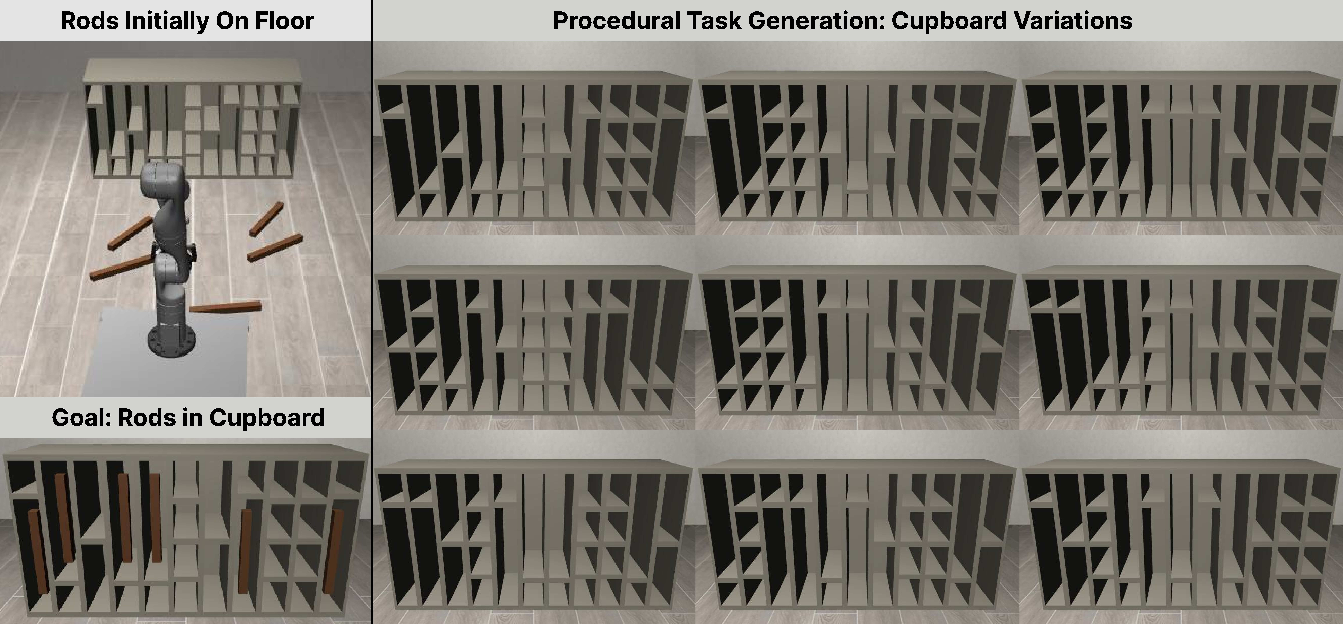
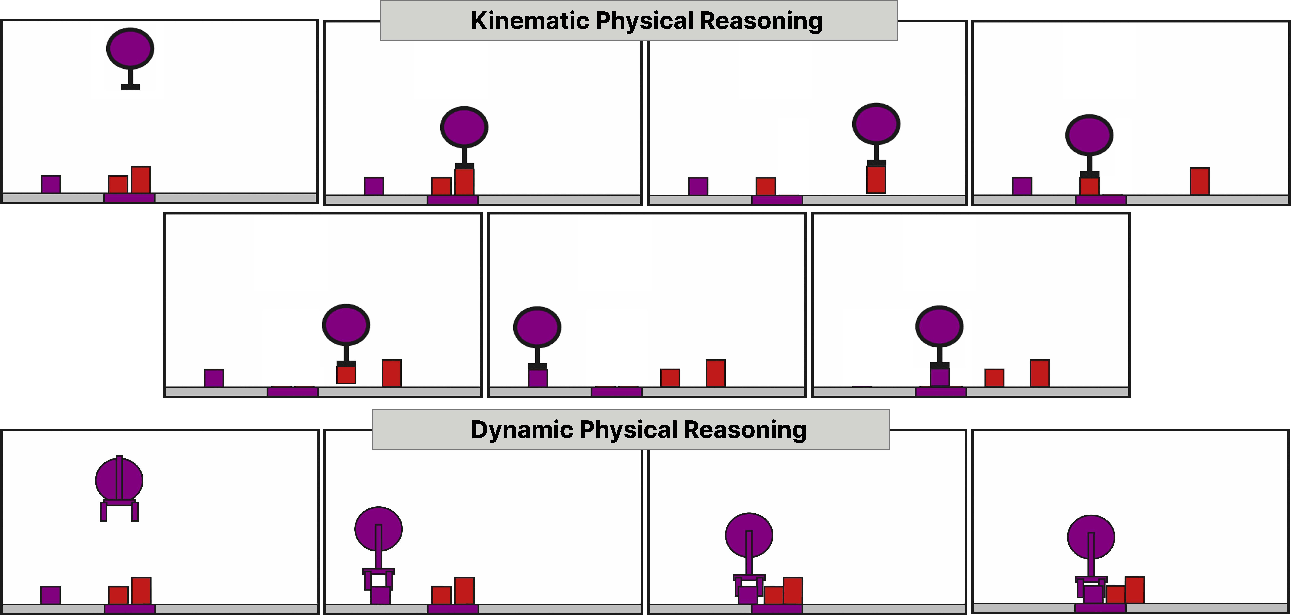
- KinDERGarden: 25 different simulated environments (like puzzle levels) in both 2D and 3D. Some levels focus on positions only (kinematics), while others include forces and motion (dynamics).
- KinDERGym: A Python library that makes these environments easy to use. It includes:
- A standard “Gym” interface (like a game engine API for robot learning).
- Reusable “skills” (e.g., Pick(object), Place(object)) and “concepts” (e.g., On(object, surface)) so planners can reason at a higher level.
- Tools to control robots by phone, VR headset, or game controller, plus recorded demonstrations.
- KinDERBench: A benchmark suite to compare 13 different robot methods, including planning, imitation learning, reinforcement learning, and large AI models (like LLMs and vision-language-action models).
They also did a “real-to-sim-to-real” test: the robot looked at a real scene, built a matching simulation, planned there, and then executed the plan back in the real world. This shows the simulations aren’t just toys—they relate to actual robot behavior.
What do “kinematics,” “dynamics,” and “object-centric states” mean?
- Kinematics: Think “positions and shapes.” It’s about where things are and whether they fit, without worrying about speed or forces. Example: Will the robot’s arm collide if it moves here?
- Dynamics: Think “motion and forces.” It’s about how fast things move, how they bounce, and whether they spill or tip. Example: Can the robot sweep marbles into a drawer without them flying out?
- Object-centric states: The robot’s world is described as a list of objects and each object’s properties (like location, size, speed). It’s like an inventory with precise stats for each item, which makes it easy to vary the number and types of objects.
What did they find?
Overall, many existing methods struggled on harder physical reasoning tasks. Here are the big takeaways:
- Planning with handcrafted skills did best: A “bilevel planner” (which first plans high-level steps, then computes detailed motions) had the highest success on average. But it requires more engineering work to set up those skills and rules.
- Large language/vision models help, especially with examples: LLM/VLM planners performed well, and did better when given in-context examples (like showing them a few solved cases). However, they still lagged behind the best planner on complex tasks.
- Imitation learning did surprisingly well on some long, multi-step tasks: Methods trained on demonstrations could open drawers, pick up tools, and sweep items—though they still struggled with tougher physics and precision.
- Standard reinforcement learning struggled: With “sparse rewards” (only getting -1 each step until success), RL methods had a hard time on long, complex tasks. They did better on short, simpler ones.
- Model-based control with true physics did okay; learned physics was unreliable: Using the real simulator dynamics directly (MPC) worked decently. But when the model of the world was learned from data (MBRL), performance dropped.
- Some methods generalized beyond training: For example, a vision-language-action model trained with one obstacle could still handle scenes with 0–3 obstacles fairly well.
In short: no single approach solves everything. Methods that “think ahead” with structured skills do best, but they need effort to set up. Pure learning methods are easier to use but struggle more on tough physics puzzles.
Why is this important?
Physical reasoning is at the heart of useful robots. If a robot can’t understand how objects move, fit, and interact, it will bump into things, spill, or get stuck. KinDER gives researchers a clear, shared way to measure progress on these core skills, without mixing in unrelated complications like language parsing or photorealistic perception. That makes it easier to see what’s working, what’s not, and where to improve.
What could this change in the future?
This benchmark can push the field forward by:
- Encouraging better hybrid methods that combine planning (clear reasoning) with learning (flexibility and generalization).
- Driving research on tool use, multi-object manipulation, and safe, stable motion.
- Improving ways to scale planning as the number of objects grows.
- Helping bridge simulation and reality, so plans made in sim work on real robots.
The authors also note limitations: simulations can’t capture every detail of the real world; they focused on single-robot setups; and not every possible method was tested. But by open-sourcing KinDER, they invite the community to build on it—adding more methods, demos, and real-world tests.
Quick guide to the five core challenges (with simple examples)
- Basic spatial relations: Put the fork to the left of the plate; stack a book on the shelf without hitting other books.
- Nonprehensile multi-object manipulation: Sweep many small items into a drawer without picking each one up.
- Tool use: Use a hook to pull something closer; use a box as a container to carry objects.
- Combinatorial geometric constraints: Pack items tightly without collisions; navigate a crowded area without bumping into furniture.
- Dynamic constraints: Carry a full cup without spilling; toss a ball over a barrier; sweep objects smoothly so they don’t scatter.
By testing these challenges clearly and consistently, KinDER helps robots get better at the “physics puzzles” of the real world.
Practical Applications
Immediate Applications
The following applications can be deployed today by leveraging KinDER’s open-source environments (KinDERGarden), software stack (KinDERGym), and standardized evaluation suite (KinDERBench). Each item summarizes use case, sectors, tools/workflows that may emerge, and key dependencies or assumptions.
- Benchmarking and regression testing for robot manipulation stacks — Use KinDERBench to track success rates, rewards, and inference time across updates to planning/RL/IL/VLA components, focused on physical reasoning rather than perception.
- Sectors: robotics, software QA, autonomous systems
- Tools/workflows: CI/CD pipelines that run KinDER test batteries; dashboards comparing versions and methods; failure triage via procedural variations
- Dependencies: integration with object-centric states; simulator determinism/config mgmt; compute budget for multi-seed evaluation; licensing for physics backends (e.g., MuJoCo)
- Rapid prototyping of parameterized skills and predicates — Use KinDERGym’s options (skills) and PDDL-integrated predicates to design, unit-test, and iterate preconditions/effects for TAMP or hybrid planners before real deployment.
- Sectors: robotics R&D, industrial automation
- Tools/workflows: skill authoring templates; predicate libraries; unit tests per core challenge (spatial, tool-use, etc.)
- Dependencies: engineering expertise to define skills; assumptions that object-centric states and geometry are accessible in target systems
- Teleoperation-driven data collection at scale — Immediately use the iPhone web app, Meta Quest 3S, and PS5 interfaces to collect high-quality demonstrations for imitation learning and pretraining.
- Sectors: academia, startups, data operations, edTech
- Tools/workflows: remote annotation/teleop shifts; scripted distribution of procedural tasks for balanced coverage; auto-quality checks from success metrics
- Dependencies: trained human operators; ergonomic/latency considerations; consistent scene asset configs; data privacy/storage policies
- Standardized evaluation of foundation-model planning for robotics — Evaluate LLM/VLM/VLA planners on KinDER’s core challenges with reproducible baselines to validate claims and guide model selection.
- Sectors: AI product teams, robotics vendors, cloud AI providers
- Tools/workflows: prompt libraries for LLMCon/LLMPlan/VLMPlan; skill API integration; ablations (with/without images or states)
- Dependencies: API access to frontier models; prompt/control costs; alignment between training priors and KinDER task distributions
- Curriculum design for RL/IL and hybrid methods — Build staged curricula (Kinematic2D → Dynamic2D → Kinematic3D → Dynamic3D) that introduce complexity in dynamics, contacts, and combinatorial constraints.
- Sectors: machine learning research, education, corporate L&D
- Tools/workflows: automated progression rules; checkpointed policies; skill-chaining pipelines
- Dependencies: compute for training; reward shaping for RL if needed; reproducibility of procedural seeds
- Real-to-sim-to-real dry runs for manipulation procedures — Use the paper’s twin-simulation workflow (object pose estimation → simulation plan → execution) to de-risk deployments for tasks like shelf packing or transport.
- Sectors: warehousing/logistics, service/home robotics, labs
- Tools/workflows: pose pipelines (e.g., bounding boxes to states); plan validation in sim; safety checks before real execution
- Dependencies: reliable object pose estimation; calibration; manageable sim-to-real gaps in contact/friction
- Comparative research in physical reasoning methods — Side-by-side evaluation of TAMP, MPC/MBRL, IL (e.g., Diffusion Policy), RL (PPO/SAC), and VLA under identical conditions.
- Sectors: academia, industrial research labs
- Tools/workflows: shared evaluation harnesses; leaderboards; reproducible seeds and configs
- Dependencies: agreed protocols; consistent hyperparameter budgets; community governance for benchmark updates
- Education and courseware in robot planning and learning — Incorporate KinDER environments into assignments and labs on task and motion planning, imitation learning, and FM-based planning.
- Sectors: higher education, MOOC platforms, bootcamps
- Tools/workflows: canned datasets; scaffolded notebooks; autograders based on SR/Rwd/Inf-Time
- Dependencies: student access to supported OS/Python; GPU availability for IL/RL; didactic materials
- Tool-use and nonprehensile manipulation testing — Immediately probe whether a manipulation stack can utilize tools (boxes, hooks, sticks) and exploit contacts (sweeping, pushing) using KinDER’s 2D/3D tasks.
- Sectors: home robotics, hospitality, light manufacturing
- Tools/workflows: tool affordance tests; contact-rich policy validation; failure clustering by core challenge type
- Dependencies: end-effector compatibility; physics fidelity for relevant contacts; safety gating for contact behaviors
- Procurement, grant, and review checklists — Use KinDER as a neutral yardstick in RFPs and research reviews to assess claims about general-purpose manipulation and planning.
- Sectors: government, funding agencies, corporate R&D
- Tools/workflows: minimum bar (SR) thresholds per challenge; reproducibility packages; “no-perception” physical reasoning tracks
- Dependencies: acceptance of standardized metrics; agreement on task subsets; reproducibility artifacts
- Systems integration testbed for asset reuse — Leverage KinDER’s integration with RoboCasa/MimicLabs assets and BDDL-like procedural generation to bootstrap internal simulation suites.
- Sectors: robotics platforms, simulation vendors
- Tools/workflows: scene templating; task generators; cross-backend test harnesses (PyBullet, MuJoCo, Pymunk)
- Dependencies: asset licensing; maintenance of scene libraries; consistency across backends
Long-Term Applications
These applications require additional research, scaling, or ecosystem development (e.g., more robust sim-to-real, broader hardware support, or standard-setting).
- Industry-wide certification for physical reasoning — Establish standardized KinDER-derived tests as part of safety/competency certification for consumer and service robots.
- Sectors: policy/regulation, consumer robotics, insurers
- Potential products/workflows: certification suites; grading rubrics per core challenge; audit trails for model updates
- Assumptions/dependencies: stakeholder buy-in; consensus on task difficulty and scoring; auditability and security of test runs
- Generalist household robot pretraining curricula — Use KinDER as a pretraining backbone for agents that later fine-tune in photorealistic or real environments for tasks like tidying, organizing, and basic tool-use.
- Sectors: home robotics, elder care, hospitality
- Potential tools/products: multi-stage curricula; sim-to-real adapters; foundation manipulation models
- Assumptions/dependencies: transfer learning pipelines; richer perception-layer integration; domain randomization breadth
- Warehouse and micro-fulfillment manipulation policies — Train and validate policies for packing, retrieval, and obstacle navigation in tight spaces using the combinatorial constraint tasks.
- Sectors: logistics, e-commerce, retail
- Potential workflows: digital-twin evaluation; TAMP+VLA hybrids for bin packing; tool-use for constrained handling
- Assumptions/dependencies: calibrated digital twins; SKU geometry/pose metadata; handling compliance and safety constraints
- Foundation-model–augmented TAMP for tool use — Hybrid planners where VLAs/LLMs propose high-level decompositions and TAMP ensures feasibility under kinematic/dynamic constraints.
- Sectors: robotics platforms, AI cloud services, integrators
- Potential tools/products: “FM-in-the-loop” planners; skill libraries auto-discovered or auto-refined by FMs
- Assumptions/dependencies: reliable grounding from language to skills; latency/cost control; robust failure recovery
- Learned libraries of reusable tool affordances — From KinDER tool-use tasks, build generalized affordance models that transfer across novel tools and scenes (e.g., hooks, trays, boxes).
- Sectors: home and industrial robotics, maintenance
- Potential workflows: affordance explorers; online tool discovery; safety filters for contact-rich actions
- Assumptions/dependencies: diverse training data; generalization to new geometries/materials; hardware capable of nuanced tool interaction
- Hardware design guided by physical reasoning metrics — Use benchmark outcomes to co-design end-effectors, grippers, and mobile bases optimized for contact-rich, multi-object manipulation.
- Sectors: robotics hardware, OEMs, prosthetics
- Potential products: grippers with sweeping/tray attachments; compliance-tunable fingers; modular tool belts
- Assumptions/dependencies: reliable mapping from sim results to real performance; cost and manufacturability constraints
- Autonomy update governance with benchmark gating — Gate software releases behind quantitative KinDER benchmarks to manage regression risk at fleet scale.
- Sectors: commercial robotics, fleet operators
- Potential workflows: canary releases with benchmark gates; automated rollback on metric regressions
- Assumptions/dependencies: coverage adequacy; drift detection; secure and reproducible evaluation
- Simulation-informed policy and funding prioritization — Use KinDER-style tasks to prioritize research investments (e.g., dynamic constraints vs. combinatorial geometry) based on measured capability gaps.
- Sectors: public agencies, corporate R&D strategy
- Potential workflows: capability portfolios; challenge-track funding calls; annual scorecards
- Assumptions/dependencies: community consensus on task relevance; evolving benchmarks to avoid overfitting
- Multi-robot coordination for physical reasoning — Extend KinDER scenarios to multi-agent settings (e.g., joint sweeping, cooperative transport) to study embodied coordination under geometric/dynamic constraints.
- Sectors: logistics, construction, disaster response
- Potential products: cooperative manipulation planners; shared skill libraries with role assignment
- Assumptions/dependencies: new environments; communication/control protocols; safety and verification frameworks
- Assistive and healthcare manipulation — Translate nonprehensile multi-object manipulation and dynamic-constraint policies to assisting tasks (e.g., meal setup, medication organization).
- Sectors: healthcare, eldercare, rehabilitation
- Potential tools/products: validated manipulation routines; tool-use for delicate handling; safety monitors for spills/falls
- Assumptions/dependencies: regulatory approval; robust perception; patient-specific customization
- Space and field robotics tool improvisation — Leverage tool-use and dynamic-constraint reasoning to improvise with found objects (e.g., planetary maintenance, disaster recovery).
- Sectors: aerospace, defense, emergency response
- Potential workflows: predeployment training on abstracted KinDER tasks; on-site adaptation with FM-augmented planners
- Assumptions/dependencies: severe sim-to-real gaps; environment variability; limited compute/communications in the field
Cross-cutting Assumptions and Dependencies
- Sim-to-real transfer quality depends on accurate object-centric state estimation, calibration, and faithful contact/friction modeling.
- Parameterized skills and predicates require engineering effort; benefits are larger when downstream systems expose similar abstractions.
- Foundation models’ performance is sensitive to prompting, context length, and availability/cost of API access.
- Procedural generation aids coverage but may not reflect edge cases in specific deployments; additional domain-specific scenarios will be needed.
- Compute and data budgets (demos, rollouts) materially affect RL/IL/FM comparisons; fair budgeting is necessary for meaningful evaluation.
Glossary
- Affordances: Action possibilities an object offers to an agent (e.g., a tool’s functionality). Example: "They should understand not only common tool affordances, but also abstract mechanisms"
- BDDL: A domain specification language for describing tasks and objects in embodied benchmarks. Example: "we use environment configuration files … and take inspiration from the BDDL specification language introduced in BEHAVIOR"
- Bilevel Planning (BP): A hierarchical planning approach that searches over high-level task structures and samples low-level parameters/motions. Example: "Bilevel Planning~(BP)~\cite{srivastava2014combined,silver2023predicateinvent,li2025IVNTR}: A search-then-sample TAMP planner; uses skills and concepts."
- Bounding box: The minimal axis-aligned box enclosing an object, often used for geometry and collision reasoning. Example: "bounding box dimensions in "
- Collision-checking: Computational testing for interpenetrations between robot and scene elements to ensure feasibility and safety. Example: "collision-checking methods from PyBullet"
- Combinatorial geometric constraints: Geometry-based restrictions whose number/complexity grows rapidly with the number of objects (e.g., pairwise collisions). Example: "combinatorial geometric constraints"
- Constraint satisfaction problems: Formal problems defined by variables and constraints whose solutions satisfy all constraints. Example: "generalized constraint satisfaction problems"
- Degrees of freedom (DOF): Independent parameters needed to define a robot’s configuration. Example: "a 7DOF Kinova Gen3 arm"
- Diffusion Policy (DP): An imitation learning approach that models action generation with diffusion processes. Example: "Diffusion Policy (DP)~\cite{chi2025diffusion}: Imitation learning over RGB images"
- Dynamic constraints: Limits arising from system dynamics (e.g., velocities, accelerations) that must be respected for feasible motion. Example: "requires satisfying dynamic constraints."
- End effector: The robot’s tool or gripper at the end of a kinematic chain that interacts with the environment. Example: "a rectangular vacuum on its end effector"
- Foundation model (FM): Large pretrained models (e.g., language/vision) used as general-purpose components for downstream tasks. Example: "Foundation model (FM) based approaches"
- Forward kinematics: Computing an end effector’s pose from joint configurations. Example: "object modeling, forward kinematics, and collision-checking methods"
- Generative Skill Chaining (GSC): A method that composes learned skills generatively to solve tasks. Example: "Generative Skill Chaining (GSC)~\cite{mishra2023gsc}"
- Gymnasium: A standardized API for reinforcement learning environments and agents. Example: "KinDERGarden environments inherit from the general Gymnasium~\cite{towers2024gymnasium} API"
- Imitation learning (IL): Learning policies from expert demonstrations rather than from trial-and-error rewards. Example: "imitation learning (IL)~\cite{osa2018algorithmic,jang2022bc,chi2025diffusion}"
- In-context examples: Prompted examples used by a large model to guide behavior without gradient updates. Example: "prompted with in-context examples"
- Inverse kinematics: Computing joint configurations that achieve a desired end-effector pose. Example: "inverse kinematics is used to derive environment actions"
- LLM Planning (LLMPlan): Planning using a LLM to propose and sequence actions/skills. Example: "LLM Planning (LLMPlan)~\cite{silver2022pddl,song2023llm}: An LLM (GPT-5.2~\cite{singh2025openai}) planner"
- Model Predictive Control (MPC): Optimization-based control that replans over a receding horizon using a model of dynamics. Example: "Model Predictive Control~(MPC)~\cite{howell2022predictive}"
- Model-based Reinforcement Learning (MBRL): RL that learns a dynamics model and plans or controls using that learned model. Example: "Model-based Reinforcement Learning~(MBRL)~\cite{chitnis2022learning}"
- Mobile manipulator: A robot combining a mobile base with a manipulator arm for combined navigation and manipulation. Example: "We also show real-world validity on a mobile manipulator"
- MuJoCo: A physics engine for accurate and efficient rigid-body simulation. Example: "we use the MuJoCo physics backend for dynamics"
- Nonprehensile multi-object manipulation: Manipulation without grasping (e.g., pushing, sweeping), often affecting multiple objects simultaneously. Example: "nonprehensile multi-object manipulation"
- Object-centric states: Representations mapping each object name to a feature vector describing its state. Example: "all environments use object-centric states."
- Options: Temporally extended actions with policies and termination conditions used for hierarchical control. Example: "Skills are implemented as options~\cite{sutton1999between}"
- Parameterized skills: Reusable skills with arguments (e.g., objects, poses) that specialize them to specific situations. Example: "parameterized skills and concepts"
- PDDL operators: Symbolic action schemas in the Planning Domain Definition Language specifying preconditions and effects. Example: "with associated PDDL operators~\cite{McDermott1998PDDL}"
- Procedural generation: Programmatic creation of varied task instances or environments. Example: "implemented with procedural generation inside the function"
- Proximal Policy Optimization (PPO): An on-policy RL algorithm using clipped policy updates for stable training. Example: "Proximal Policy Optimization (PPO)~\cite{schulman2017proximal}"
- PyBullet: A physics and robotics library often used for kinematics, collision checking, and simulation. Example: "from PyBullet~\cite{coumans2015bullet}"
- Pymunk: A 2D physics library used for simulating rigid-body dynamics. Example: "We use the Pymunk physics backend for dynamics~\cite{pymunk}."
- Real-to-sim-to-real: A pipeline transferring between real-world and simulation to plan and validate actions. Example: "We additionally include real-to-sim-to-real experiments on a mobile manipulator"
- Reinforcement learning (RL): Learning to act by maximizing cumulative reward through trial and error. Example: "reinforcement learning (RL)~\cite{schulman2017proximal,haarnoja2018soft,mirza2020physically}"
- Relational predicates: Symbolic relations over entities (e.g., On(object, surface)) used for reasoning and planning. Example: "Concepts are implemented as relational predicates"
- Scene graph: A graph-structured representation capturing objects and their relations in a scene. Example: "defining a two-level scene graph"
- SE(2): The 2D special Euclidean group of planar rotations and translations. Example: "in "
- SE(3): The 3D special Euclidean group of spatial rotations and translations. Example: "in "
- Soft Actor-Critic (SAC): An off-policy RL algorithm optimizing a stochastic policy with entropy regularization. Example: "Soft Actor-Critic (SAC)~\cite{haarnoja2018soft}"
- Sparse rewards: Reward signals that are rarely provided (e.g., only at success), making learning challenging. Example: "Rewards are sparse: is given at every step until successful termination"
- Task and motion planning (TAMP): Integrative planning that combines symbolic task-level reasoning with geometric motion planning. Example: "task and motion planning (TAMP)~\cite{kaelbling2013integrated,srivastava2014combined,garrett2020pddlstream,garrett2021integrated,zhao2024survey}"
- Task space: The space of end-effector poses or task-relevant outputs, as opposed to joint angles. Example: "The Meta Quest 3S interface uses the right-hand controller for task-space inputs"
- Teleoperation: Human control of a robot remotely via interfaces like keyboards, controllers, or VR. Example: "multiple teleoperation interfaces"
- Trajectory optimization: Numerical optimization of continuous control trajectories to minimize cost or maximize reward under dynamics. Example: "predictive sampling trajectory optimization using MPC"
- VLM Planning (VLMPlan): Planning with a vision-LLM to interpret scenes and propose action sequences. Example: "VLM Planning (VLMPlan)~\cite{hu2023look}: A VLM (GPT-5.2~\cite{singh2025openai}) planner"
- Vision-Language-Action (VLA): Models that map multimodal inputs (vision and language) to actions, often pretrained and then fine-tuned. Example: "A pretrained VLA fine-tuned on the same demos as DP."