- The paper presents a novel angle-structure hierarchy that quantifies quantum encoding complexity for numerical integration via controlled rotations and a detailed depth analysis.
- It demonstrates that for d=1 functions, quantum protocols achieve an error scaling of O(ε⁻¹ log(1/ε)), outperforming classical Monte Carlo methods.
- The study validates the theoretical framework on quantum hardware and establishes an unconditional quantum–classical separation for low-regularity functions.
Structural Complexity of Quantum Numerical Integration: An Angle-Structure Characterization
Introduction
The paper "On the complexity of quantum numerical integration: an angle-structure characterization" (2604.24289) addresses the quantum numerical integration problem via Quantum Amplitude Estimation (QAE), centering on the cost of constructing amplitude oracles for encoding integrands. The classical integration error is a compound of discretization and statistical sampling, with quantum protocols replacing the Monte Carlo error O(M−1/2) with O(M−1), given M oracle calls. However, the quantum advantage is contingent on the encoding complexity—the circuit depth required to prepare the integrand as amplitude in a quantum state. The paper develops a structural theory using a hierarchy Gn(d) for function classes defined by the multilinear degree of the angle map, offering explicit and practical characterization of quantum encoding complexity.
Angle-Structure Hierarchy and Encoding Complexity
A central contribution is the introduction of the angle-structure hierarchy Gn(d), for functions g:Xn→[0,1] on the n-qubit grid Xn, defined by enforcing multilinearity of degree at most d on the angle map Θg:{0,1}n→[0,π], where O(M−1)0. Membership in O(M−1)1 is efficiently checkable via the Walsh–Hadamard transform; the class reduces to affine functions (O(M−1)2 encoding depth) for O(M−1)3, and to generic exponential complexity for O(M−1)4.
For O(M−1)5, the encoding operator O(M−1)6 factorizes into O(M−1)7 multi-controlled O(M−1)8 gates, each corresponding to multilinear monomials. This yields a gate count that interpolates between the affine regime O(M−1)9 (for M0) and M1 for arbitrary function encoding. The circuit depth is determined by the degree M2 and qubit count M3.
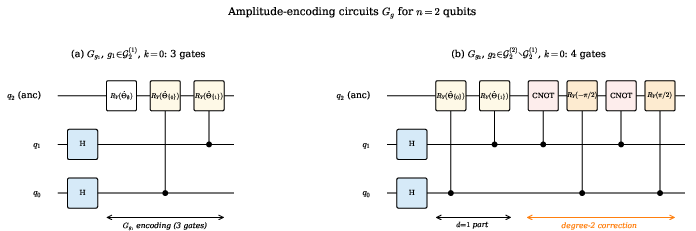
Figure 1: Amplitude-encoding circuits M4 for M5 qubits, M6. (a) M7 in M8 shows 3 single-controlled rotations; (b) M9 in Gn(d)0 adds a doubly-controlled gate, demonstrating the degree hierarchy.
This monomial-factorization is shown to be tight at Gn(d)1, with optimality for generic functions. For intermediate degrees, the gate count scales as Gn(d)2, and the degree of the angle map serves as a circuit-complexity exponent.
Depth-versus-Accuracy Trade-off and Separation Results
The paper combines the structural encoding results with classical discretization estimates to derive a comprehensive trade-off. For Gn(d)3, the total gate count to achieve Gn(d)4-accuracy is Gn(d)5, with constant success probability. For Gn(d)6, this scales as Gn(d)7, strictly improving upon classical Monte Carlo for all Gn(d)8.
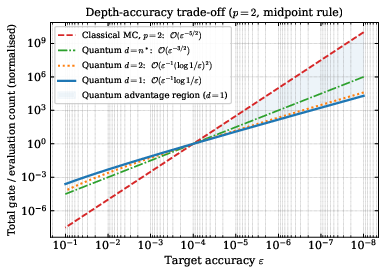
Figure 2: Depth-accuracy trade-off: total gate count (quantum) or evaluation count (classical) normalized to 1 at Gn(d)9, plotted against target accuracy for the midpoint rule.
A critical theoretical advance is the unconditional quantum–classical separation theorem: within Gn(d)0, there exist functions of Sobolev regularity Gn(d)1 that admit quantum encoding depth Gn(d)2 and total quantum cost Gn(d)3, while all classical algorithms require cost Gn(d)4. This separation is robust against rough function classes and does not depend on the smoothness of the integrand, highlighting structural independence between encoding complexity and classical approximation difficulty.
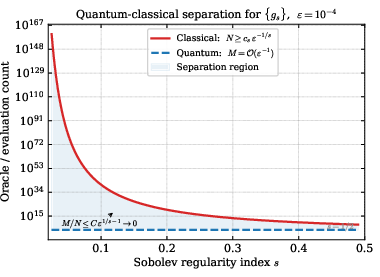
Figure 3: Quantum–classical separation for the family Gn(d)5 with Sobolev regularity Gn(d)6, showing constant quantum oracle cost and diverging classical evaluation count as Gn(d)7.
Practical Implications and Experimental Validation
The theoretical results are validated on two hardware platforms: SpinQ Triangulum (3-qubit NMR) and IBM Kingston (127-qubit superconducting). Circuits in Gn(d)8 execute successfully for Gn(d)9 on both platforms (g:Xn→[0,1]0 gates), while g:Xn→[0,1]1 encodings exceed the Triangulum coherence budget but execute on Kingston. This confirms the hierarchy as a practical hardware-feasibility criterion consistent with the circuit complexity predictions.
The ability to explicitly classify integrands by encoding degree enables algorithm designers to select quantum integration strategies with predictable resource requirements and to assess feasibility on a given device. The trade-off formulas guide qubit allocation and circuit construction and suggest that for applications such as quantum finance (e.g., Heston model kernels), efficient encodings can be achieved for relevant classes.
Theoretical Implications and Future Directions
From a complexity-theoretic perspective, the angle-structure hierarchy refines the oracle-model limitations by charging for amplitude oracle construction. It offers a stringent characterization of when the quantum statistical advantage translates into concrete computational gains for the full integration pipeline. The explicit separation for low-regularity functions exposes new avenues for quantum algorithms in integration and simulation tasks where classical techniques face fundamental barriers.
Potential future developments include:
- Tight bounds for gate counts at intermediate degrees (g:Xn→[0,1]2)
- Extension of the hierarchy to non-uniform grids and higher-order quadrature
- Application to multivariate and Markov-chain integrands, particularly in stochastic finance models
- Robustness analyses under realistic noise models, addressing depth-versus-accuracy under decoherence
- Direct analysis of cryptographic Boolean function classes via the Walsh-support framework
Conclusion
This work presents an explicit structural theory for quantum numerical integration by quantifying encoding complexity through the angle-map degree hierarchy. It bridges quantum statistical advantages and practical circuit costs, identifies explicit classes where overall quantum complexity is superior, and validates these findings experimentally. The hierarchy g:Xn→[0,1]3 provides a predictive framework for quantum integration algorithms, establishing both theoretical separation and practical feasibility thresholds. The results pave the way for principled algorithm design and complexity analysis in quantum numerical computation, with significant implications for integration tasks in quantum-enabled scientific computing.

