Published 29 Apr 2026 in quant-ph | (2604.26692v1)
Abstract: The containment of malware in computing networks may be naturally formulated as a network influence minimisation problem, in which one seeks to limit the expected spread of an infection while balancing the operational cost of disabling network connections. Classical approaches often rely on Monte Carlo simulation of stochastic diffusion processes and greedy optimisation over candidate edge removals, resulting in significant computational overhead due to repeated influence evaluations. In this work, we propose a hybrid quantum approach which combines Quantum Amplitude Estimation (QAE) and Grover Minimum Finding (GMF) to provide quadratic improvements in both the estimation and optimisation components of the problem. Specifically, QAE replaces classical Monte Carlo simulation, reducing the sampling complexity of influence estimation from $O(1/\varepsilon2)$ to $O(1/\varepsilon)$ for a target additive error $\varepsilon \ll 1$, while GMF reduces the number of candidate evaluations required to identify optimal edge removals from $O(|E_C|)$ to $O(\sqrt{|E_C|})$. We present a formal problem definition, describe the construction of the corresponding quantum oracles, and analyse the resulting complexity improvements under standard oracle assumptions. Preliminary experiments, including classical simulation of QAE and small-scale execution of Grover search on real quantum hardware, support the expected theoretical scaling. While practical implementation at scale requires fault-tolerant quantum devices, our results demonstrate that quantum algorithms offer a promising long-term direction for accelerating stochastic network optimisation problems such as malware containment.
The paper introduces a quantum approach that reduces sample complexity from O(1/ε²) to O(1/ε) using Quantum Amplitude Estimation.
It employs Grover Minimum Finding to achieve quadratic speedup in identifying optimal network interventions for malware containment.
Experimental simulations validate a 320× reduction in sample complexity along with sublinear search scaling, highlighting practical quantum advantages.
Quantum Optimization for Malware Containment: Complexity-Theoretic Advantages
Problem Formulation and Context
The fundamental challenge addressed in "Towards Quantum Optimised Malware Containment" (2604.26692) is the optimal containment of malware propagation within computer networks represented as probabilistic graphs. The problem formalizes malware control as a network influence minimization task, where the objective is to identify and remove edges (network connections) to simultaneously minimize expected infection spread and operational cost—quantified by a tunable parameter λ balancing security and disruption. Unlike blanket shutdowns, this combinatorial optimization aims for precise interventions, subject to practical risk appetites and cost-benefit constraints.
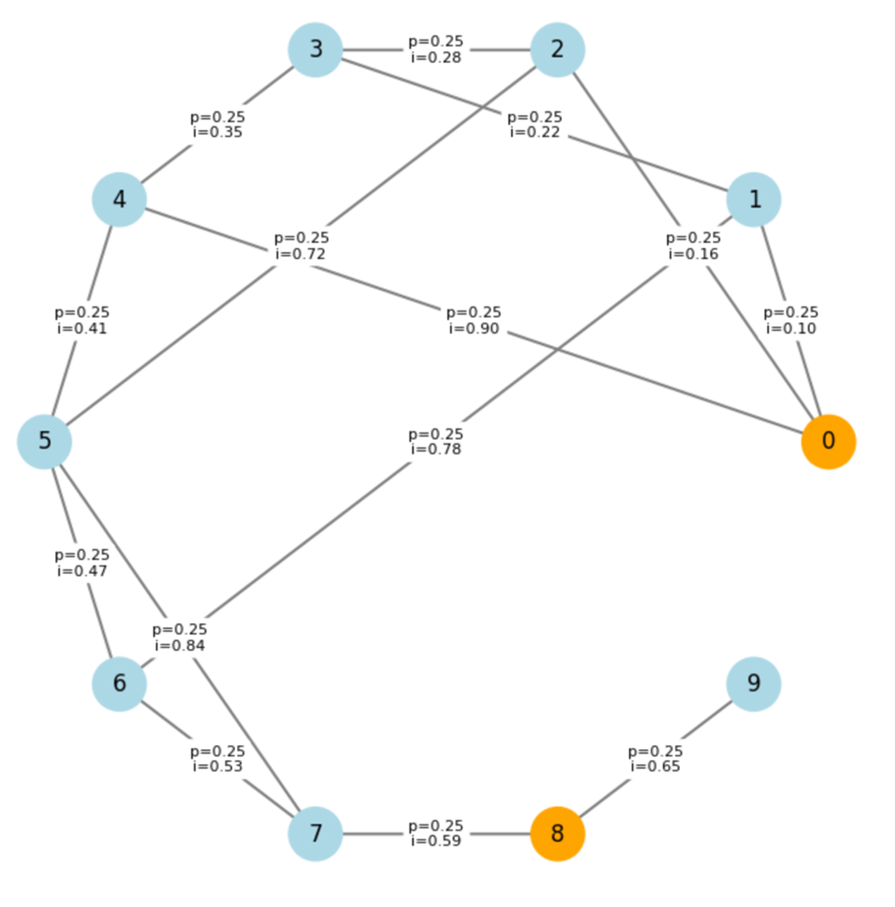
Figure 1: An example network with initial infected seed nodes (orange), per-edge activation probabilities, and operational importances.
The spread mechanism is modeled using the independent cascade (IC) diffusion process, necessitating repeated stochastic simulations to estimate expected influence. Traditionally, candidate interventions are evaluated via Monte Carlo (MC) sampling, incurring high computational costs O(1/ε2) per candidate for target accuracy ε. Each greedy optimization iteration further multiplies this cost by the number of candidates considered, compounding the overall runtime.
Quantum Algorithmic Framework
The proposed quantum workflow decomposes the classical bottleneck into two nested subproblems: (1) efficiently estimating the expected influence for a given intervention, and (2) efficiently searching for the intervention that minimizes the objective. The central contribution is the compositional use of two canonical quantum subroutines:
Quantum Amplitude Estimation (QAE): Reduces the sampling complexity for expectation estimation from O(1/ε2) to O(1/ε). QAE leverages coherent superposition and amplitude amplification to estimate the mean of a bounded random variable, here corresponding to residual network influence post-intervention.
Grover Minimum Finding (GMF): Transforms O(∣EC∣) classical search for the optimal candidate in the set EC to O(∣EC∣) quantum queries. GMF iteratively applies Grover search over candidates whose objective value improves upon the current minimum, capitalizing on quantum parallelism.
Crucially, GMF's applicability for the malware containment setting is predicated on efficient oracle access to candidate influences—which QAE supplies. The ability to encode the stochastic process into a reversible quantum circuit and subsequently estimate influence in superposition underpins the overall quadratic improvement.
Theoretical Complexity Gains
The classical and quantum computational complexities for k greedy steps, candidate set EC, and accuracy O(1/ε2)0 compare as follows:
Classical (IC/MC-baseline):
O(1/ε2)1
where O(1/ε2)2 is typically O(1/ε2)3.
Quantum (QAE + GMF):
O(1/ε2)4
where O(1/ε2)5 reflects the cost of coherent evaluation via the quantum oracle.
The improved scaling holds if O(1/ε2)6 permits practical evaluation on large graphs and with future fault-tolerant hardware. Theoretically, this yields quadratic speedup in both error and candidate search, a substantial improvement for large-scale stochastic combinatorial optimization.
Experimental Validation
Influence Estimation
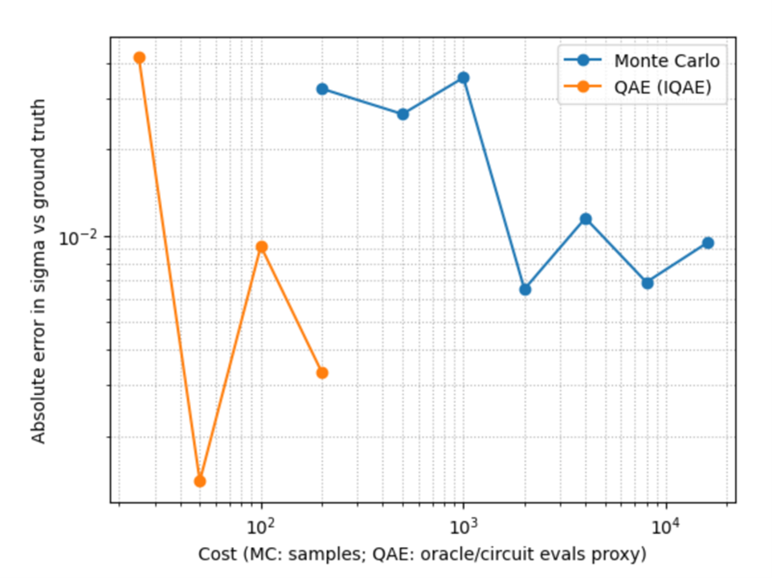
A simulation of QAE on small (O(1/ε2)7) node graphs demonstrates, at experimental scale, the anticipated quadratic advantage in influence estimation. With QAE, target estimation accuracy (e.g., O(1/ε2)8) is attained with 50 oracle calls compared to 16,000 MC runs by the IC/MC method, reflecting a O(1/ε2)9 reduction in sample complexity.
Figure 2: Estimation accuracy ε0 versus number of runs: MC (left) vs QAE (right).
These results align quantitatively with the theoretical shift from ε1 to ε2 sample scaling. However, QAE's practical runtime is not directly assessed due to classical simulation overhead and non-availability of large-scale, low-noise quantum hardware capable of implementing the necessary oracles.
Minimum Finding Search
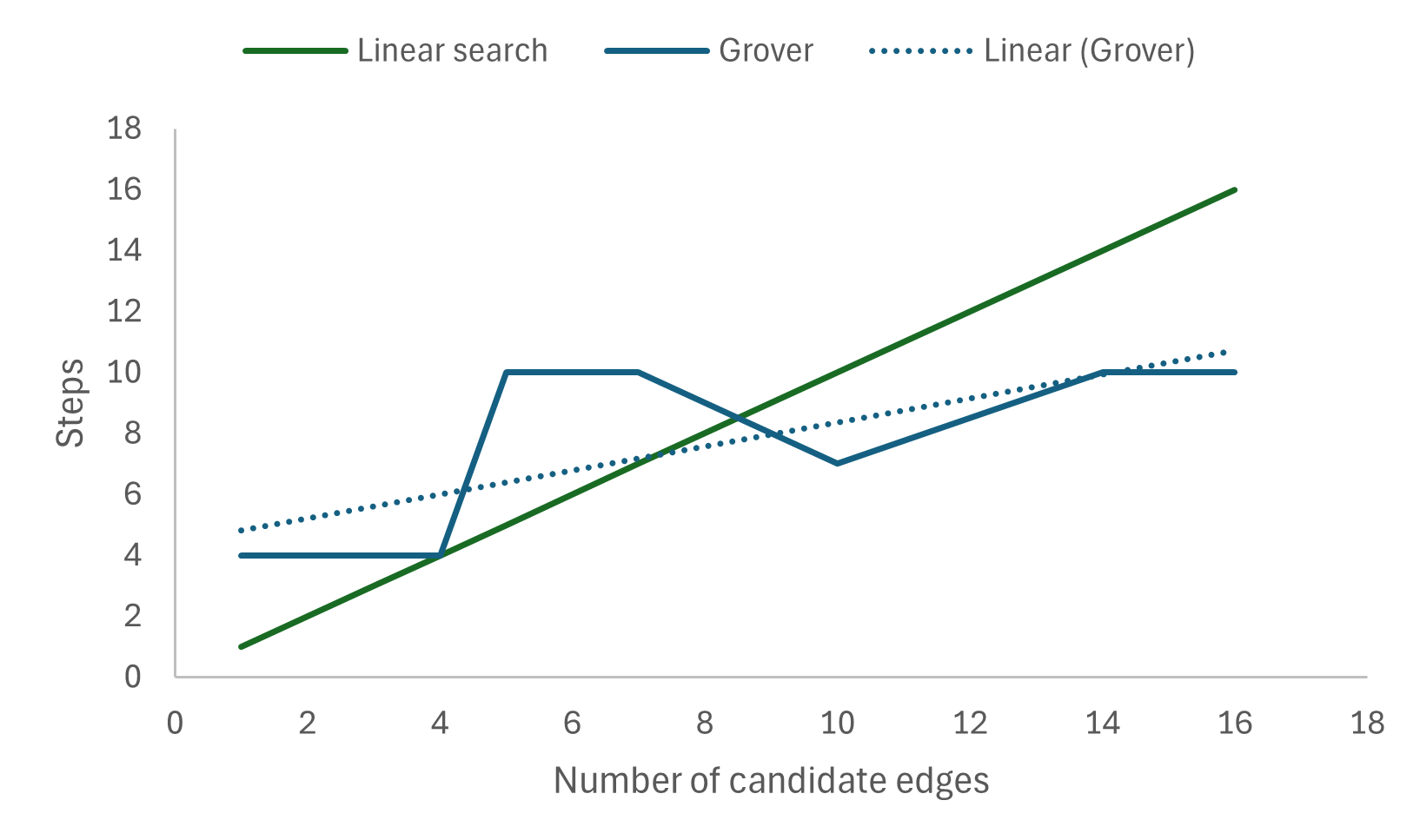
Grover Minimum Finding is evaluated independently, using precomputed influences to isolate the search speedup. Experiments on IBM's quantum hardware (for ε3–ε4 nodes, ε5–ε6 candidates) confirm the expected sublinear ε7 scaling in oracle calls relative to the linear classical baseline.
Figure 3: Steps required for minimum search: classical linear search vs Grover quantum search.
Again, while quantum oracle calls become expensive and noise-sensitive for realistic circuits, the observed scaling on physical hardware is consistent with the quadratic reduction, despite the noise and small-scale limitations imposed by current devices.
Practical and Theoretical Implications
Key numerical findings:
QAE achieves up to ε8 fewer samples than classical MC for fixed accuracy in small graph experiments, consistent with the predicted ε9 scaling.
GMF demonstrates a clear quadratic reduction in search steps even on present (albeit small) hardware.
Strong claims:
The composition of QAE and GMF establishes a quadratic improvement in computational complexity in both influence estimation and candidate search in the malware containment problem for the oracle model.
The practical runtime benefit is contingent not on asymptotic sample scaling alone, but on the circuit depth and error rates achievable for realistic graphs and models—thus, quantum advantage is provable in complexity, but not yet operational in runtime given today's NISQ devices.
Contradictions to classical approaches:
The work challenges the notion that MC-based influence estimation and large-scale combinatorial search on graphs must necessarily incur steep polynomial (in O(1/ε2)0 and O(1/ε2)1) costs, exposing these steps to quadratic improvements with quantum algorithms given suitable oracles.
Outlook and Future Directions
With anticipated advances in fault-tolerant quantum architectures [e.g., Nature 649, 39–46 (2026)] and robust error correction (Gottesman, 2022, Ostmann et al., 8 Oct 2025), the compositional quantum approach outlined here may become a viable strategy for malware containment and more broadly for influence minimization in stochastic networks. Immediate next steps include scalable quantum oracle synthesis for network diffusion, integrated error mitigation, and hybrid quantum-classical frameworks that could bridge pre-fault-tolerant regimes by offloading tractable subroutines to quantum hardware.
Practically, this line of research reframes computational bottlenecks in network optimization, suggesting that with feasible quantum circuits for real-world network structures and diffusion models, intervention strategies that are prohibitively expensive classically could become tractable.
Conclusion
This work formalizes malware containment as a quantum-accelerated network influence minimization problem, presenting a pipeline that integrates Quantum Amplitude Estimation and Grover Minimum Finding for quadratic gains in both influence estimation and candidate optimization. While constrained by current hardware, the compositional framework establishes a robust theoretical foundation for quantum-advantaged solutions in combinatorial stochastic network problems. As quantum devices mature, these methods are positioned to substantively impact the landscape of practical cybersecurity and network resilience optimization.
“Emergent Mind helps me see which AI papers have caught fire online.”
Philip
Creator, AI Explained on YouTube
Sign up for free to explore the frontiers of research
Discover trending papers, chat with arXiv, and track the latest research shaping the future of science and technology.Discover trending papers, chat with arXiv, and more.