- The paper introduces a universal algorithm that achieves optimal convergence rates in both randomized and deterministic high-dimensional integration settings.
- It leverages randomized lattice rules, prime selection, and the median trick to amplify probability and bypass smoothness assumptions.
- Empirical tests confirm near-optimal error decay over weighted Korobov spaces, ensuring robustness in black-box numerical integration.
Introduction
High-dimensional integration—particularly for functions over [0,1]d in weighted Korobov spaces—remains a central issue in computational mathematics, complexity theory, and uncertainty quantification. The paper "A simple universal algorithm for high-dimensional integration" (2411.19164) provides a universally near-optimal algorithm for both deterministic and randomized settings, independent of the dimension, leveraging randomized lattice rules, carefully selected primes, and the median trick for probability amplification. The analysis provides optimal error rates over weighted Korobov classes, regardless of the parameterization or smoothness assumptions, without requiring a priori knowledge of the integrand's structure. This essay outlines the paper’s contributions, the technical underpinnings, numerical validation, and implications for tractability theory and randomized numerical algorithms.
Problem Setting and Challenges
The goal is to approximate integrals of the form
Id(f)=∫[0,1]df(x)dx
for high-dimensional functions f. The integration models leverage reproducing kernel Hilbert spaces—specifically, weighted Korobov spaces of smoothness α>1/2—for theoretical tractability. Classical lattice rules depend critically on generating vectors tailored to assumptions about f, but in practical high-dimensional applications, these assumptions are rarely validated. Furthermore, deterministic approaches may underperform without precise tuning. Universal algorithms (not requiring knowledge of smoothness or weight structure) addressing both worst-case and randomized error are lacking.
Algorithmic Construction
The proposed algorithm is simple yet universal:
- For increasing n, sample N=2⌈h(n)log2n⌉+1 independent lattice rules.
- Each rule uses a random prime p from (n/2,n] and a vector z∈{1,…,p−1}d sampled uniformly.
- Evaluate each quadrature Qpz(f) on the integrand.
- Return the median as the estimate.
The function h(n) controls probability amplification and can be taken as slowly growing (e.g., h(n)=max(1,loglogn)). The median reduces error probability exponentially with N. This construction sidesteps the need for problem-dependent selection of p or z.
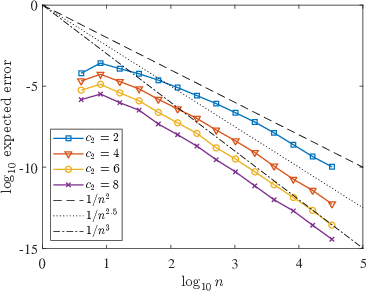
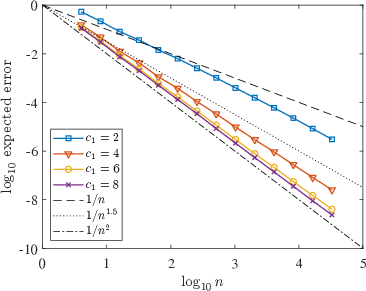
Figure 1: The function f1 illustrating the randomized error decay for d=20.
Theoretical Guarantees
The main theoretical findings are encapsulated as follows:
- Randomized Error Bound: For all α>1/2 and any product weights γj∈(0,1], the mean error decays as
ed,α,γran(Mn)≤Cn−α−1/2+ε
with C and the threshold n0 independent of d, provided the sum of γj1/α converges. This matches the known randomized tractability rates for these spaces.
- Deterministic Error Bound: With probability 1−n−h(n), the deterministic worst-case error satisfies
ed,α,γdet(Mn)≤Cn−α+ε
again non-asymptotic in d.
Both results are non-restrictive in the choice of weights (holding for both product and general weights) and depend only weakly on ε. The proofs combine probabilistic concentration via the median trick, probabilistic existence of good generating vectors, and extensions of classical lattice rule bounds.
Figure 2: The error behavior for f1 at d=20 for varying n.
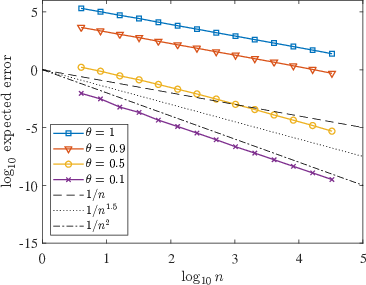
Figure 3: Results for the non-periodic test function at d=10 showing the impact of smoothness and weights on convergence.
Extension to Non-Periodic and Varying Smoothness
While the theoretical results target periodic functions (as is standard for lattice rules), the algorithm accommodates non-periodic functions through the tent transformation—mapping f nonlinearly onto a periodic extension without altering the integral. This technique yields similar convergence behavior for weighted half-period cosine spaces, extending universality at the cost of some intractability risks in very high dimensions (when using more elaborate transformations).
Numerical Results
The paper provides extensive empirical validation:
- Empirical Convergence Rates: For analytically smooth periodic benchmark functions (such as f1 and f2), the observed convergence aligns with the theoretical prediction. Rigorous regression shows mean errors decaying nearly as n−2 or better for highly smooth integrands in high dimensions (e.g., d=20,50).
- Behavior on Non-periodic Functions: For non-periodic f, the tent transformation allows the method to exploit available smoothness, achieving rates close to optimal as long as higher-dimensional smoothness and weights permit.
- Universality: The same randomized construction adapts automatically to the integrand, leveraging additional smoothness or decay structure without explicit user intervention or tuning.
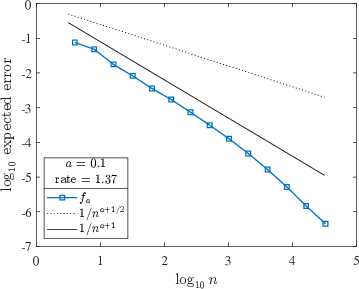
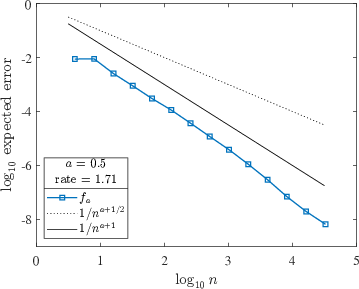
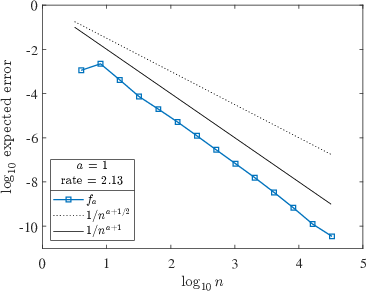
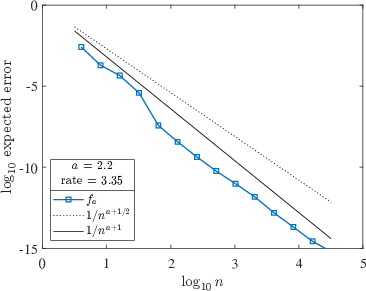
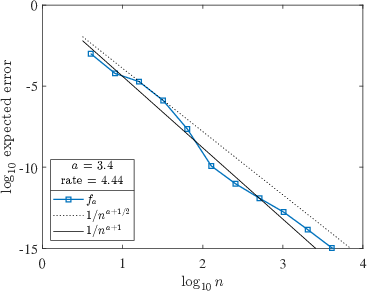
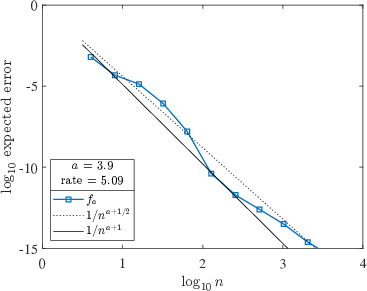
Figure 4: Error decay rates for the parameterized family fa,c with varying smoothness at a=0.1.
Figure 5: Randomized error convergence for a=0.1, demonstrating adaptability across different smoothness classes.
Implications and Future Directions
This work resolves a principal challenge in tractability theory: constructing explicit, simple, and universal algorithms whose error bounds do not degrade in high dimension, and whose performance is robust to unknown smoothness and weighting of the function space. The combined use of randomized primality selection, random generating vectors, and the median trick represents a robust recipe for universal randomized (and, with high probability, deterministic) integration in high dimensions.
The universality property—guaranteed error decay independent of the function class parameters—implies direct applicability in uncertainty quantification for PDEs, Bayesian inverse problems, and multiscale modeling. That no parameters require tuning by the practitioner renders the algorithm suitable for black-box scenarios pervading modern scientific computing.
Further prospects include rigorous quantitative analysis of the algorithm under different node transformations, exploration of alternative universality notions (including infinite smoothness or general reproducing kernels), and potential adaptation to integration over non-cubical domains, weighted measures, or more general quasi-Monte Carlo structures.
Conclusion
The median-of-randomized-lattice-rules algorithm described in "A simple universal algorithm for high-dimensional integration" (2411.19164) achieves order-optimal convergence in both randomized and deterministic error for high-dimensional integrals in weighted Korobov (and related) spaces, with error rates dimension-independent under mild decay conditions on the weights. Its universality, simplicity, and robust numerical behavior set a paradigm for black-box numerical integration in high-dimensional settings.

