Quantum Causal Discovery via Amplitude Estimation of Kullback-Leibler Divergence
Published 25 Apr 2026 in quant-ph | (2604.23451v1)
Abstract: Causal discovery from observational data underpins applications in finance, climate modeling, and machine learning. Constraint-based causal discovery reduces structure learning to a sequence of conditional independence (CI) tests, where each test decides independence by estimating conditional mutual information $I(X;Y \mid Z)$ to additive precision $τ$ and thresholding against it. Classically this requires $Θ(1/τ{2})$ samples per test, a cost that dominates in the high-precision regime typical of weak dependencies. We present QKLA (Quantum Kullback--Leibler Amplitude estimation), a quantum algorithm that encodes a clipped log-density ratio as a bounded amplitude and applies amplitude estimation to recover the KL divergence. Given coherent oracle access to the joint distribution, QKLA achieves a quadratic precision improvement, needing only $\mathcal{O}((L/τ)\log(1/δ))$ queries, where $L$ is the log-ratio clip bound. Embedded in the PC algorithm, this compounds to an $\widetildeΩ(1/(Lτ))$ reduction in total queries for the full causal discovery procedure. We validate the theory in three experiments. A gate-level state-vector simulation of the full QKLA circuit confirms the predicted $\mathcal{O}(1/M)$ error decay. Across $K=20$ random binary distributions, classical and quantum error scalings match theory to slope accuracy $\pm 0.005$. On two benchmark networks (\textsc{Asia}, 8 nodes; \textsc{Synthetic-12}, 12 nodes), quantum PC matches classical skeleton-recovery F1 while using $2.5$--$3.0\times$ fewer oracle queries at $τ= 5\cdot 10{-3}$ bits and up to $12\times$ fewer at $τ= 10{-3}$ bits.
The paper presents QKLA, a quantum algorithm that achieves quadratic precision speedup by directly encoding and estimating clipped KL divergence via quantum amplitude estimation.
It integrates the estimator into the PC algorithm, reducing the query complexity from O(1/τ²) to O(1/τ) and demonstrating significant efficiency gains.
Experimental validation confirms reduced query budgets and competitive F1 scores, highlighting the practical benefits of quantum causal discovery.
Quantum Causal Discovery via Amplitude Estimation of Kullback-Leibler Divergence
Problem Motivation and Algorithmic Framework
Constraint-based causal discovery, notably instantiated by the PC algorithm, fundamentally relies on the efficient and precise estimation of conditional independence (CI) via conditional mutual information (CMI), I(X;Y∣Z). Classical plug-in estimation scales prohibitively with sample complexity as O(1/τ2) for additive precision τ, which becomes especially problematic in the high-precision regime when distinguishing weak dependencies. The paper introduces QKLA (Quantum Kullback-Leibler Amplitude estimation), a quantum algorithm leveraging quantum amplitude estimation (QAE) for bounded-amplitude encoding of a clipped log-density ratio, facilitating the direct estimation of KL divergence.
QKLA operates in the quantum oracle model with unitary access to a joint distribution preparation oracle and a reversible arithmetic oracle for log-ratio calculations. By encoding the clipped log-ratio into a quantum amplitude and invoking QAE, the algorithm achieves quadratic improvement in precision, requiring only O((L/τ)log(1/δ)) queries (where L is the log-ratio clip bound and δ is the failure probability).
When QKLA is embedded as a CMI estimator within PC, the compounded quantum query complexity is O(nd+2rdL/τ) compared to the classical Ω(nd+2rd/τ2), yielding a quantum-to-classical complexity ratio of Ω(1/(Lτ)).
Quantum Encoding and Complexity Analysis
The amplitude encoding strategy is central: the log-density ratio, clipped to [−L,+L], is mapped to O(1/τ2)0 via O(1/τ2)1, with O(1/τ2)2 being the clipped log-ratio. The expectation O(1/τ2)3 is then extracted using QAE with rigorous error bounds. The per-call precision bound and query complexity are formalized, accounting for the clipping bias which is strictly controlled and typically negligible for well-behaved distributions.
Median amplification is used to drive the success probability to arbitrary levels at logarithmic overhead. Notably, the worst-case error scaling (when CI is near O(1/τ2)4) is acknowledged and handled explicitly.
Composition into Conditional Mutual Information and PC Algorithm
QKLA is systematically composed into QCMIE (Quantum CMI Estimator), which aggregates per-stratum clipped KL divergences weighted by their marginal probabilities. The per-test query complexity is O(1/τ2)5, where O(1/τ2)6 encapsulates the conditioning stratum cardinality.
This estimator is plugged into the PC algorithm, formalizing the total query cost for structure learning as O(1/τ2)7, with union-bounded success probability across CI tests for robust end-to-end correctness.
Experimental Validation
Three experiments validate the theoretical claims both at the gate-level and algorithmic level:
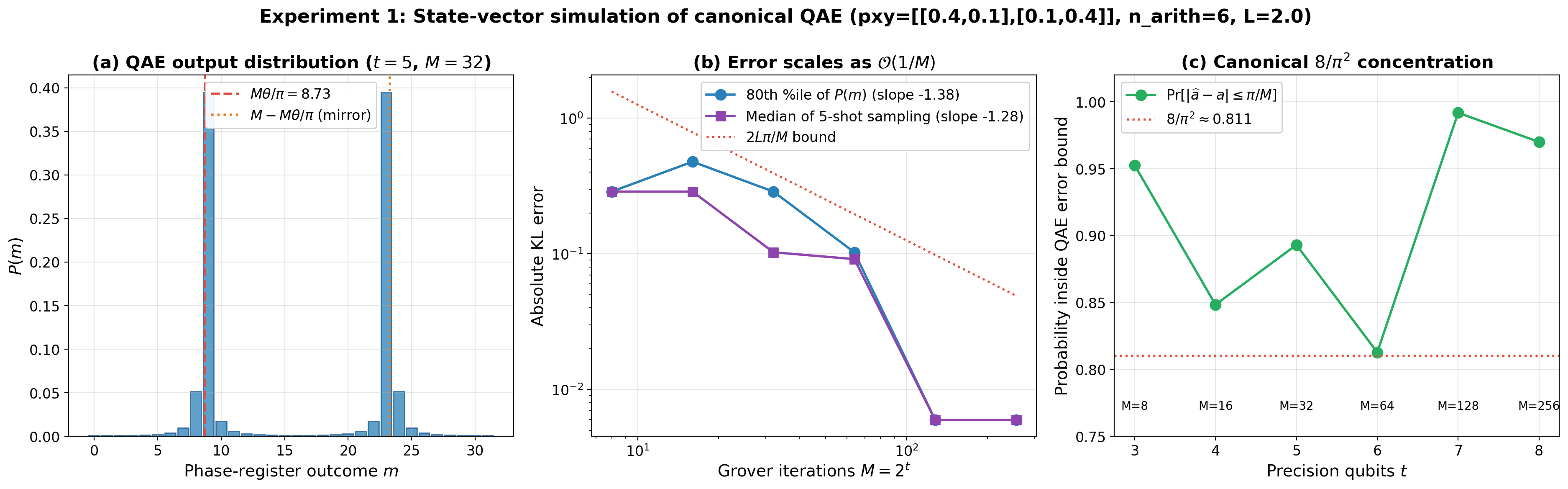
Experiment 1: Gate-level state-vector simulation of QKLA verifies circuit correctness, canonical QAE distribution, and O(1/τ2)8 error decay (where O(1/τ2)9 is the number of Grover iterations).
Figure 1: Gate-level state-vector simulation of the QKLA circuit on target τ0, confirming theoretical QAE output and error scaling.
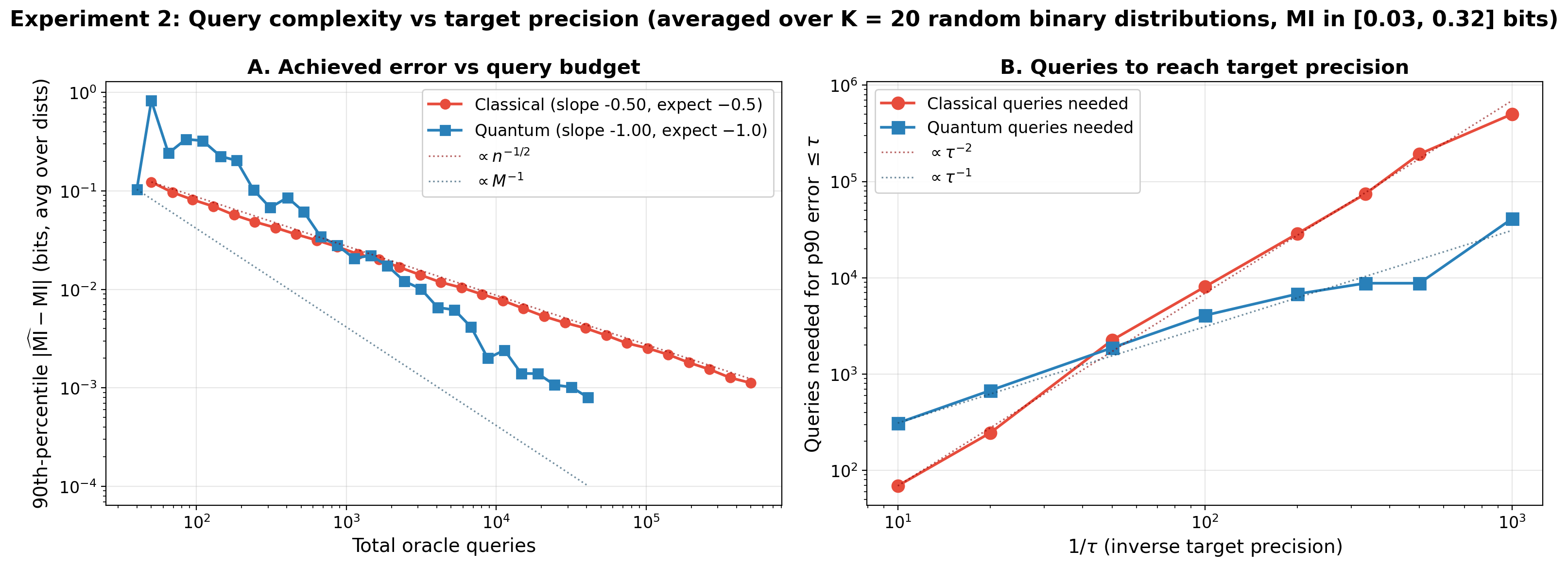
Experiment 2: Precision scaling is empirically measured by sweeping classical and quantum query budgets across τ1 random binary distributions; quantum error scales as τ2 and classical error as τ3, matching theory to within τ4. Crossover in query cost occurs at τ5 bits, with quantum requiring τ6 fewer queries at τ7 bits and up to τ8 fewer at τ9 bits.
Figure 2: Empirical scaling exponent comparison between classical and quantum query budgets, showing the quadratic quantum advantage.
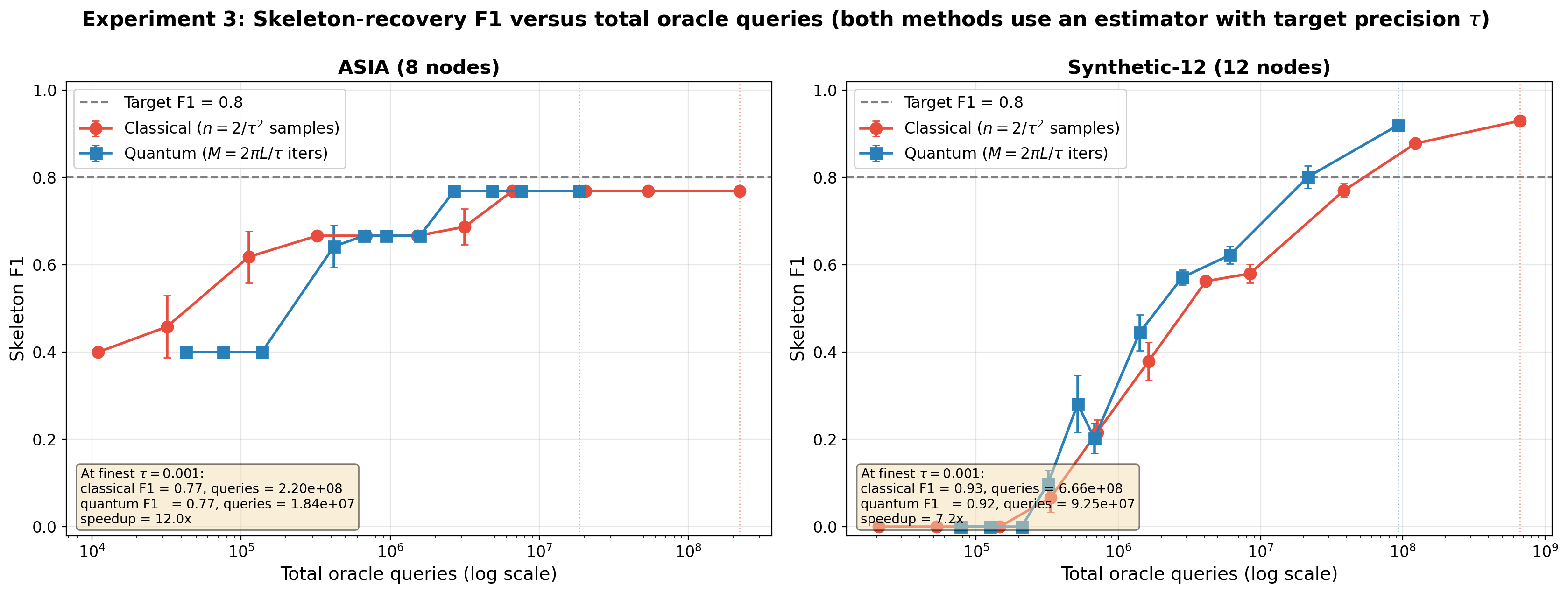
Experiment 3: Full PC algorithm runs on benchmark networks (Asia, Synthetic-12). Quantum PC achieves F1 performance comparable to classical, but with significantly reduced queries: O((L/τ)log(1/δ))0-O((L/τ)log(1/δ))1 fewer at O((L/τ)log(1/δ))2 bits, and up to O((L/τ)log(1/δ))3 fewer at O((L/τ)log(1/δ))4 bits.
Figure 3: PC skeleton-recovery F1 score versus total oracle queries, highlighting quantum query efficiency over classical baselines.
Comparisons, Related Work, and Implications
The presented oracle model diverges from prior quantum KL-divergence estimation, which typically relies on separate sampling-oracle access and cascaded amplitude estimation or quantum Monte Carlo—a regime optimal for large alphabets but suboptimal for high-precision, fixed-alphabet CMI estimation relevant to constraint-based discovery. QKLA’s explicit log-ratio clip and coherent arithmetic oracle enable precision scaling unattainable by those prior methods.
Quantum causal discovery approaches based on process matrices or quantum kernels address fundamentally different settings (quantum events or continuous-variable data) and do not establish per-test precision-based speedup bounds.
The practical implications are clear: QKLA delivers a rigorous quadratic reduction in oracle query complexity for PC-style constraint-based discovery in the high-precision regime, with all governing constants explicit. Circuit depth and oracle preparation costs are shown to be amortizable, making the method feasible for nontrivial causal graph sizes.
Future Directions
Tightening error bounds near O((L/τ)log(1/δ))5 and variance-adaptive QAE variants may improve constants.
Further reduction of the O((L/τ)log(1/δ))6 factor via data-adaptive clipping or alternative amplitude encoding is an open problem.
Extending quantum speedup guarantees to hypothesis-test-based CI or kernel-based tests merits investigation.
Quantum-enhanced causal discovery may be expanded to continuous variables and large-scale graphical models as circuit technology matures.
Conclusion
The quantum causal discovery algorithm QKLA, by encoding KL divergence into bounded amplitude and exploiting quantum amplitude estimation, achieves quadratic precision speedup in oracle query complexity for constraint-based structure learning, explicitly quantified and validated experimentally. When composed into CMI estimation and the PC algorithm, it offers a practical reduction in queries for high-precision causal discovery, with precise error control and robust scaling confirmed across benchmark networks.
“Emergent Mind helps me see which AI papers have caught fire online.”
Philip
Creator, AI Explained on YouTube
Sign up for free to explore the frontiers of research
Discover trending papers, chat with arXiv, and track the latest research shaping the future of science and technology.Discover trending papers, chat with arXiv, and more.