- The paper establishes the optimal asymptotic order of quadrature error for functions in fractional Gaussian Sobolev spaces with dominating mixed smoothness.
- It constructs explicit quadrature schemes that achieve n^{-s} convergence rates, validated through numerical experiments in Hermite spaces.
- The work reveals the equivalence between fractional Gaussian Sobolev and weighted Hermite spaces in L2, linking spectral theory with integration error analysis.
Optimal Numerical Integration for Functions in Fractional Gaussian Sobolev Spaces
Introduction and Problem Statement
The paper "Optimal numerical integration for functions in fractional Gaussian Sobolev spaces" (2604.03659) analyzes the construction and optimality of quadrature rules for the numerical integration of functions in multi-dimensional fractional Gaussian Sobolev spaces with dominating mixed smoothness. The primary focus is on function spaces Wps(Rd,γ) and Wp,Gs(Rd,γ), defined with respect to the standard Gaussian measure and formulated using a kernel associated with the fractional Ornstein-Uhlenbeck operator. These spaces generalize classical Sobolev (and Besov) spaces to the Gaussian-weighted Rd setting and encapsulate both integer and fractional smoothness regimes.
The core contribution lies in establishing the asymptotic order of the worst-case error for linear quadrature rules when integrating functions from these spaces, and in constructing quadrature schemes that achieve optimal convergence rates. Additionally, the paper reveals the equivalence between fractional Gaussian Sobolev spaces with p=2 and weighted Hermite spaces, providing a direct link between Sobolev regularity and Fourier-Hermite expansion decay.
Mathematical and Functional Setup
Consider the integral
Iγ(f)=∫Rdf(x)dγ(x)=∫Rdf(x)ρ(x)dx
where γ is the standard d-dimensional Gaussian measure and ρ(x)=(2π)−d/2exp(−∥x∥2/2). The integration is considered for functions f belonging to fractional Gaussian Sobolev spaces Wps(Rd,γ), characterized by dominating mixed smoothness Wp,Gs(Rd,γ)0, Wp,Gs(Rd,γ)1, and formulated using the spectral properties of the Ornstein-Uhlenbeck operator.
A (linear) quadrature rule for approximating Wp,Gs(Rd,γ)2 is
Wp,Gs(Rd,γ)3
with nodes Wp,Gs(Rd,γ)4 and weights Wp,Gs(Rd,γ)5. The worst-case error over the unit ball Wp,Gs(Rd,γ)6 is
Wp,Gs(Rd,γ)7
where the infimum runs over all quadrature formulas of the above form. The fundamental objective is the determination of the optimal rate of decay of Wp,Gs(Rd,γ)8 as Wp,Gs(Rd,γ)9 and the explicit construction of quadratures that achieve this rate.
Characterization of Function Spaces
Fractional Gaussian Sobolev and Hermite Spaces
The paper rigorously defines Rd0 via difference and kernel seminorms, linking fractional smoothness to difference operators weighted by kernels derived from powers of the Ornstein-Uhlenbeck semigroup. An essential result is that for Rd1, these spaces coincide with Hermite spaces Rd2, whose elements are characterized by Fourier-Hermite coefficients Rd3 satisfying a weighted Rd4-summability condition:
Rd5
The orthogonality and eigenfunction structure of the Hermite polynomials under both the Gaussian Rd6 inner product and applications of fractional powers of the Ornstein-Uhlenbeck operator are crucial in the linkage of these two formalisms.
Relationship with Classical Sobolev Spaces
The connection to classical Sobolev and Besov-type spaces is articulated via covering Rd7 by cubes and employing local-to-global constructions for the quadrature and function space norm estimation, showing that the decay rates for integration error in the Gaussian case match those for the unit cube up to logarithmic factors.
Main Results: Optimal Rates and Quadrature Construction
For the class of fractional Gaussian Sobolev spaces Rd8 with dominating mixed smoothness, Rd9, p=20, p=21, the following asymptotic rate is established for the worst-case integration error:
p=22
This rate holds for quadratures with p=23 nodes, matching up to constants the lower bounds constructed using localized “fooling functions” and upper bounds via the integration rule assembly method.
The same order holds for fractional spaces defined with the Gagliardo seminorm (p=24), notably for p=25. For Hermite spaces, the order for p=26 is
p=27
A key contribution is the construction of explicit quadrature rules that assemble optimal cubature formulas defined on unit cubes into a global quadrature on p=28. This construction preserves the optimal convergence rate and results in node densities that decay exponentially away from the origin, matching the Gaussian measure's decay.
Numerical Verification
Numerical experiments in the paper, focused on the univariate case with various values of p=29, validate the predicted convergence rate of the worst-case quadrature error.
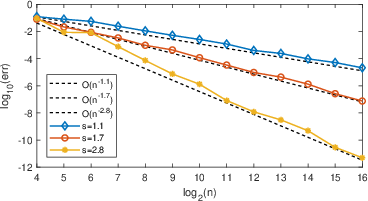
Figure 1: Worst-case error of numerical integration for functions in Hermite spaces.
Theoretical and Practical Implications
The established rates provide a comprehensive solution to the optimal integration error for a broad class of mixed smoothness spaces equipped with Gaussian weights. The identification of Hermite spaces with fractional Sobolev spaces in the Iγ(f)=∫Rdf(x)dγ(x)=∫Rdf(x)ρ(x)dx0-Gaussian setting links the functional-analytic properties of these spaces to their spectral decomposition, facilitating both theoretical analysis and computational implementation.
On a practical level, the concrete quadrature assembly strategy enables construction of highly efficient, near-optimal cubature rules for Gaussian-weighted multivariate integration, relevant in high-dimensional uncertainty quantification, Bayesian computation, and the numerical solution of PDEs with random inputs.
Theoretically, the equivalence of convergence rates for Gaussian Sobolev spaces and unit cube Sobolev spaces reveals a robustness of sparse grid and higher order quasi-Monte Carlo techniques when extended to unbounded domains with exponentially decaying measures. It also ties the analysis of information complexity and tractability in high dimensions to spectral properties of underlying operators and function expansions.
Future Directions
Further investigation may include the following:
- Extending the analysis to the dependence on the dimension Iγ(f)=∫Rdf(x)dγ(x)=∫Rdf(x)ρ(x)dx1 with a focus on tractability and breaking the curse of dimensionality.
- Studying similar optimal rates and quadrature constructions for more general measures, such as anisotropic Gaussian, or for non-product or non-uniform measures relevant to applications in physics and finance.
- Designing adaptive or randomized integration schemes with theoretical guarantees based on fractional Sobolev/Hermite space membership.
Additionally, linking these results to kernel-based and machine learning integration methods could provide further pathways for the incorporation of operator- or spectrum-structured quadrature techniques in data-driven models.
Conclusion
This work rigorously determines the asymptotically optimal rate for worst-case integration error and provides explicit quadrature constructions for functions in fractional Gaussian Sobolev spaces with mixed smoothness and their Iγ(f)=∫Rdf(x)dγ(x)=∫Rdf(x)ρ(x)dx2 equivalence with Hermite spaces. The results bridge modern information-based numerical analysis with spectral theory and provide both comprehensive theoretical insight and computationally relevant quadrature schemes for Gaussian-weighted integration on Iγ(f)=∫Rdf(x)dγ(x)=∫Rdf(x)ρ(x)dx3.

