- The paper introduces an explicit flow ansatz for the Hubble parameter that reconciles a Weyl-flat null origin with observational CMB parameters.
- It employs a parametrization of ε(N) that smoothly transitions from a conformally flat past to a slow-roll shelf, yielding predictive results for nₛ and r.
- The analysis implies that minimal deformation in the early universe does not rigidly dictate observable phenomenology, allowing standard reheating dynamics.
Inflation from a Weyl-flat Null Origin: A Technical Assessment
Asymptotic Weyl-flat Null Origin and Its Inflationary Realization
"Inflation from a Weyl-flat null origin" (2604.18641) systematically investigates whether a Penrose-compatible Weyl-flat initial condition for the universe—a state characterized by vanishing Weyl curvature and thus minimal gravitational entropy—can be reconciled with observational constraints within canonical single-field inflation. The study reframes the original conceptual debate not as a question of whether exact power-law inflation is compatible with data, but as whether the asymptotic property of the spacetime—ϵ(N)→ϵ∞∈(0,1) as N→∞, with N the number of e-folds to the end of inflation—can generate viable CMB phenomenology through controlled, finite-N deformations of the background flow.
This approach establishes that the geometric legacy of the Weyl-flat null origin is encoded in an asymptotic universality class rather than a rigid field-space profile, opening a broad yet constrained set of inflaton flows connecting null-incomplete, conformally flat past boundaries to realistic values of the spectral tilt ns and the tensor-to-scalar ratio r.
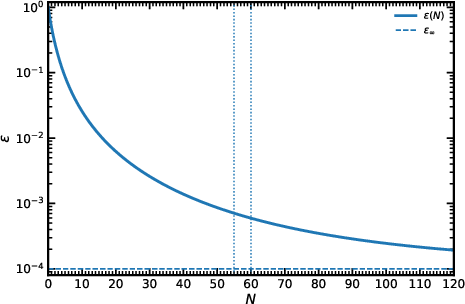
Figure 1: Flow profile for benchmark A, (ϵ∞,N0,p)=(10−4,3,5/2); the asymptotic regime is set by ϵ∞, and smooth exit, ϵ(0)=1, occurs automatically.
The crux of the framework is an explicit flow ansatz for the Hubble-flow parameter:
ϵ(N)=ϵ∞+(1−ϵ∞)(N+N0N0)p,p>1,
which interpolates smoothly from an arbitrary past attractor class to slow-roll shelves and a graceful exit at N→∞0. Here, N→∞1 governs the asymptotic power-law behavior and hence the Weyl-flat null origin, N→∞2 the location of the departure from this attractor, and N→∞3 the sharpness of this transition. Notably, inflation terminates naturally without recourse to auxiliary exit mechanisms or abrupt potential features.
The proposition proved in the paper rigorously isolates the conditions under which the FRW background remains Weyl-flat and approaches a power-law inflation regime, even as local departures—governing CMB observables—are permitted through higher-order terms in N→∞4. The flow-based reconstruction is both necessary and sufficient; explicit integration confirms that the past boundary is a null hypersurface (N→∞5), and the field-space potential asymptotes to an exponential in the remote past.
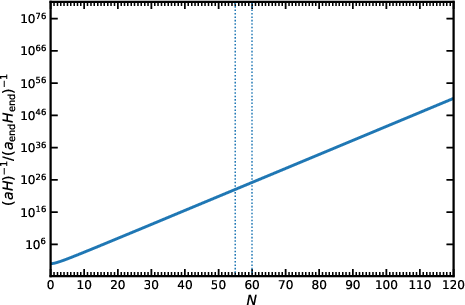
Figure 2: Comoving Hubble radius decreases monotonically, confirming sustained accelerated expansion up to the exit.
Field-space Dynamics and Structure
The reconstructed potential exhibits a tripartite structure: an asymptotic exponential tail (N→∞6), a slow-roll shelf in the observable window, and rapid steepening towards the end of inflation. These features are completely determined by the N→∞7-space flow, not ad hoc in field space.
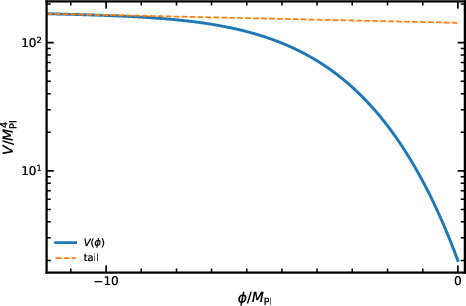
Figure 3: Reconstructed potential for benchmark A; the exponential tail matches the proposition, while the shelf and steepening arise dynamically from the flow.
This structure demonstrates that the far-past inflationary geometry—the Weyl-flat null origin—does not rigidly determine the properties of the observable perturbations. Instead, the phenomenological freedom is localized within a finite e-fold interval, offering an explicit realization of separation between ultraviolet initial data and IR observables.
Power Spectra: Precision Results and Observational Constraints
The scalar and tensor perturbations are solved exactly via mode equations in e-folds, eschewing the lowest-order slow-roll approximation and ensuring fidelity to the underlying background:
N→∞8
(based on benchmark A, N→∞9).
This places the model well within the most stringent CMB constraints, with the tensor amplitude N0 in the range N1 to N2, and the inflationary scale N3 GeV. The scalar spectral index and its running and the tensor tilt match canonical expectations but are derived without recourse to slow-roll approximations.
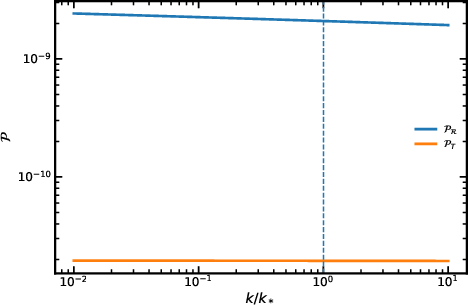
Figure 4: Numerical scalar and tensor spectra demonstrating near power-law behavior across the crucial CMB window.
Parameter Space, Observational Viability, and Reheating
A comprehensive scan over N4 at fixed N5 shows that the Weyl-flat null origin leads to an extended, not isolated, corridor of viable models in the N6 plane, with N7 not suppressed to zero. This is a bold claim that directly challenges the widespread assumption that power-law (Weyl-flat) pasts necessarily overshoot CMB bounds.
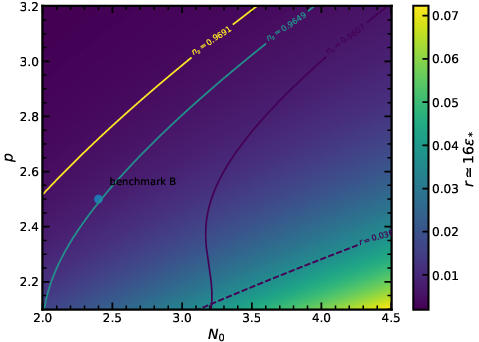
Figure 5: Structure of the parameter space displaying a wide viable corridor for N8 and N9.
Explicit reheating diagnostics are performed, resulting in conventional reheating durations and temperatures for appropriately tuned benchmarks (see benchmark B: N0), confirming that the model can accommodate standard post-inflationary thermal histories.
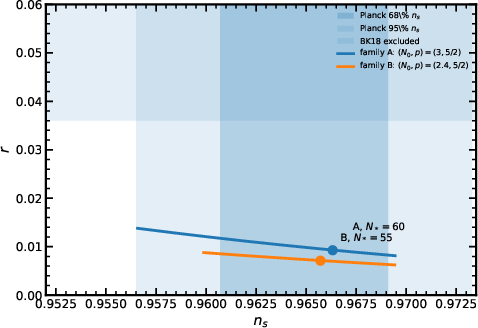
Figure 6: Observable families in the N1 plane by varying N2, delineating the (benchmark-dependent) viable regions.
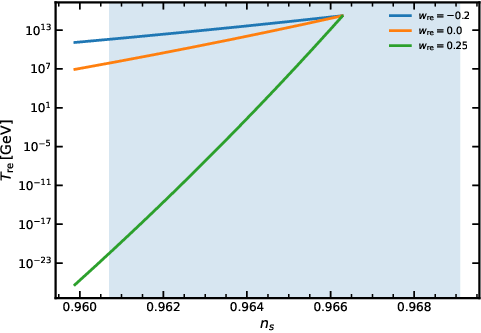
Figure 7: Reheating map for benchmark family B; the Planck N3 region coincides with positive N4 and thermal histories spanning N5 GeV.
Theoretical Implications and Directions for Further Research
The construction explicitly decouples the geometric (asymptotic) content of the initial singularity from the phenomenological predictions accessible to cosmological observations. The model demonstrates that low Weyl curvature at the origin—Penrose's hypothesis—does not overdetermine, nor does it unduly restrict, inflationary predictions in the CMB window. Instead, the observable phenomenology is governed by controlled, finite-N6 deviations from the attractor class.
The formalism enables further extensions:
- Analysis of the stability of the Weyl-flat property under anisotropic or inhomogeneous perturbations.
- Non-adiabatic initial quantum states and their compatibility with the null-origin scenario.
- Embedding in models with rich post-inflationary dynamics or additional sectors (axionic, gauge, etc.).
- Constraints on inflationary universality classes based on their asymptotic geometric origin rather than only near-horizon-pivot local potential shapes.
Open questions remain regarding the UV-completion of the reheating sector and the quantum selection of the initial vacuum state, with the present construction providing a sharply defined background for future investigation.
Conclusion
The paper provides a rigorous demonstration that a canonical single-field inflation model with a Weyl-flat null origin is not only compatible with but naturally accommodates modern observational data. The explicit ansatz and reconstruction show that the Planck-preferred N7 and the currently allowed range of N8 can emerge from an asymptotically power-law, conformally flat past, provided finite-N9 deformations are admitted. Consequently, the geometric initial condition shapes but does not straitjacket observable phenomenology, and strong constraints on the tensor amplitude ns0 in future CMB and B-mode data will directly test this asymptotically motivated corridor. This framework opens precise avenues for analytic and numerical study at the intersection of geometry, dynamics, and cosmological data.

