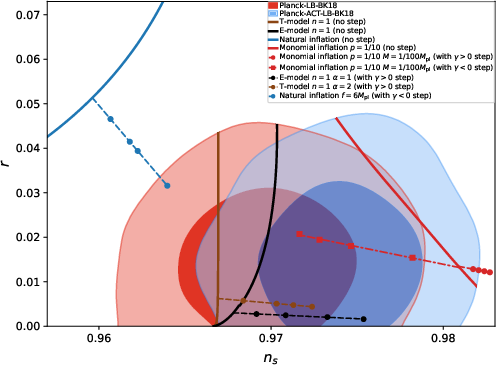
- The paper introduces minimal, localized step deformations in the inflaton potential that shift the field value at horizon exit to adjust the inflationary parameters nₛ and r.
- It employs a smooth step parametrization using parameters γ, φ₍c₎, and Δφ under slow-roll conditions to indirectly modify the observable CMB predictions.
- Results demonstrate that the approach reconciles plateau and monomial models with ACT-favored data, while revealing limitations for natural inflation.
Localized Steps and ACT-Favored Single-Field Inflation
Introduction
Recent data from the Atacama Cosmology Telescope (ACT), when combined with Planck and DESI, indicate a scalar spectral index ns significantly larger than the Planck-only value, directly confronting the microphysical viability of dominant single-field slow-roll inflationary models. The work "Localized Steps toward ACT-Favored Inflation" (2604.02148) systematically analyzes a class of phenomenological step-like deformations in the inflaton potential as minimal modifications that can reconcile canonical single-field inflation with the new data, particularly in the (ns,r) plane.
Step-Modulated Inflationary Dynamics
The formalism considers single-field models with canonical kinetic terms in the Einstein frame, introducing a smooth, localized step in the inflaton potential parameterized as V(ϕ)=V0(ϕ)ξ(ϕ), with ξ(ϕ)=1+γtanh[(ϕ−ϕc)/Δϕ]. The key parameters are the amplitude γ, location ϕc, and width Δϕ. All computations are performed under the quasi-de Sitter, slow-roll regime. The conditions ∣γ∣≪1 and Δϕ≪∣ϕ∗−ϕe∣ ensure that the deformation remains localized, preserves control over slow-roll parameters, and does not directly imprint sharp features in the CMB power spectrum at observable scales.
The principal mechanism operates via a localized change in the rolling rate of the inflaton as it traverses the step, resulting in a nontrivial remapping between the field value ϕ∗ at CMB horizon exit and the (ns,r)0-fold number (ns,r)1, with fixed total duration of inflation.
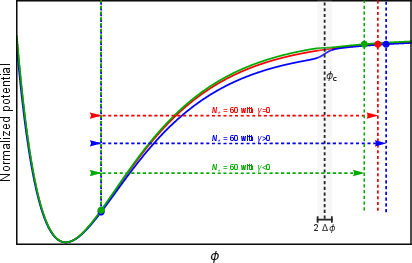
Figure 1: Starobinsky potentials with different step signs, indicating the shift in field value (ns,r)2 for a fixed number of (ns,r)3-folds ((ns,r)4).
Importantly, prior to reaching the step, the CMB modes evolve as in the unmodified model due to the exponential suppression of step derivatives, leaving CMB-scale slow-roll parameters unaltered at leading order. The shift in (ns,r)5 is entirely indirect, originating from a displacement of (ns,r)6 induced by the redistribution of (ns,r)7-folds across the potential.
For a steepening step ((ns,r)8), the field traverses the step region more rapidly, reducing the local (ns,r)9-fold count. Consequently, V(ϕ)=V0(ϕ)ξ(ϕ)0 is shifted toward a flatter section of the potential. Conversely, a flattening step (V(ϕ)=V0(ϕ)ξ(ϕ)1) increases V(ϕ)=V0(ϕ)ξ(ϕ)2-folds locally and shifts V(ϕ)=V0(ϕ)ξ(ϕ)3 toward a steeper region. The sign and localization of the step thus modulate the prediction within the V(ϕ)=V0(ϕ)ξ(ϕ)4 parameter space with high parametric control.
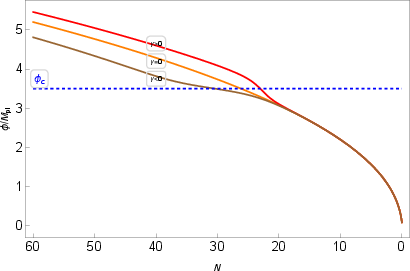
Figure 2: Evolution of the inflaton field V(ϕ)=V0(ϕ)ξ(ϕ)5 versus V(ϕ)=V0(ϕ)ξ(ϕ)6-folds V(ϕ)=V0(ϕ)ξ(ϕ)7 for a monomial potential with different step amplitudes, illustrating the field value shift at V(ϕ)=V0(ϕ)ξ(ϕ)8.
Comparison with Planck and ACT Observations
Application of the framework focuses on representative inflationary potentials: monomial models, V(ϕ)=V0(ϕ)ξ(ϕ)9-attractor plateau models (both T and E types), and natural inflation. Benchmarks are chosen to ensure the step remains non-intrusive at CMB scales and that slow-roll remains valid.
Quantitatively, for plateau models, step modulation extends the viable region in γ4, producing a shift γ5 for γ6, matching the ACT-induced preference.
Implications and Future Prospects
The proposed mechanism offers a minimal and technically natural way to accommodate tension arising from high-precision CMB observations by exploiting otherwise unobservable, localized features in the potential. The approach does not invoke modifications to gravity, nonminimal couplings, or reheating scenarios, allowing sharp, controlled theoretical error estimates. Its primary limitation is the absence of microphysical justification for the step’s origin, which remains a phenomenological parameterization—though such features could arise from phase transitions, particle thresholds, or moduli stabilization in UV-complete theories.
The effect is model-dependent and tightly constrained; for models structurally unable to reach the ACT-favored region (e.g., natural inflation), the mechanism is inadequate, highlighting the discriminatory power of precise γ7 measurements. Future CMB polarization experiments and improved γ8-bounds will further constrict allowed modulations and may distinguish minimal deformation signatures, especially when combined with non-Gaussianity and reheating signatures.
Conclusion
A localized step in the inflaton potential can remap the field value at horizon exit for observable CMB scales and thereby shift the inflationary predictions in a controlled, model-dependent manner. For plateau and monomial models, this modulation is sufficient to restore agreement with combined Planck, ACT, and BICEP/Keck constraints. However, natural inflation remains outside the preferred parameter space regardless of step deformation. This analysis underscores the utility of minimal, UV-agnostic phenomenological modifications, while motivating their microphysical origin as a focus of future theoretical work.