An Analytic Formalism of Inflation for Derivative Coupled Scalar Field and Validating its predictions for Some Inflationary Potentials
Published 11 Apr 2026 in astro-ph.CO, gr-qc, hep-ph, and hep-th | (2604.10148v1)
Abstract: One of the fundamental objectives of contemporary cosmology is to understand the physics of the inflationary universe, owing to its observably verifiable predictions about the very early universe with an energy scale of $\sim 10{16}$ GeV. Recent observations from the ACT and the Planck mission, constrain the values of the scalar spectral index, $n_s$, and the tensor-to-scalar ratio, with state-of-the-art accuracy and upper limits, respectively. In the current work, a type of non minimally coupled inflationary model in which the gravity and the background scalar field interact through a covariant product of the Ricci tensor and derivatives of the scalar field. With this interaction at the backdrop, we estimate $n_s$ and $r$ for a wide range of inflaton self-interaction potentials, including power law, exponential $α$ attractor, Arctan, Hilltop, and polynomial model. We show that the higher derivative terms involving the scalar field resulting from the derivative coupling term can be handled without facing any singularity within the slow-roll regime. We show that it is possible to produce $n_s$ and $r$ values consistent with ACT and Planck observations for each of the chosen sets of potentials for the derivative coupled action.
The paper introduces an analytic formalism for inflation with non-minimal derivative coupling (NMDC) to the Ricci tensor, addressing higher friction effects in the slow-roll regime.
It employs both analytic and numerical methods to derive predictions for inflationary observables like the scalar spectral index (nₛ) and tensor-to-scalar ratio (r) across various potential models.
The study validates the NMDC framework against recent CMB data, demonstrating that plateau-like potentials yield observationally viable predictions while steep power-law models are disfavored.
Analytic Formalism for Inflation with Derivative Coupled Scalar Fields: Theoretical Development and Observational Constraints
Introduction
This work develops a comprehensive analytic formalism for inflationary cosmology with a scalar field exhibiting a non-minimal derivative coupling (NMDC) to the Ricci tensor, Rμν, focusing on implications within the slow-roll regime. The motivation is grounded in recent CMB observations, notably the latest ACT DR6 and Planck data, which show a mild but persistent trend toward a higher scalar spectral index ns, questioning the viability of many traditional inflationary potentials. By coupling the kinetic term to curvature—specifically through a Ricci tensor contraction—this model introduces modified friction in the inflaton dynamics, potentially reconciling fast-roll potentials with current constraints on ns and the tensor-to-scalar ratio r. The formalism is validated for several widely considered inflationary potentials, both analytically (power-law) and numerically (exponential α-attractor, arctan, hilltop, polynomial attractor), against the most recent cosmological datasets.
Theoretical Framework
The action under consideration extends the Einstein-Hilbert action by coupling the kinetic term of the scalar field ϕ to the Ricci tensor:
S=21∫d4x−g[R−gμν∂μϕ∂νϕ−λ21Rμν∂μϕ∂νϕ−2V(ϕ)]
Here, 1/λ2 is the coupling constant, dictating the strength of NMDC. The coupling term introduces higher derivative corrections into the field equations. However, under slow-roll and high friction assumptions (C=K/λ2≫1), the analysis shows that problematic higher derivatives are suppressed or effectively negligible, permitting consistent slow-roll inflationary solutions.
The slow-roll parameters—ϵ and ns0—are re-expressed in terms of the potential and the NMDC parameter as
ns1
and the number of ns2-folds is modified accordingly. The fundamental inflationary observables, ns3 and ns4, remain functionally similar to the canonical case but quantitatively distinct owing to the suppression of ns5 and ns6 by the NMDC friction term.
Predictions for Observables and Model Comparison
The derived formalism is employed to compute ns7 and ns8 predictions for a diverse set of inflationary potentials. Analytical results are presented for the power-law case; other potentials necessitate numerical integration due to the complexity of the ns9-folds calculation.
Power-Law Potential
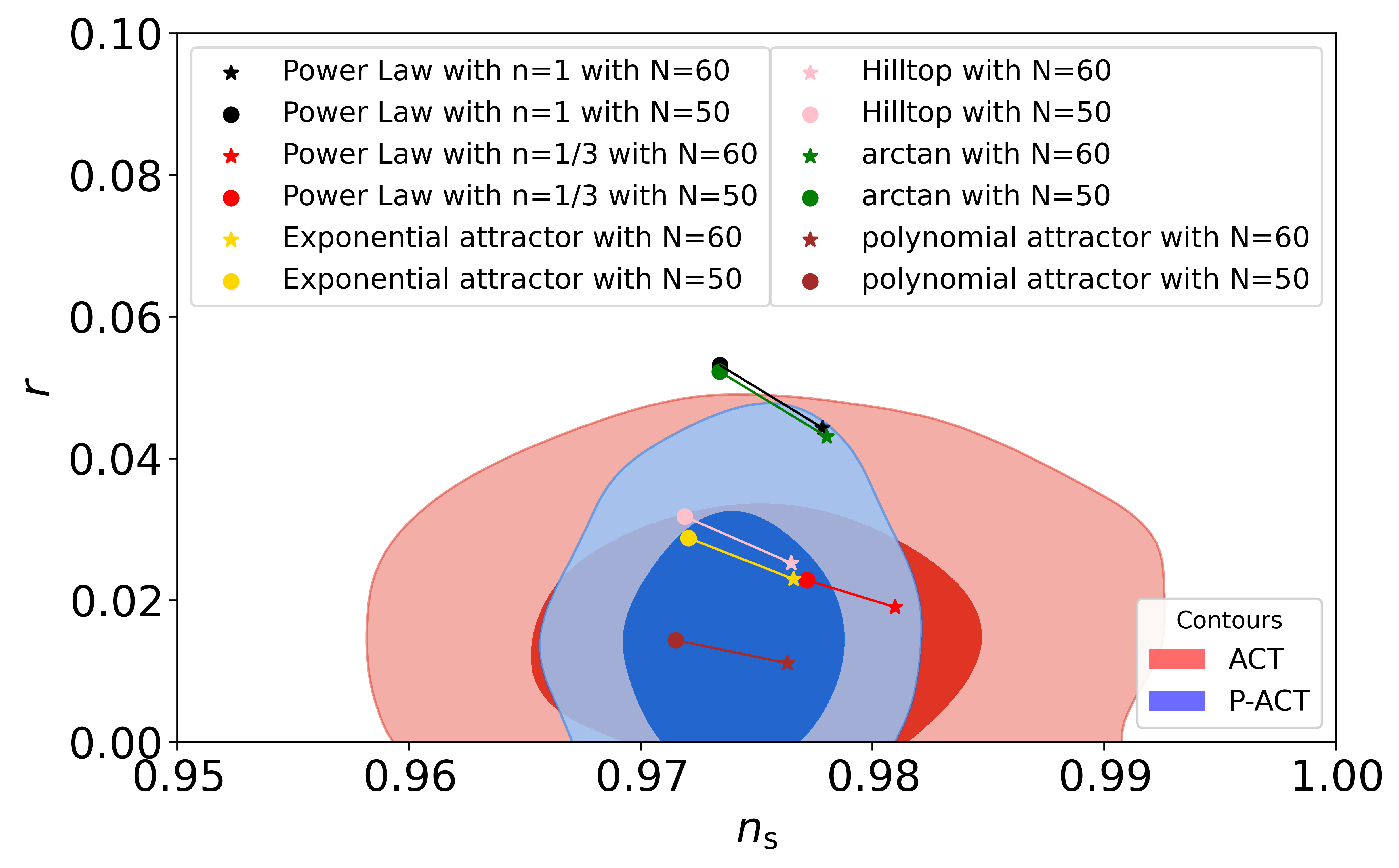
For ns0, analytic expressions link ns1 and ns2 directly to the potential exponent ns3 and the NMDC parameter. The results for ns4 (canonical linear) are strongly inconsistent with the ACT and Planck contours (ns5), whereas ns6 is marginally consistent at ns7 for ns8.
Exponential ns9-Attractor
Plateau potentials, e.g., r0, yield predictions for r1--r2 and r3--r4 across reasonable r5 and r6 values, occupying the central region of observational likelihoods.
Hilltop, Arctan, and Polynomial Attractors
The hilltop and polynomial attractor models similarly achieve strong concordance with the r7--r8 confidence contours for typical parameter choices, with r9 as low as α0. The arctan potential fares less well, comparable to the power-law α1 scenario, illustrating the differentiated discriminating power of current data.
Figure 1: 1α2 (dark) and 2α3 (light) likelihood contours in the α4-α5 plane from ACT+BK and Planck+BK, overlaid with theoretical predictions for the various potentials and α6 e-folds (dots and asterisks respectively).
A clear ordering emerges: models with strong plateau behavior (exponential/hilltop/polynomial attractor) are robustly consistent; steep power-law models are excluded; arctan is in marginal tension. Higher α7 consistently reduces α8 and increases α9, as expected in slow-roll.
Numerical Results and Observational Implications
Table: Summary of ϕ0 and ϕ1 predictions for representative potentials for ϕ2.
Well within 1S=21∫d4x−g[R−gμν∂μϕ∂νϕ−λ21Rμν∂μϕ∂νϕ−2V(ϕ)]8
These results demonstrate that strong NMDC can bring models with otherwise excluded potentials into observational accord, primarily by suppressing S=21∫d4x−g[R−gμν∂μϕ∂νϕ−λ21Rμν∂μϕ∂νϕ−2V(ϕ)]9 and enabling higher 1/λ20 at moderate e-folds. However, the absolute range of acceptable potentials is still highly constrained by the observed location of 1/λ21, and significant tension persists for steep monomial models even with derivative coupling.
Theoretical and Practical Implications
This analytic approach confirms that NMDC inflationary models are highly adaptable, accommodating contemporary CMB results that favor low 1/λ22 and slightly higher 1/λ23. The NMDC mechanism increases effective gravitational friction, enabling models with steeper potentials to exhibit sustained slow-roll, consistent with suppressed tensor modes and the observed spectral tilt. The high-friction limit both simplifies the analysis and is phenomenologically well-motivated.
From a theoretical perspective, this work clarifies the utility of Ricci tensor couplings relative to existing Einstein tensor NMDC models—highlighting that in the slow-roll limit, ghostly higher derivative terms are systematically negligible and the physical observables are robust to these modifications. It also establishes a basis for extending NMDC analysis to more general curvature couplings (e.g., Riemann/Weyl) and multi-parameter inflationary actions.
On the practical side, these results are directly relevant for model selection as new, high-precision cosmological datasets become available. They show that NMDC models must generally predict 1/λ24 for 1/λ25–0.98 to remain viable, and sharply restrict the parameter space for potentials not already exhibiting plateau behavior. Inclusion of NMDC terms thus constitutes a useful degree of freedom for matching inflation theory to precision CMB observations.
Prospects for Future Work
Possible future directions include:
Generalizing the NMDC framework to accommodate additional curvature or higher-derivative couplings, provided stability and ghost-free constraints are respected.
Systematic exploration of alternative potentials within the NMDC context, especially non-polynomial and multifield models.
Quantitative assessment of perturbation spectra beyond leading slow-roll and confrontation with next-generation CMB polarization results.
Development of consistency conditions or model-independent signatures—e.g., non-Gaussianities or primordial feature searches—that might distinguish NMDC inflation from canonical or other extended inflation paradigms.
Conclusion
By constructing an explicit analytic formalism for Ricci tensor NMDC inflation and validating it against a wide class of potentials, this study demonstrates that enhanced gravitational friction enables robust compliance with the latest CMB constraints. Plateau-like potentials in particular are favored, yielding suppressed tensor-to-scalar ratios and 1/λ26 in agreement with ACT and Planck data. Steep power-law models remain strongly excluded. The formalism provides a template for broader investigations into the role of curvature coupling in inflation, offering both theoretical clarity and practical tools for interpreting ongoing and future cosmological observations.
“Emergent Mind helps me see which AI papers have caught fire online.”
Philip
Creator, AI Explained on YouTube
Sign up for free to explore the frontiers of research
Discover trending papers, chat with arXiv, and track the latest research shaping the future of science and technology.Discover trending papers, chat with arXiv, and more.