Testing $α$-attractor P-model of inflation by Cosmic Microwave Background radiation
Published 19 Apr 2026 in hep-ph and astro-ph.CO | (2604.17430v1)
Abstract: In a recently proposed approach to testing models of inflation by Cosmic Microwave Background (CMB) radiation the reheating temperature is directly expressed in terms of the CMB observables. Its model independent bounds translate in a given model into narrow ranges of those observables. In that approach we analyse the polynomial class of the $α$-attractor inflaton potential models (P-models), in a broad range of polynomials and with the inflaton decays and fragmentation in the reheating period taken into account. The predictions for the CMB observables, the scalar spectral index $n_s$ and tensor-to-scalar ratio $r$, are compared with the Planck and Planck combined with ACT data. Both can be accommodated by that class of the $α$ attractor models. The sensitivity of the results of that comparison to the reheating temperature and to the upper bound on the ratio $r$ is clearly demonstrated.
The paper introduces a novel method connecting the reheating temperature Tₓ with CMB observables to constrain α-attractor polynomial inflation models.
The analysis distinguishes between integer and fractional exponent models while accounting for inflaton fragmentation effects and both perturbative and non-perturbative reheating regimes.
Key implications include more precise predictions for nₛ and r, setting tighter bounds that will be further tested by future high-precision CMB polarization experiments.
Testing α-Attractor P-Model Inflation via CMB: Reheating Constraints and Fragmentation Effects
Introduction
This work undertakes a rigorous analysis of the polynomial α-attractor class of inflationary models ("P-models"), focusing on novel methods to constrain their parameter space by exploiting Cosmic Microwave Background (CMB) observables. Unlike approaches relying on an assumed range of inflationary e-foldings, this analysis directly links the reheating temperature T×—the temperature at the onset of radiation domination—with the CMB spectral index ns and tensor-to-scalar ratio r. The study encompasses both perturbative and non-perturbative reheating regimes, accounting for effects from inflaton fragmentation, and systematically evaluates the compatibility of various P-models with Planck, BICEP/Keck, ACT, and combined data.
Analytical Framework: Connecting CMB Observables and Reheating
The inflationary observables ns, r, and As are computed in terms of the polynomial potential parameters and the inflaton value at horizon exit ϕk∗. The P-model potential,
V(ϕ,α,n,Λinf)=Λinf4ϕ2n+(3α/2)2nϕ2n,
is analyzed for a range of integer and fractional α0. The traditional approach of specifying the number of e-foldings α1 is replaced by solving for α2 via a consistency condition that traces the comoving pivot scale through inflation, reheating, and radiation era. In particular,
α3
with α4 set by slow-roll violation, yields precise relations between α5, α6, α7, and the model parameters.
An essential feature of this approach is its utilization of the model-independent bounds on the reheating temperature,
α8
with the lower limit from BBN and the upper limit from physical consistency. This translates into sharp constraints on the allowed regions in the α9 plane for each T×0.
Model Behavior Across Polynomial Exponents
T×1 (Quadratic Potential) and T×2 (Quartic Potential)
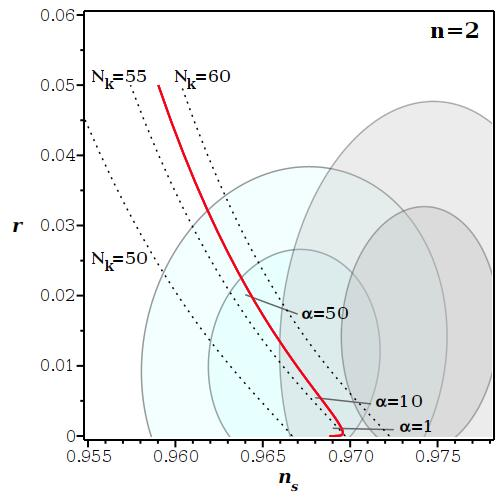
For quadratic T×3 and quartic T×4 P-models, fragmentation is subdominant since oscillations in these potentials do not lead to efficient non-perturbative particle production under minimal couplings. In the quartic case, due to T×5 during both inflaton oscillations and radiation domination, the prediction for T×6 is independent of T×7, yielding a unique trajectory in T×8 space.
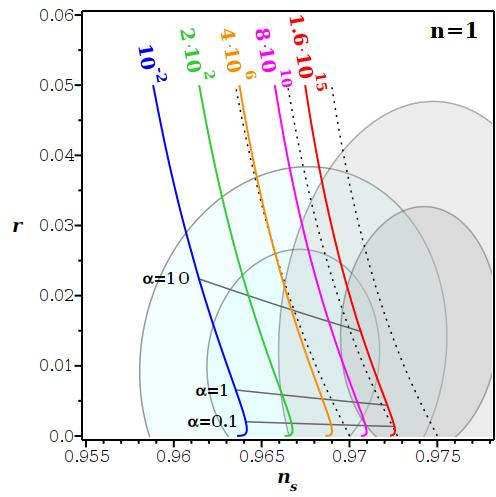
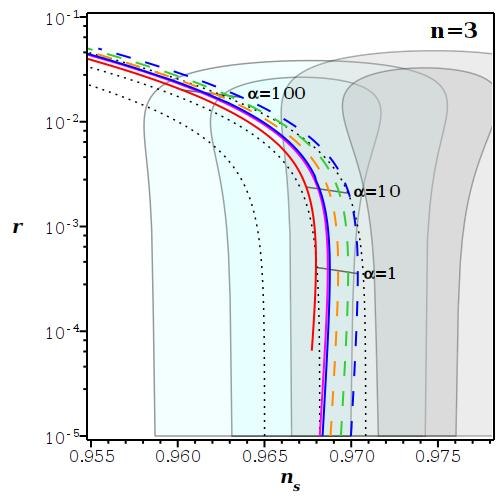
For T×9, ns0 increases with ns1 for fixed ns2; the range of ns3 over allowed ns4 is approximately ns5. The ns6 model predicts a nearly vertical line in the ns7 plane, reflecting the absence of ns8 dependence.
Figure 1: Curves of constant reheating temperature ns9 on the r0 plane for r1-attractor P-models with r2 (left) and r3 (right).
Both models accommodate the P-BK-D data robustly, but compatibility with P-BK-D-ACT is more selective, particularly at low r4.
r5 and r6: Effects of Inflaton Fragmentation
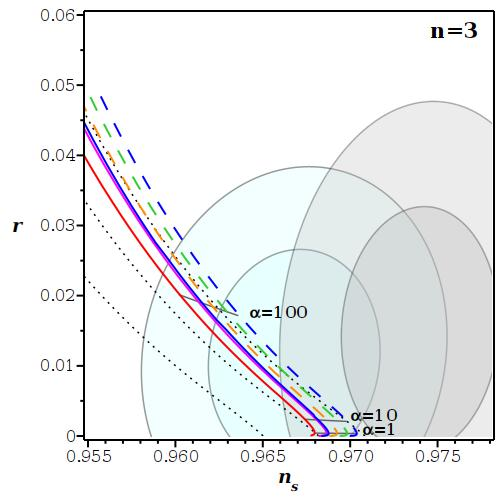
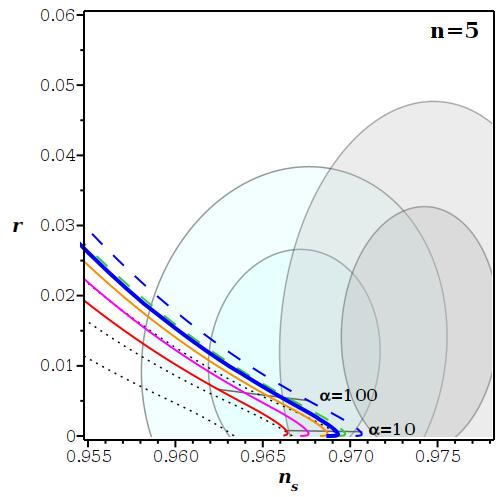
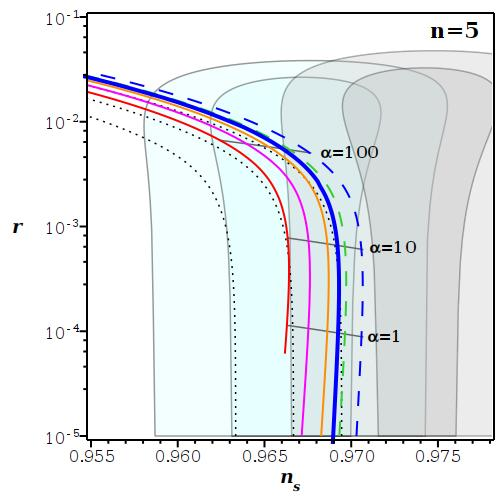
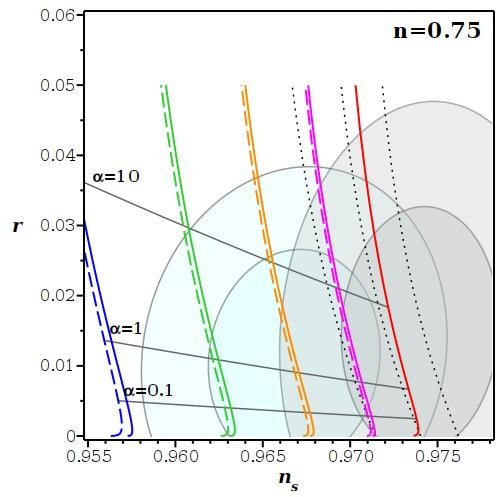
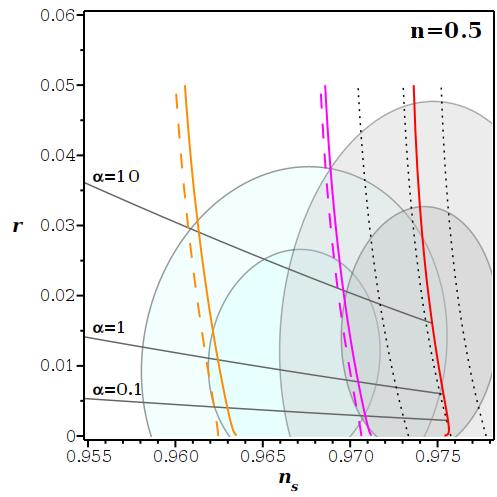
For higher polynomials (r7), the inflaton oscillates in a potential shallower than quadratic, yielding a stiffer equation of state and facilitating fragmentation. Numerical results indicate that after rapid transfer of energy to relativistic inflaton quanta, r8 shifts quickly to r9, capping the ns0-dependence. Thus, for each ns1, ns2 falls within a narrow range dictated by the model-independent reheating bounds and fragmentation thresholds.
Figure 2: Curves of constant reheating temperature ns3 on the ns4 plane for ns5 (left) and ns6 (right), with and without fragmentation.
Fragmentation induces a stepwise change in the expansion history, and for ns7 the allowable range for ns8 for a given ns9 is reduced to r0--r1, increasingly so for larger r2. Experimental data requires r3 for viability, and upcoming CMB polarization measurements reaching r4 will offer strong exclusion potential for such models.
r5 and r6: Fractional Powers and Enhanced Sensitivity
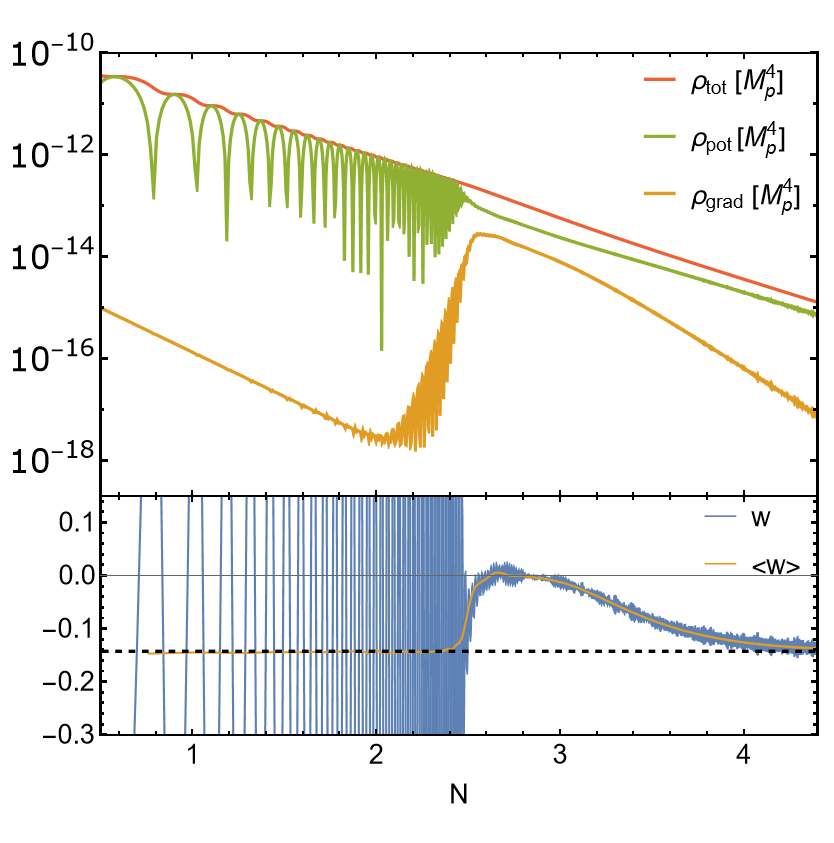
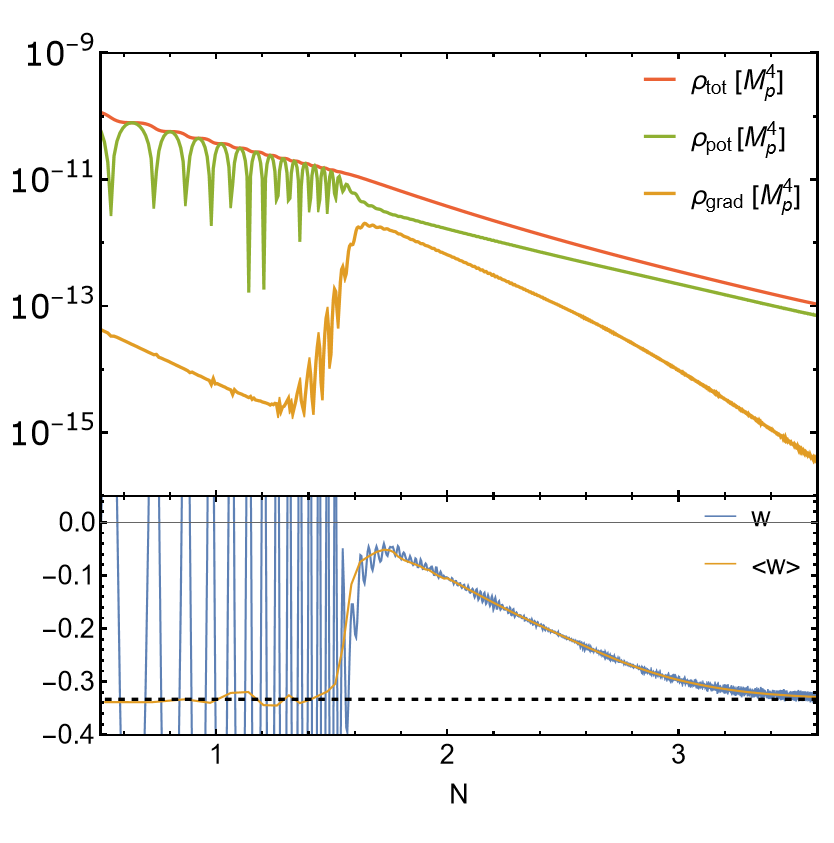
Fractional exponents (r7) exhibit distinct fragmentation dynamics: temporary increases in r8 due to particle production are reversed as coherent oscillations re-dominate. Numerical lattice simulations reveal transient behaviors in the energy density and equation-of-state,
Figure 3: Evolution of inflaton energy density components and equation of state r9 for As0 (left) and As1 (right) during reheating with fragmentation.
Incorporating fragmentation yields substantial shifts in the predicted As2, especially at low As3. For instance, As4 models display a variation in As5 of almost As6 across the allowed As7 (compared to As8 for As9), allowing for possible lower bounds on the reheating scale from CMB data that can exceed those from BBN.
Figure 4: Curves of constant reheating temperature ϕk∗0 on the ϕk∗1 plane for ϕk∗2 (left) and ϕk∗3 (right), contrasting cases with and without fragmentation.
The minimal allowed values of ϕk∗4 (for low ϕk∗5) decrease with ϕk∗6, reaching as low as ϕk∗7 for ϕk∗8, further distinguishing these models from integer-power counterparts.
Comparison with Experimental Data
All considered P-models (with ϕk∗9) can accommodate current combined data at the V(ϕ,α,n,Λinf)=Λinf4ϕ2n+(3α/2)2nϕ2n,0 level. However, increasing precision—especially a decrease in the upper bound on V(ϕ,α,n,Λinf)=Λinf4ϕ2n+(3α/2)2nϕ2n,1—intensifies theoretical constraints, particularly in the presence of non-perturbative reheating phenomena. The inclusion of fragmentation is essential for an accurate determination of theoretical predictions, with the impact varying critically with V(ϕ,α,n,Λinf)=Λinf4ϕ2n+(3α/2)2nϕ2n,2.
Theoretical and Phenomenological Implications
Directly constraining inflationary parameters via reheating temperatures inferred from CMB observables negates the need for arbitrary assumptions about e-foldings. The explicit dependence on V(ϕ,α,n,Λinf)=Λinf4ϕ2n+(3α/2)2nϕ2n,3 opens new parameter regimes, particularly relevant for physics beyond the Standard Model tied to the early universe, including baryogenesis and dark matter genesis. This framework allows for imposition of model-specific lower bounds on V(ϕ,α,n,Λinf)=Λinf4ϕ2n+(3α/2)2nϕ2n,4 from CMB data, which may surpass traditional BBN constraints.
Future CMB B-mode searches (e.g., LiteBIRD, CMB-S4) approaching V(ϕ,α,n,Λinf)=Λinf4ϕ2n+(3α/2)2nϕ2n,5 are expected to critically probe, and in some cases eliminate, large classes of P-models. The analytic and numerical tools demonstrated here represent an essential methodology for such theoretical-experimental interplay.
Conclusion
This analysis of polynomial V(ϕ,α,n,Λinf)=Λinf4ϕ2n+(3α/2)2nϕ2n,6-attractor P-models establishes a highly constrained mapping between the reheating temperature and CMB observables. The approach incorporates both perturbative and non-perturbative reheating, with careful attention to inflaton fragmentation effects. The derived bounds on V(ϕ,α,n,Λinf)=Λinf4ϕ2n+(3α/2)2nϕ2n,7 and V(ϕ,α,n,Λinf)=Λinf4ϕ2n+(3α/2)2nϕ2n,8—sharpened by physical reheating bounds and fragmentation—are compared systematically with experimental data, indicating that while all considered models remain viable under present constraints, imminent experimental advances will impose strong discriminatory power. This formalism provides a template for future analyses of inflationary models in the high-precision cosmological era.
“Emergent Mind helps me see which AI papers have caught fire online.”
Philip
Creator, AI Explained on YouTube
Sign up for free to explore the frontiers of research
Discover trending papers, chat with arXiv, and track the latest research shaping the future of science and technology.Discover trending papers, chat with arXiv, and more.