- The paper introduces a same-sector flattening mechanism by integrating out a heavy dilaton mode, producing an analytic axion potential using the Lambert W function.
- It achieves explicit control over kinetic and metric corrections, ensuring suppressed hilltop curvature and a near-geodesic inflationary trajectory.
- The model’s analytic framework robustly aligns inflationary observables with CMB constraints and provides a rigorous benchmark for reheating and EFT deformations.
Dilaton-Flattened Axion Inflation: Analytic Control of Same-Sector Backreaction for Natural Inflation
Motivation and Context
The construction addresses the critical issue of flattening the axion potential in natural inflation frameworks, as required by current CMB constraints on the tensor-to-scalar ratio r. Whereas conventional mechanisms invoke additional sector couplings or non-local effects, this work implements a same-sector, closed-form flattening mechanism in a two-field local EFT, leveraging the dynamical backreaction of a heavy trace-anomaly (dilaton/glueball) mode on the axion’s periodic potential. This approach avoids introducing ad hoc plateau operators or relying on large-N vacuum structure; instead, it resums heavy-field corrections into a single analytic structure with explicit control of all kinetic and metric corrections.
Same-Sector Effective Theory and Analytic Backreaction
The authors start from a two-field potential involving a heavy radial (dilaton) field σ and an axion θ (canonically related to a), with the potential exhibiting a quadratic radial component and an axion-dependent periodic term whose amplitude is modulated by σ. Parametric backreaction is governed by a single parameter β, tied to the heavy field’s response. Integrating out the heavy mode at tree level yields an exact closed-form axion potential in terms of the principal Lambert W function:
Ueff(θ)=V0+2βχ0[W(2βS(θ))+21W(2βS(θ))2],S(θ)≡1−cosθ.
This structure naturally and monotonically flattens the potential near the hilltop as β increases, interpolating between the standard natural inflation limit (N0) and a broad, plateau-like potential for large N1.
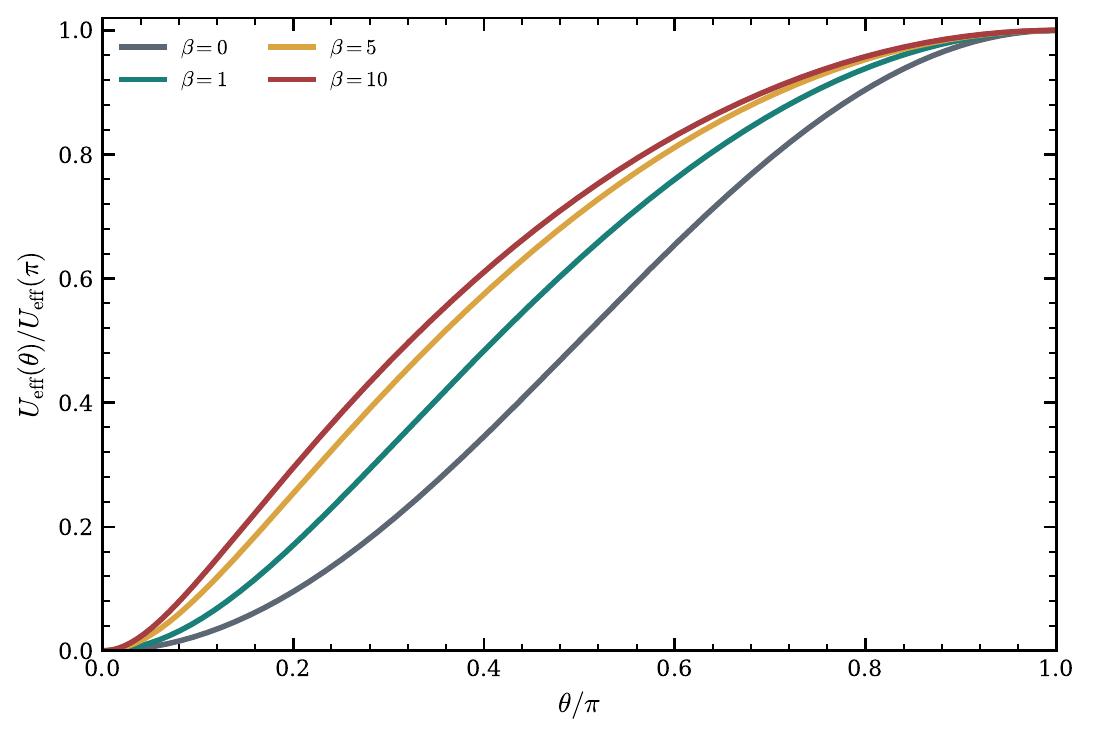
Figure 1: Normalized backreacted effective potential N2, demonstrating the flattening as N3 increases and reduction to ordinary natural inflation for N4.
Analytic Control of Local Observables
Hilltop Curvature and Flattening
The principal analytic result is the complete resummation of heavy-field backreaction at the potential and kinetic level. The hilltop curvature, encoding N5 and the local mass parameter, is given by
N6
with the suppression factor N7 manifestly encoding the flattening effect.
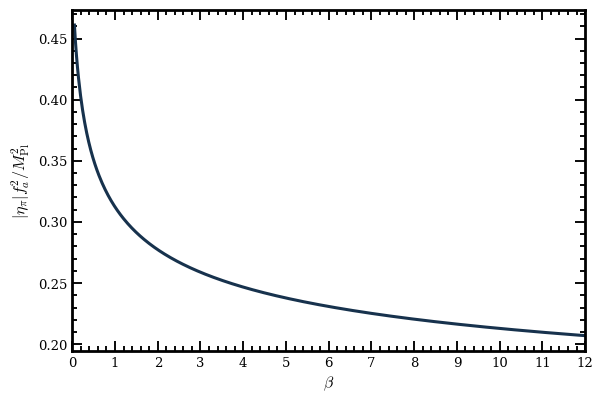
Figure 2: Hilltop-curvature suppression factor N8 as a function of N9. Flattening grows monotonically with increasing σ0.
Orthogonal-Mode Mass and Turn Rate
The mass of the orthogonal (radial) fluctuation and the geometric turn-rate σ1 along the slow-roll trajectory are analytically controlled, ensuring strict adiabaticity and the validity of the single-field reduction throughout the relevant parameter space:
σ2
with the orthogonal mode always remaining hierarchically heavy, and σ3 generically below σ4 even for strong flattening.
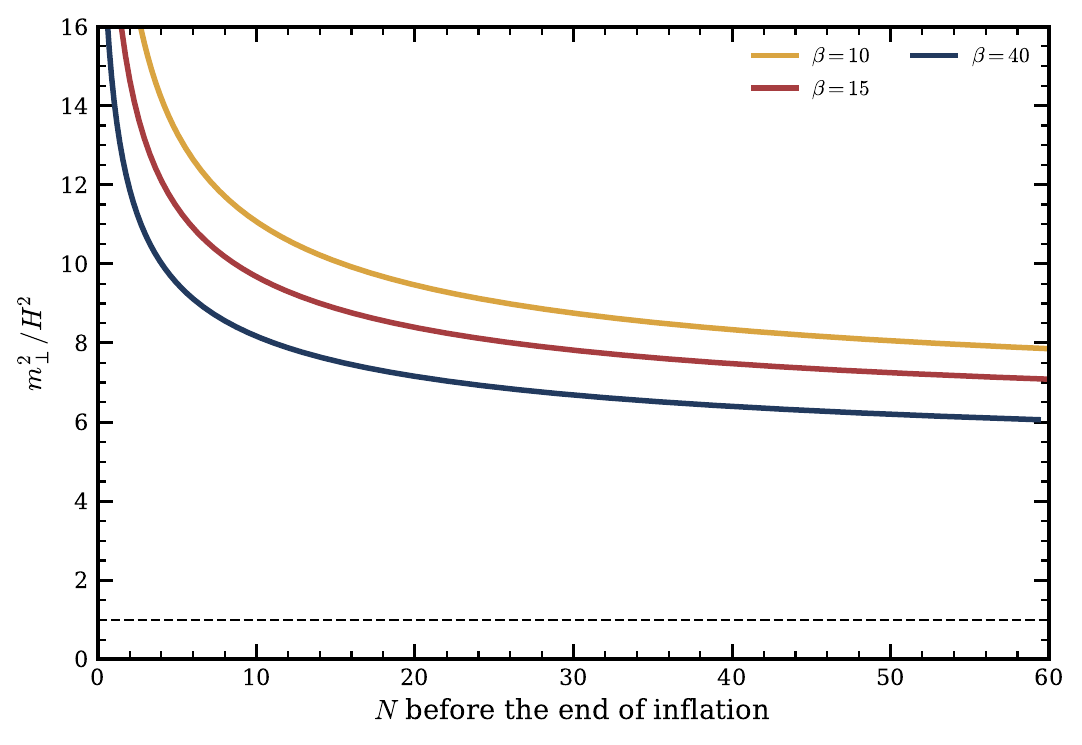
Figure 3: Orthogonal-mode mass ratio σ5 along the inflationary background, shown to remain σ6 throughout.
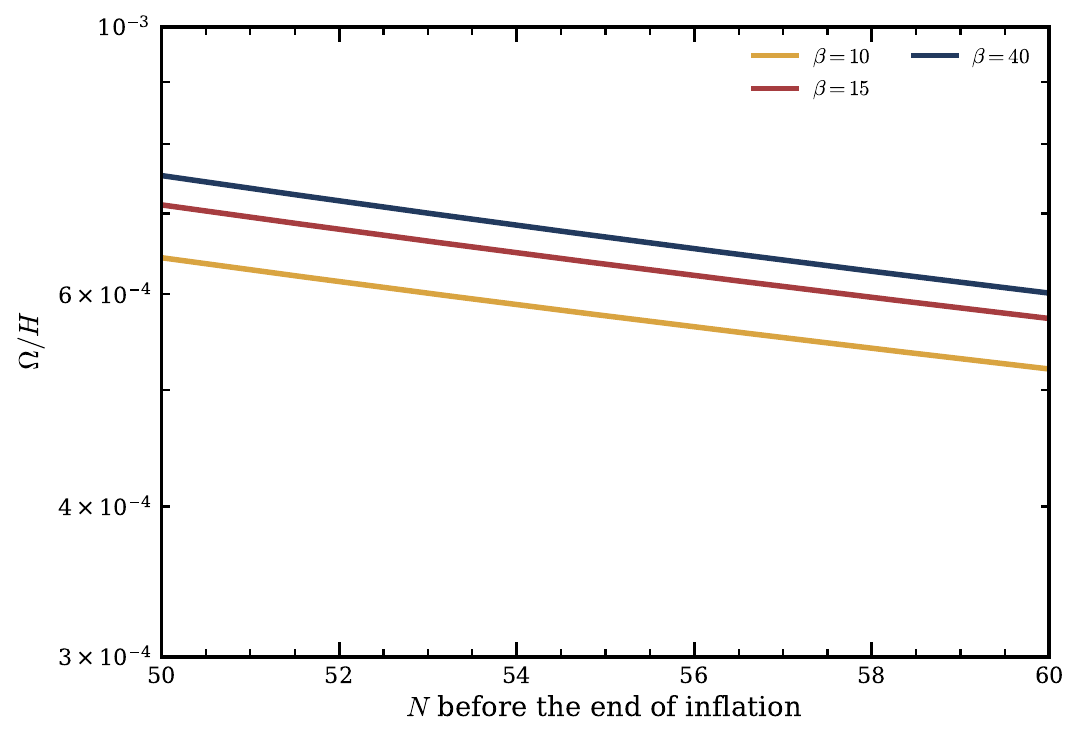
Figure 4: Turn-rate ratio σ7 stays beneath σ8 over the observable window, confirming near-geodesic inflation and suppressed entropy transfer.
Nontrivial Trough Metric and Control of Kinetic Factors
The exact one-field reduction yields a field-space metric deviating from the minimal constant-kinetic approximation by less than a percent in all relevant regimes, but the formalism controls such corrections without approximation:
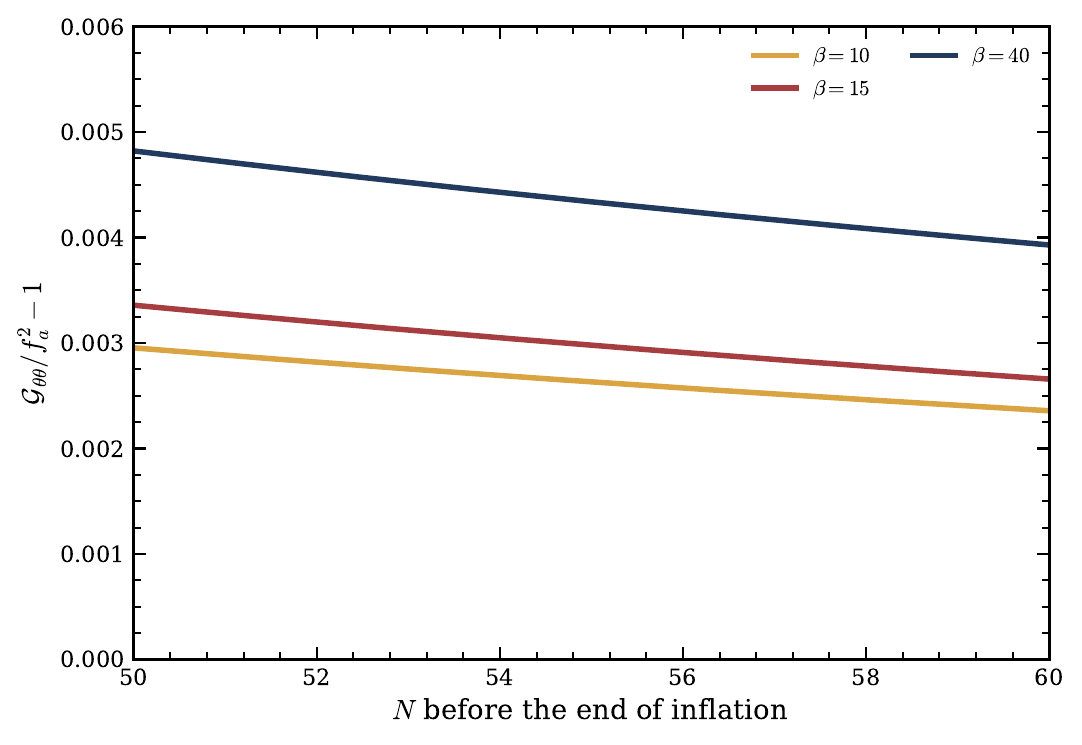
Figure 5: Exact trough-metric correction σ9, demonstrating the induced kinetic deformation remains small but is systematically included.
Generic local deformations (higher-dimension operators, non-exponential susceptibilities) propagate analytically into the effective single-field description. The response is suppressed by the same denominators that control the mass hierarchy, ensuring benchmark observables are protected within the same EFT.
Inflationary Phenomenology and Confrontation with Observations
θ0–θ1 Structure and CMB Bounds
The model's flattening mechanism allows for a significant downward shift in the tensor-to-scalar ratio θ2 at fixed θ3, placing the predictions comfortably within current ACT/SPT/BICEP/Keck constraints for moderate θ4. The closed-form θ5–θ6 trajectories and robustness bands for θ7 e-folds are computed exactly within the reduced theory.
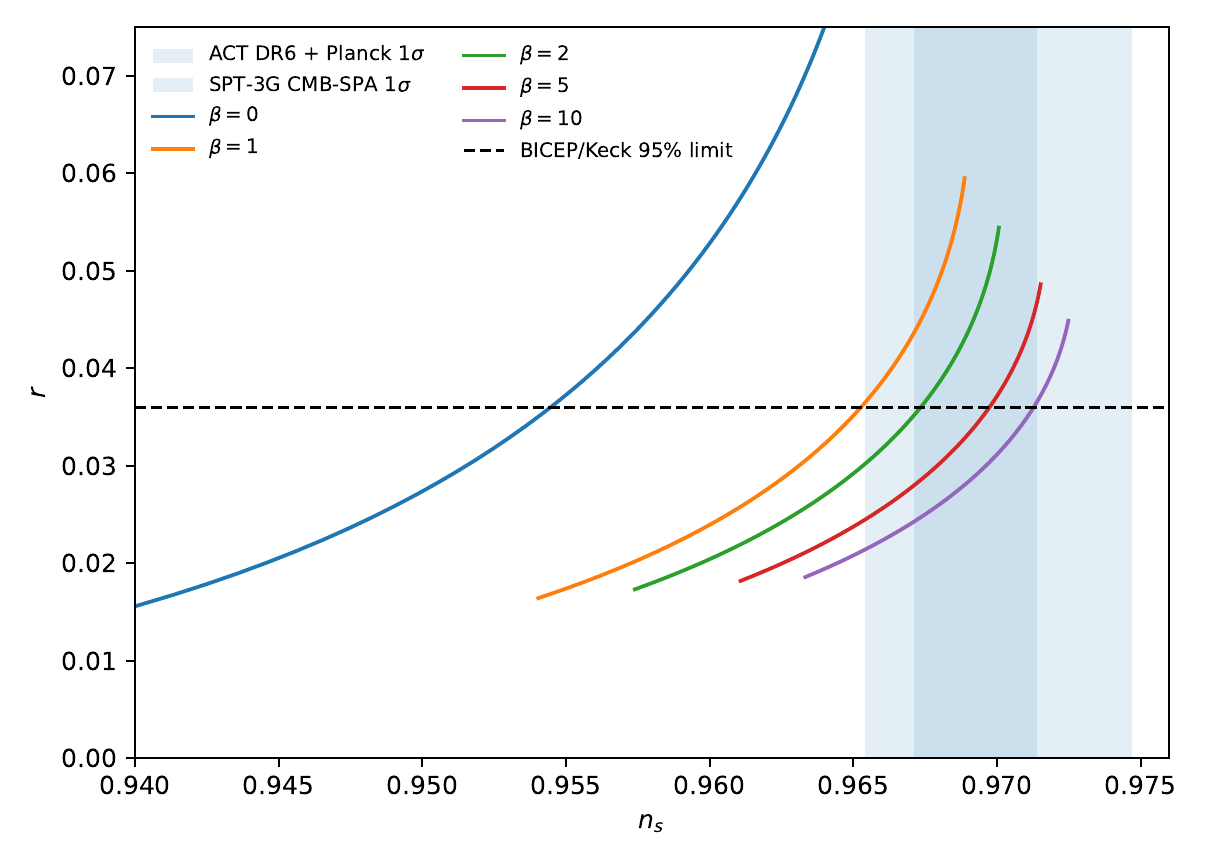
Figure 6: Model θ8–θ9 trajectories at a0 for several a1, with CMB and BICEP/Keck bounds indicated. Increasing a2 further suppresses a3 at given a4.
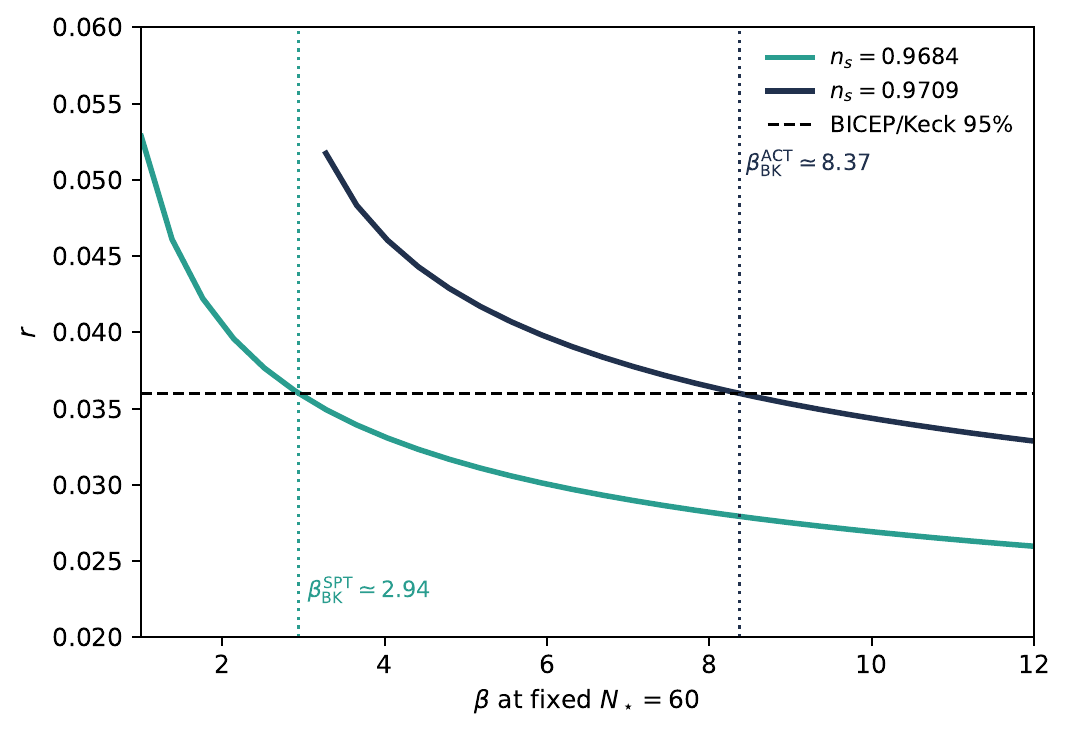
Figure 7: Tensor amplitude a5 as a function of flattening parameter a6 at fixed a7. Visualizes the intersection with CMB bounds for central a8 values.
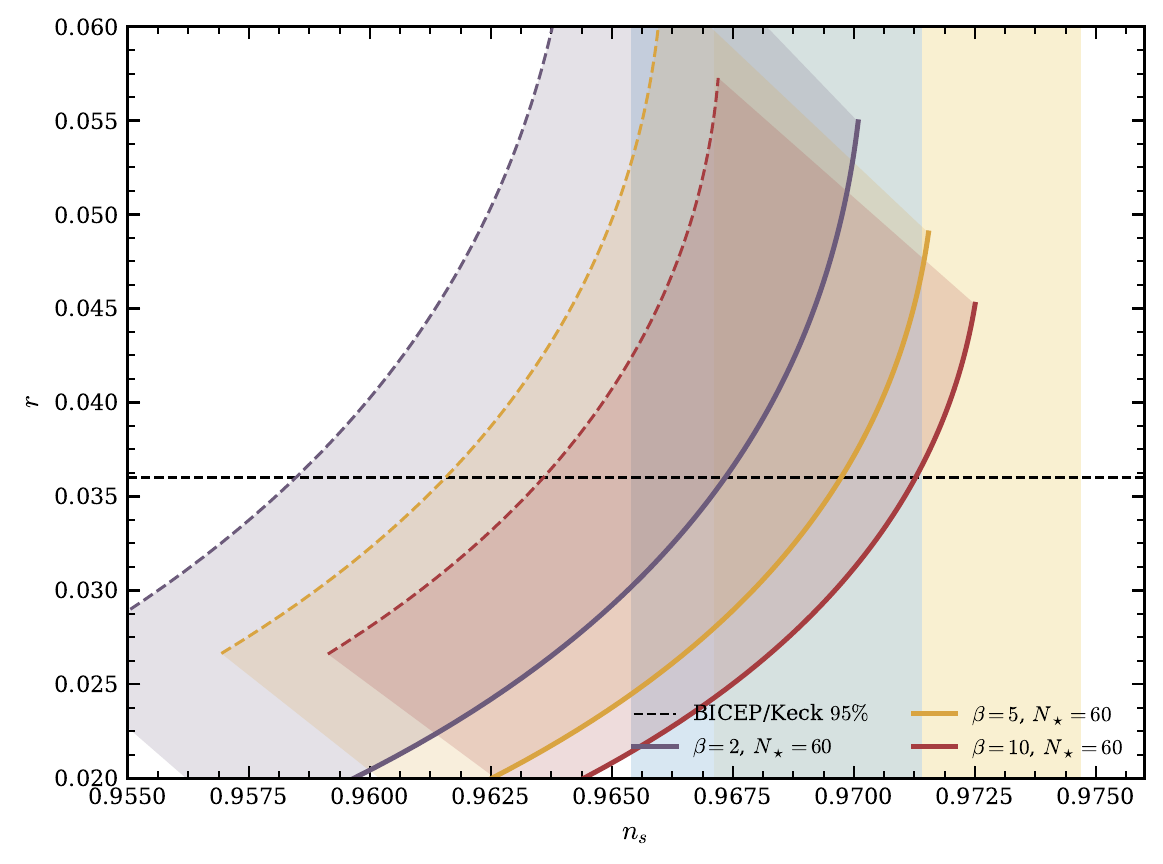
Figure 8: Robustness bands in the a9 plane for varying σ0, contrasted with CMB intervals; colored by different flattenings.
Benchmark values, e.g. σ1–σ2 and σ3 for σ4, are well within current constraints and maintained across moderate changes in σ5 or σ6.
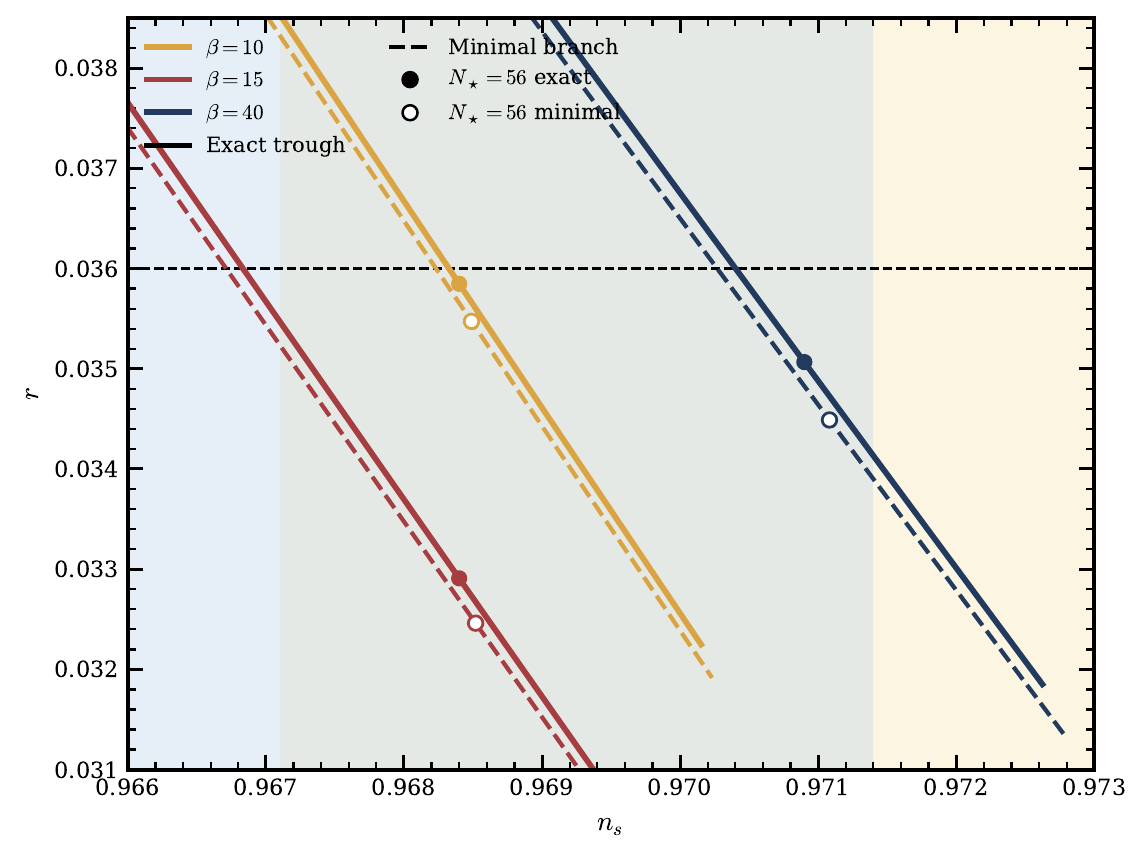
Figure 9: Comparison of trough-reduced (solid) and minimal-kinetic (dashed) theory predictions, with benchmark marker points for both.
Calibration Against Reheating and Robustness to Vacuum Shift
The formalism provides analytic expressions for the constant-σ7 reheating map, identifying the σ8 boundary and allowing one to calibrate both CMB and post-inflationary observables with minimal theoretical ambiguity. The predictions are robust to moderate vacuum shifts σ9, as shown numerically.
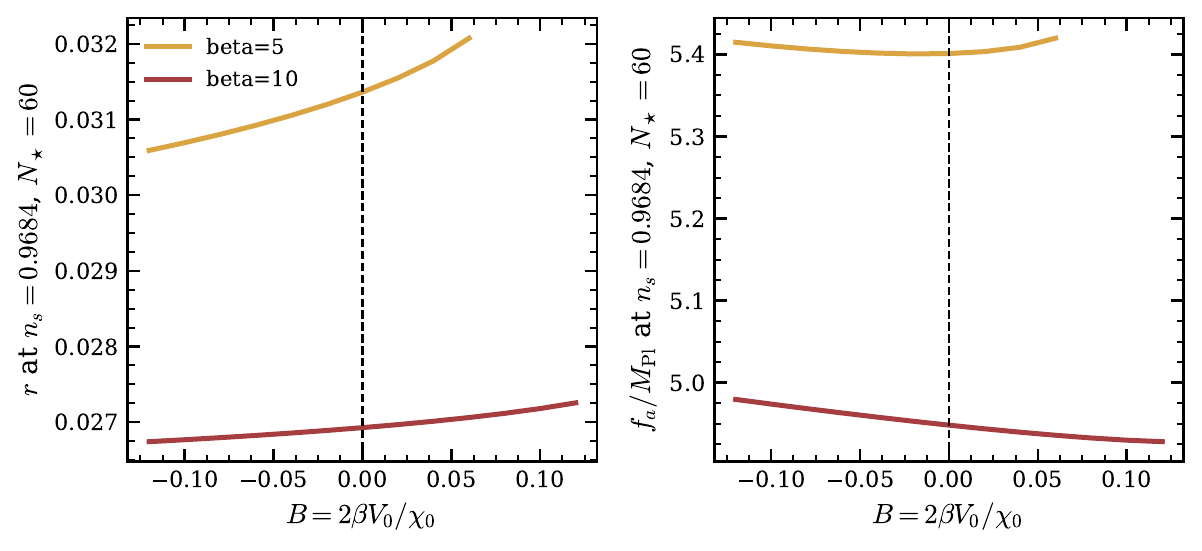
Figure 10: Sensitivity analysis of β0 and β1 predictions to nonzero vacuum offset β2, highlighting mild shifts for moderate β3.
Reheating Dynamics and EFT Control
The formal reheating analysis yields high reheating temperatures, β4 GeV for β5, with all observable branches safely on the physical (positive β6) side of the reheating duration map. The analytic β7 boundary can be explicitly computed for any branch of the model.
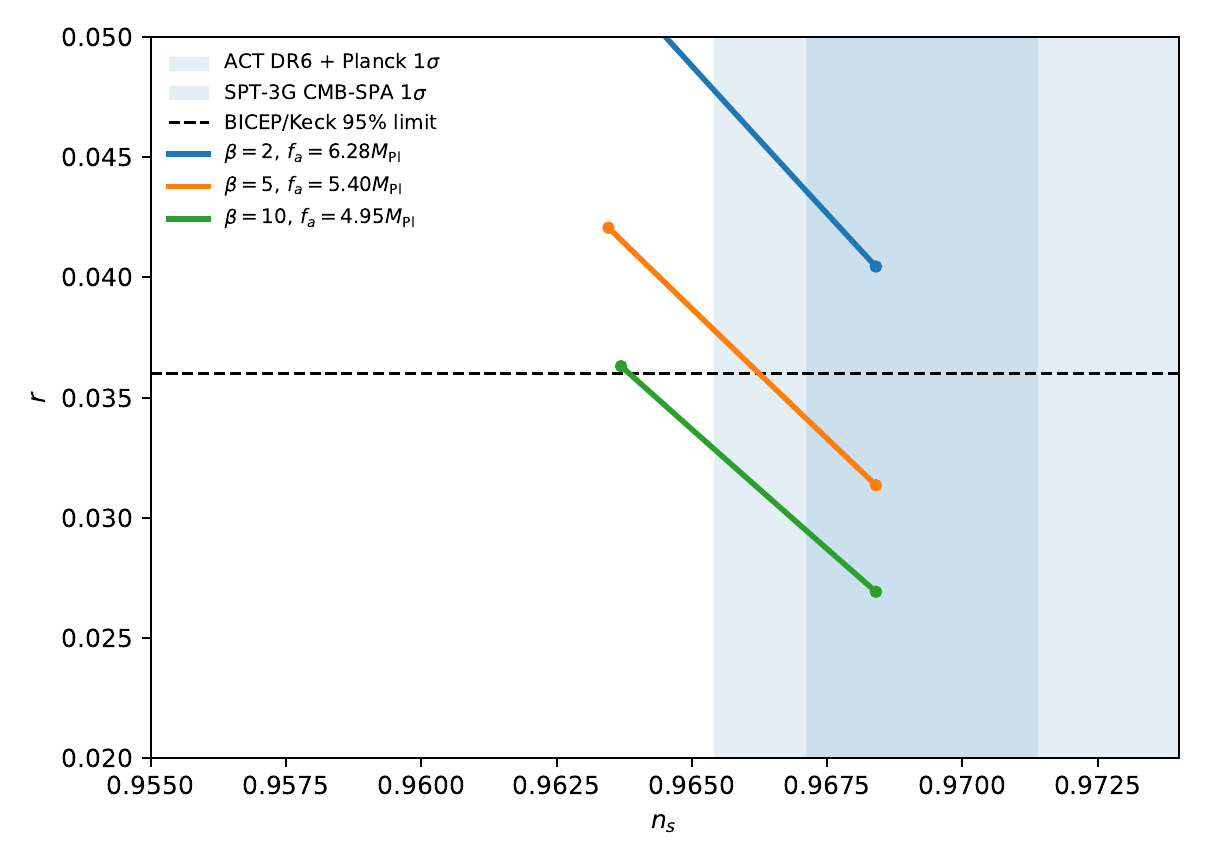
Figure 11: Model β8–β9 loci traced over W0 for the reheating-compatible branches; filled/open markers distinguish chosen benchmarks and reheating boundaries.
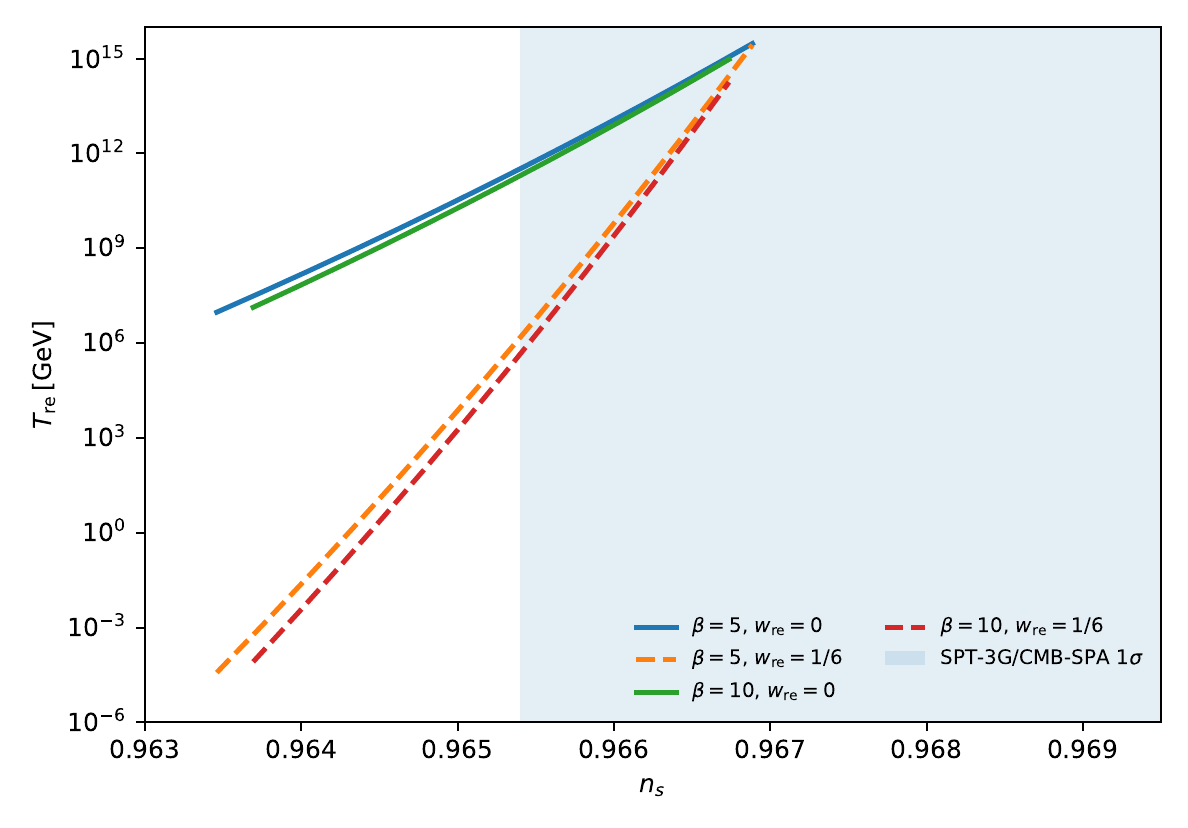
Figure 12: Reheating temperature W1 along benchmark branches for two representative W2 values; only the W3 region shown.
Theoretical Implications and Future Developments
The model demonstrates that same-sector backreaction, implemented via integrating out a heavy trace-anomaly mode, gives analytic, robust flattening of axion inflation potentials compatible with all current observational constraints—even for super-Planckian axion decay constants. The framework offers a precise target for UV completions where both topological and dilaton dynamics arise from the same gauge sector, as distinct from string monodromy or large-W4 multi-branch models.
The formalism provides a systematic way to include and quantify higher-dimensional and non-minimal deformations of the underlying EFT, and its analytic structure makes it suitable as a benchmark for further survey-level likelihood analysis or embedding in broader model scans.
One open direction is the explicit UV-matching of the potential parameters to specific microscopic realizations, including lattice or holographic computations for the heavy sector’s susceptibility, and a detailed microphysical account of the reheating transfer to the Standard Model. The model's ability to connect CMB phenomenology and post-inflationary history within a unified local EFT framework makes it a reference template for future theoretical and phenomenological studies in axion inflation, glueball/dilaton dynamics, and same-sector flattening scenarios.
Conclusion
This work provides a controllable, analytic framework for implementing potential flattening in axion inflation by leveraging heavy-mode backreaction within a two-field same-sector EFT. All inflationary and reheating observables, including adiabaticity, curvature, and slow-roll parameters, are characterized by explicit closed-form expressions. The model’s predictions satisfy current observational data, with explicit analytic control over the impact of EFT deformations and reheating physics, making it a rigorous benchmark for both bottom-up model construction and top-down UV completions.

