- The paper introduces DIRCR, a unified model that integrates row-wise analogical reasoning and holistic matrix inference for improved abstract visual reasoning.
- It employs a dual-inference module with gated attention and a rule-contrastive learning module to enforce distinctive, robust rule-based features.
- Empirical results on RAVEN, I-RAVEN, and RAVEN-FAIR demonstrate superior accuracy and enhanced data efficiency, validating the model's efficacy.
Dual-Inference Rule-Contrastive Reasoning for Abstract Visual Reasoning
Introduction
Abstract visual reasoning (AVR), and in particular tasks modeled after Raven's Progressive Matrices, constitute critical benchmarks in measuring an artificial system's capacity for high-level relational and compositional inference. Existing AVR models typically emphasize either local analogical reasoning (e.g., row-wise compositional patterns) or global holistic inference; however, they seldom synthesize both, and often lack explicit regularization on intermediate features, leading to entangled, non-transferable representations. The DIRCR (Dual-Inference Rule-Contrastive Reasoning) model (2604.17584) presents a unified approach that explicitly integrates local and global reasoning strategies and enforces rule-based feature distinctiveness via contrastive supervision.
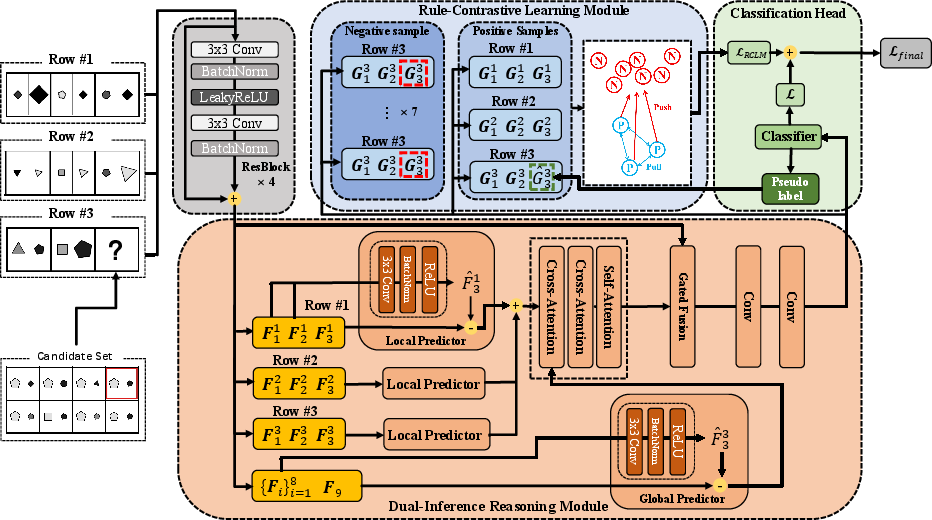
Figure 1: Block diagram of the DIRCR model, illustrating the Dual-Inference Reasoning Module (DIRM) with local and global paths integrated through gated attention, and the Rule-Contrastive Learning Module (RCLM) imposing auxiliary contrastive loss on rule-aware features.
Model Architecture
Dual-Inference Reasoning Module (DIRM)
DIRM is decomposed into two operations: a local path focused on row-wise analogical inference, and a global path dedicated to n-to-1 holistic context integration. The local path approximates relational reasoning within a row, explicitly predicting the third element from the initial two. This operationalizes compositional analogies, with a shared convolutional predictor across rows to enforce representational consistency. Prediction errors (residuals) serve as critical supervisory signals, encouraging discovery of constituent rules rather than rote memorization of image statistics.
In parallel, the global path processes all context panels, providing holistic context for inferring the missing entry and capturing dependencies that span across rows and columns. Fusion is accomplished via a cross-attention and self-attention sequence, followed by a structure-aware gating mechanism. The attention stack allows complementary, bidirectional information flow between local and global cues, while the gating mechanism accentuates rule-consistent activations and denoises spurious correlations.
Stacking multiple DIRM blocks (K-fold hierarchy) enables progressive abstraction, emulating hierarchical rule composition as required by high-complexity matrix problems.
Rule-Contrastive Learning Module (RCLM)
RCLM targets the well-documented issue of unconstrained intermediate representations in standard AVR architectures, which fosters overfitting to surface visual cues. RCLM remedies this by pseudo-labeling candidate answers and forming explicit sets of positive (rule-consistent) and negative (rule-violating) samples. A two-layer perceptron projects these reasoning features into a contrastive latent space, with a supervised contrastive loss function optimizing for intra-class compatibility and inter-class discrimination.
This module ensures that features encoding correct rules cluster tightly, whereas those corresponding to incorrect candidate rules are systematically repelled. Importantly, it regularizes features at an intermediate layer, not just the output, mitigating mode collapse and enhancing out-of-distribution robustness.
Experimental Evaluation
DIRCR was extensively evaluated on the RAVEN, I-RAVEN, and RAVEN-FAIR datasets, representing a spectrum of abstract reasoning challenges of escalating difficulty and decreasing annotation bias. All evaluations adhered to standardized train/validation/test splits.
Empirically, DIRCR achieved state-of-the-art reasoning accuracies: 98.5% on RAVEN, 97.8% on I-RAVEN, and 98.7% on RAVEN-FAIR. These results not only surpass dual- and single-inference baselines but also demonstrate improved robustness on bias-minimized datasets, confirming DIRCR's reliance on structured reasoning rather than on superficial pattern correlations.
Ablation studies reveal the necessity of both reasoning paths and the contrastive loss for optimal performance. Models employing either only local or only global paths regress in accuracy by over 1%. Adding RCLM consistently boosts generalization, especially in reduced-data regimes. Increasing K (number of stacked DIRM blocks) confers additional gains up to K=3, with a minor drop for K=4, attributable to overfitting.
DIRCR's advantage is further magnified under data-limited settings, outperforming previous methods even with only one quarter of the original training data and exhibiting reduced accuracy drop on the debiased I-RAVEN.
Theoretical and Practical Implications
The dual-path architecture demonstrates the necessity of jointly modeling analogical (row-wise) and holistic (matrix-wide) relations for abstract reasoning in high-dimensional visual data. The architectural generality of DIRM, together with RCLM's intermediary-level contrastive constraints, offers a template for other compositional reasoning domains involving hierarchical, multi-relational inference.
Practically, DIRCR's strong data-efficiency and robustness to distribution shifts suggest direct applicability to real-world tasks where labeled data are scarce and inductive biases are critical—such as scene understanding in autonomous agents or compositional question answering.
Outlook and Future Directions
Future research may focus on extending DIRCR along several axes: integration of causal graph induction mechanisms, expansion to multi-step reasoning over more complex visual contexts, or application to multi-modal analogical reasoning scenarios. Moreover, dynamically weighting the contributions of local vs. global reasoning paths via task-adaptive mechanisms could further improve the flexibility and interpretability of high-level reasoning models.
Conclusion
DIRCR establishes a high-water mark for abstract visual reasoning by unifying complementary dual-inference strategies and imposing explicit rule-based feature regularization via contrastive learning. Its architecture substantiates the hypothesis that integrating multi-level reasoning with intermediate representational constraints yields significant gains in abstraction, generalization, and data efficiency on challenging AVR benchmarks.

