- The paper proposes the AVR framework, which adaptively selects among full, perception-only, and direct answer formats to optimize visual reasoning.
- It demonstrates a 50–90% token reduction on benchmarks while maintaining or boosting accuracy in diverse VQA tasks.
- The FS-GRPO reinforcement strategy incentivizes concise, correct responses, effectively preventing overthinking in multimodal models.
Learning Adaptive Reasoning Paths for Efficient Visual Reasoning
Motivation and Problem Statement
Visual reasoning models (VRMs) integrate visual perception and language reasoning for complex multimodal tasks such as visual question answering (VQA). Recent advances enable these models to mimic human-like chains of thought (CoT), yet they often suffer from overthinking—the tendency to generate unnecessarily verbose reasoning paths, which inflate computational cost and sometimes introduce errors. This is largely attributed to Reasoning Path Redundancy, where multiple cognitive stages (e.g., perception, reasoning, answer) are invoked even when parsimonious responses suffice.
Statistical analysis confirms the prevalence of this inefficiency: in Qwen3-VL-4B-Thinking, over one third of questions (36.7%) can be answered without explicit reasoning, and 32.1% can be answered directly without perception or reasoning, yet existing models indiscriminately employ full CoT for all inputs. The Overthinking Score (mean token length ratio of original to compressed correct responses) underscores this pattern, with a substantial fraction of outputs exhibiting marked redundancy.
These findings motivate a paradigm shift—away from monolithic reasoning pipelines toward adaptive, task-sensitive cognitive strategies capable of contextually selecting reasoning paths for efficiency without compromising accuracy.
AVR: Adaptive Visual Reasoning Framework
The proposed AVR (Adaptive Visual Reasoning) framework structurally decomposes the VRM pipeline into three cognitive functions:
- Visual Perception: extraction of relevant visual facts from the image,
- Logical Reasoning: inference and multi-step deduction over perceived facts,
- Answer Application: mapping inferred results to final answer formats.
Three corresponding response formats are defined:
- Full Format: includes all stages (
<perception>…<reasoning>…<answer>),
- Perception-Only Format: skips reasoning, retaining only perception and answer,
- Direct Answer: answers without any intermediate justification.
AVR employs a two-stage training regime:
FS-GRPO’s reward function incorporates:
- Format reward: rewards concise, correct answers more,
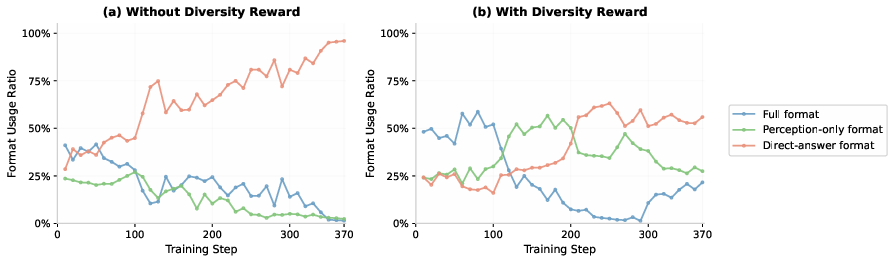
- Diversity reward: mitigates format collapse (i.e., the model always picking the shortest path),
- Length penalty: adjusts for verbosity via a dynamic tolerance threshold.
Experimental Results and Analysis
Benchmarks and Metrics
AVR is evaluated across multiple VQA and multimodal reasoning benchmarks, stratified by perceptual, logical, and general complexity. Metrics comprise both accuracy and token count (response length).
Key comparative baselines include:
- Thinking models (always full CoT),
- Instruct models (SFT only, variable format),
- SOTA selective reasoning methods (Think-or-Not [TON], ARM2).
AVR consistently achieves a 50–90% reduction in token consumption while maintaining or exceeding the accuracy of baseline thinking models. Noteworthy trends include:
- On perception-intensive tasks (e.g., OCRBench, TextVQA), AVR saves over 80% tokens and improves accuracy (up to +6.6%) compared to full reasoning.
- On reasoning-heavy tasks (e.g., MathVista), AVR adaptively defaults to full-format responses, preserving accuracy while improving efficiency.
- On general benchmarks, token savings are commensurately significant without accuracy loss.
AVR also outperforms TON and ARM2, providing stronger accuracy–efficiency trade-offs due to its multi-format design and adaptive format policy.
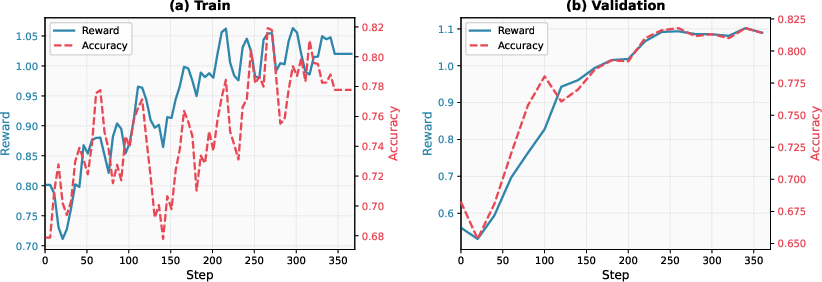
Figure 4: FS-GRPO training dynamics indicate steady increases in mean reward and answer accuracy, confirming stable and effective optimization of adaptive reasoning policies.
Detailed format distribution analysis demonstrates that AVR dynamically matches response format to task requirements:
- Perception-intensive tasks: strong preference for direct-answer or perception-only formats,
- Reasoning-intensive tasks: majority full-format usage,
- Mixed tasks: balanced allocation across all three, depending on complexity.
This validates the hypothesis that task-aware path selection optimally balances cost and performance, preventing both under- and over-reasoning.
Ablations and Sensitivity
Ablation studies confirm:
- The necessity of all three formats for optimal efficiency–accuracy tradeoff,
- The vital role of diversity reward in preventing collapse to overly terse formats,
- Robustness of AVR’s gains to reasonable hyperparameter variations (length tolerance and format bonus magnitudes).
Broader Implications and Future Directions
AVR advances VRM efficiency by reconciling the need for deep compositional reasoning with the practical imperative for cost-effective inference. The framework’s structured decomposition and reinforcement approach highlight several important implications:
- Modular format design enables interpretability and introspection into model reasoning decisions.
- Adaptive reasoning policies address overthinking, facilitate deployment in resource-constrained environments, and reduce inference latency and energy usage.
- The FS-GRPO framework provides a generalizable foundation for selective reasoning and could inform the design of future RL-based optimization for language and multimodal models.
Further investigation may explore:
- Finer-grained reasoning decomposition (beyond three formats),
- Real-time dynamic format selection at inference,
- Transferability across tasks and domains,
- Integration with explanation and verification modules for trustworthy AI.
Conclusion
AVR introduces an adaptive approach to visual reasoning by structuring and training VRMs to select among multiple cognitive paths based on task demands. Through multi-format SFT and a format-aware RL objective, AVR achieves significant inference cost reduction with maintained or improved accuracy, generalizing across scales and model families. This establishes adaptive, modular reasoning as a critical driver for efficient and robust multimodal systems (2604.14568).