- The paper introduces a unified geometric guidance mechanism that integrates representations, architecture, and loss functions to maintain consistent camera-controllable image editing.
- It achieves best-in-class performance with improved LPIPS, SSIM, and PSNR metrics across diverse datasets and extensive camera motions.
- The study demonstrates that systematic geometric injection effectively mitigates artifacts and preserves scene fidelity even in complex and extreme camera movement scenarios.
UniGeo: Unified Geometric Guidance for Camera-Controllable Image Editing via Video Models
Overview and Motivation
Camera-controllable image editing fundamentally requires coherent and high-fidelity novel view synthesis under varying camera poses. The primary challenge is to preserve strict cross-view geometric consistency under both moderate and extensive camera motions—failure to do so leads to geometric drift, duplicated structures, and scene degradation. Existing approaches often inject geometric priors only at isolated levels (e.g., representation only), which results in fragmented guidance and subsequent structural breakdown, especially under continuous camera motion.
UniGeo introduces a systematic, unified geometric guidance mechanism, leveraging video diffusion models' continuity priors to address the shortcomings of fragmented geometric guidance. The framework injects geometric priors at three foundational levels: representation, architecture, and loss function, enabling robust geometric propagation and alignment throughout scene generation.
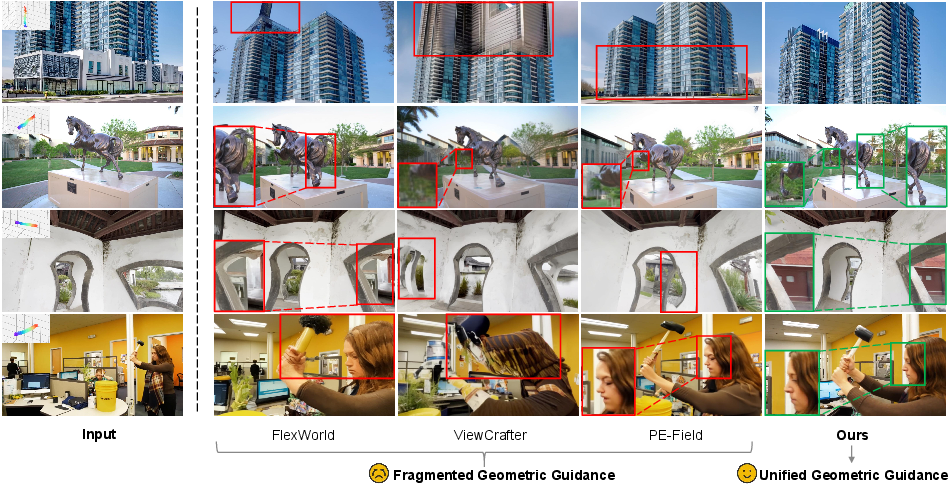
Figure 1: Visual comparison under camera motion: UniGeo preserves scene geometry and fidelity, addressing distortions/artifacts common with fragmented guidance.
Methodology
Unified Geometric Guidance
UniGeo employs three tightly coupled modules for unified geometric guidance:
- Frame-Decoupled Point Cloud Injection (FDPCI):
- Constructs a 3D point cloud sequence from the input image aligned along the camera trajectory.
- Point cloud renderings, produced using uniform camera trajectory intervals, act as geometric priors.
- These priors are concatenated with video latent tokens along the frame dimension rather than the channel, decoupling individual geometric reference frames for each timestep.
- This injection avoids corrupted alignments and allows flexible interaction within the network, mitigating errors from imperfect priors.
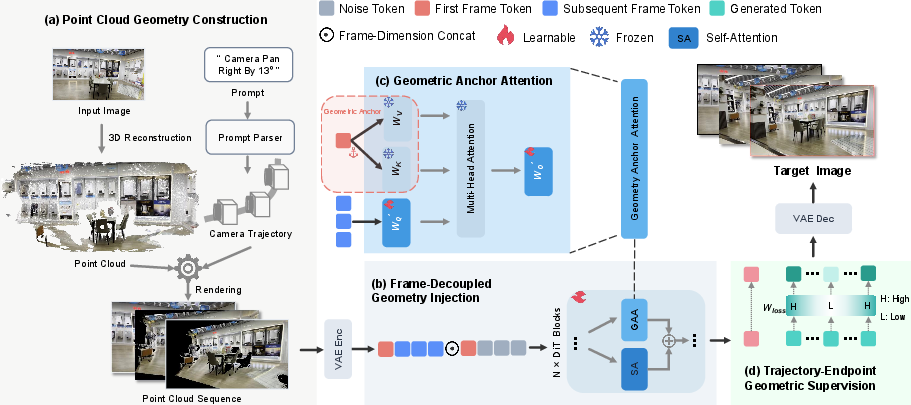
Figure 2: UniGeo framework: Geometry construction, frame-decoupled injection, geometric anchor attention, and trajectory-endpoint supervision.
- Geometric Anchor Attention (GAA):
- Introduces a cross-frame attention mechanism that leverages first-frame geometric features as persistent anchors.
- Queries from subsequent frames are explicitly aligned with the geometric key/value projections of the reference frame, enforcing global geometric structure across the sequence.
- The influence of this module is controlled by an explicit weighting factor for stability and tuning.
- Trajectory-Endpoint Geometric Supervision (TEGS):
- Implements a temporally varying loss function, weighting trajectory-endpoint frames more heavily to reinforce target-view structural fidelity.
- This is paralleled by sparse temporal sampling, reducing unnecessary modeling on intermediate frames and enhancing endpoint consistency.
- A temporal extension mechanism ensures the target view persists over several decoding steps, improving geometric preservation at the endpoint.
Experimental Evaluation
Quantitative Results
UniGeo is benchmarked on RE10K, Tanks and Temples, DL3DV, and MannequinChallenge datasets, evaluated across extensive and limited camera motions. Key metrics include FID, SSIM, LPIPS, and PSNR. UniGeo consistently achieves best-in-class results across all scenarios:
- Extensive Camera Motion (e.g., RE10K, Tanks):
- LPIPS: 0.2377 (RE10K), 0.2633 (Tanks); significant improvement over FlexWorld (LPIPS: 0.3008 for RE10K).
- PSNR: 14.9723 (RE10K), 14.4537 (Tanks).
- Higher SSIM and lower FID in all cases, demonstrating both improved perceptual similarity and generative diversity.
- Limited Camera Motion:
- LPIPS: 0.1730 (RE10K), 0.1526 (Tanks).
- PSNR: 17.2989 (RE10K), 17.8171 (Tanks).
- Superior cross-view fidelity and geometric integrity.
Qualitative Analysis
Visualizations confirm that competing methods exhibit structural duplication and local artifacts, particularly under wide camera sweeps, whereas UniGeo maintains geometric identity and plausibility for both large-scale and fine-grained edits.
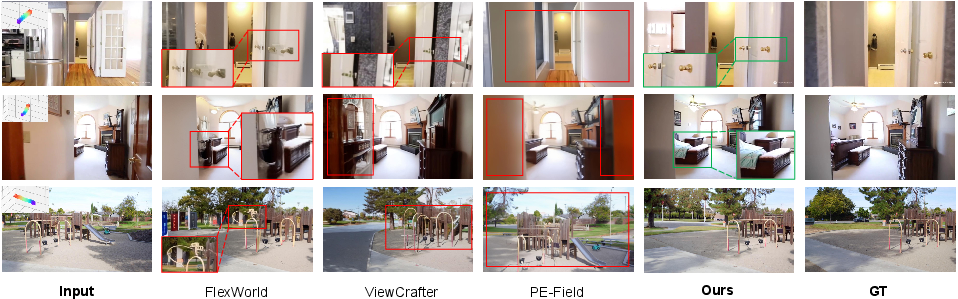
Figure 3: Under extensive camera motion, UniGeo avoids geometric structure duplication seen in other methods.
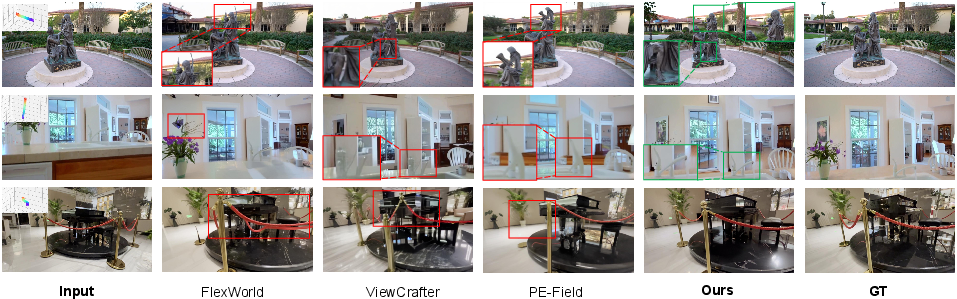
Figure 4: For limited camera movements, UniGeo preserves spatial layout and scene details across views.
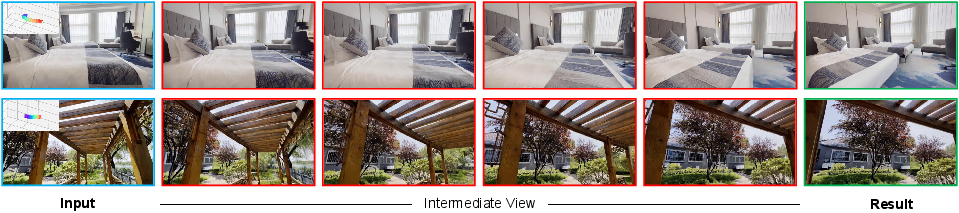
Figure 5: The model produces temporally continuous frame synthesis, with geometry preserved along the full camera trajectory.
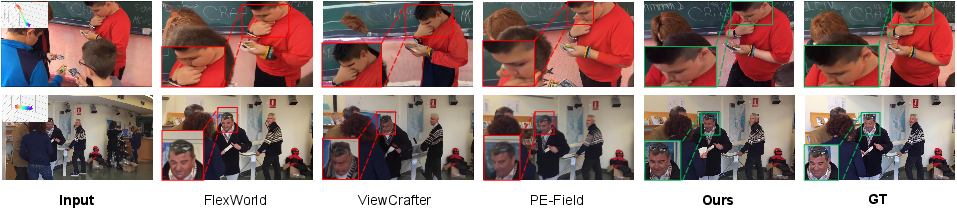
Figure 6: On the MannequinChallenge dataset, UniGeo maintains identity and consistency for human subjects under camera motion.
Ablation Studies
Systematic ablations isolate the impact of each UniGeo module:
- Removing FDPCI or TEGS increases LPIPS and reduces SSIM, confirming their necessity for geometric integrity.
- GAA’s anchor attention provides optimal results at α=1.0; both under- and over-weighting degrade alignment.
- Extreme settings (e.g., removing all intermediate supervision) result in blur and major structural breakdowns.

Figure 7: Qualitative ablations: Removing point clouds or intermediate supervision yields duplication, misplacement, and blur, degrading cross-view consistency.
Failure Modes
UniGeo’s limitations arise in scenes of extreme complexity or dramatic viewpoint change. In such domains, errors from the geometric priors (e.g., inaccurate depth/point clouds) propagate, resulting in degraded structure or unstable texture transfer.

Figure 8: Failure cases—left: complex objects confound geometry/texture; right: extreme camera moves harm consistency.
Implications and Future Directions
UniGeo’s architectural paradigm—systematically unifying geometric guidance at representation, architecture, and objective levels—offers a foundation for future high-fidelity, view-consistent editing across 2D/3D generative modeling. Broader applications include robust video generation, robotics, and virtual content creation where strict geometric consistency is critical.
Potential extensions involve:
- Improved geometric prior estimation via learning-based or multi-modal fusion,
- Integrating uncertainty-aware geometric representation for high-complexity/low-data regimes,
- Model acceleration for practical deployment (e.g., more lightweight LoRA variants or frame-skipping heuristics).
Conclusion
UniGeo redefines camera-controllable image editing, overcoming core limitations concerning geometric consistency by enforcing unified geometric guidance throughout the video generative pipeline. Empirical results conclusively demonstrate SOTA performance for diverse motions and scenes, setting a new technical standard for geometrically faithful image editing using video models (2604.17565).