
- The paper introduces a Language Contract that decouples architectural complexity to enable parallelized repo-level synthesis.
- Its dual-layer symbolic projection and dynamic hierarchical execution graph achieve sub-linear context scaling and robust self-healing.
- Experimental results demonstrate 100% structural integrity and competitive functional success against legacy multi-agent frameworks.
Contract-Coding: Structured Symbolic Paradigm for Repo-Level Generation
Introduction and Motivation
Contract-Coding introduces an intent-first symbolic orchestration framework addressing systemic context-fidelity bottlenecks in automated repo-level synthesis. Traditional chain-of-thought multi-agent pipelines (MetaGPT, ChatDev) exhibit multiplicative error propagation and linear context accumulation, sharply limiting scalability as user intent diffuses into semantic noise and exceeding the available attention span for complex repositories. Specification-driven approaches, while rigorously architectural, presuppose complete design blueprints—a rare practical occurrence. Contract-Coding formalizes a Language Contract that autonomously projects ambiguous user intents into an architectural “thumbnail” (SSOT), enforcing information hiding and topological independence. This transforms the generative process into parallel execution grounded in a contract-driven hierarchical graph, mitigating architectural collapse.
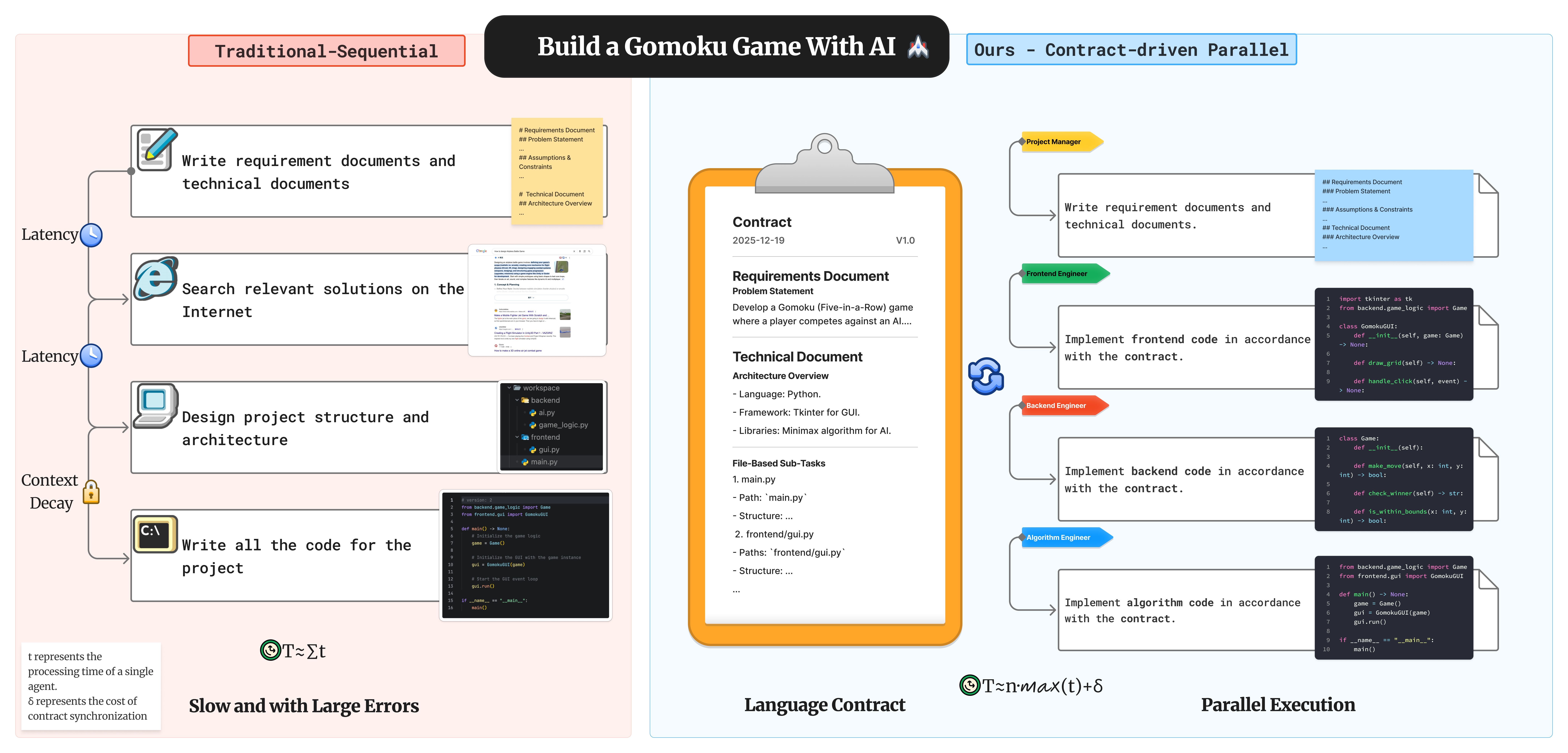
Figure 1: Language Contracts enforce parallel architectural orchestration by decoupling module dependencies, avoiding context accumulation inherent in linear workflows.
Methodological Details
Symbolic Projection
The Language Contract operates as a dual-layer semantic barrier, comprising high-dimensional constraint projections (requirements, APIs, dependencies) and an executable symbolic kernel encoded as file-module mappings, strict type signatures, and state spaces. Construction is restricted to atomic mutations ("Add", "Update"), prohibiting semantic drift. A two-stage pipeline (Generator proposal, Discriminator audit) ensures architectural soundness (e.g., acyclicity, completeness), dynamically propagating residual ambiguity to downstream execution agents for adaptive contract patching.
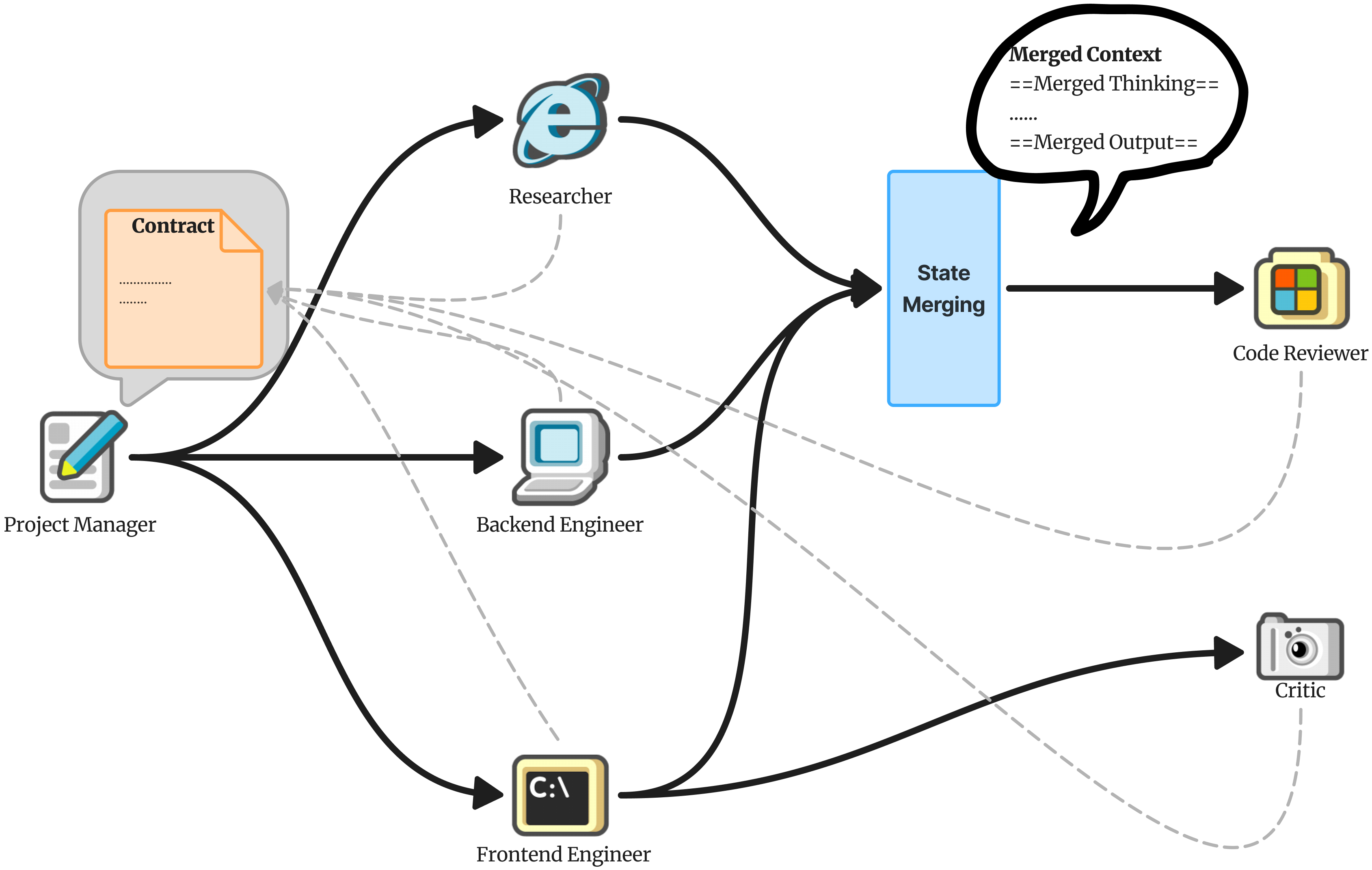
Figure 2: The global state matrix, formalized by the Language Contract, drives the Hierarchical Execution Graph for agent scheduling and workflow resolution.
Hierarchical Execution Graph (HEG)
Repo-level synthesis is restructured into a Dynamic HEG, where execution topology and scheduling are contract-conditioned. Atomic tasks are directly mapped from contract sections, each with status lifecycles (Todo, Done, Error, Verified). Workers operate strictly on contract context—never on noisy implementation history—ensuring conditional independence (as formalized), unlocking parallelism and sub-linear reasoning context scaling. Normative critics verify implementations against contract constraints, iteratively converging under bounded topological depth.
Contract Auditing and Self-Healing
The Contract Auditor synchronizes structure, status, and consistency through three metrics:
Appendix describes conflict repair and aggregation via a Differential Interval Analysis protocol and a union-first conflict resolution strategy prioritizing information preservation.
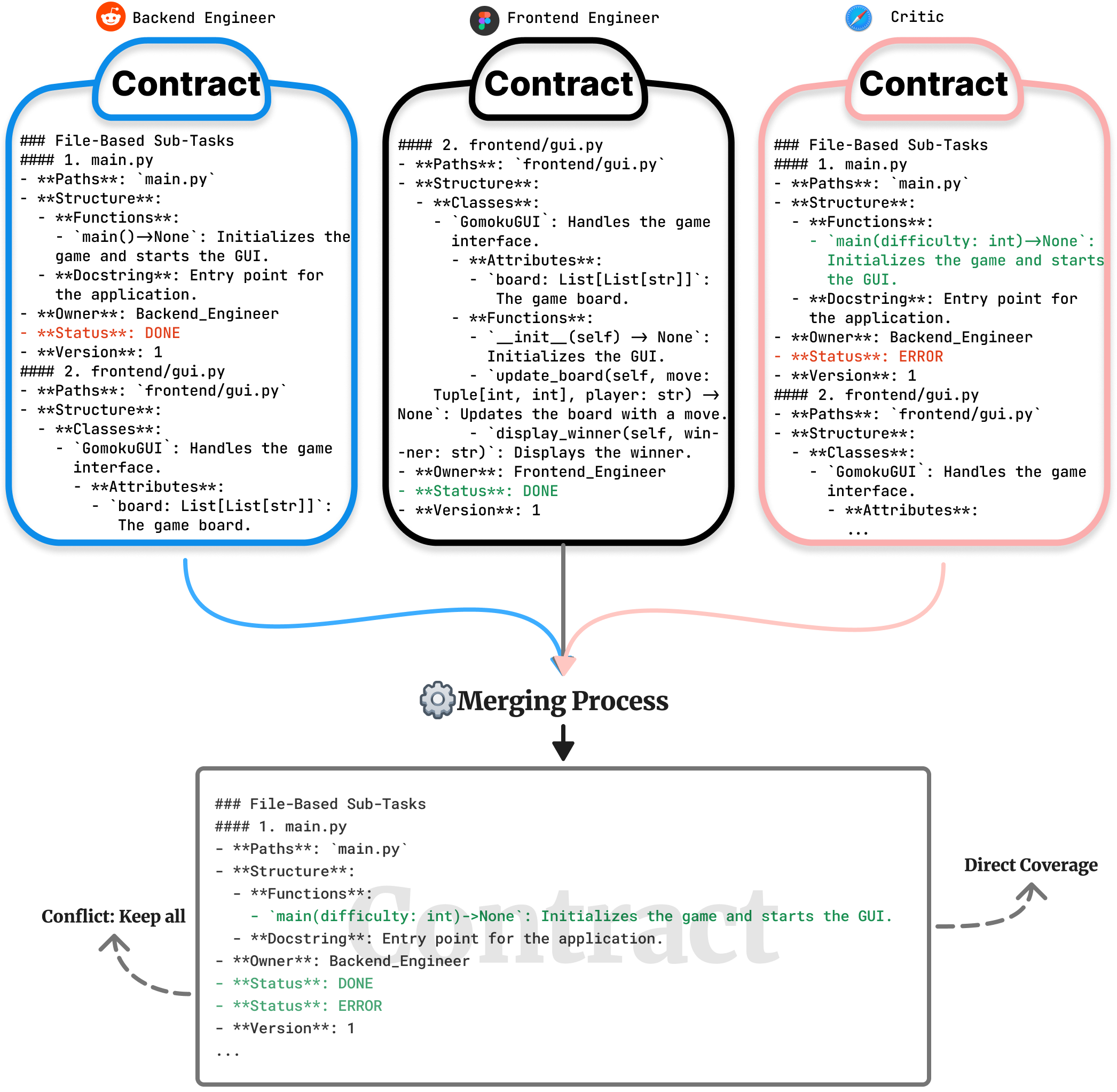
Figure 4: Atomic patches based on the immutable baseline contract resolve semantic conflicts while avoiding silent data loss.
Experimental Evaluation
Complexity Spectrum and Context Scaling
Contract-Coding is evaluated on Greenfield-5, spanning logic scripts, event-driven games, resource management, and a Roguelike requiring modular scale (>15 files). Baselines include legacy academic multi-agent frameworks and commercial AI IDEs. Metrics combine executed/interacted/rule-adherence benchmarks and architectural/topological analysis.
Contract-Coding achieves 100% structural integrity throughout, with a 47% functional success rate and significant context compression: complexity growth yields sub-linear Language Contract size, downgrading repository synthesis to manageable single-file tasks. Legacy frameworks collapse under context saturation; commercial tools rely on high-latency, brute-context scaling, which yields diminishing returns.
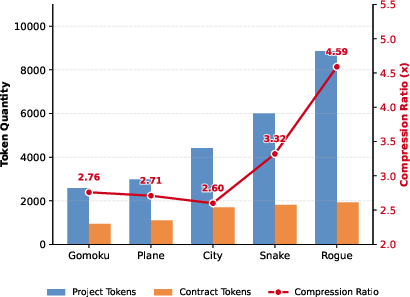
Figure 5: The Language Contract exhibits sub-linear token scaling relative to repository complexity, substantiating semantic compression.
Forensic Failure Analysis
Legacy multi-agent frameworks manifest hollow skeletons (MetaGPT), reflection-action gaps (ChatDev), and context collapse (FLOW). Commercial tools escalate logical drift and interface mismatch as complexity increases. Contract-Coding's failures are strictly local logic bugs, never architectural collapse, validating the claim that structural integrity is achieved via symbolic decoupling.
Practical and Theoretical Implications
Contract-Coding formally separates architectural orchestration from implementation, enforcing global consistency and parallel efficiency through the symbolic SSOT. Practically, this paradigm differentially compresses reasoning space, enabling scalable repo-level generation without exorbitant context windows or infrastructure. Theoretically, the approach validates that conditional independence and information hiding (via contracts) fundamentally resolve the scalability wall observed in chain-of-thought systems.
The model-agnostic ablation confirms robustness, with non-proprietary models (Qwen-Plus) achieving parity in functional success, indicating that the architectural topology—not model capacity—is paramount for scalable repo generation.
Limitations and Future Directions
Contract-Coding’s O(1) dependency depth applies to parallel execution, but system latency may scale with synchronization/repair rounds in cases of extreme semantic coupling. Benchmark limitations persist, as no standardized suite exists for greenfield, multi-file synthesis. Commercial IDEs’ internal changes deter reproducibility. Future research directions include automated benchmarks for large-scale contract-driven paradigms, conflict-aware merging using arbiter LLMs, and optimizing union-first strategies for ultra-large teams.
Conclusion
Contract-Coding operationalizes structured-symbolic repo generation, decoupling architectural complexity from implementational context. Through Language Contracts and auditable graph orchestration, it achieves near-optimal structural integrity, efficient parallelism, and robust self-healing in real-world, intent-driven engineering. Empirical results validate sub-linear context scaling and competitive efficiency, marking contract-driven symbolic paradigms as a viable path beyond brute-force context expansion for autonomous software synthesis (2604.13100).