- The paper introduces QuMod—a parallel job scheduler that leverages adaptive circuit cutting to distribute large quantum workloads across modular QPUs.
- It details both LO and LOCC paradigms, optimizing qubit mapping and synchronization to overcome sampling overhead and resource constraints.
- Empirical evaluations demonstrate improved throughput, fidelity, and scheduling efficiency on heterogeneous workloads, underscoring QuMod’s scalability potential.
Parallel Quantum Job Scheduling on Modular QPUs with Circuit Cutting: An Expert Overview of QuMod
Introduction and Motivation
Contemporary quantum computing systems are hindered by the limited number of high-fidelity physical qubits available per quantum processing unit (QPU), especially in the NISQ regime. Error-corrected, large-scale algorithms demand orders of magnitude more qubits than are available on monolithic devices. Modular quantum computing—where multiple QPUs are interconnected via classical or quantum links—addresses some of these scaling bottlenecks, enabling quantum jobs to be distributed across a heterogenous, networked set of QPUs.
The QuMod framework introduces a parallel quantum job scheduler specifically optimized for such modular architectures (2604.11013). It leverages circuit cutting (both LO and LOCC paradigms) to partition and distribute jobs exceeding the resources of any single QPU. QuMod addresses novel synchronization, qubit mapping, and sampling-overhead challenges that arise when multiple users compete for these resources in a cloud environment.
Modular Architectures and Circuit Cutting
Monolithic architectures face straightforward resource limitations. Modular QPUs interconnected by high-speed classical or photonic links introduce the ability to ‘knit’ together circuits too large for any individual device. The dominant circuit cutting strategies are:
- Local Operations (LO): Subcircuits are run independently. Cut wires and gates are replaced with probabilistic local transformations and results are assembled classically using quasi-probability decomposition. Sampling overhead increases exponentially with the number of cuts (16k wires or 9k gates), constraining practical scalability.
- Local Operations supplemented by Classical Communication (LOCC): Enables teleportation-style cross-QPU operation. Measurement outcomes are sent across classical links mid-circuit to synchronize downstream subcircuits, reducing the sample complexity exponentially (4k per cut wire), but introducing strict device synchronization and additional latency.
These approaches are tightly linked to hardware topology and communication latency constraints. LOCC is enabled only by tightly coupled modular backends and real-time classical communication.
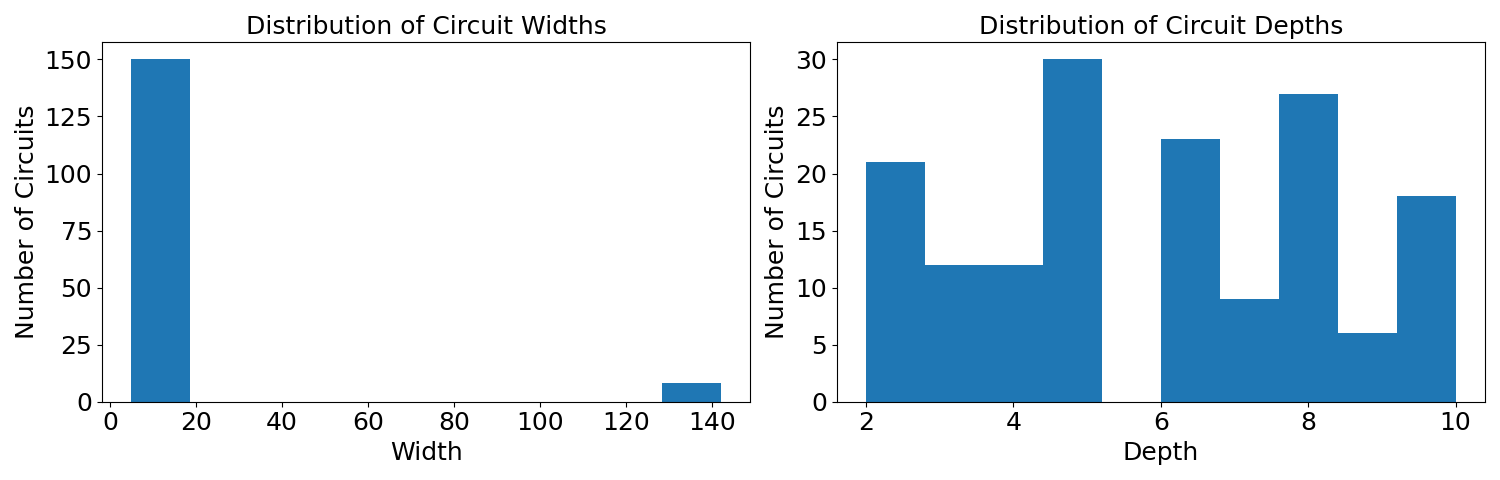
Figure 1: Distributions of circuit widths and depths in a heterogeneous random job queue, characterizing the diversity of scheduling scenarios managed by QuMod.
Scheduler Design: The QuMod Framework
QuMod implements a discrete-event quantum scheduler whose central routine iteratively forms runtime- and causality-consistent groups of jobs, then adapts circuit cutting and device mapping to maximize parallel execution while controlling for sampling overhead and hardware constraints.
Key features:
- Multi-Programmable Scheduler: Joint optimization over qubit mapping, parallelism, circuit cutting, and measurement synchronization across modular QPUs.
- Dynamic Grouping with Precedence Constraints: Utilizes dynamic programming to form device groups, ensuring downstream fragments (in LOCC) are not scheduled ahead of upstream source jobs.
- Adaptive Circuit Cutting: Jobs are selected for cutting based on qubit and sampling resource budgets, with adaptive rejection of excessively fragmented circuits that would exceed available subcircuit ‘slots’ or drive up sampling costs above global budgets.
QuMod’s core scheduling algorithms support both LO and LOCC execution modes (see Algorithm 1–3 in the original paper) and specifically handle causality (upstream/downstream) and synchronization required by LOCC paradigms.
Empirical Evaluation
The evaluation uses a SimPy-powered discrete-event simulation of modular quantum hardware, parameterized from eleven IBM QPU backends. Benchmarks include MQT-QUEKO (small synthetic circuits), large circuits (>127 qubits), and heterogeneous workloads with a broad distribution of circuit widths and depths.
MQT-QUEKO Benchmarks
LO and LOCC scheduling of small circuits yields similar makespans, as all subcircuits efficiently fit alongside each other, and the benefit of reduced sampling overhead in LOCC is less pronounced than synchronization-induced delay.
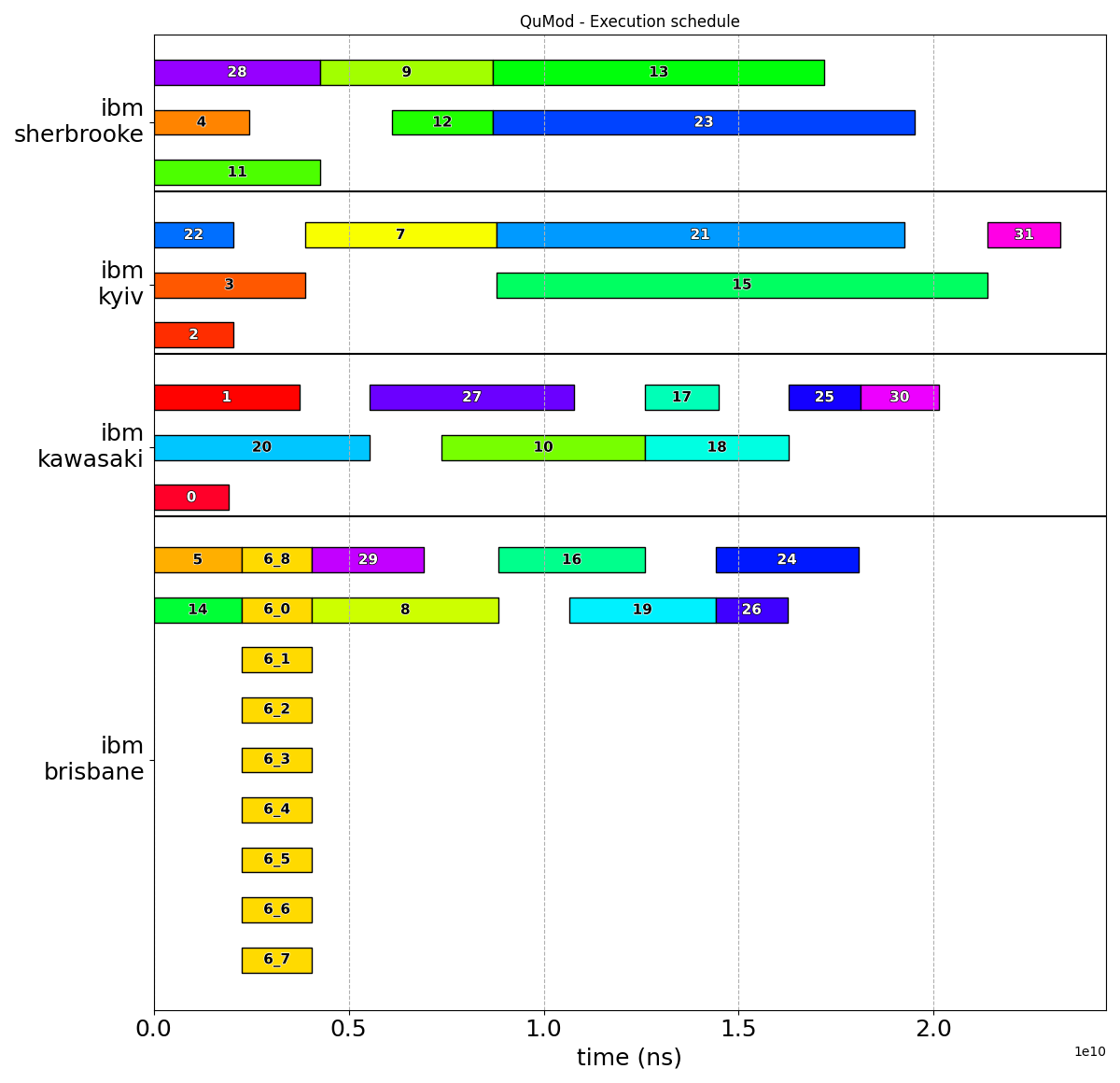
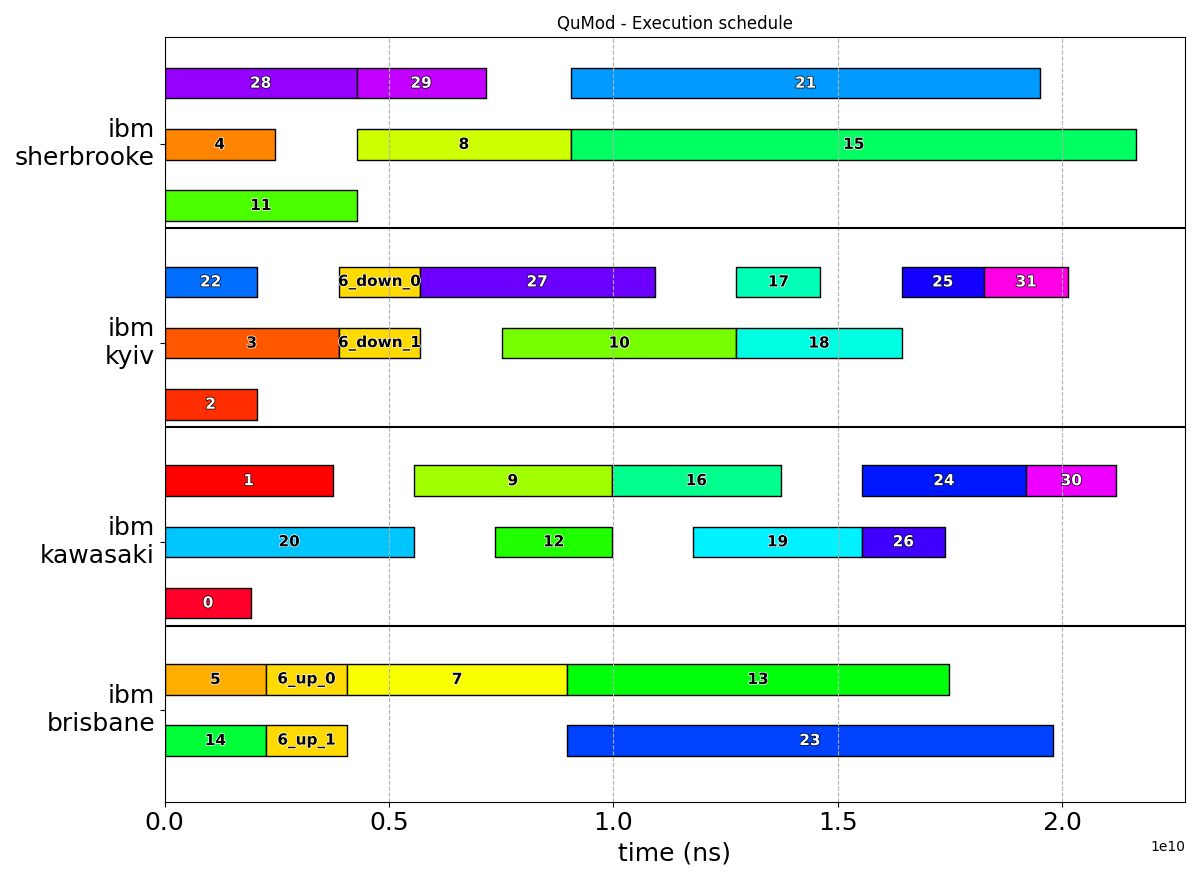
Figure 2: MQT-QUEKO benchmark schedules in LO (left) and LOCC (right) mode; LO enables independent parallelization, LOCC imposes upstream/downstream execution constraints across QPUs.
Large Circuits and Mandatory Cutting
When jobs exceed monolithic QPU capacity (e.g., 142-qubit circuits), circuit cutting is essential. In the LO paradigm, the exponential scaling in subcircuit count forces the schedule into near-sequential execution (since subcircuits are large and can’t be grouped), inflating response times.
LOCC mode enables additional jobs to be adaptively cut and intermixed for parallelism, utilizing upstream/downstream groupings to maximize hardware utilization and reduce overall makespan.
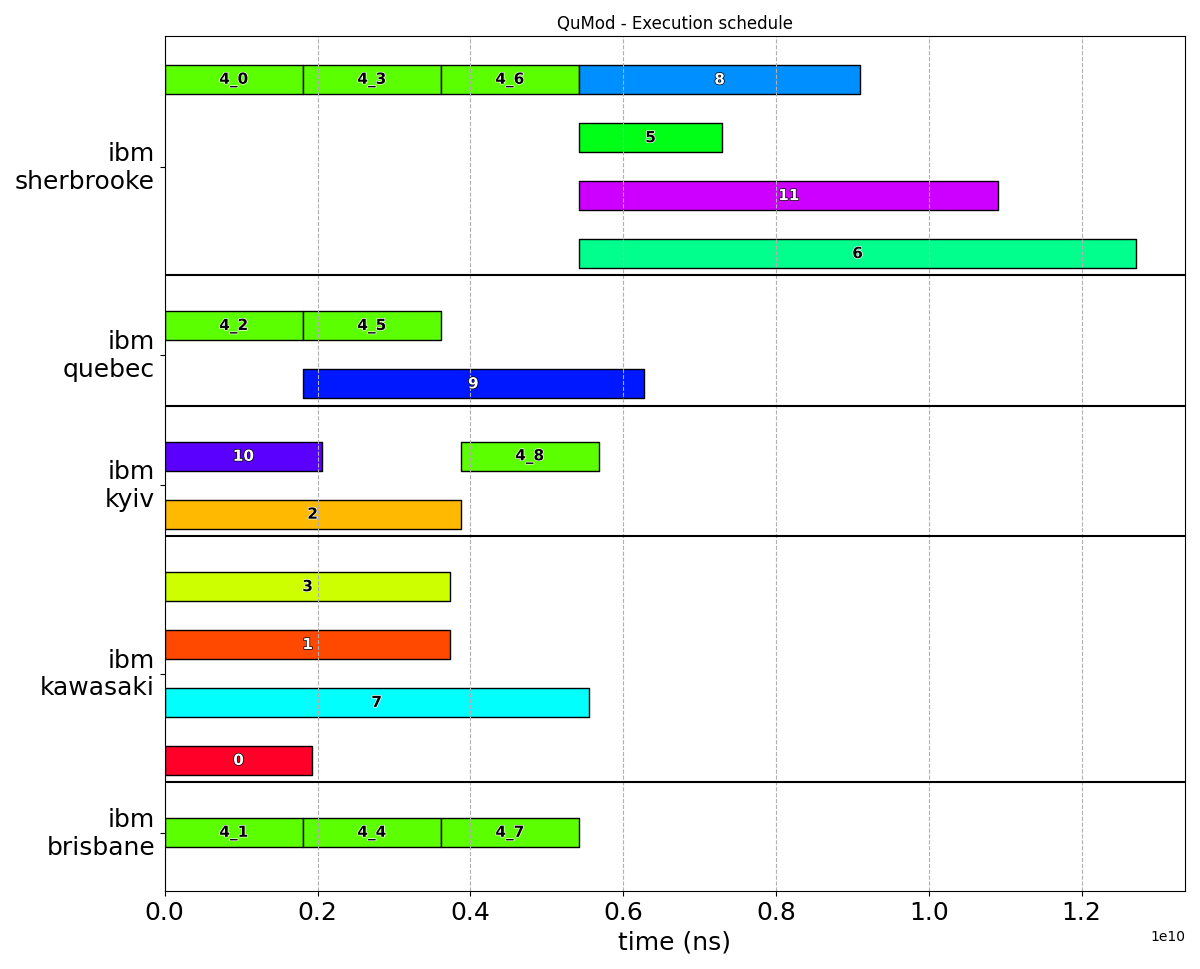
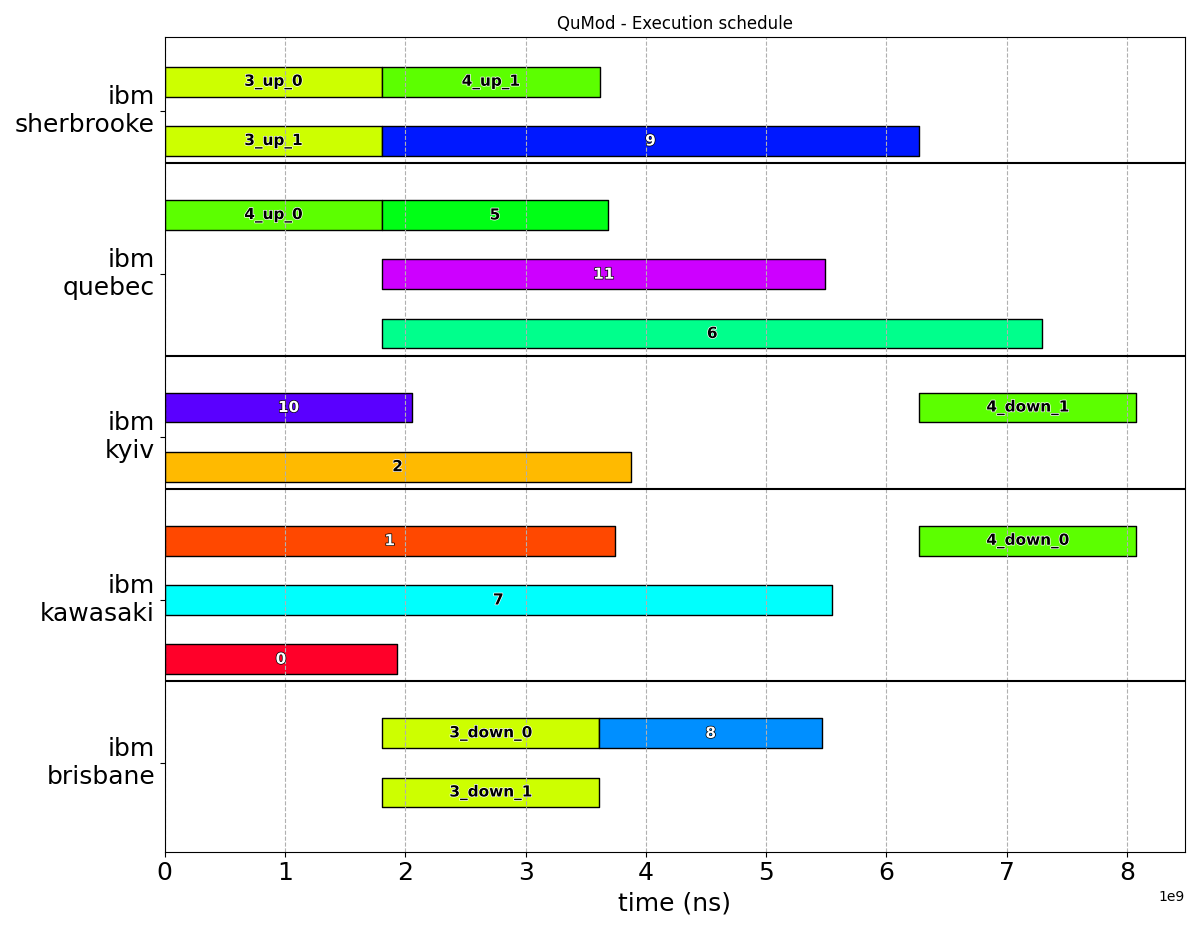
Figure 3: Scheduling large, mandatory-cut circuits; in LO mode (left), group size constraints prevent parallel execution of large subcircuits, while LOCC (right) dynamically selects additional cuts to optimize device utilization and increase concurrency.
Heterogeneous Workloads
On general, mixed workloads, LOCC mode achieves superior performance metrics:
- Lower average queue length, wait time, and total response time.
- Improved throughput: More parallelism obtained by smaller subcircuits and flexible distribution.
- Higher fidelity (measured by LPST proxy): Less sampling variance and higher expected correctness versus LO.
These numerical results are consistent across all workload classes, particularly as job distribution heterogeneity increases and circuit sizes outstrip monolithic device capacities.
Technical Implications and Comparative Analysis
LOCC-based circuit cutting achieves orders-of-magnitude reduction in sampling overhead for large jobs, at the cost of explicit synchronization and communication-induced latency. QuMod demonstrates that, provided inter-QPU latency is competitive with circuit coherence times, the trade-off sharply favors LOCC for complex, large-scale jobs—particularly as modular hardware matures.
Contrasted with recent quantum job scheduling approaches (e.g., Qoncord [10764550], QuFlex [kulkarni2025quflex], QuSplit [li2025qusplit]), QuMod’s key distinction is its co-optimization of scheduling with both qubit and sampling resources across a modular backend, and its explicit modeling of cross-device synchronization in LOCC.
Limitations and Future Outlook
While QuMod’s LOCC-mode performance is robust in simulation, real-world modular QPU environments introduce additional layers of complexity—variable classical link latencies, error propagation via mid-circuit measurements and classical control, and decoherence effects that violate idealized teleportation assumptions.
Potential future directions:
- Heterogeneous-device-aware scheduling: Accounting for calibration drift and dynamically fluctuating fidelities across QPUs.
- Hybrid quantum-classical algorithms: Integration of circuit knitting with VQA pipelines, leveraging cloud-heterogenous resources.
- Low-latency network protocols and error mitigation: Pushing modular QPU cross-linking to sub-millisecond latencies to minimize synchronization penalties.
As the quantum cloud ecosystem matures—with hybrid modular backends featuring both quantum and classical links—the principles underlying QuMod’s adaptivity will likely be essential to achieving usable, scalable quantum acceleration for practical workloads.
Conclusion
QuMod establishes a comprehensive framework for scheduling parallel quantum jobs on modular, interconnected QPUs using adaptive circuit cutting. Its dual-mode (LO/LOCC-aware) approach rigorously leverages both sampling complexity and device synchronization to optimize makespan and fidelity under realistic resource constraints. The results indicate significant practical value for modular quantum clouds as they transition toward high-throughput, multi-tenant operation, and highlight the primacy of LOCC-based knitting in scaling quantum workloads beyond current hardware limitations.
Reference:
QuMod: Parallel Quantum Job Scheduling on Modular QPUs using Circuit Cutting (2604.11013)