Adaptive Resource Orchestration for Distributed Quantum Computing Systems
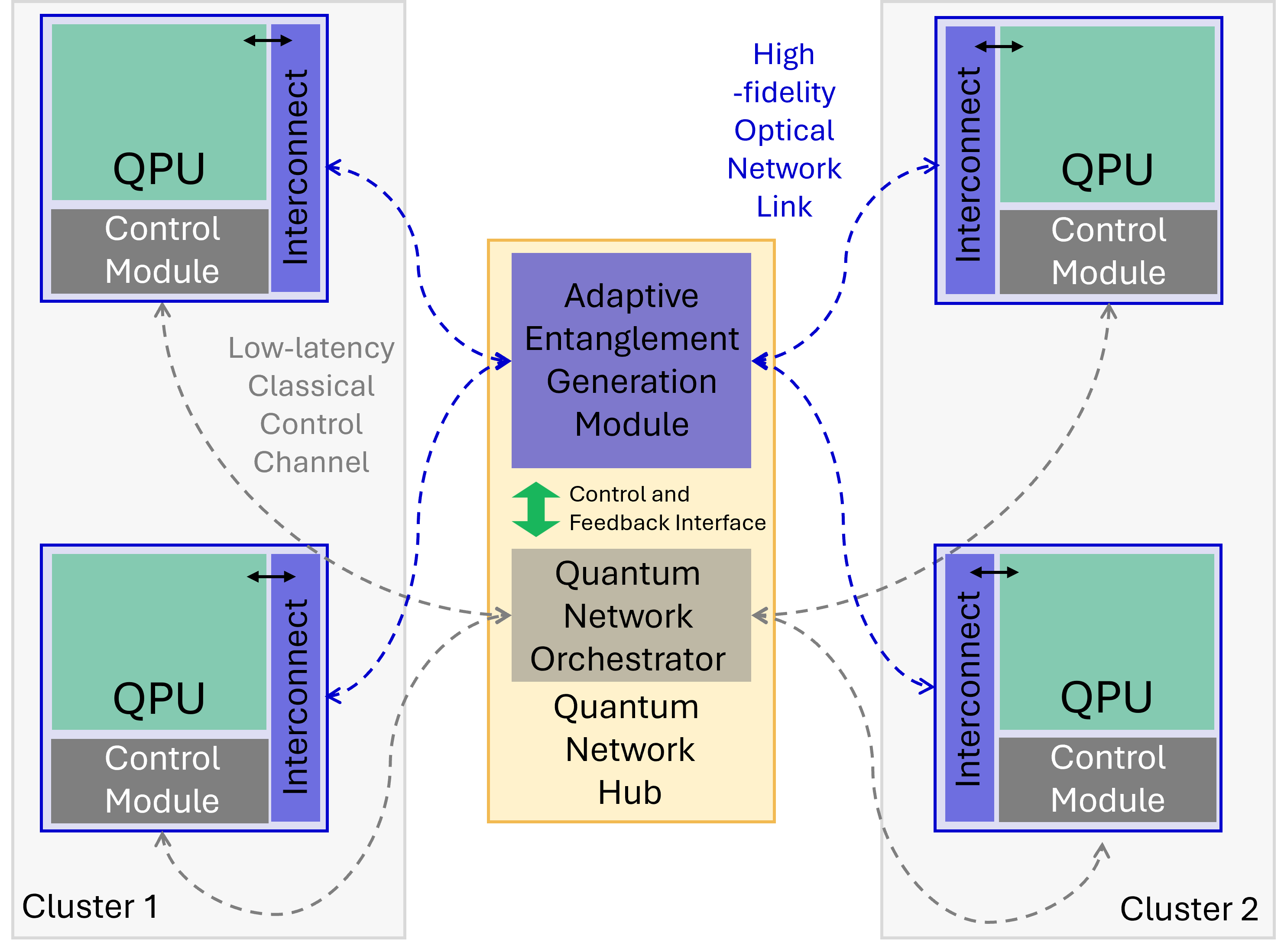
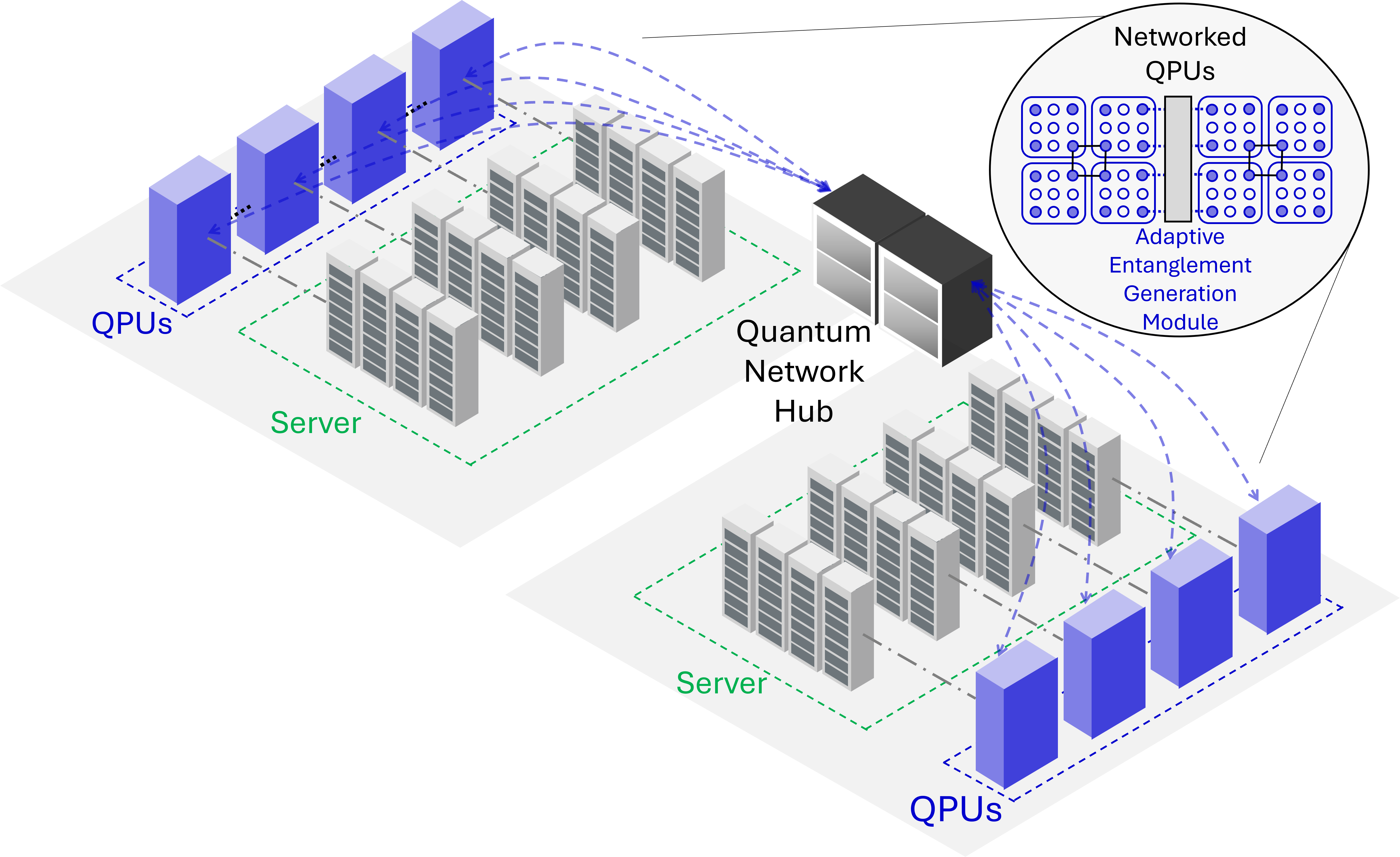
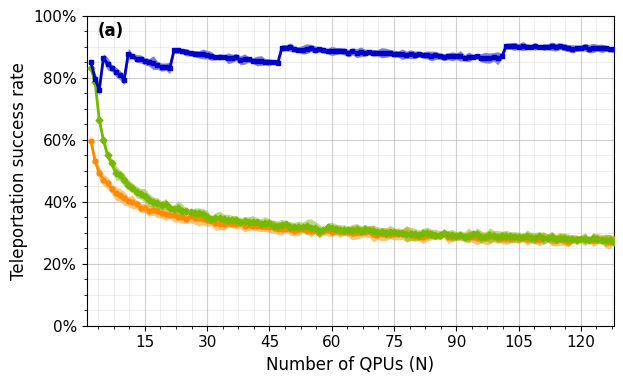
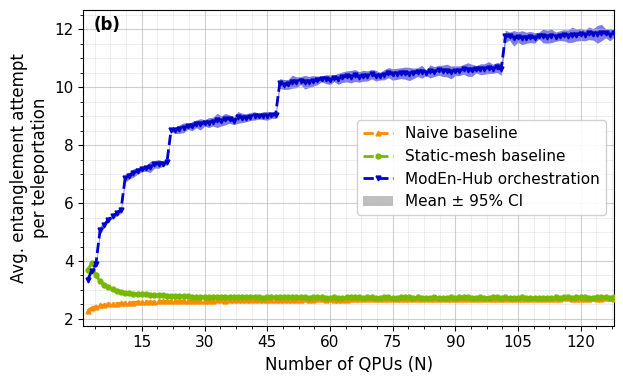
Abstract: Scaling quantum computing beyond a single device requires networking many quantum processing units (QPUs) into a coherent quantum-HPC system. We propose the Modular Entanglement Hub (ModEn-Hub) architecture: a hub-and-spoke photonic interconnect paired with a real-time quantum network orchestrator. ModEn-Hub centralizes entanglement sources and shared quantum memory to deliver on-demand, high-fidelity Bell pairs across heterogeneous QPUs, while the control plane schedules teleportation-based non-local gates, launches parallel entanglement attempts, and maintains a small ebit cache. To quantify benefits, we implement a lightweight, reproducible Monte Carlo study under realistic loss and tight round budgets, comparing a naive sequential baseline to an orchestrated policy with logarithmically scaled parallelism and opportunistic caching. Across 1-128 QPUs and 2,500 trials per point, ModEn-Hub-style orchestration sustains about 90% teleportation success while the baseline degrades toward about 30%, at the cost of higher average entanglement attempts (about 10-12 versus about 3). These results provide clear, high-level evidence that adaptive resource orchestration in the ModEn-Hub enables scalable and efficient quantum-HPC operation on near-term hardware.
Paper Prompts
Sign up for free to create and run prompts on this paper using GPT-5.
Top Community Prompts
Explain it Like I'm 14
Overview
This paper is about making many small quantum computers work together like one big, powerful machine. The authors propose a central “hub” that creates and manages special quantum links called entanglement between different quantum processors. With this hub and smart control software, the system can send quantum information between machines quickly and reliably, even though quantum signals are fragile.
Key Objectives
The paper sets out to:
- Design a central “Modular Entanglement Hub” (ModEn-Hub) that connects many quantum processors using light (photons).
- Build a smart “orchestrator” (control software) that decides when and how to create entanglement, move quantum states, and run gates between distant machines.
- Use adaptive strategies (a bit like learning to manage resources better over time) to decide which links to build, when to try multiple attempts in parallel, and when to keep “spare” entangled pairs ready.
- Test whether this approach works better than a simple, one-try-at-a-time method by running many simulated experiments.
Methods and Approach
Think of each quantum processor (QPU) as a musician in an orchestra, and the ModEn-Hub as the conductor. The conductor:
- Creates “entangled pairs” (like two magic coins that always match in a special way, no matter how far apart they are). These pairs are called Bell pairs or “e-bits.”
- Uses these pairs to “teleport” quantum states between machines. Teleportation here doesn’t move the physical qubit; it moves its state using the shared entangled pair plus a few ordinary bits sent over a fast classical network.
- Keeps a small stash of extra entangled pairs ready for popular connections, so the next operation can start immediately.
To see how well this works, the authors ran a Monte Carlo simulation. That’s like rolling lots of smart dice over and over to estimate how often a plan succeeds. They compared two strategies under a strict limit of only three “rounds” (tries) per request:
- Baseline: Try to create one entangled pair per round, in sequence. No saving extras.
- Orchestrated (their approach): Try several entanglement attempts in parallel (more tries as the network grows), and if more than one succeeds, keep one extra in a small cache for next time.
Because bigger networks are harder (signals can be weaker or more crowded), the simulation also made each single attempt slightly less likely to work as the number of connected QPUs increased. This models real-world losses and delays.
Main Findings
- Much higher reliability: With the orchestrated approach, teleportation succeeded about 90% of the time across network sizes from 1 up to 128 QPUs. The simple baseline dropped toward about 30% as the network got larger.
- Trade-off in cost: The orchestrated method used more total “entanglement attempts” per successful teleportation (about 10–12 on average at large sizes) compared to the baseline (about 3). In plain terms, the smart approach spends more tries up front (by doing them in parallel and caching spares) to keep success high and steady.
Why this matters: In quantum networks, you often get only a few quick chances before the quantum information fades. The orchestrated method makes those few chances count by trying multiple paths at once and saving useful results for later.
Implications and Impact
- Scaling up quantum computing: Instead of building one gigantic quantum computer, we can network many smaller, different types of machines and make them act like a larger, unified system.
- Practical data-center design: A hub-and-spoke layout means each QPU needs just one link to the hub, not a separate link to every other QPU. That’s much easier and cheaper to grow.
- Faster, more flexible operations: Keeping a small cache of entangled pairs and coordinating teleportation in real time cuts delays and boosts reliability, which is crucial for near-term quantum hardware.
- New applications: This approach could enable bigger computations than any single device can handle, support secure multi-party quantum tasks, and even link devices for better sensing and timing.
Looking ahead, there are challenges to solve—like improving hardware that converts signals between different technologies, keeping extremely precise timing, agreeing on standards across vendors, and weaving error correction into the network. Still, the results here show that smart, adaptive orchestration at a central hub can make distributed quantum computing much more reliable on the kinds of hardware we expect to have soon.
Knowledge Gaps
Knowledge Gaps, Limitations, and Open Questions
The following list distills what remains missing, uncertain, or unexplored in the paper and can guide concrete next steps for future research.
Modeling and Evaluation
- The Monte Carlo model aggregates losses into an ad hoc without physics-based justification; validate or replace with a calibrated, platform-specific channel-and-device model (including fiber attenuation, coupling, BSM visibility, detector dark counts, multiphoton events).
- Results hinge on arbitrary policy parameters (e.g., round budget, , , , ); conduct sensitivity analyses and parameter sweeps to quantify robustness.
- No modeling of quantum-memory decoherence or finite coherence times; integrate time-dependent fidelity decay for stored ebits and its impact on success/latency.
- Caching is idealized (capacity=1 per pair, no time-to-live, no eviction); quantify cache coherence-time distributions, optimal capacities, and eviction/replenishment policies under realistic memory errors.
- Teleportation success is the only reliability metric; add ebit fidelity distributions, end-to-end gate infidelity, latency CDFs, jitter, throughput, and fairness metrics.
- Workload model uses uniform random source–destination pairs; evaluate realistic traffic with temporal/spatial locality, burstiness, multi-tenant mixes, and concurrent requests.
- No contention/queueing model at the hub or QPU interfaces; incorporate port constraints, blocking in the switching fabric, source rates, and scheduling conflicts.
- Lack of analytical performance bounds; derive closed-form or provable bounds linking , , , and cache parameters to success, latency, and attempt costs.
Orchestration Algorithms and Control Plane
- Reinforcement-learning–based orchestration is proposed but not instantiated; specify state/action spaces, reward design, training regimes, and compare against strong baselines with ablations.
- No guarantees on stability, safety, or convergence of learning-based policies; develop constraints/verification methods and fallback policies for safety-critical control.
- Orchestrator assumes negligible classical latency; measure and model feed-forward delays, clock jitter, and control-plane congestion, and study their algorithmic impact.
- Centralized control is a single point of failure; design redundancy, failover, and consistency mechanisms for the global entanglement map under asynchronous updates.
- Fairness and QoS across tenants are unspecified; define schedulers and SLAs for prioritization, isolation, and admission control under limited entanglement rate.
- Missing co-scheduling of classical and quantum tasks (e.g., feed-forward, compilation, tomography); quantify end-to-end control-loop bottlenecks and mitigation strategies.
Architecture and Scalability
- Single-hub scalability limits are not quantified; model maximum sustainable QPU count given port counts, source rates, switching speed, and memory capacities.
- Multi-tier (inter-hub) architectures are acknowledged but not designed; develop hierarchical routing, inter-hub synchronization, and swap-depth control to meet end-to-end fidelity/latency targets.
- Optimal parallelism is chosen heuristically; formulate and solve constrained optimization to select dynamically based on traffic, memory, port utilization, and fidelity goals.
- The photonic fabric is described as blocking and bounded-degree; analyze head-of-line blocking, path setup times, and time/frequency multiplexing trade-offs under load.
Physical Layer and Hardware
- No experimental validation of the hub module; provide prototype measurements (source brightness, heralding rate, BSM visibility, insertion loss, switching latency, memory T1/T2).
- Transduction performance and integration (e.g., microwave–telecom) are critical but unquantified; characterize fidelity–efficiency–bandwidth trade-offs and rack-scale packaging constraints (size, power, cryogenics).
- Timing and synchronization overheads are not measured at scale; evaluate White Rabbit or equivalent distribution at 102–103 nodes and quantify stability, drift compensation, and operational costs.
- Cross-talk, spectral filtering, and isolation in dense multiplexing regimes are not analyzed; determine acceptable channel spacing and switch specifications to maintain target Bell-state fidelity.
- No treatment of active fiber stabilization (phase/length noise) for interference-based BSMs; quantify required stabilization bandwidth and its effect on duty cycle.
Error Correction, Purification, and Reliability
- Integration with fault tolerance is left for future work; design schedules for distributed stabilizer measurements, teleportation of logical qubits, and quantify overhead vs. link error rates.
- Entanglement purification is not considered; evaluate when to purify vs. increase , the impact on cache policies, and end-to-end logical error rates.
- Classical error handling (e.g., Pauli-frame tracking under BSM errors, classical bit flips) is not modeled; include error detection/correction on feed-forward channels and its latency impact.
Applications, Algorithms, and Heterogeneity
- No end-to-end evaluation on real circuits (e.g., VQE/QAOA/QEC primitives); benchmark partitioned workloads with the proposed orchestration to report time-to-solution and accuracy vs. monolithic baselines.
- Circuit partitioning and “entanglement-efficient compilation” are cited but not integrated; build a closed-loop toolchain that co-optimizes partitioning, routing, and scheduling with live network state.
- Heterogeneous QPU characteristics (gate times, fidelities, connectivity) are not modeled; quantify their impact on mapping, load balancing, and synchronization.
- Multi-qubit entanglement (GHZ/cluster-state distribution) and distributed state-preparation workflows are not explored; extend scheduling and resource allocation beyond Bell pairs.
Security, Standards, and Reproducibility
- Trust model is unclear for a hub-centric architecture; specify authenticated entanglement, tenant isolation, measurement-device–independent options, and defenses against DoS/resource exhaustion.
- Standards and APIs are noted as missing; propose concrete abstractions for ebit requests, lifetime/quality constraints, error reporting, and non-local gate annotations (e.g., OpenQASM extensions).
- Fidelity measurement/telemetry (e.g., in situ link probing) is not integrated; define protocols to estimate and feed measured link quality into the orchestrator in real time.
- Reproducibility is claimed but no artifacts are provided; release the simulator, configurations, and datasets to enable independent verification and extension.
Glossary
- Adaptive Entanglement Generation Module: A programmable subsystem that creates and routes entangled photon pairs on demand for networked QPUs. "It integrates an Adaptive Entanglement Generation Module and a Quantum Network Orchestrator"
- Bell pair: A maximally entangled two‑qubit state (e.g., |Φ+⟩) used as the basic resource for teleportation and non‑local gates. "onâdemand, highâfidelity Bell pairs across heterogeneous QPUs"
- Bell-state measurement: A joint measurement projecting two qubits onto a Bell basis, enabling operations like teleportation and entanglement swapping. "Bell-state measurement stations to enable entanglement swapping."
- Blind quantum computation: A protocol allowing a client to delegate quantum computation to servers without revealing inputs, algorithm, or outputs. "relying on protocols related to multiâparty key distribution or blind quantum computation"
- circuit‑switched photonic fabric: A reconfigurable optical interconnect that establishes temporary end‑to‑end optical paths (circuits) between nodes. "a reconfigurable, blocking circuitâswitched photonic fabric of bounded degree (not full mesh)"
- CNOT: The controlled‑NOT gate, a two‑qubit operation flipping the target qubit conditioned on the control qubit. "Suppose processor~A must execute a CNOT whose control qubit resides on A and whose target qubit sits on processor~B."
- Coherence window: The time interval over which a quantum state remains sufficiently intact (coherent) for reliable operations. "operations on spatially separated qubits must be completed within their coherence windows."
- Controlled‑Z gate: A two‑qubit entangling gate that applies a Z phase to the target when the control is |1⟩. "the deterministic teleportation of a controlled-Z gate"
- Decoherence: The loss of quantum coherence due to interaction with the environment, degrading quantum information. "qubits decohere rapidly"
- Distributed quantum computing: Executing a quantum program across multiple networked QPUs that collectively act as a single virtual machine. "A promising route to this scale is distributed quantum computing"
- e-bits: Entangled qubit pairs shared between nodes, serving as the communication resource for teleportation and remote gates. "pairs of entangled qubits, also known as e-bits, distributed between QPUs"
- Entanglement cache: A strategy of pre‑generating and storing Bell pairs for later use to reduce latency on demand. "maintaining an entanglement cache"
- Entanglement routing: Selecting multi‑hop paths and swap operations to deliver end‑to‑end entanglement under fidelity/latency constraints. "introduces the entanglementârouting problem"
- Entanglement source: Hardware that generates entangled photon pairs (e.g., via SPDC or quantum dots) for distribution across the network. "ModEnâHub centralises entanglement sources and shared quantum memory"
- Entanglement swapping: A protocol that creates entanglement between distant qubits by measuring intermediate ones in the Bell basis. "to enable entanglement swapping."
- Entanglement throughput: The rate at which usable entangled pairs are established between endpoints in a quantum network. "maximise entanglement throughput under latency constraints."
- Feed-forward control: Real‑time classical processing of measurement outcomes to determine and trigger subsequent quantum operations. "enable real-time feed-forward control."
- Heralded Bell pair: An entangled pair whose successful creation is confirmed by a classical signal (herald). "may attempt to create a heralded Bell pair."
- Heralded success probability: The probability that an entanglement attempt is both generated and confirmed by a heralding signal. "if a particular fibre link shows reduced heralded success probability"
- Hilbert space: The abstract vector space in which quantum states live; its dimension grows exponentially with qubit count. "Hilbertâspace dimension "
- hub‑and‑spoke photonic interconnect: A topology where a central hub provides optical connectivity to many peripheral QPUs. "a hubâandâspoke photonic interconnect paired with a realâtime quantum network orchestrator"
- Logical qubit: An error‑corrected qubit encoded across many physical qubits to protect against noise. "thousands of logical qubits"
- ModEn‑Hub: The proposed Modular Entanglement Hub architecture that centralizes entanglement services and orchestration. "We propose the Modular Entanglement Hub (ModEnâHub) architecture"
- No‑cloning theorem: A fundamental result stating that unknown quantum states cannot be copied exactly. "the noâcloning theorem forbids amplification or regeneration of unknown quantum states"
- Non‑local gates: Gates applied across qubits residing on different QPUs, typically implemented via teleportation and entanglement. "teleportationâbased nonâlocal gates"
- Optical switching: Reconfigurable routing of optical signals (photons) to connect different nodes on demand. "optical switching within the hub"
- Photonic links: Optical channels used to carry quantum information (photons) between devices. "over highâfidelity photonic links"
- Quantum memory: A device that stores quantum states (e.g., photons or spins) for later use while preserving coherence. "shared quantum memory"
- Quantum Network Orchestrator: The classical control plane that schedules, routes, and coordinates entanglement and distributed quantum operations. "the Quantum Network Orchestrator, which coordinates the timing and routing of entanglement generation, quantum teleportation, and remote gate operations across QPUs."
- Quantum processing unit (QPU): A quantum processor capable of preparing, manipulating, and measuring qubits. "quantum processing units (QPUs)"
- Quantum repeater: An intermediate node that extends entanglement over long distances via memory and swapping operations. "quantum repeaters"
- Quantum teleportation: A protocol that transfers a quantum state using shared entanglement and classical communication. "quantum teleportation and non-local gates"
- Quantum transduction: Converting quantum states between different frequency domains (e.g., microwave to optical) for networking. "microwaveâtoâtelecom transduction."
- Quantum‑HPC: The integration of quantum computing resources into high‑performance computing paradigms and systems. "a coherent quantumâHPC system."
- QAOA: The Quantum Approximate Optimization Algorithm, a variational method for combinatorial optimization. "VQE, QAOA, and related algorithms"
- Spontaneous parametric down-conversion: A nonlinear optical process that probabilistically generates entangled photon pairs. "such as spontaneous parametric down-conversion or quantum-dot-based emitters"
- Surface codes: A leading family of topological quantum error‑correcting codes suitable for scalable architectures. "distributed surface codes"
- Telecom photons: Photons at telecommunication wavelengths (around 1.3–1.5 μm) suitable for low‑loss fiber transmission. "platforms can emit telecom photons directly"
- Temporal multiplexing: Scheduling multiple entanglement generation attempts over time slots to increase utilization and throughput. "Temporal multiplexing of Bellâpair generation equalises utilisation across heterogeneous hardware"
- Tunable entanglers: Adjustable entanglement sources or devices whose parameters can be configured in real time. "integrate tunable entanglers with realâtime orchestration logic"
- VQE: The Variational Quantum Eigensolver, a hybrid algorithm for estimating ground‑state energies and related problems. "VQE, QAOA, and related algorithms"
- White Rabbit: A high‑precision timing and synchronization protocol achieving sub‑nanosecond accuracy over fiber. "Precisionâtiming solutions such as White Rabbit achieve subânanosecond accuracy over optical fibre"
Practical Applications
Overview
The paper proposes ModEn‑Hub: a hub‑and‑spoke photonic interconnect paired with a real‑time quantum network orchestrator that centralizes entanglement sources and shared quantum memory to deliver on‑demand, high‑fidelity Bell pairs across heterogeneous QPUs. It introduces adaptive orchestration (logarithmically scaled parallel entanglement attempts and opportunistic ebit caching) and shows via a reproducible Monte Carlo study that, under tight round budgets and realistic losses, orchestration sustains ≈90% teleportation success (versus ≈30% for a naïve baseline) at the cost of more entanglement attempts. Below are actionable, real‑world applications derived from these findings, methods, and innovations.
Immediate Applications
- Quantum data‑center pilot lines (2–6 QPUs)
- Sector: Cloud/HPC, software.
- What: Deploy a rack‑mount “ModEn‑Hub” photonic interconnect with a Quantum Network Orchestrator (QNO) to interconnect co‑located superconducting and/or trapped‑ion QPUs for small distributed workloads and cross‑vendor demonstrations.
- Tools/workflows: ModEn‑Hub appliance; QNO service; circuit partitioner and entanglement‑efficient compiler pass; ebit cache module; orchestration dashboards.
- Assumptions/dependencies: Short‑reach fiber links; lab‑grade photonic interfaces; White Rabbit or equivalent sub‑ns timing; coherent timescales compatible with data‑center latencies; operational acceptance of increased entanglement attempts for high success rates.
- Distributed algorithm prototyping on heterogeneous QPUs
- Sector: Academia/industrial R&D (chemistry, finance, logistics).
- What: Partition VQE/QAOA circuits across multiple small QPUs using entanglement‑efficient compilation to validate scaling behavior and cost models.
- Tools/workflows: Compiler plug‑ins for Qiskit/Cirq (graph partitioning, gate re‑ordering); teleportation‑based non‑local gate templates.
- Assumptions/dependencies: Moderate‑fidelity Bell pair delivery; cross‑platform calibration; small ebit cache; acceptance of shallow circuit depth due to NISQ noise.
- RL‑assisted entanglement scheduling service
- Sector: Software/telecom operations for quantum networks.
- What: Deploy a reinforcement learning policy (as in the paper) that sets parallelism K(N), caching, and swap timing to maximize success within round budgets; operate as a microservice in the control plane.
- Tools/workflows: Training pipeline on simulator traces; online policy with safety bounds; fallbacks to heuristics; A/B testing against baselines.
- Assumptions/dependencies: Telemetry access (loss, wait times, cache hits); guardrails to ensure stability; policy retraining as hardware characteristics drift.
- Entanglement observability and SRE for quantum networks
- Sector: DevOps/SRE in quantum cloud.
- What: Production‑grade monitoring of p_eff(N), round‑based success, ebit cache occupancy/age, fidelity distributions, and teleportation latency to guide capacity planning and incident response.
- Tools/workflows: Metrics exporters, tracing of teleportation workflows, SLA dashboards, anomaly detection.
- Assumptions/dependencies: Standardized counters and events from QPUs and hub software; calibration routines; security/tenant isolation for metrics.
- Orchestration‑aware SDKs and APIs
- Sector: Software/standards.
- What: Expose a unified API to request ebits, non‑local gates, and entanglement confirmations; add compiler annotations for partitioning constraints and network budgets.
- Tools/workflows: Runtime stubs and mocks; network‑state‑aware transpilers; sample notebooks.
- Assumptions/dependencies: Early industry alignment on verbs (request_epr, confirm_epr, teleport_gate), error semantics, and resource hints.
- Education and testbeds
- Sector: Academia.
- What: Use the paper’s lightweight Monte Carlo simulator and a small hub prototype to teach distributed quantum computing, orchestration, and routing.
- Tools/workflows: Open‑sourced simulator; lab exercises on K(N), caching, and tight‑round trade‑offs.
- Assumptions/dependencies: Public datasets and reference configurations; classroom‑grade hardware or emulators.
- Secure multi‑party demos (blind/distributed computation)
- Sector: Enterprise R&D, privacy tech.
- What: Demonstrate blind/distributed quantum computing across two or more institutional QPUs with the hub as an exchange point; evaluate trust and audit controls.
- Tools/workflows: Protocol templates (e.g., universal distributed blind QC); authenticated classical channels; policy for hub observability.
- Assumptions/dependencies: Moderate‑rate ebit delivery; agreed‑upon cryptographic assumptions (trusted vs semi‑trusted hub).
- Metrology‑compute co‑scheduling on campus
- Sector: Sensing/metrology.
- What: Coordinate entanglement distribution to a pair of clock/sensor nodes while sharing the hub with compute QPUs; small‑scale hybrid sensing trials.
- Tools/workflows: Orchestrator policies that allocate time windows for metrological ebits; fidelity tracking per use class.
- Assumptions/dependencies: Compatible sensor hardware (e.g., ion/atom‑based); timing stability; clear priority rules.
- Capacity and cost modeling for roadmaps and procurement
- Sector: Policy/strategy, enterprise IT.
- What: Use the paper’s success/attempt trade‑off curves to forecast hardware, optical, and operations budgets for incremental scaling.
- Tools/workflows: Sizing tool that inputs target success, N, round budgets, and outputs source rates, switch ports, memory depth, and staffing.
- Assumptions/dependencies: Parameter calibration to local hardware; sensitivity analysis for p0, beta, cache size.
Long‑Term Applications
- Virtual large‑qubit quantum cloud (cross‑vendor)
- Sector: Cloud/HPC, software.
- What: Offer “virtual 1k+ logical qubits” by composing many smaller QPUs through hubs; bill per entanglement‑minute and non‑local gate.
- Tools/products: Managed ModEn‑Hub service; orchestration‑aware compilers in mainstream SDKs; tenant‑level SLAs.
- Dependencies: High‑rate, high‑fidelity transduction and switching; mature APIs; automatic partitioning; robust multi‑tenant isolation.
- Multi‑tier, metro‑to‑regional hub networks
- Sector: Telecom/infrastructure.
- What: Spine‑leaf ModEn‑Hubs with hierarchical entanglement routing and swap scheduling across many hops.
- Tools/products: Entanglement routing controllers; inter‑hub timing sync; congestion control for ebit traffic.
- Dependencies: Quantum repeaters or low‑loss links; scalable synchronization; routing algorithms with QoS/fidelity guarantees.
- Fault‑tolerant distributed surface codes
- Sector: Hardware/architecture.
- What: Realize logical qubits across modules, teleport logical states, and perform lattice surgery via inter‑module ebits.
- Tools/products: Orchestrator integrated with QEC cycles; logical‑level cache and scheduling; error budgets tying network to code cycles.
- Dependencies: Sufficient physical qubits per module; link error rates compatible with thresholds; deterministic feed‑forward latencies.
- SLA‑backed “entanglement as a service”
- Sector: Policy/enterprise IT.
- What: Contractual SLAs for ebit rate, fidelity, and latency with monitoring, credits, and incident processes.
- Tools/products: Standardized telemetry and certification tests (akin to link‑layer BERTs for quantum); compliance audits.
- Dependencies: Accepted fidelity metrics and test suites; third‑party attestation; legal/insurance frameworks.
- Secure multi‑party quantum computation for regulated data
- Sector: Finance, healthcare, public sector.
- What: Cross‑organization quantum analytics (e.g., portfolio optimization, privacy‑preserving drug design) without exposing raw data.
- Tools/products: Protocol stacks for blind/distributed QC; policy kits for governance and liability; audit trails.
- Dependencies: Verified protocols on noisy, networked hardware; standards for accountability and export control compliance.
- Quantum internet exchange points (Q‑IX)
- Sector: Telecom/policy.
- What: Neutral interconnect facilities where carriers and providers peer entanglement services via federated hubs.
- Tools/products: Inter‑operator control plane; settlement/billing; interop certification.
- Dependencies: Inter‑domain standards; security models for authenticated entanglement; spectrum/fiber policy support.
- Hybrid sensing networks (timing, navigation, geodesy)
- Sector: Aerospace/defense, energy, telecommunications.
- What: Entangled clocks and distributed phase‑sensitive sensors coordinated by hubs for ultra‑precise timing, gravimetry, and synchronization.
- Daily life impact: More accurate timing for finance and grid control; resilient positioning systems complementing GNSS.
- Dependencies: Ruggedized quantum sensors; stable long‑haul entanglement; environmental noise mitigation.
- Domain‑integrated workflows for industry workloads
- Sector: Pharma/materials (VQE), logistics/finance (QAOA/optimization), energy (grid optimization).
- What: Orchestration‑aware pipeline stages in EDA/chemistry/OR tools that plan partitioning, non‑local gate budgets, and network SLAs.
- Tools/products: Plugins for Gaussian/OR‑Tools/SAP IBP; cost models incorporating entanglement attempt budgets.
- Dependencies: Repeatable advantage at logical scales; predictable network behavior; vertical co‑design with users.
- On‑chip/in‑rack transduction and integrated photonics market
- Sector: Hardware manufacturing.
- What: Standard modules for microwave‑to‑telecom transduction, multiplexed entanglers, and quantum memories tailored to hub slots.
- Tools/products: QSFP‑like optical quantum pluggables; cryo‑friendly photonic packages; memory blades with lifetime/fidelity specs.
- Dependencies: >99% transduction fidelity with acceptable size/power; supply chain maturity; thermal and EMI engineering.
- Certified autonomous orchestration agents
- Sector: AI/ML, safety.
- What: ML agents that optimize routing/caching under constraints, with formal safety envelopes and certifiable behavior.
- Tools/products: Safe RL toolkits; digital twins for training; explainability and rollback mechanisms.
- Dependencies: Regulatory acceptance; robust simulation‑to‑hardware transfer; failsafe interlocks.
- National quantum infrastructure programs
- Sector: Policy/government.
- What: Funding and standards for ModEn‑Hub deployments, timing networks, interop APIs, workforce training, and security baselines.
- Daily life impact: Accelerated rollout of quantum‑secure services; regional innovation ecosystems.
- Dependencies: Cross‑ministry coordination; standards bodies alignment; public–private partnerships.
- Consumer‑facing quantum‑secure and time services (indirect)
- Sector: Telecom/consumer services.
- What: Quantum‑enhanced time sync and secure backbones underpinning financial transactions, 5G/6G fronthaul, and cloud gaming/AR.
- Daily life impact: More reliable networks and secure services; eventual quantum‑ready apps leveraging precise time.
- Dependencies: Carrier‑grade hubs; cost‑effective metro deployments; integration into existing timing/security stacks.
Notes on cross‑cutting assumptions and dependencies
- Hardware: Continued gains in source brightness, detector efficiency, quantum memories, and especially microwave‑to‑telecom transduction; compact, rack‑mount integration.
- Networking: Sub‑ns synchronization at scale; low‑latency classical control channels; optical switching with bounded blocking and QoS.
- Software/standards: Common abstractions for ebit request/confirm, error semantics, and resource hints; orchestration‑aware compilers; interop across vendors.
- Error management: Transition from error mitigation to logical QEC, with orchestrator‑aware code cycles; realistic handling of decoherence in ebit caches.
- Operations/economics: Acceptance of higher entanglement attempt rates to sustain performance; telemetry‑driven capacity planning; SLA frameworks and auditability.
- Security/governance: Authenticated entanglement, tenant isolation, and privacy assurances for multi‑party computation; regulatory guidance for multi‑tenant hubs.
These applications follow directly from the paper’s core insights: centralizing entanglement and adding adaptive, network‑aware orchestration preserves high non‑local gate success under realistic constraints, enabling modular scaling, heterogeneous integration, and new service models as hardware and standards mature.
Collections
Sign up for free to add this paper to one or more collections.