Qurator: Scheduling Hybrid Quantum-Classical Workflows Across Heterogeneous Cloud Providers
Published 7 Apr 2026 in quant-ph and cs.OS | (2604.05505v2)
Abstract: As quantum computing moves from isolated experiments toward integration with large-scale workflows, the integration of quantum devices into HPC systems has gained much interest. Quantum cloud providers expose shared devices through first-come first-serve queues where a circuit that executes in 3 seconds can spend minutes to an entire day waiting. Minimizing this overhead while maintaining execution fidelity is the central challenge of quantum cloud scheduling, and existing approaches treat the two as separate concerns. We present Qurator, an architecture-agnostic quantum-classical task scheduler that jointly optimizes queue time and circuit fidelity across heterogeneous providers. Qurator models hybrid workloads as dynamic DAGs with explicit quantum semantics, including entanglement dependencies, synchronization barriers, no-cloning constraints, and circuit cutting and merging decisions, all of which render classical scheduling techniques ineffective. Fidelity is estimated through a unified logarithmic success score that reconciles incompatible calibration data from IBM, IonQ, IQM, Rigetti, AQT, and QuEra into a canonical set of gate error, readout fidelity, and decoherence terms. We evaluate Qurator on a simulator driven by four months of real queue data using circuits from the Munich Quantum Toolkit benchmark suite. Across load conditions from 5 to 35,000 quantum tasks, Qurator stays within 1% of the highest-fidelity baseline at low load while achieving 30-75% queue time reduction at high load, at a fidelity cost bounded by a user-specified target.
The paper introduces a unified scheduler that models hybrid workflows as dynamic DAGs and optimizes both fidelity and queue time.
It employs a canonical error model to standardize calibration data, achieving sub-10% error in fidelity estimation on benchmark circuits.
The approach adapts quantum-specific constraints like non-preemptibility and entanglement synchronization to reliably schedule tasks across providers.
Qurator: Joint Quantum-Classical Workflow Scheduling in Heterogeneous Quantum Cloud Environments
Introduction
The integration of quantum devices into high-performance computing (HPC) and cloud environments introduces novel constraints in workflow scheduling absent from classical heterogeneous systems. Qurator, presented in "Qurator: Scheduling Hybrid Quantum-Classical Workflows Across Heterogeneous Cloud Providers" (2604.05505), systematically addresses these constraints, targeting the unique interplay between quantum error-prone hardware, device heterogeneity, queue dynamics, and complex quantum-classical dependencies. The work models hybrid workflows as dynamic DAGs containing both quantum and classical tasks and develops a scheduler that leverages device calibration data, cross-provider metrics, and quantum-native constraints (e.g., entanglement, no-cloning, circuit cutting/merging).
Hybrid Quantum-Classical Workflow Semantics
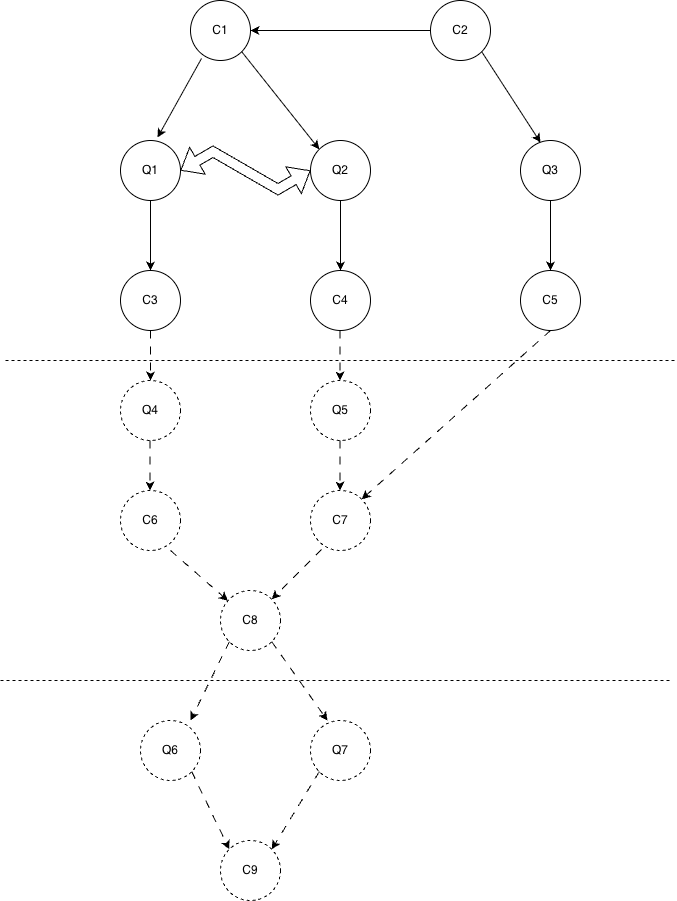
Hybrid workloads are structured as annotated DAGs, where vertices represent a mixture of quantum and classical tasks, and edges encode dependencies. Crucially, the DAG is revealed dynamically; quantum nodes may be generated or parameterized at runtime by preceding classical tasks (as in VQE or QAOA), thus static scheduling is not viable.
Figure 1: Example of a dynamic workflow DAG for a variational quantum algorithm, with dynamically submitted quantum and classical tasks, and explicit representation of inter-device entanglement.
Quantum cloud scheduling departs from classical approaches due to several fundamental features:
Non-preemptibility: Quantum jobs, once started, cannot be paused or migrated.
No-Cloning Theorem: Duplicating quantum state for speculative execution or work-stealing is physically disallowed.
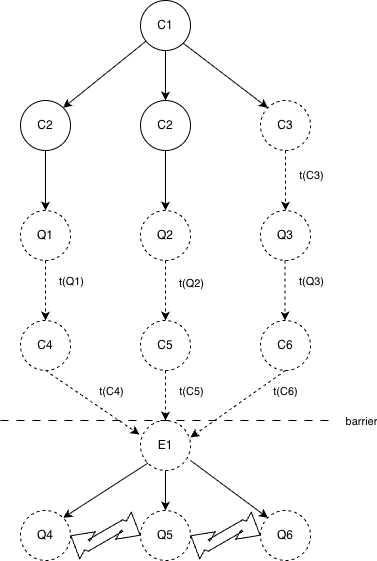
Synchronization barriers from entanglement distribution: Tight temporal coordination is required for distributed quantum tasks.
Heterogeneous device and gate configuration: Varying gate sets, qubit counts, calibration quality, and lack of unified metrics.
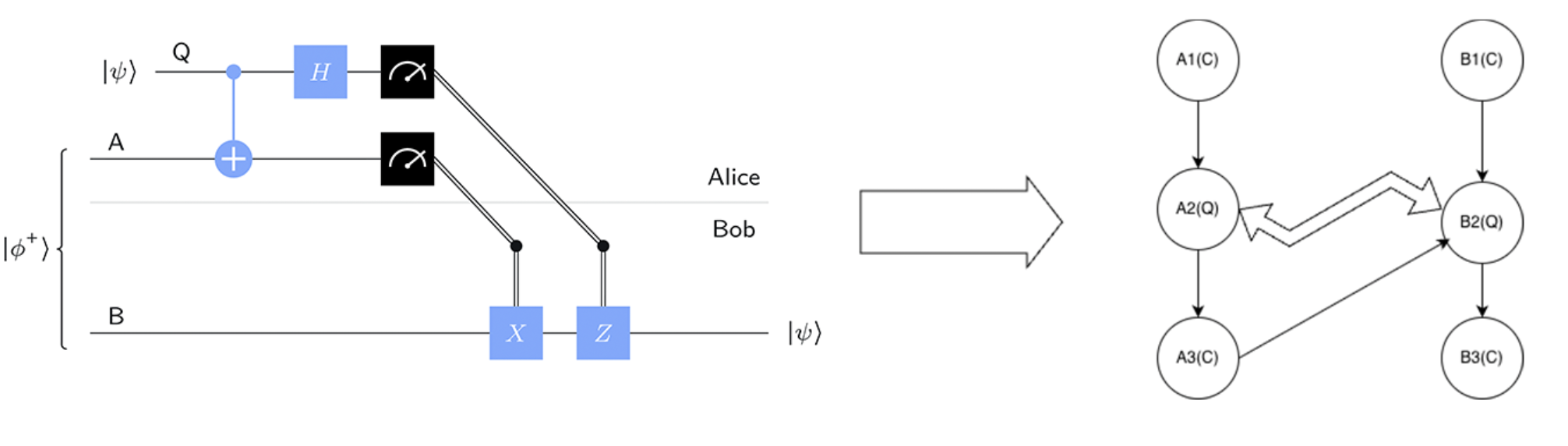
For composite workflows, tasks often involve both quantum and classical post-processing, as shown in hybrid circuits (e.g., quantum teleportation):
Figure 2: Task DAG for quantum teleportation, illustrating quantum-classical interleaving and dynamic task dependency.
Cross-Provider Fidelity Estimation
Each quantum hardware provider exposes device calibration data (e.g., gate error rates, readout fidelity, decoherence times) in incompatible formats. Qurator introduces a unified, canonical error model that reconciles these metrics into a logarithmic operational success score. The score composes gate error, readout error, and decoherence contributions for any given quantum circuit after provider-specific transpilation and routing—the dominant factors influencing fidelity.
For gate-model devices (e.g., IBM, IQM, Rigetti, AQT), per-qubit/per-edge errors and durations are used.
For all-to-all devices (ion traps, e.g., IonQ), routing cost is minimized; circuit duration is bounded by architectural synchronization.
For neutral-atom/Rydberg platforms (e.g., QuEra), atom loss and filling probabilities are major contributors.
Decoherence penalties are estimated via total gate durations relative to per-qubit T2.
For provider unification, all device-specific metrics are normalized into the canonical model, allowing direct estimation and comparison of expected success probabilities for arbitrary circuits post-mapping.
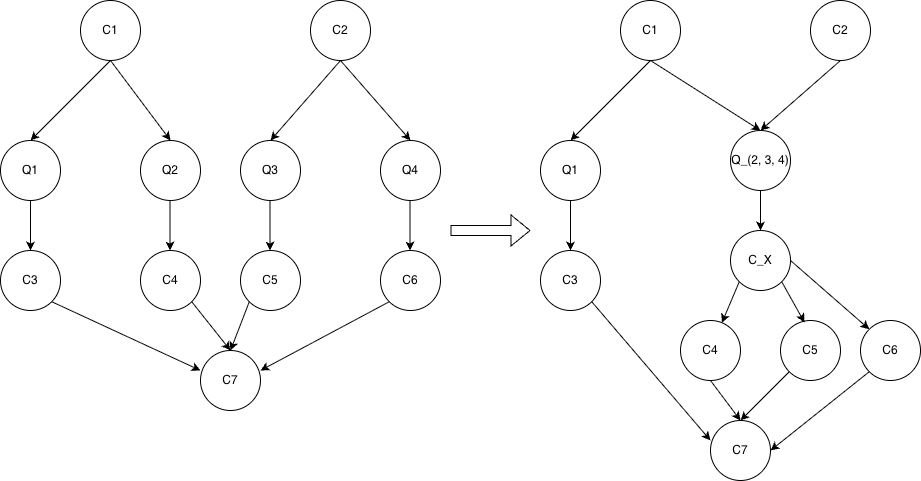
Figure 3: Example circuit transformation for merging quantum tasks to enable parallel execution on a single QPU, reducing device synchronization cost.
Validation against empirical GHZ benchmarks on six providers demonstrates sub-10% estimation error in most regimes; accuracy degrades only for large circuits (7-10 qubits) where decoherence dominates, but the model remains sufficient for device ranking and practical scheduling.
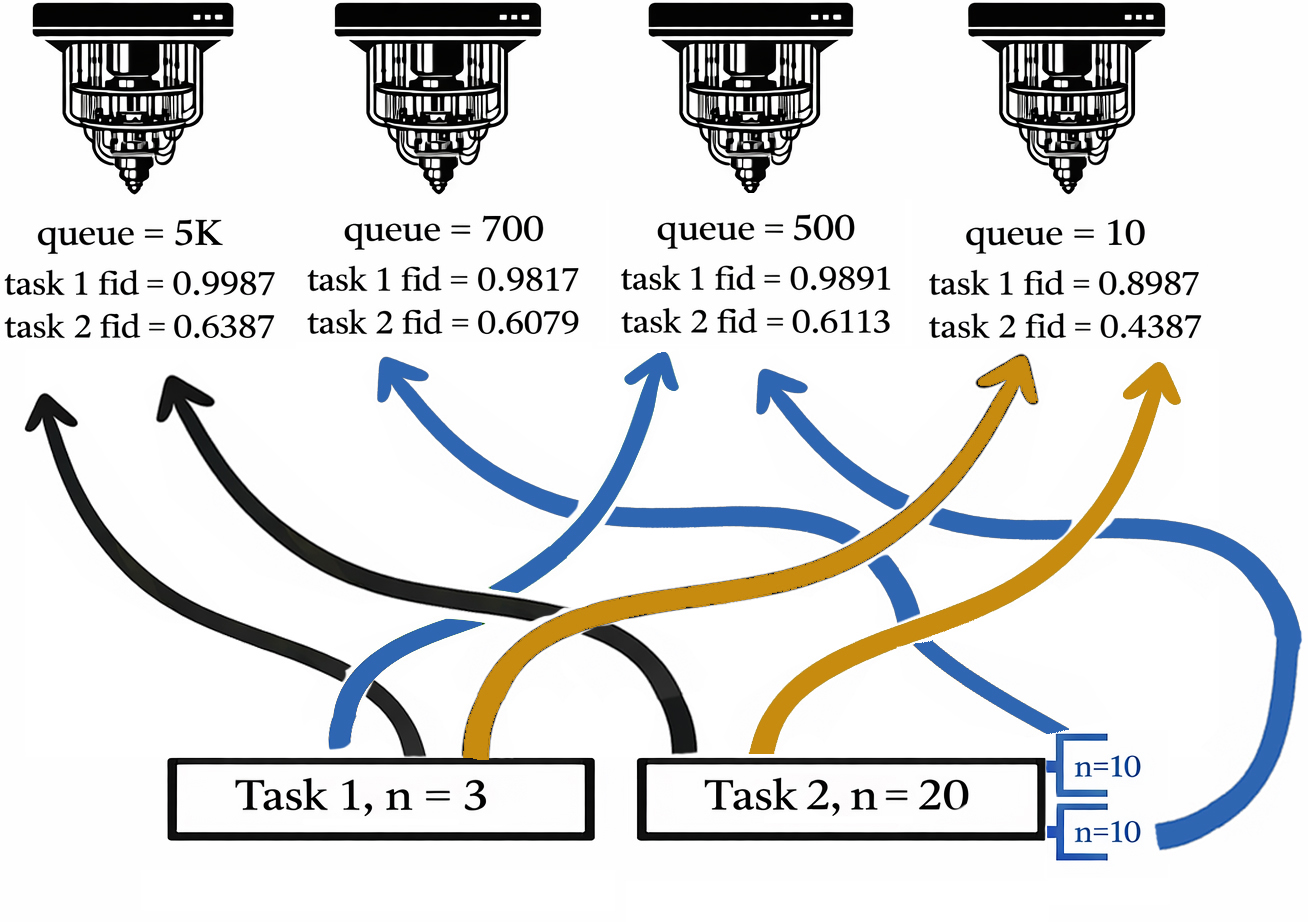
Figure 4: Comparative scheduling visualization for least busy (gold), highest-fidelity (black), and Qurator (blue); n is qubit count. Qurator balances fidelity and queue time contingent on load and device availability.
Quantum-Aware Scheduling Methods
Qurator frames scheduling as a joint optimization problem—queue time minimization subject to fidelity constraints, within the provider's restricted API. The scheduler exposes programmer-tunable policies for:
Prioritization strategy (e.g., favoring large circuits for limited high-qubit devices),
Cutting/merging policies for tasks,
Target fidelity, which acts as a dynamic feasibility filter.
For independent quantum tasks, the device scoring coefficient is load-adaptive: cd=wf−wq,
where wf∝Fest (fidelity estimate, dominant at low load), and wq penalizes queue length (dominant at high load). Queue time is estimated by kernel-smoothing historic data, and all scoring weights are parametrically robust.
For circuit cutting, Qurator uses CutQC-like partitioning when no device has sufficient high-fidelity qubits, trading post-processing overhead for improved success probability. For circuit merging, a multi-phase packing/first fit approach enables batch execution of depth-similar, small circuits on larger devices, amortizing preparation and wait costs without excessive fidelity loss.
Synchronized quantum task groups (i.e., entangled, distributed tasks) are scheduled using a formal model of the entanglement barrier: prerequisite tasks must synchronize with minimal skew for entanglement distribution and operation before decoherence. Device assignment aligns expected queue-induced start times, with the scheduler minimizing start/finish skew within the available routing and network coherence budgets.
Figure 5: Synchronization barrier imposed by entanglement distribution; only tightly coordinated execution avoids decoherence of EPR pairs used by distributed tasks.
Empirical Evaluation
Queue/Fidelity Tradeoffs
Qurator was benchmarked on the MQT benchmark suite, with real queue and calibration data from 11 diverse QPUs. Results were analyzed across low, medium, and high load, and as a function of qubit count.
Low load: Qurator tracks the highest-fidelity baseline within 1% for both small and medium circuits, accepting up to 10× higher queue times (<2 min), compared to least-busy scheduling, for $10$–$20$% higher POS.
Medium load (500–5000 tasks): Qurator sacrifices up to 8% fidelity to achieve $30$–n0 queue time reduction; least-busy baseline is inferior in fidelity except for the smallest circuits.
High load (5000–35,000 tasks): Queue time dominates, but Qurator strictly enforces fidelity floors based on user threshold. For cut high-qubit circuits, it achieves up to n1 POS gain over the least-busy baseline, with necessary queue penalty for smaller-device execution.
Circuit merging reduces queue time by n2–n3 for small circuits with an associated fidelity penalty, requiring explicit opt-in.
(Figure 6)
Figure 6: Scheduler performance across high, medium, and low load for fidelity (top) and queue time (bottom), partitioned by circuit qubit count and load regime; Qurator stays within 1% of optimal fidelity at low load while reducing queue at scale.
Distributed Entangled Task Scheduling
Practical scheduling for distributed entangled quantum workloads is fundamentally limited by the interplay of decoherence times and public cloud queue stochasticity. Qurator benchmarks:
Start/finish skew: As queue lengths per device climb, synchronization quality decays; practical survival proxies only occur in idle or lightly loaded networks (queues n4 tasks).
Circuit merging: For small and moderate-depth entangled tasks, merging onto a single QPU preserves coherence near unity. Above 40-60 qubits, merge feasibility sharply declines due to device constraints.
Figure 5: Summary of synchronization metrics for cross-entangled task scheduling. Log-scale skew/violation, budget success rates, and survival proxies highlight the sharp transition from feasible to infeasible distributed quantum execution across queue regimes. Curves indicate the importance of merging for survival in slack networks.
(Figure 7)
Figure 7: Merge rate for entangled circuits by qubit count. Small circuits commonly merge, but rates plummet above current QPU capacity.
Implications and Directions
Qurator formalizes and operationalizes quantum constraints in scheduling, providing a practically deployable and provider-agnostic solution to hybrid workflow scheduling. Its parametric fidelity/cost tradeoff framework, cross-provider unification, and entanglement-aware scheduling semantics are generalizable to future quantum cloud and network systems.
The canonical error model provides a foundation for future scheduling and orchestration research, especially in nonuniform, cloud-scale quantum compute environments.
Circuit merging and cutting, as first-class scheduler operations, yield direct throughput and reliability advantages under current hardware limitations.
Potential future directions are:
Advanced, fine-grained reservation-based scheduling and negotiation with providers as APIs mature.
Dynamic rescheduling/cancellation, conditioned on real-time queue insights and fair provisioning.
Deeper integration of measurement commutation and quantum-classical runtime cross-compilation for further utilization and overhead reduction.
Extension to tightly-coupled quantum/HPC environments, including network- and control-plane coordination for global entanglement.
Conclusion
Qurator establishes a scalable, extensible basis for multi-provider, hybrid quantum-classical workflow scheduling in realistic public cloud environments. By unifying fidelity estimation, incorporating quantum-native scheduling semantics, and empirically characterizing the limitations of distributed entangled execution, this work defines the actionable design space for quantum workflow orchestration in the NISQ and early fault-tolerant eras. Its adaptability to future device and network enhancements ensures continued relevance as quantum cloud technology matures.
“Emergent Mind helps me see which AI papers have caught fire online.”
Philip
Creator, AI Explained on YouTube
Sign up for free to explore the frontiers of research
Discover trending papers, chat with arXiv, and track the latest research shaping the future of science and technology.Discover trending papers, chat with arXiv, and more.