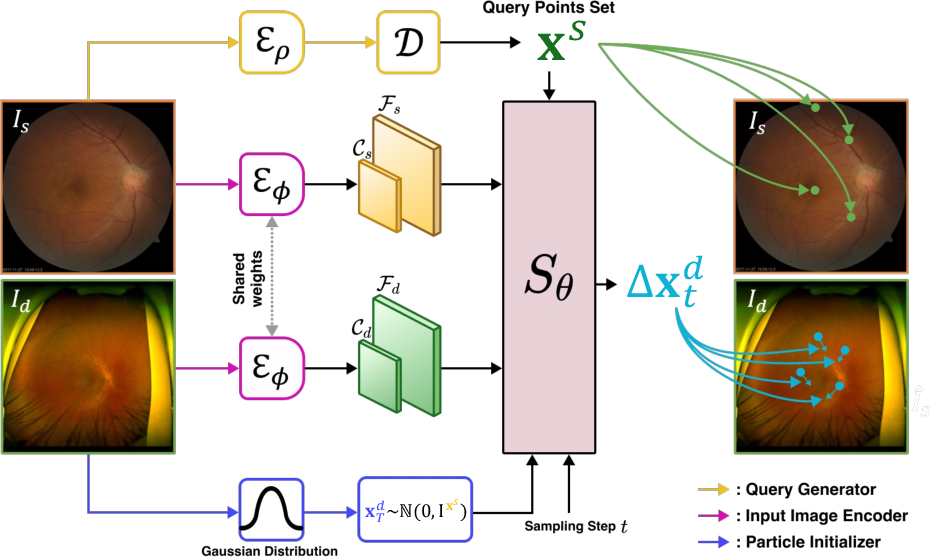
- The paper introduces Particle Diffusion Matching (PDM), an iterative, diffusion-guided framework that unifies global and local alignment for standard and ultra-widefield fundus images.
- The methodology uses a reverse diffusion process with Random Walker Transformers to iteratively refine particle correspondences, reducing outlier sensitivity.
- Experimental results on benchmark datasets show state-of-the-art performance with a 58.56% acceptable rate and significant improvements over prior methods.
Particle Diffusion Matching: A Diffusion-Based Framework for SFI-UWFI Alignment
Introduction
This work addresses the challenging problem of aligning standard fundus images (SFIs) and ultra-widefield fundus images (UWFIs), which differ significantly in field of view, scale, color, and texture saliency. While SFIs cover a small retinal region with high resolution, UWFIs offer expansive coverage but at the expense of clarity. The scarcity of robust, distinctive features in both modalities, coupled with large geometric transformations between them, renders existing correspondence and registration methods inadequate. This paper introduces Particle Diffusion Matching (PDM), an iterative, diffusion-guided random walk framework for precise SFI-UWFI alignment, unifying global and local correspondence estimation into a single, end-to-end optimizable loop. The primary innovation is treating correspondences as a set of particles, which are refined via a diffusion process jointly conditioned on source keypoints, local features, and structural coherence, yielding superior alignment in sparse, large-FOV, and low-feature regimes.
Methodology
PDM frames alignment as a Random Walk Correspondence Search (RWCS) task. Keypoints are detected on the source SFI, while their UWFI counterparts are initialized as random Gaussian samples (particles). RWCS drives a reverse diffusion process guided by a parameterized network that iteratively denoises particle positions, leveraging image features, neighborhood distributions, and estimated global transforms for progressive refinement.
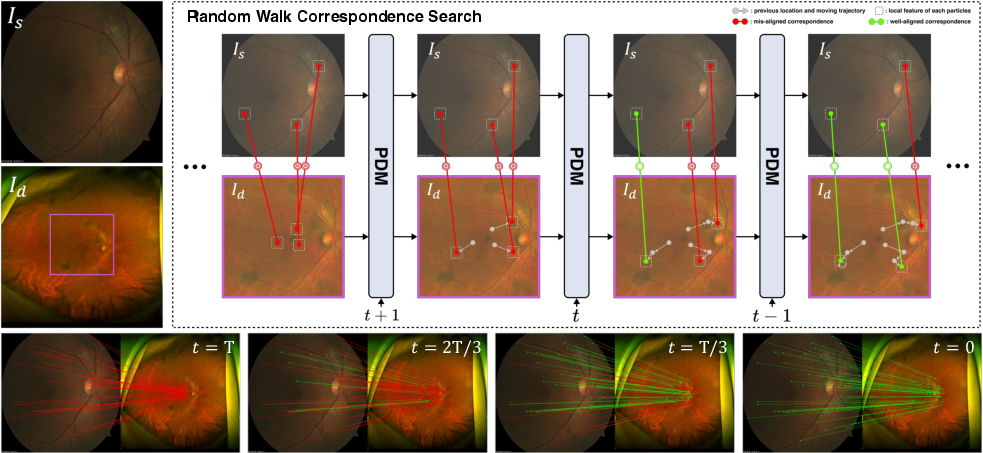
Figure 1: The RWCS scheme, illustrating the trajectories of particle correspondence pairs evolving through time, with color encoding correct (green) and incorrect (red) correspondences.
This approach departs from tentative matching with subsequent outlier rejection: correspondences are maintained as persistent pairs throughout the process, jointly optimized according to both individual local cues and global geometric consistency. RWCS can thus robustly recover 1:1 matches even under severe perspective or photometric shift, markedly reducing outlier sensitivity.
The diffusion process is parameterized as a denoising diffusion probabilistic model (DDPM), where the reverse process is learned to iteratively update destination particles with estimated motion vectors conditioned on the current state, timestep, and both input images.
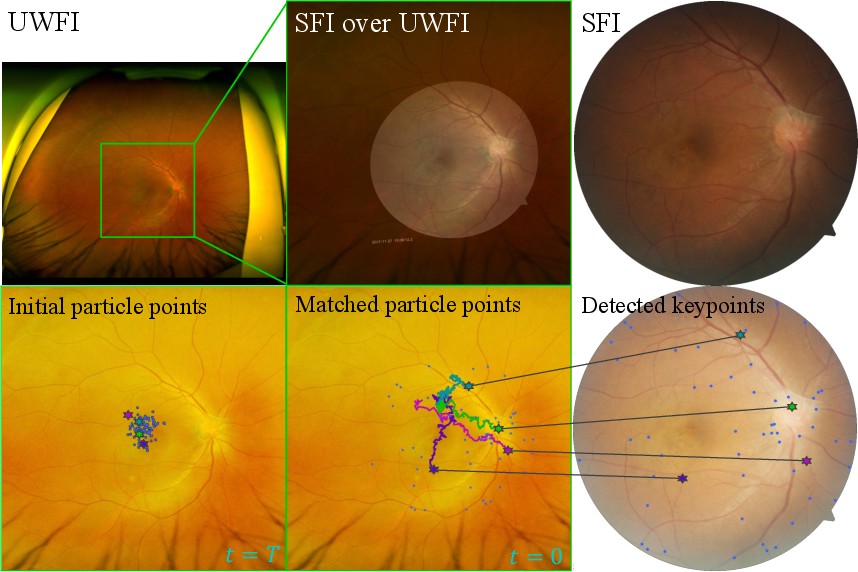
Figure 2: PDM in action, showing the evolution of particle point distributions from initialization (random, left) to converged matches (right) over a highly non-overlapping SFI-UWFI pair.
The overall architecture comprises:
Multi-level feature extraction and progressive refinement enable PDM to jointly resolve global misalignment and local deformations, obviating the need for discrete cascades of global and local registration modules.
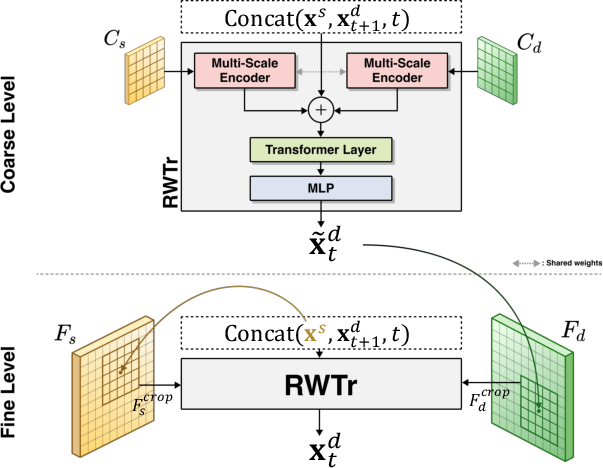
Figure 4: Structure of the Random Walker Transformer submodules used in the coarse-to-fine update step.
Supervised training is achieved by minimizing a composite loss comprising DDPM reconstruction, a pixel-level normalized cross-correlation term to enforce appearance consistency, and a regularization on homography accuracy via differentiable RANSAC.
Experimental Results
Evaluation on the principal KBSMC SFI-UWFI dataset, as well as FIRE (SFI-SFI) and FLORI21 (UWFI-UWFI) datasets, demonstrates robust state-of-the-art performance for PDM. On KBSMC, PDM achieves a 58.56% Acceptable rate and 34.8 mAUC, a 17.65% and 7.2% improvement over the best prior modality-invariant method MINIMA, respectively. Statistical analysis (Wilcoxon rank-sum test) confirms these gains as highly significant.
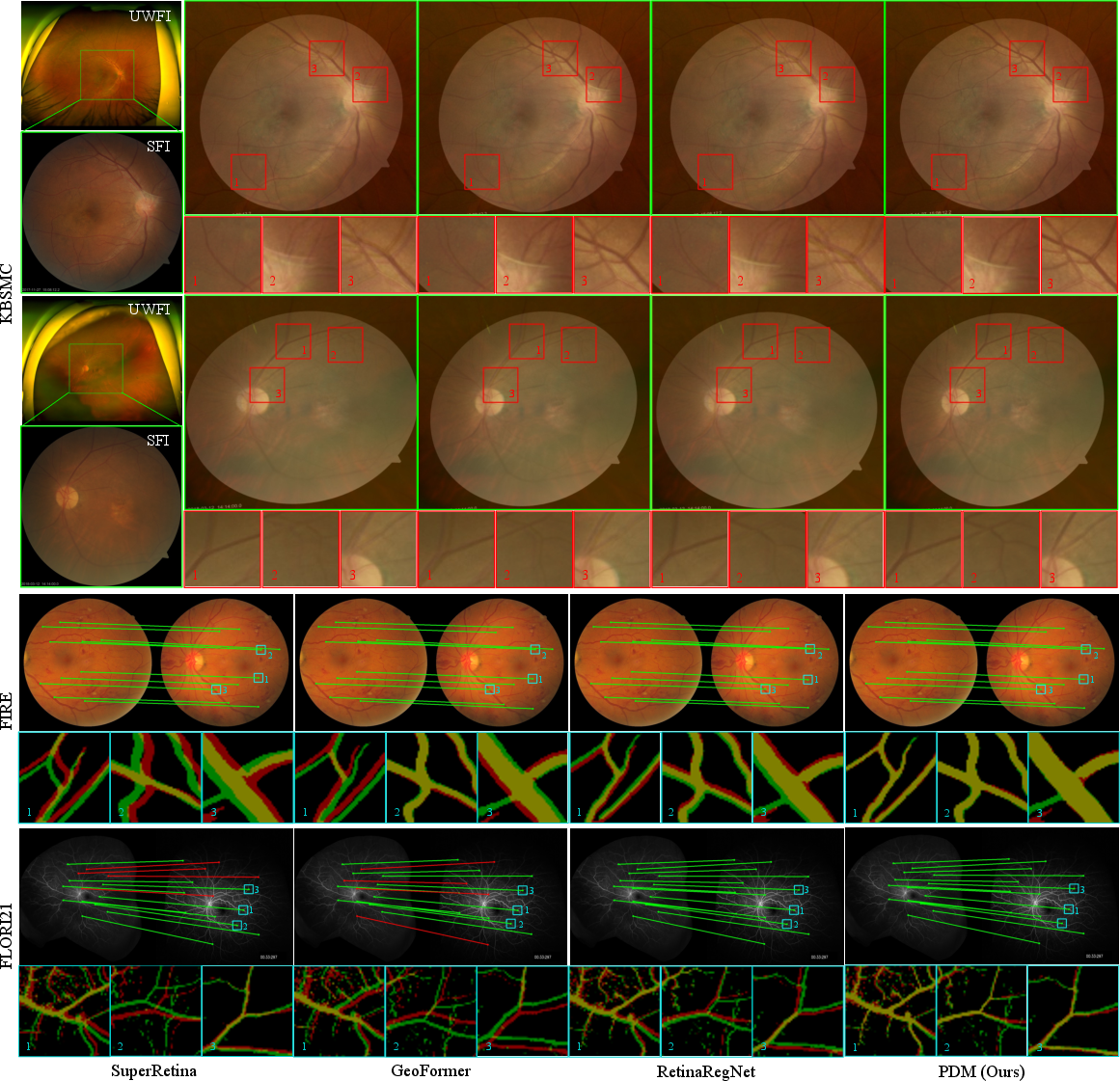
Figure 5: Qualitative comparisons between PDM and strong baselines across multi-style fundus pairs, with correct/incorrect matches color-coded.
Efficiency is maintained via sparse correspondence refinement; inference takes only 0.45s/image with modest memory requirements, outperforming or matching strong baselines like GeoFormer and RetinaRegNet on both speed and RAM.
Ablation studies confirm optimality at 100 particles, dual-scale transformer architectures, and SIFT+Blob query points. Performance is robust to the sampling range and number of diffusion steps, saturating at 100 iterations. PDM also exhibits competitive generalization in zero-shot evaluation on FIRE and FLORI21, suggesting limited overfitting to institutional/clinical specifics.
Robustness is illustrated even in highly non-overlapping, rotated, or textureless situations (Figure 6, Figure 7), though performance is contingent on the availability and quality of source keypoints.
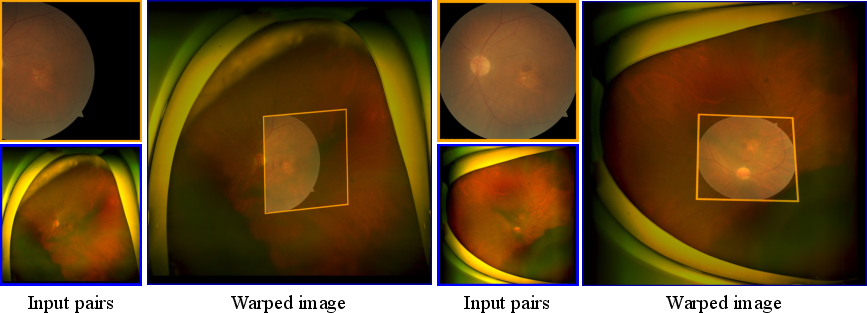
Figure 6: PDM maintains alignment in the presence of minimal overlap or extreme rotation.
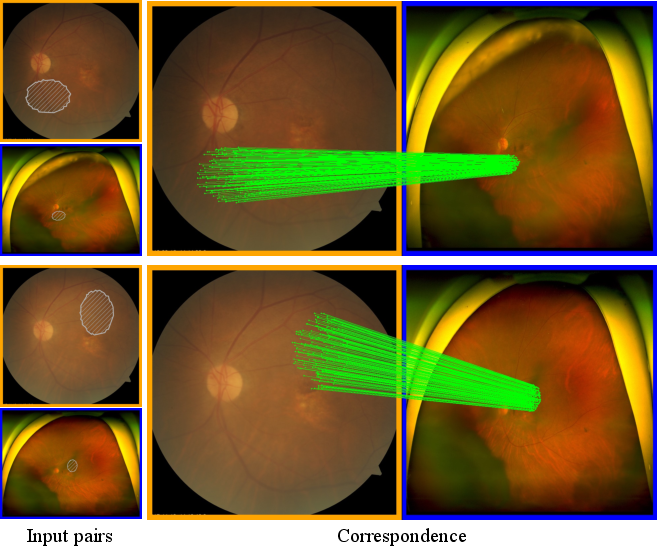
Figure 7: PDM's transformation estimation in highly textureless regions, indicating robustness to weak features.
Failure cases generally arise when both modalities lack salient structures or when domain shift/quality divergence is excessive (Figure 8).
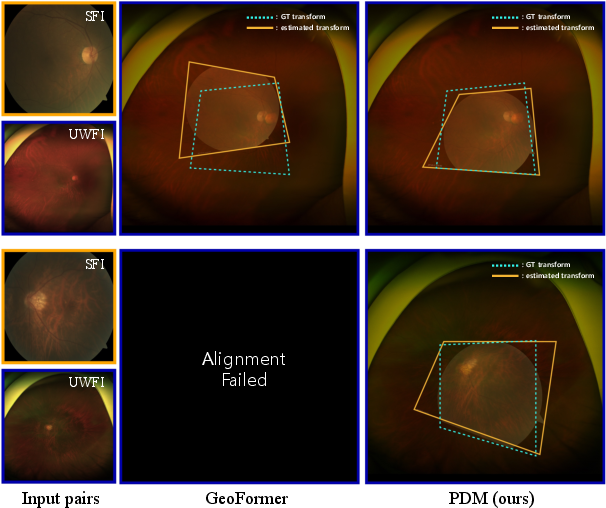
Figure 8: Failure examples with both PDM and baseline methods on highly degraded or domain-divergent samples.
Generalization to generic scene correspondence is demonstrated by competitive performance on HPatches, MegaDepth, and ScanNet datasets, although domain-specific tuning may be required to optimally handle non-planar or highly 3D-structured scenes (Figure 9).
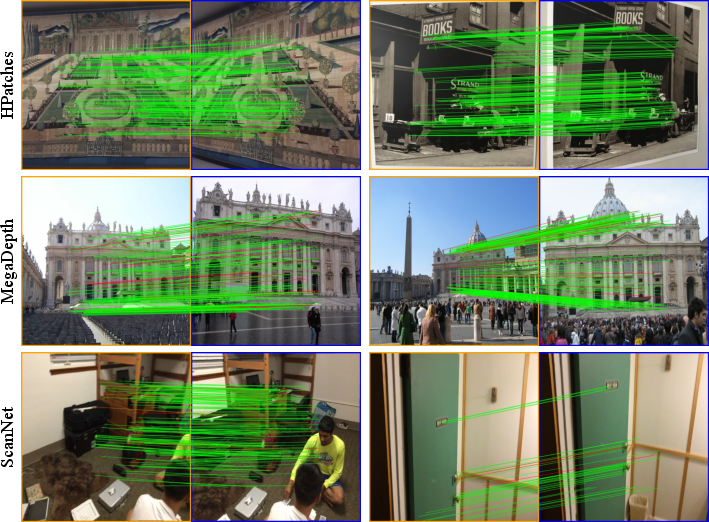
Figure 9: PDM applied to generic scene benchmarks, visualizing correspondences on HPatches, MegaDepth, ScanNet.
Implications and Future Directions
PDM advances medical image registration in several key dimensions:
- It is currently the only fully automatic SFI-UWFI alignment solution that jointly models global and local geometric transformation within a diffusion-optimization loop.
- By unifying correspondence discovery and refinement, it enables new, accurate, and scalable pipelines for multi-modal retinal data fusion, critical for supervised learning, disease diagnosis, and research into peripheral retinal conditions.
- The particle diffusion paradigm is applicable to other sparse-feature, large-transform correspondence problems beyond ophthalmology.
Theoretically, PDM establishes that deep diffusion models can offer robust, distributionally-aware alternatives to classic match-and-refine or local-dense registration methods, especially where feature sparsity and geometric distortion conspire to defeat conventional pipelines.
Nevertheless, its reliance on the quality and distribution of detected keypoints indicates possible fragility under extreme blur/illumination degradation; integration with learnable query extraction modules or post-hoc region constraints could further boost stability. Moreover, adaptive or particle-density-aware diffusion could mitigate rare cases of local deformation overwhelming sparse correspondences.
Conclusion
PDM provides a state-of-the-art, diffusion-guided framework for the alignment of SFIs and UWFIs, demonstrating substantial improvements over both classic and contemporary deep learning algorithms for challenging cross-modal registration. Through a principled joint search and refinement of correspondences within the particle diffusion model, PDM sets a new, extensible direction in robust medical and cross-domain image alignment (2604.10085).