- The paper introduces harmonic morphisms as the minimal maps that preserve random walk dynamics during network coarse-graining.
- It develops the harmonic degree metric to quantify dynamical preservation across geometric, Laplacian, and GNN-based renormalization methods.
- Empirical results reveal that Laplacian renormalization can uniquely yield exact harmonic morphisms, offering practical insights for multiscale network analysis.
Harmonic Morphisms and Dynamical Invariants in Network Renormalization
Introduction
The paper "Harmonic morphisms and dynamical invariants in network renormalization" (2604.08386) provides a rigorous reformulation of dynamical preservation in network renormalization, centered on the concept of harmonic morphisms as minimal sufficient maps for upholding random walk dynamics under coarse-graining. The authors address ambiguities in current renormalization group (RG) applications to complex networks by systematically characterizing which coarse-grainings conserve random walk properties, thus laying a formal foundation for the evaluation and design of multiscale network transformations.
Theoretical Foundation: Harmonic Morphisms and Random Walk Preservation
The central theoretical contribution identifies discrete harmonic morphisms—surjective maps preserving locally harmonic functions—as the necessary and sufficient structure-preserving morphisms for simple random walks. These mappings guarantee that first-exit probabilities from macro-sets in the fine-grained network exactly match the one-step transition probabilities in the coarse network, up to a random time change.
This equivalence is formalized in Theorem 2, which states that for any surjective function φ:V→V, φ is a harmonic morphism if and only if for all x∈φ−1(y) and all neighboring macro-nodes y′∼y, the exit probabilities match those induced by the coarse-grained random walk. The authors show that the core combinatorial check is horizontal conformality, where each node x in a macro-set φ−1(y) must have the same number of neighbors in each adjacent macro-set.
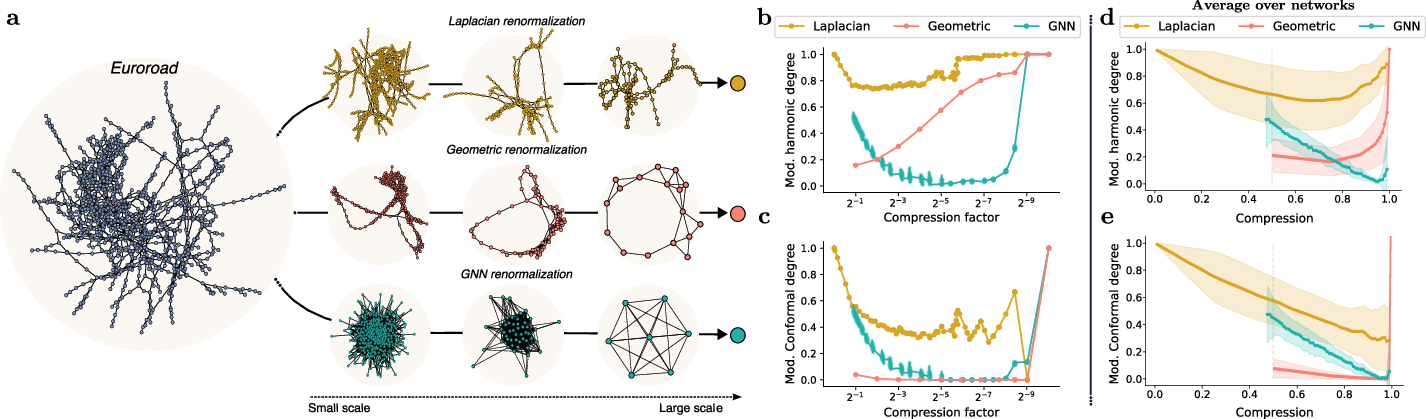
Figure 1: Examples illustrating harmonic morphisms, horizontal conformality, and counterexamples with asymmetric multiplicity leading to dynamical inconsistency.
This framework connects discrete network dynamics to notions from continuous conformal geometry and establishes structural constraints as combinatorial analogs of conformal maps.
Harmonic Degree: Quantifying Dynamical Preservation
To operationalize these results, the harmonic degree is introduced as a metric quantifying the fraction of nodes for which the coarse-graining is locally a harmonic morphism. Modified variants account for unbalanced macro-set sizes to robustly evaluate structure across scales. The harmonic deviation quantifies continuous imbalance. The authors further extend these definitions to combinatorial conformality for lazy random walks.
Empirical Analysis: Distinct Dynamical Fingerprints of Renormalization Methods
The authors systematically compare three classes of network renormalization:
- Geometric Renormalization: Nodes are merged based on global latent hyperbolic embedding and angular proximity.
- Laplacian Renormalization: Local diffusion determined by the graph Laplacian steers merging based on short-time dynamics.
- GNN-based Renormalization: A deep learning approach preserving the Laplacian heat-trace spectrum via, e.g., a partition-function-mimicking neural network.
Their analysis reveals method-specific dynamical fingerprints:
- Geometric renormalization yields an S-shaped curve: initially low harmonicity improved at large scales as macro-sets align with latent geometry.
- Laplacian renormalization exhibits a robust high-low-high signature: extremely high harmonic degree at both fine and very coarse scales, with a transient dip at intermediate compression due to asymmetric macro-set merging.
- GNN-based renormalization results in a uniformly low harmonic degree, indicating a lack of random-walk structure preservation.
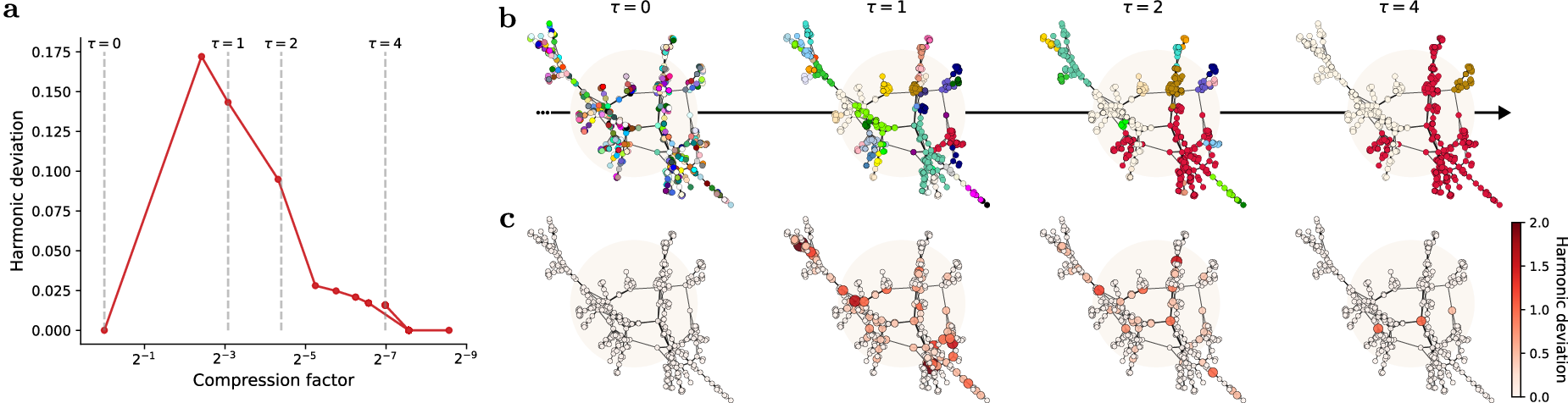
Figure 2: Renormalization flows and harmonic/conformal degree fingerprints for Euro-Road under geometric, Laplacian, and GNN-based schemes. Each method induces a characteristic curve robust across networks.
When averaging across multiple real-world networks, these trends remain consistent, confirming the universality of the observed method-induced dynamical patterns.
Mechanistic Insights: Structure and Scale of Random Walk Preservation
Examining the spatial distribution of harmonic deviation under Laplacian flows, the authors show that the loss of harmonicity at intermediate scales is localized at community boundaries, not global—interfaces between macro-sets develop transient asymmetry, which is resolved as the network further coalesces.
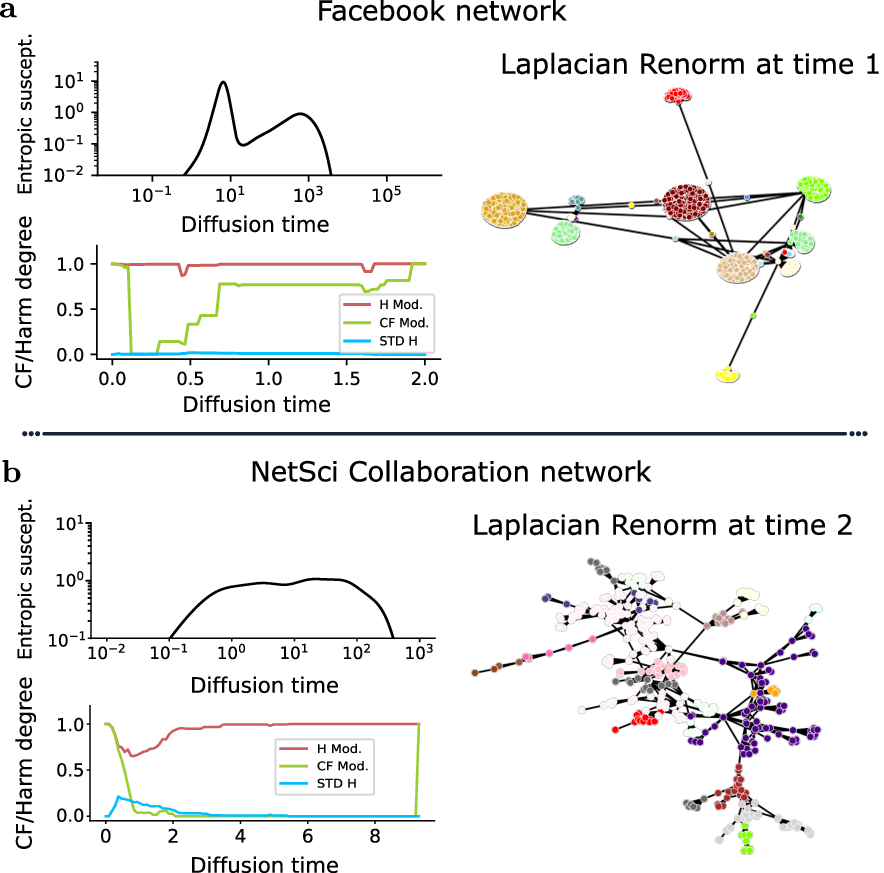
Figure 3: Spatial mapping of harmonic deviation in NetSci collaboration network reveals boundary localization of dynamical distortion at intermediate scales.
A striking and explicit empirical result is the spontaneous emergence of exact harmonic morphisms (harmonic degree identically one) at certain scales for specific real networks (e.g., Facebook social network) under Laplacian renormalization. This property is nontrivial and unattainable by other methods.
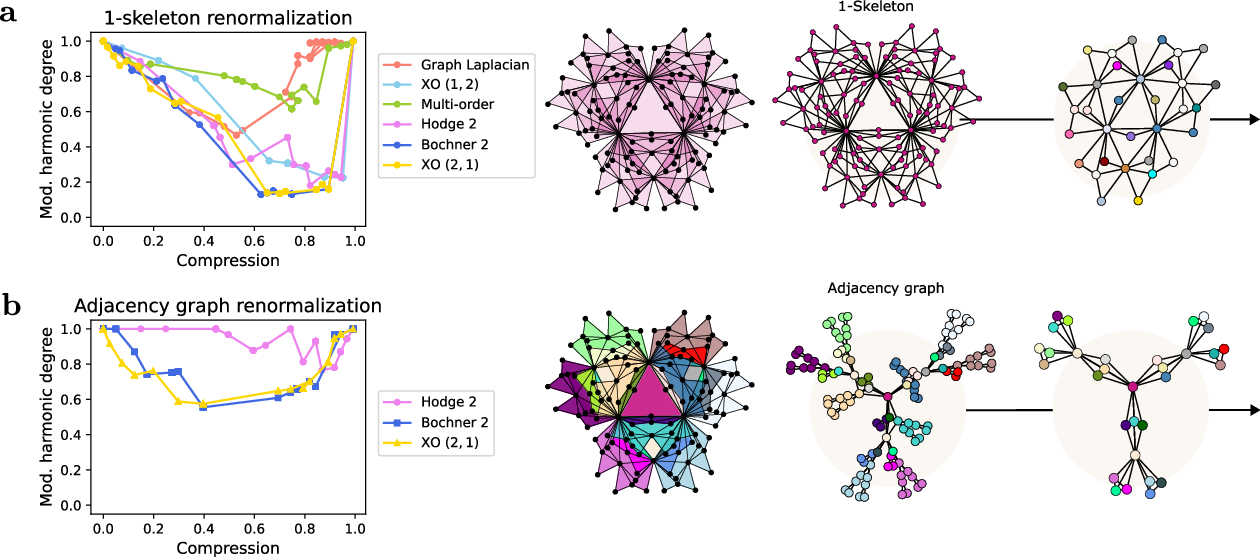
Figure 4: The Facebook network demonstrates sustained exact harmonicity under Laplacian renormalization, in contrast to the less aligned NetSci network.
The study further demonstrates that the harmonic degree is orthogonal to entropic susceptibility (the mainstream diagnostic for Laplacian renormalization), as the latter detects scales of diffusive deceleration while the harmonic degree specifically signals dynamical preservation by the coarse-graining.
Extension to Higher-Order Structures
The framework generalizes to higher-order topological structures, including simplicial complexes. Here, the notion of harmonic degree is applied to coarse-grainings of (k,m)-adjacency graphs driven by higher-order diffusion (e.g., via Hodge or Bochner Laplacians):
- Node-based renormalization via multi-order Laplacians preserves harmonicity when dynamics act on nodes.
- Higher-order Laplacian-driven merges often disrupt node-level harmonicity, except in topologically matched cases where the order of diffusion and the intrinsic dimension coincide.
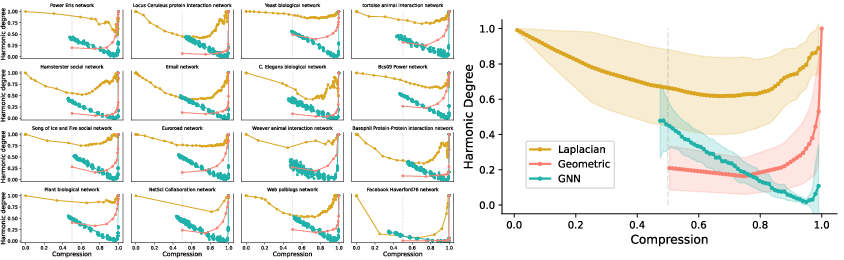
Figure 5: Harmonic degree as a function of compression across 16 networks for various renormalization protocols, revealing the superior random walk alignment of Laplacian-based coarse-grainings.
Practical and Theoretical Implications
The identification of harmonic morphisms as the unique class of random-walk preserving maps closes a major conceptual gap in network RG approaches. Practically, the harmonic degree presents a diagnostic criterion for evaluating and optimizing coarse-graining schemes in domains where preserving diffusive dynamics is critical (e.g., mesoscale modeling, network reduction, multiscale simulation).
Methodologically, the discovery that Laplacian renormalization can generate exact harmonic morphisms in empirical networks, while other methods cannot, motivates the design of customized or hybrid RG flows tuned to application-specific dynamical constraints. Additionally, the arithmetic constraints imposed by harmonic morphisms on spanning tree counts and global Laplacian spectra suggest links to combinatorial and algebraic invariants hitherto underexploited in network science.
Limitations and Future Research
The study is restricted to undirected, unweighted networks and simple/lazy random walks; extending these frameworks to weighted, directed, temporal, and non-Markovian dynamics presents several open questions. Mechanisms for optimal harmonic morphism discovery are at a nascent stage, and a complete classification of which networks admit these morphisms at all scales (e.g., via graph gonality) is an outstanding challenge. The extension to dynamical processes beyond random walks, such as consensus dynamics, spreading, synchronization, and exact conditions for operator-specific preservation, is a high-priority research direction.
Conclusion
This paper establishes that harmonic morphisms provide the rigorous foundation for dynamical preservation in network renormalization, resolving a longstanding ambiguity in coarse-graining practice. The harmonic degree emerges as a robust, method-agnostic metric exposing the alignment or lack thereof between coarse-graining schemes and diffusive network dynamics. The comprehensive empirical analysis reveals strong, sometimes exact, dynamical equivalence under Laplacian-based renormalization, advancing the synthesis of statistical mechanics, algebraic graph theory, and data-driven network analysis into a coherent multiscale framework.