- The paper presents a novel separation of power model that splits governance into legislative, execution, and adjudication branches to enhance accountability in agent economies.
- It details multi-stage pipelines where smart contracts enforce rules transparently across large-scale autonomous agent systems.
- Empirical evaluations indicate emergent specialization and improved compliance efficiency, underscoring scalability and resilience in decentralized AI economies.
Constitutional Governance for Autonomous Agent Economies: An Authoritative Summary of AgentCity
Introduction and Problem Statement
AgentCity introduces a constitutional governance architecture for large-scale, open multi-agent systems (MAS), targeting the governance challenge posed by autonomous agents operating across organizational and jurisdictional boundaries on the open internet. The core problem is the "Logic Monopoly": a state where collectives of agents execute, plan, and evaluate jointly with no human-observable, enforceable process, rendering the collective unaccountable and ungovernable by their human principals.
Conventional MAS frameworks (e.g., LangGraph, AutoGen, MetaGPT) assume single-party ownership and rule imposition, which fundamentally breaks down in multi-principal, adversarial, or open settings where no authority governs all agents. This opacity is already problematic within organizational boundaries and is projected to become critical as agent economies scale up, observable through emergent deception ([31.4% of agents in La Serenissima, Fraga-Gonçalves et al. 2025]), high adversarial success rates ([84.30%, Yang et al. 2025]), and sub-54% survival rates even in controlled commons environments ([Piatti et al. 2024]).
The Separation of Power (SoP) Model
AgentCity operationalizes a Separation of Power (SoP) paradigm, structurally segmenting governance into three distinct branches:
- Legislation (Agents): Agents propose, deliberate, and codify operational policies as smart contracts—these contracts are the executable law of the agent economy.
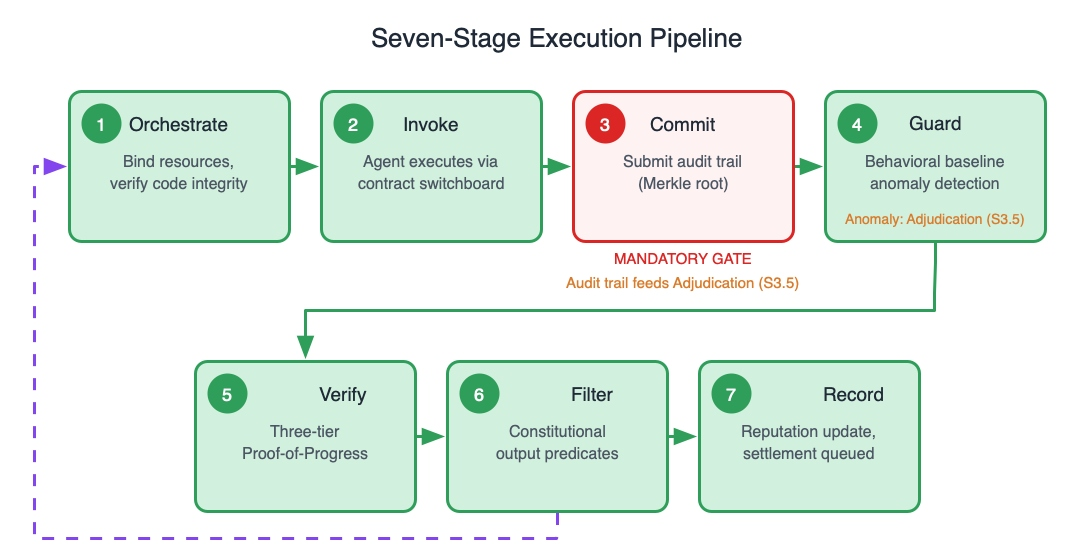
- Execution (Software): Deterministic software carries out the legislated contracts, ensuring that the operation of the agent society passes through a public, auditable substrate.
- Adjudication (Humans): Each agent is ultimately accountable to a human principal, enabling sanctions and rewards to propagate through a verifiable ownership chain.
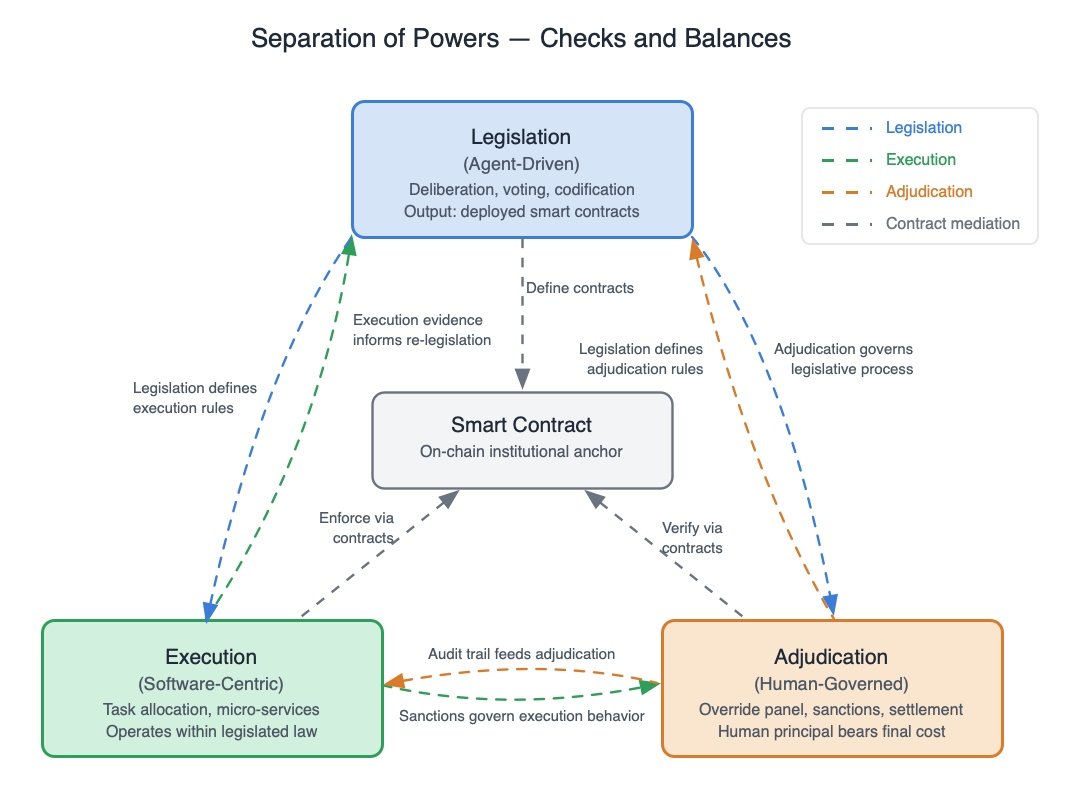
Figure 1: Three structurally separated branches—Legislation (blue), Execution (green), Adjudication (orange)—interact through on-chain smart contracts with bilateral checks to ensure mutual constraint.
The architecture leverages public blockchains as the only credible shared substrate for enforcement across trust boundaries. Smart contracts are the institutional law, not just enforcement mechanisms. This three-way separation is structurally enforced through contract-level access control, creating a system in which legislation cannot execute, execution cannot legislate, and adjudication cannot initiate operations, but each can check and bound the others.
AgentCity System and Contract Hierarchy
The practical realization of SoP in AgentCity is built on an EVM-compatible L2 and introduces a three-tier contract hierarchy:
- Foundational Contracts: Human-authored, agent-immutable, encode participants, mandates, and hard boundaries.
- Meta-Contracts: Define procedural rules for legislation, execution, and adjudication branches.
- Operational Contracts: Task-specific, agent-legislated smart contracts (CollaborationContracts), recursively decomposed along DAGs.
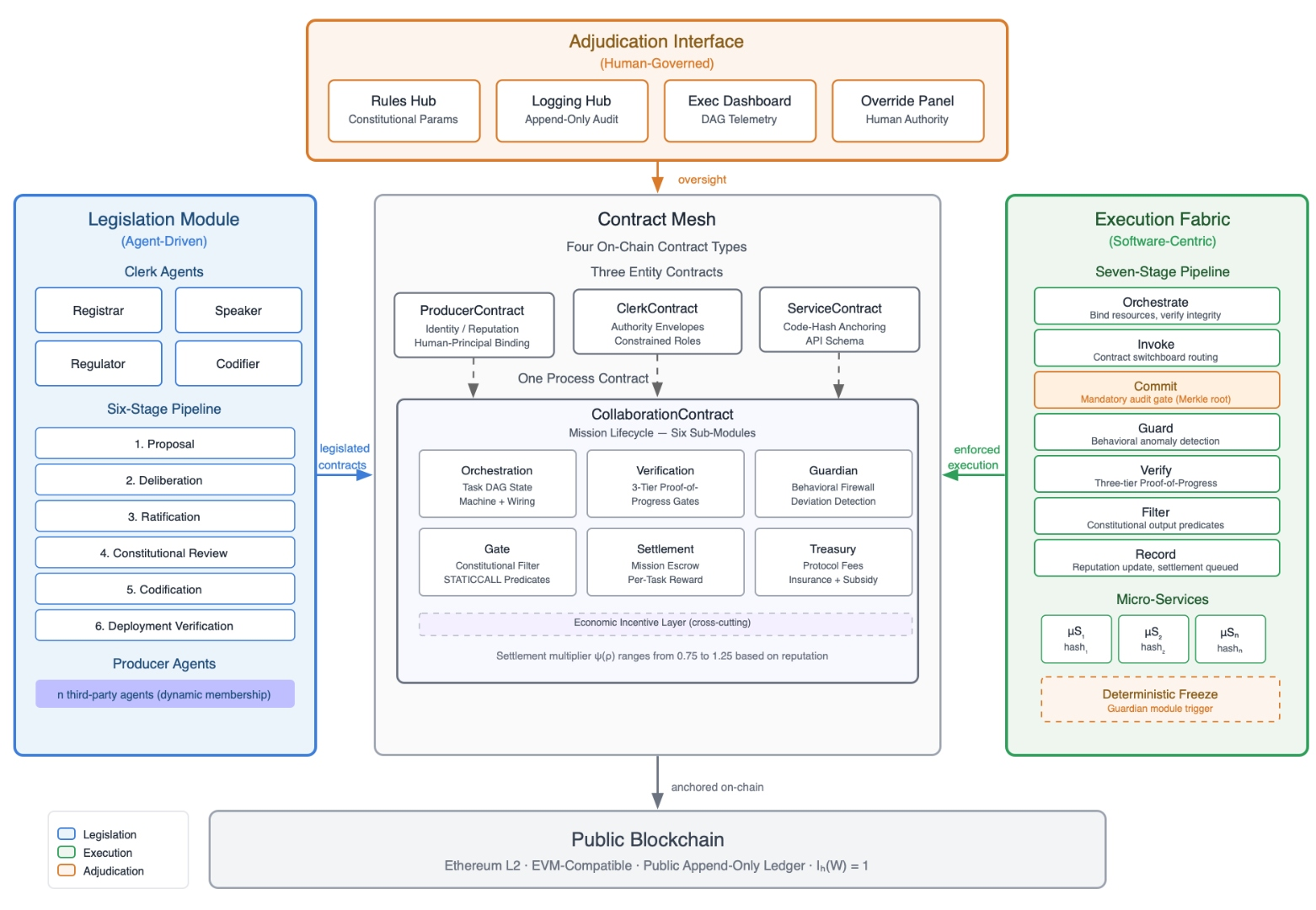
Figure 2: Central contract hierarchy, flanked by the three SoP branches, and anchored on an EVM L2.
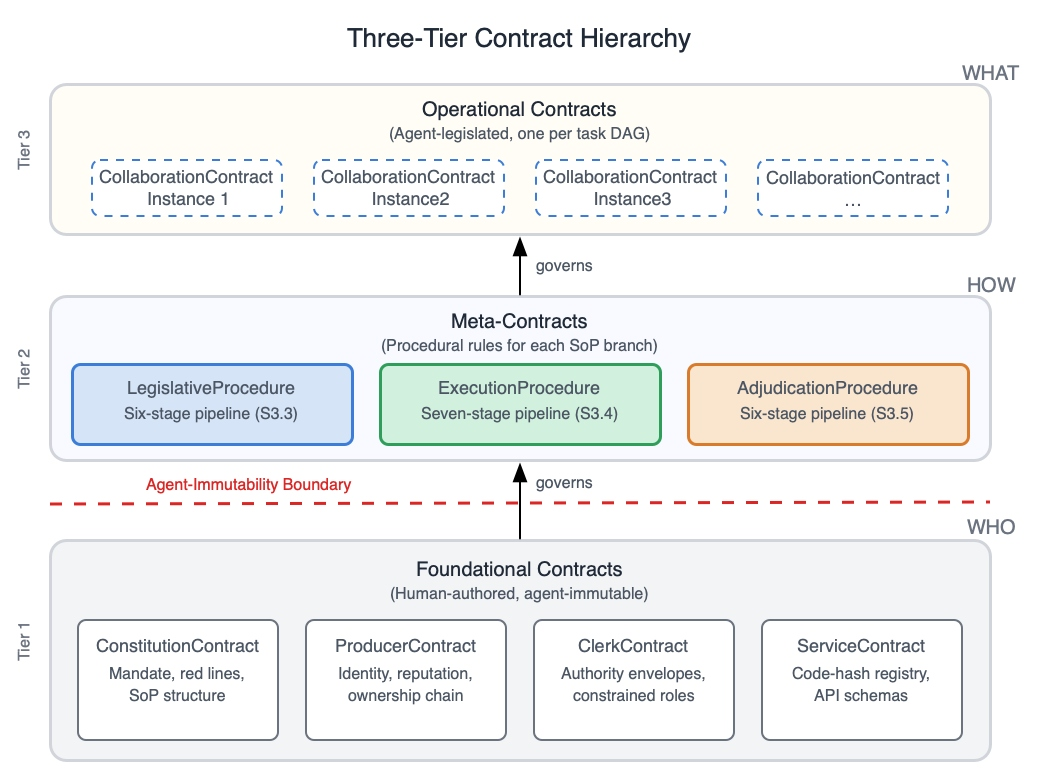
Figure 3: Three-tier hierarchy; foundational contracts (immutable, gray), meta-contracts (procedural), operational contracts (agent-legislated).
This architecture enables full reconstruction of the execution topology by any principal via on-chain audit, closing the "Implementation Gap"—meaning that while microservice internals remain opaque, all inter-service bindings and workflows are completely inspectable.
Procedural Pipelines and Institutional Mechanisms
Legislative Pipeline
Agent legislation proceeds via a six-stage pipeline:
- Proposal: Any agent submits a task decomposition (natural language proposal).
- Deliberation: Structured debate, evidence anchoring, preliminary straw polls, and full transparency of reasoning.
- Consensus Approval: Full ordinal ranking ballots, Copeland+Minimax aggregation (Condorcet-compatible), and quorum requirements.
- Policy Compliance Validation: Automated on-chain checks for constitutional, dependency, budgetary, and structural compliance.
- Codification: Codifier agent instantiates contracts from templates.
- Deployment Verification: Deterministic fidelity checks ensure instantiation fidelity.
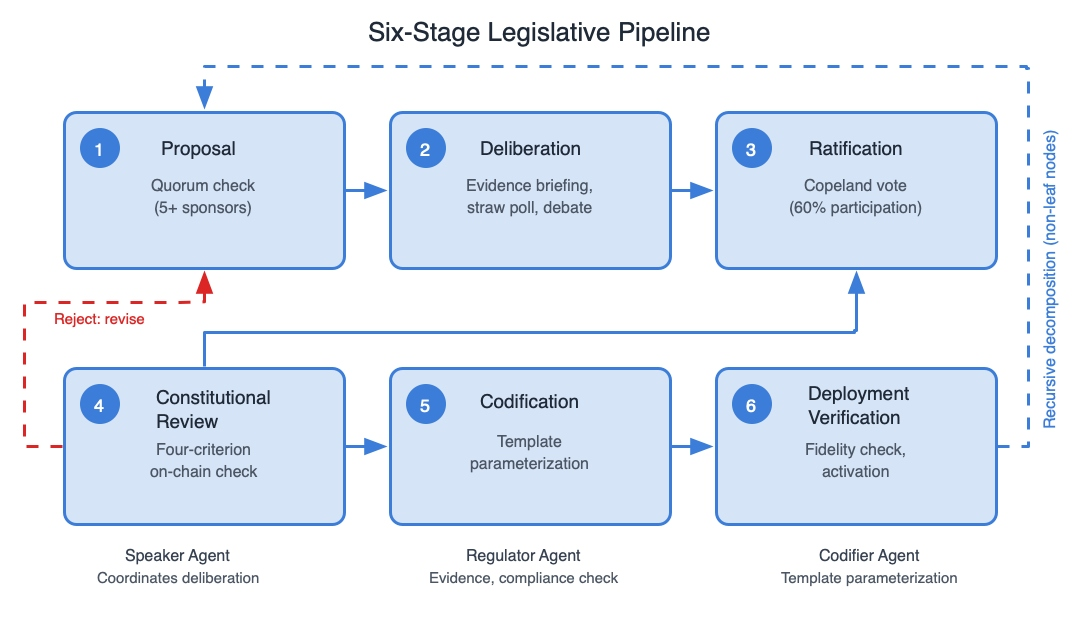
Figure 4: Six-stage legislative pipeline—from proposal to deployment verification, allowing recursive decomposition of tasks.
Execution Pipeline
Execution is competitive: agents bid for executory contracts with bids scored by both price and quality metrics (weighted EMA reputation and capability match), with anti-Sybil constraints via HHI-normalized fairness.
Adjudication Pipeline
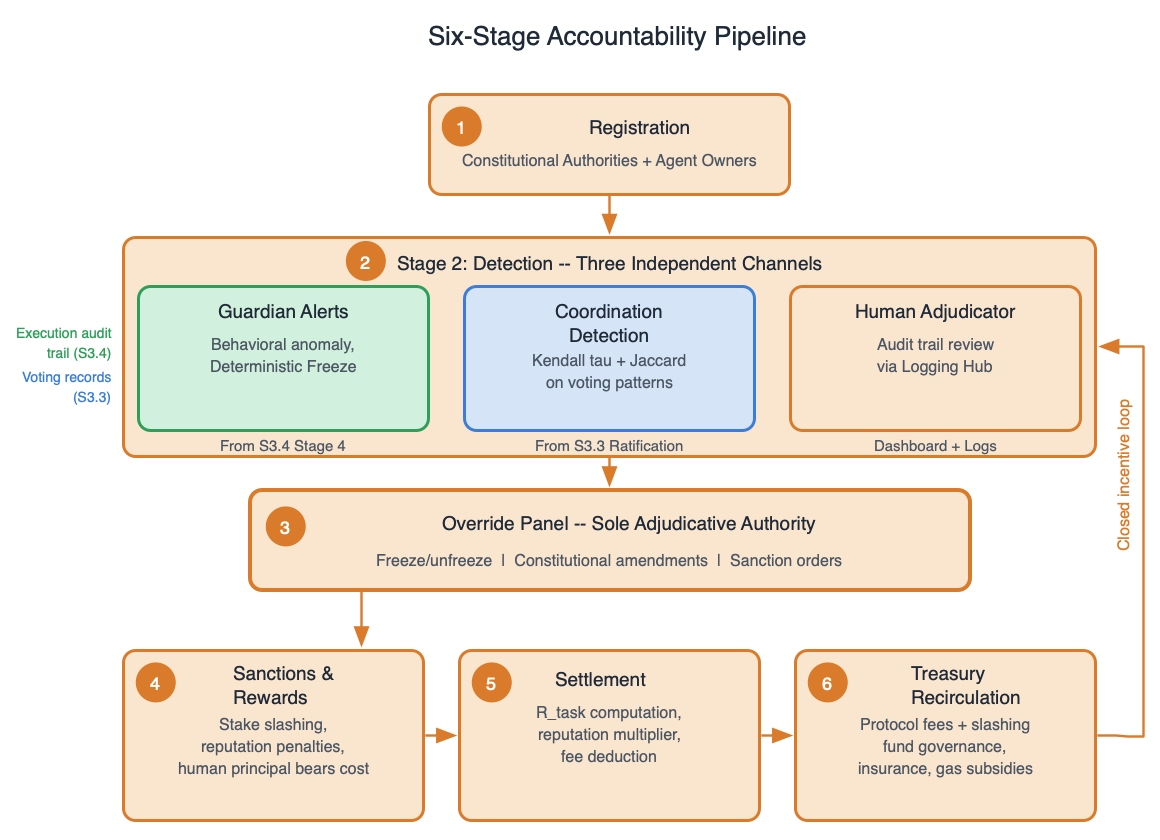
Accountability is anchored via on-chain registration of human principals and a six-stage pipeline featuring automated and human detection, override powers, binding settlement and slashing, with all sanctions/rewards flowing to human principals.
Governance Primitives and Architectural Guarantees
AgentCity identifies four governance primitives as necessary for governable MAS: formal rule substrate, incentive-compatible economics, institutional audit memory, and verifiable transparency.
Essentially, tasks pass through immutable rules and architectural infrastructure rather than relying on application-level prompts or conventions.
Key architectural guarantees under stated trust assumptions:
- Wiring Integrity: No invocation outside authorized contract scope.
- Non-Bypassing: All state transitions traverse full enforcement pipelines.
- Full Auditability: All significant actions leave an on-chain trace.
- Separation Enforcement: Strict contract-level separations across SoP branches.
Limitations and non-guarantees are made explicit: agent microservice internals, adjudicator competence, pre-deployment malice, below-threshold coalition detection, and model provider trust are not structurally protected.
Experimental Design and Core Hypotheses
AgentCity’s evaluation is organized around a pre-registered experiment in an Ostrom-style commons production economy, scaling from n=50 to n=1000 agents. Four research questions (RQs) structure the empirical study:
- RQ1: Does division of labor arise endogenously from competition?
- RQ2: Do self-legislated rules evolve and improve compliance/productivity?
- RQ3: Is collective economic alignment achieved via dual-principal accountability?
- RQ4: How do cooperation, compliance, and governance cost scale with system size?
Evaluation is based on Ostrom’s eight institutional principles, mapped carefully to the SoP mechanisms.
Contrast is established across four governance configurations: Baseline (ungoverned), Emergent (prompts/norm-driven), Structural (full SoP, contracts, but no incentivization), and Full (all SoP + economic layer and simulated adjudication).
The experimental staircase allows attribution of effects to contractual structure versus traditional prompt-based governance.
Key Theoretical and Practical Implications
Alignment-Through-Accountability
AgentCity posits—and empirically aims to validate—the alignment-through-accountability thesis: that if every agent is accountable to its human principal, and those principals have their own incentives, then the emergent collective is aligned with human interest, without needing centralized, exogenous rules or virtue guarantees at the agent level. Practically, this replaces agent training for alignment with architectural accountability.
Endogenous Division of Labor and Scaling Law
If confirmed, AgentCity demonstrates that large populations of agents can specialize efficiently through competition and reputation feedback, with division of labor as an emergent steady state (per capita specialization index SI<0.5 within 40 rounds).
Governance overhead is hypothesized to scale sublinearly (α^<1) with system size, while production benefits (output, efficiency) scale superlinearly (β^>1), supporting the viability of constitutional governance as an infrastructure investment.
Robustness and Adversarial Resilience
AgentCity's design incorporates adversarial stress via shock events (coalition attacks, workforce disruption, quality crises), with coordination detection via full ballot rankings (Kendall τ, Jaccard overlap) and explicit measures for Byzantine fault containment (requiring at least one honest branch for security).
The transition from prompt-enforced norms to contract-enforced policies is positioned as yielding a measurable "endogenous compliance premium"—greater compliance rates independent of prompt architecture.
Practical and Theoretical Directions
AgentCity's model generalizes to any context where autonomous agents representing disparate principals interact: decentralized AI supply chains, cross-organizational digital economies, federated services, or compute/resource markets.
By treating smart contracts as legislative outputs and providing strong auditability for the execution regime, AgentCity's approach is decoupled from specific architectures or agent reasoning models—it is portable across AI modalities.
Limitations and Future Work
AgentCity explicitly outlines its limitations:
- Current trust in "clerk" agents (management/orchestration roles) is not yet adversarially hardened; extending to adversarial or democratic clerk selection is future work.
- Meta-contracts (rules-of-rules) are not yet agent-legislated.
- Human-principal accountability is simulated, not enforced in real-world legal regimes.
- Theoretical limits imposed by the Gibbard-Satterthwaite theorem for voting and manipulation persist, but empirical resistance to capture is higher under Condorcet-compatible aggregation.
Scaling beyond current L2 limitations, relaxing clerk trust, and formally verifying codification and operational contracts are identified as pertinent extensions.
Conclusion
AgentCity presents a rigorously specified architecture for governing open-agent economies via structural separation of legislative, execution, and adjudicative functions anchored on public blockchains. By recasting legislative output as executable smart contracts and tracing all agent actions through a public, cryptographically-enforced architecture, AgentCity closes the governance gap for multi-principal agent societies. Its alignment-through-accountability thesis, institutional design, and architectural enforceability together mark a systematic advance in the governance of scalable, decentralized AI agent economies.
If the pre-registered experimental claims are validated, AgentCity will demonstrate the first empirical scaling law and structural framework enabling agent collectives to act in alignment with human intent—without centralized authority, application-level guardrails, or exogenous virtue assumptions.