- The paper demonstrates that connection delay reversibly switches synchronization transitions between explosive and hierarchical nucleation in adaptive Kuramoto networks.
- It employs a collective coordinate framework to derive analytic bounds for critical coupling, accurately predicting transition types.
- Numerical simulations validate that delay effects vary with frequency distributions, suggesting delay engineering to control network behavior.
Delay-Controlled Heterogeneous Nucleation in Adaptive Dynamical Networks
The study addresses the dynamics of synchronization in adaptive Kuramoto networks, focusing on how explicit connection delays modulate the heterogeneous nucleation pathways underlying the emergence of global synchronization. Unlike static or externally prescribed networks, adaptive networks permit connectivity to coevolve with oscillator states, introducing a feedback mechanism between topology and dynamics. This work isolates the role of pairwise interaction delays as a critical control parameter that dictates synchronization route selection, particularly in finite-size oscillator ensembles with intrinsic frequency heterogeneity. The main finding is that the presence and magnitude of delay reversibly switches the system between single-step (explosive) and multi-step (hierarchical) synchronization transitions, in a way that strongly depends on the form of the frequency distribution.
Model Specification
The system under investigation generalizes the adaptive Kuramoto model by incorporating uniform (and later, distance-dependent distributed) connection delays. Each oscillator’s phase ϕi evolves as:
ϕ˙i=ωi−Nσj=1∑Nkijsin[ϕi(t)−ϕj(t−τ)],
with adaptive synaptic weights kij following Hebbian-inspired dynamics. Timescale separation is maintained via a small adaptation parameter ϵ, while delay τ serves as a principal bifurcation parameter. The natural frequencies ωi are drawn from specified distributions: class-I (unimodal) and class-II (bimodal).
Numerical Results: Delay-Induced Transition Pathways
Numerical integration reveals a nontrivial influence of connection delay on nucleation mechanisms.
For class-I (unimodal) frequency distributions, the undelayed system (τ=0) exhibits canonical multi-step transitions to synchrony, with successive cluster formation and merging, reflected as discretized plateaus in the order parameter S(σ).
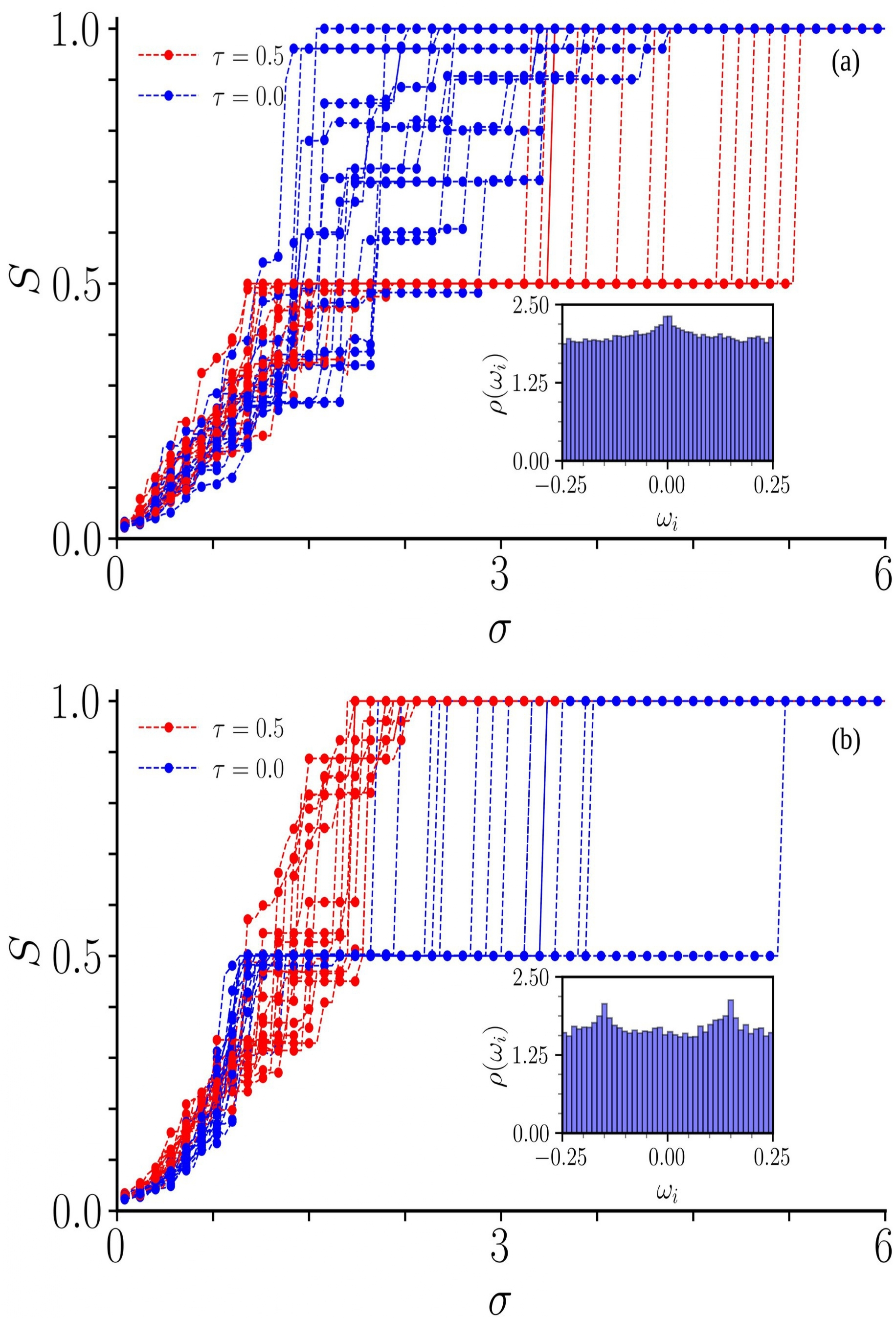
Figure 1: Synchronization index S versus coupling strength σ, contrasting class-I and class-II frequency distributions, without (blue) and with (red) delay. Delay switches the multi-step/single-step character of the synchronization transition.
When a finite delay (ϕ˙i=ωi−Nσj=1∑Nkijsin[ϕi(t)−ϕj(t−τ)],0) is introduced, this behavior collapses to an abrupt, single-step transition—the entire population synchronizes in a discontinuous, explosive manner. For class-II (bimodal) distributions, the effect inverts: the undelayed system synchronizes via a single-step transition, but delay gives rise to multi-step synchronization with intermediate partial states.
This reversal is robustly validated over statistical ensembles of random initial phases and frequency realizations.
Mechanism: Delay-Modulated Phase Lag and Cluster Stability
The origin of the delay switch is traced to the emergence of an effective, frequency-dependent phase lag in cluster interactions. For a cluster with mean frequency ϕ˙i=ωi−Nσj=1∑Nkijsin[ϕi(t)−ϕj(t−τ)],1, the coupling’s adaptation rule introduces a renormalized phase lag ϕ˙i=ωi−Nσj=1∑Nkijsin[ϕi(t)−ϕj(t−τ)],2. This frequency-dependency alters the relative stability and basin sizes of multicluster configurations: delay can artificially enhance or suppress the stability of multi-cluster states depending on the overlap between delay-induced phase shifts and the intrinsic frequency mismatch ϕ˙i=ωi−Nσj=1∑Nkijsin[ϕi(t)−ϕj(t−τ)],3 between clusters.
The evolution of the adaptive coupling matrix ϕ˙i=ωi−Nσj=1∑Nkijsin[ϕi(t)−ϕj(t−τ)],4 illustrates these effects: absence of delay supports hierarchical cluster absorption, while delay rapidly enforces either single or sequential multi-cluster transitions, depending on the frequency structure.

Figure 2: Evolution of the absolute value of adaptive coupling matrix ϕ˙i=ωi−Nσj=1∑Nkijsin[ϕi(t)−ϕj(t−τ)],5 as coupling ϕ˙i=ωi−Nσj=1∑Nkijsin[ϕi(t)−ϕj(t−τ)],6 increases. Delay and frequency class jointly control the emergence of cluster structure and absorption events.
Reduced Analytical Description and Critical Coupling Bounds
A collective coordinate (CC) framework is applied for coarse-grained dynamics, reducing the high-dimensional oscillator system to a few macroscopic variables describing cluster-wise mean phases and coupling strengths. Projection of dynamics onto the CC manifold yields evolution equations for the mean phase differences and cluster-coupling amplitudes, including explicit delay terms.
From this reduction, a quadratic equation for the relative angular velocity between clusters is derived, providing an analytic upper bound ϕ˙i=ωi−Nσj=1∑Nkijsin[ϕi(t)−ϕj(t−τ)],7 for the onset of cluster merging, dependent on delay and the difference in cluster frequencies. The CC model quantitatively reproduces the numerically observed transition types and critical coupling values.
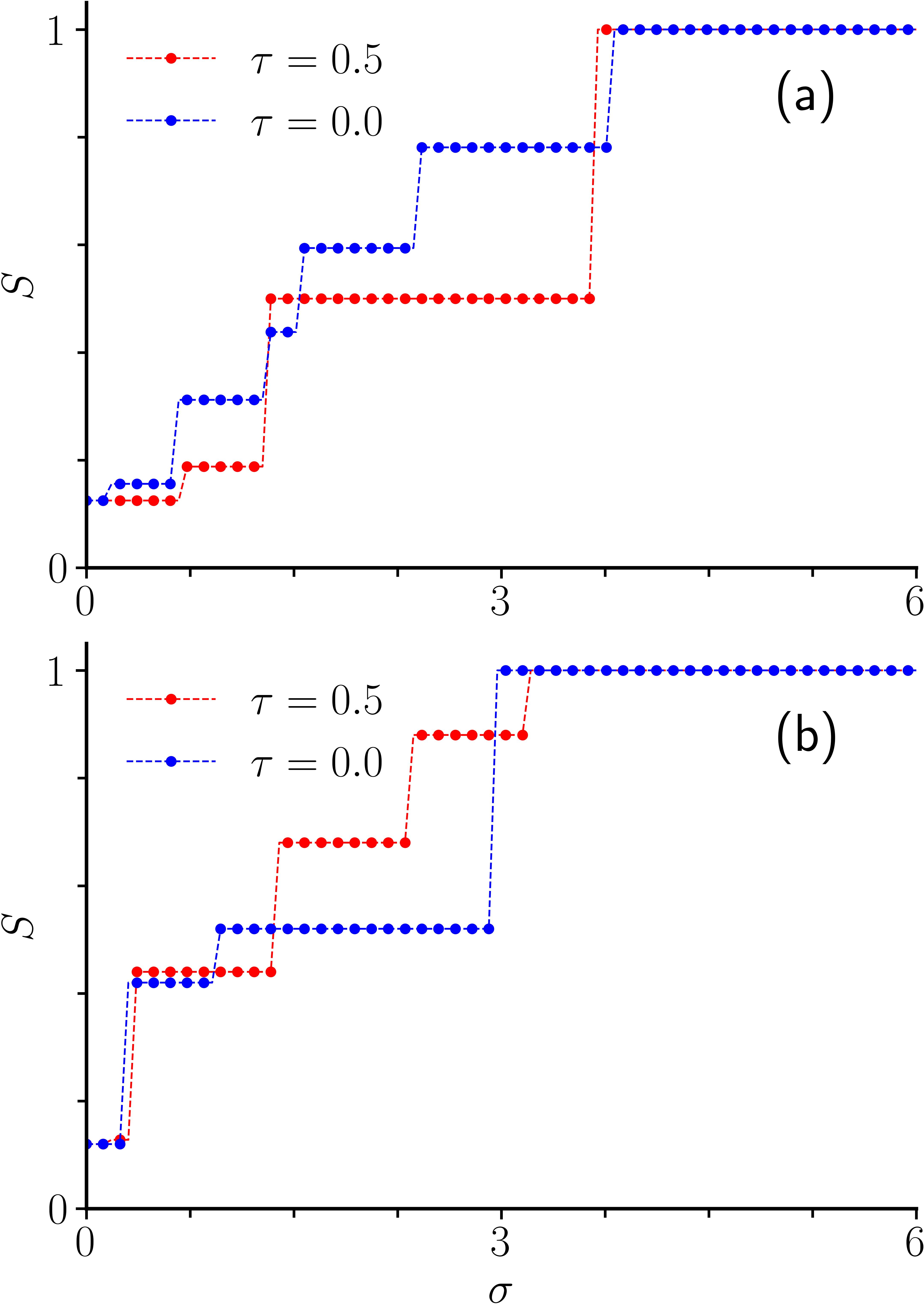
Figure 3: Synchronization transitions in the collective coordinate equations, mirroring the transition types seen in full-scope simulations and confirming the delay/frequency class dependency.
Comprehensive two-parameter sweeps in the ϕ˙i=ωi−Nσj=1∑Nkijsin[ϕi(t)−ϕj(t−τ)],8 plane map out full phase diagrams for synchronization index ϕ˙i=ωi−Nσj=1∑Nkijsin[ϕi(t)−ϕj(t−τ)],9, with the theoretically computed upper bounds overlayed for validation.
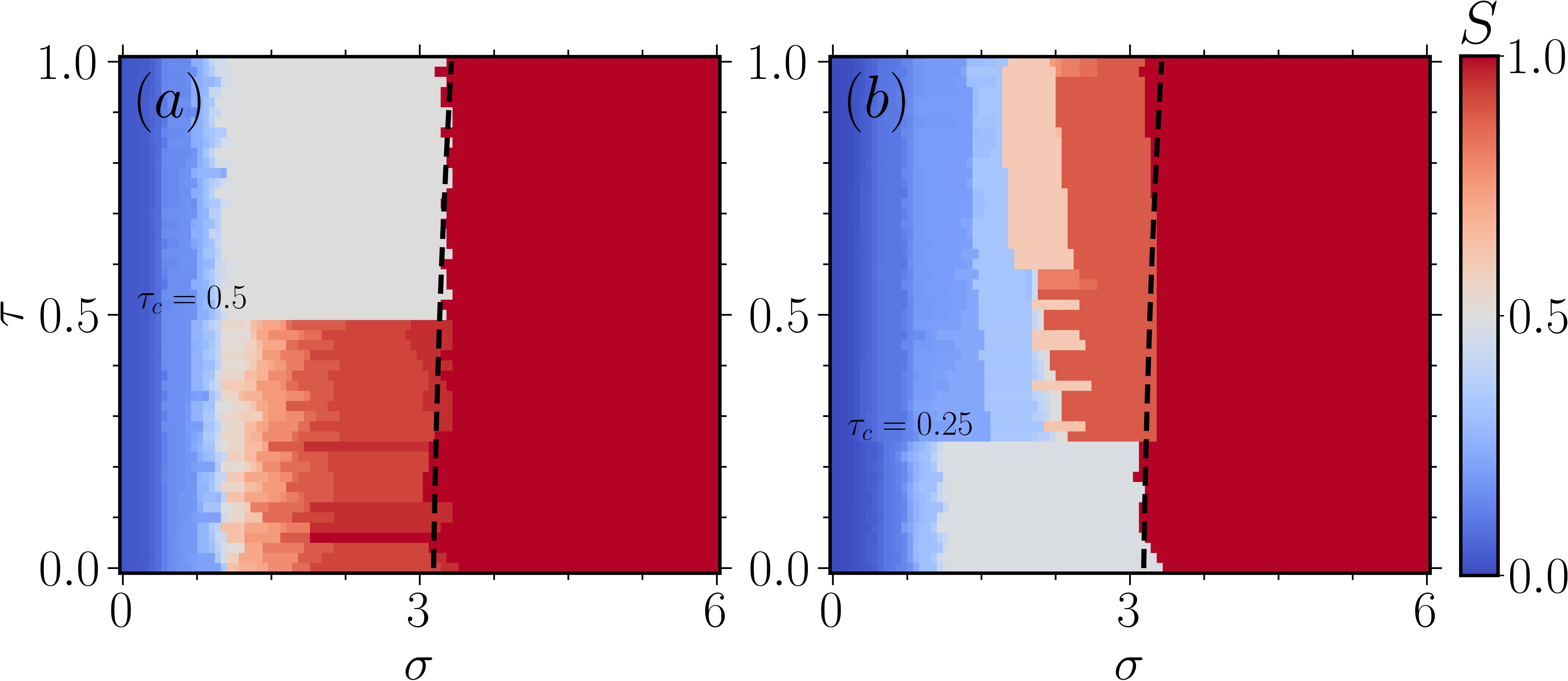
Figure 4: Phase diagrams for synchronization index kij0 in the kij1 plane for various frequency classes, displaying regime boundaries controlled by the analytical upper bound.
Distributed Delay and Finite-Size Effects
The analysis is robustly extended to systems with distributed, distance-dependent delays. Here, the effective inter-cluster delay is captured by the mean pairwise delay, and the resulting analytical boundary for clustering retains quantitative accuracy. Simulations demonstrate that core phenomenology—the reversible switching of transition type by delay—is preserved even under heterogeneous temporal coupling.
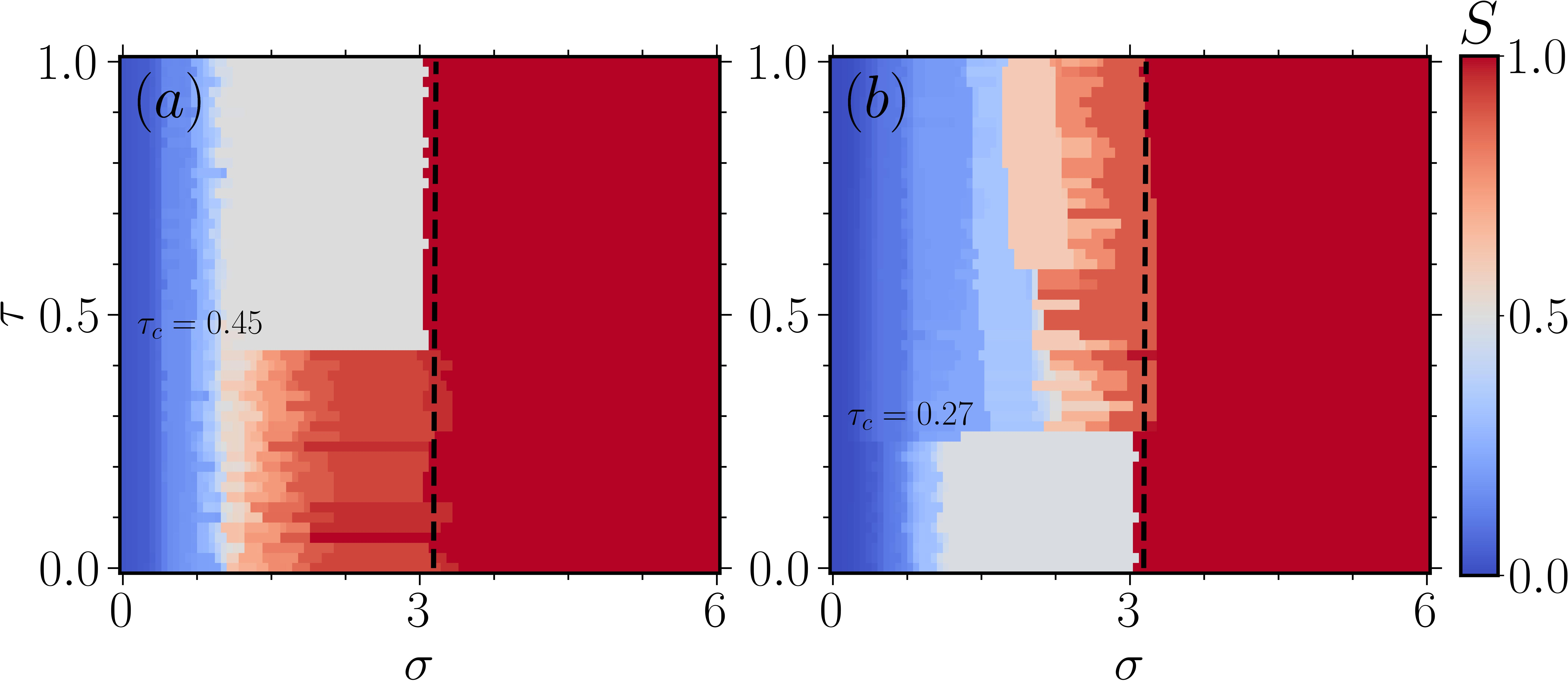
Figure 5: Phase diagrams for the distributed-delay system, confirming the persistence and generality of the observed transition control by delay.
Finite-size effects and the choice of initial conditions are shown to seed a degree of multistability, especially under uniform frequency spacing, further enabling either abrupt or hierarchical nucleation routes depending on delay, as detailed in the appendix.
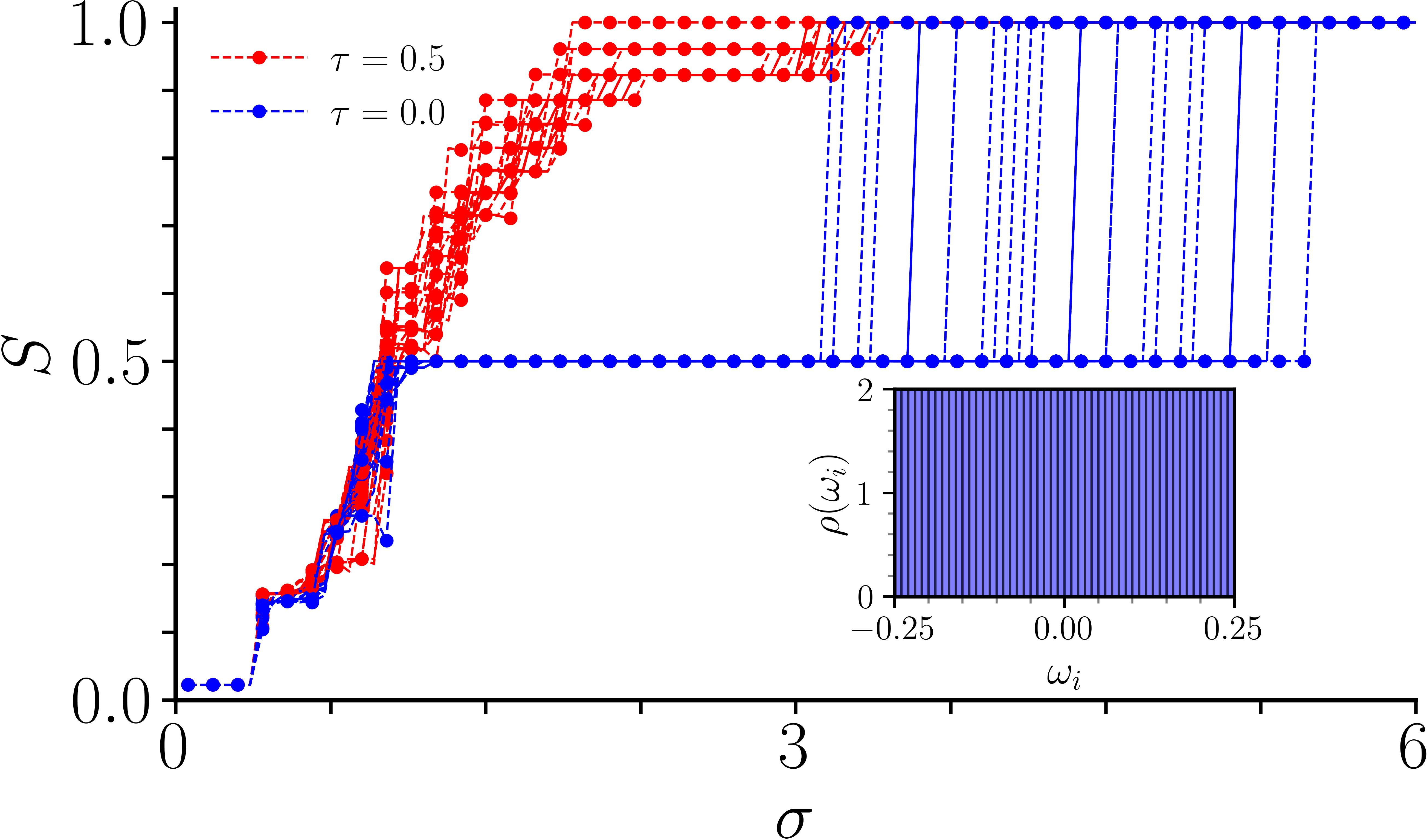
Figure 6: Synchronization index kij2 as a function of coupling in a finite-size population with uniform frequencies. Delay (red) induces multi-step, initial-condition-sensitive transitions.
Implications and Future Directions
The results provide a mechanistic rationale for the emergence of explosive (first-order) and multi-step transitions in adaptive oscillator networks, rigorously connecting them to the joint action of intrinsic disorder (frequency distribution) and communication delays. The theoretical approach captures the non-universality and reversibility of this effect: the same structural perturbation (delay) can cause fundamentally distinct route selection, depending on the spectral properties of the system. This has practical implications for networked systems where control over synchronization type is desirable: delay engineering can be used to either destabilize multicluster metastability (promoting robustness and speed) or to induce rich intermediate states for information processing.
Theoretically, the successful application of the CC framework suggests that further refinements—especially those incorporating stochastic effects and higher order interaction motifs—could extend the predictive power to even more heterogeneous or modular networks. Limitations in capturing full multicluster nucleation cascades point to an ongoing need for more refined analytic reductions. Future work could investigate the modulation of collective transitions via directed/asymmetric coupling, nonstationary delays, and application to biologically plausible neural systems.
Conclusion
This paper establishes connection delay as a non-trivial and reversible selector for synchronization pathways in adaptive Kuramoto-type networks, fundamentally mediated by the interaction between spectral disorder and time delays. The work demonstrates both through macroscopic theory and large-scale simulation that adaptive, delay-coupled oscillator networks admit either abrupt (single-step) or multistage (hierarchical) nucleation transitions, with the control directionality set by the frequency class of the system. These findings unify disparate prior results on synchronization transitions, provide actionable analytic expressions for stability boundaries, and identify promising axes for further explorations in the control of collective dynamics via adaptive and temporal mechanisms.