- The paper presents a novel three-tiered architecture that decouples macro events, social coordination, and individual agent actions for scalable simulation.
- It employs a coordination hub to transform high-level events into actionable, tag-directed directives, ensuring efficient resource use and narrative coherence.
- Empirical tests demonstrate constant-time scalability and a dramatic reduction in LLM calls, yielding predictable behavior and robust control over emergent social dynamics.
CASCADE: A Coordination-Centric, Low-Cost Architecture for Social Simulation
Introduction
CASCADE introduces a three-tiered architecture for social coordination in sandbox-style game worlds, motivated by limitations of both traditional script-driven NPCs and LLM-driven generative agents. The core insight is to decouple macro-level event causality, meso-level social coordination, and micro-level agent action, enabling scalable and controllable social environments at runtime costs compatible with commercial-scale simulation.
Architectural Overview
CASCADE’s architecture is structured into three distinct layers: the Macro State Director, Coordination Hub, and Tag-Driven NPCs. This separation facilitates efficient propagation of macro events into logically consistent, diverse individual behaviors without the inefficiency of continuous per-agent generation.
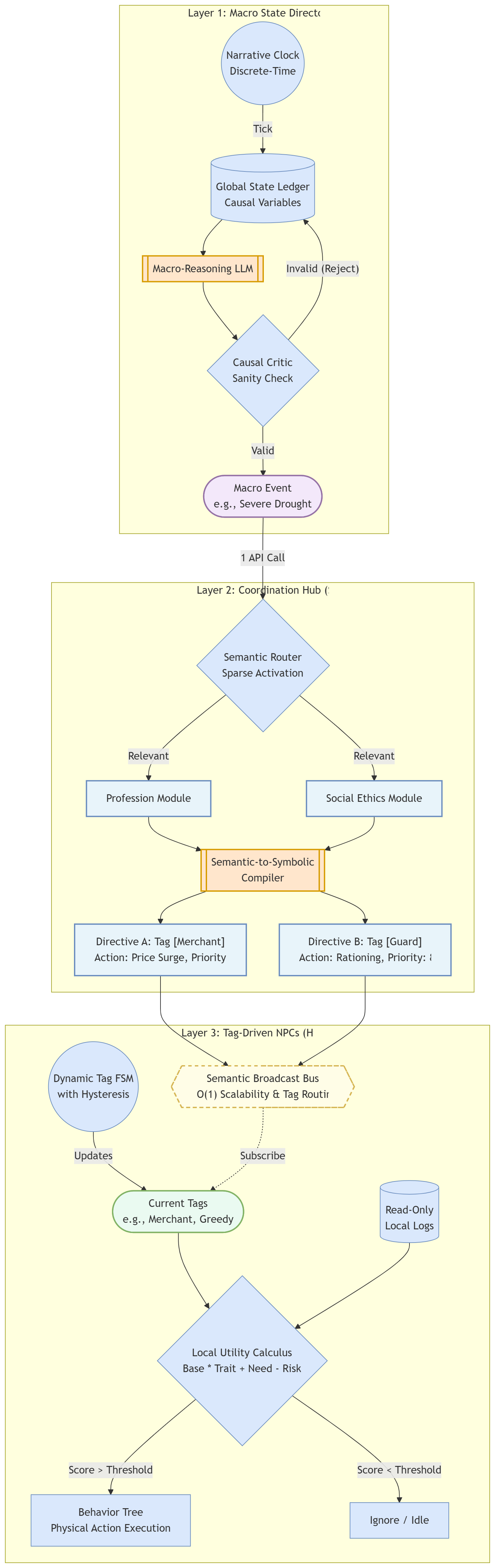
Figure 1: The CASCADE architecture: macro state variables and events are coordinated via a modular hub and executed by tag-driven NPCs using local utility calculus.
Layer 1: Macro State Director
Operating in discrete time, the Macro State Director drives the world’s evolution by managing high-level state variables (e.g., "Water Scarcity") and orchestrating causal updates according to authored rules or macro-level LLM reasoning modules. Its primary functions include:
- The Narrative Clock, which discretizes simulation time and throttles expensive world updates,
- A global state ledger that embodies canonical world state and its historical transitions,
- A causal critic that enforces plausibility constraints by cross-validating new macro-events.
This design centralizes world logic and reduces update frequency, maintaining narrative coherence with O(1) computational complexity per tick, regardless of population size.
Layer 2: Coordination Hub
The Coordination Hub translates macro-events into structured, modular directives targeted by semantic tags, selectively activating domain-specific modules. Only relevant modules are invoked (e.g., "Resource Management" in a drought), and their outputs are routed as JSON directives to relevant NPC classes using tag-based multicast channels. This modular design enables:
- Sparse activation, minimizing unnecessary computation,
- Compilation and domain translation of abstract world shifts into actionable instructions, and
- Efficient directive dissemination via tag routing.
Layer 3: Tag-Driven NPCs
NPCs receive directives filtered by their tags (e.g., [Merchant], [Farmer]). Each agent applies a local utility calculus to decide whether, and how, to enact directives, driven by agent traits, goals, needs, and a compact FSM enabling dynamic tag migration (e.g., switching occupations on resource depletion). Dialogue and action are decoupled: only player-facing interactions invoke LLMs, substantially mitigating token costs and runtime variance. The architecture guarantees that symbolic action execution remains immune to player-driven prompt manipulation.
Evaluation
CASCADE is validated using micro-scenario prototypes, such as a severe drought in a simulated town with tagged NPCs (e.g., [Merchant], [Farmer], [Mayor], [Guard]). The Macro State Director triggers a "Severe Drought," leading the Coordination Hub to generate differentiated directives: price changes for merchants, rationing for guards, conservation meetings for the mayor.
The results show strong behavioral diversity even at small scales and maintain logical constraint without per-agent prompting. For instance:
- One merchant might raise prices due to a greed trait, another offers aid per a generosity trait,
- Farmers exhibit differentiated adherence to water rationing based on laziness or industriousness,
- Guards enforce or neglect rationing per responsibility traits.
CASCADE exhibits constant-time scalability with population size, in contrast to the linear token and computational scaling of full LLM-driven baselines. LLM invocation is restricted to real player interactions, meeting stringent commercial requirements for cost and safety.
Implications and Comparative Claims
CASCADE claims clear architectural advantages over agent-centric generative paradigms by instituting a "social physics" engine, shifting cognitive burden from agents to modular coordination. This paradigm delivers:
- Stringent authorial and narrative control by centralizing causal logic and directive composition,
- Dramatic reduction in LLM calls, resulting in predictable and low computational cost,
- Structural safety via action-dialogue decoupling, which resists prompt-injection exploits.
In comparison to hybrid, tightly-coupled pipelines in industrial engines, CASCADE’s modularity encourages generalization and reuse, aiming at the emergent standardization of social simulation middleware.
Limitations and Future Prospects
While CASCADE succeeds in downward causation, its information flow is unidirectional. Notably, bottom-up phenomena—emergent micro-level disruptions (e.g., riots)—do not propagate to macro state. Addressing this, the authors propose a "Micro-Anomaly Aggregator" for dynamic, statistical synthesis of low-level events into new world states.
Spatial semantic routing is currently aliased to all tagged agents; future work includes integrating networked topologies and epidemiological models (e.g., SIR-based rumor dynamics) for locality-aware propagation and belief diffusion.
The long-term trajectory envisions CASCADE as an open, modular, community-driven platform for domain-specific coordination modules (economics, politics, kinship, religion), heralding standardized "social physics" middleware for large-scale, interactive digital societies.
Conclusion
CASCADE advances a modular, coordination-centric architecture enabling scalable, controllable social simulation in games and digital societies. By engineering a clear separation of causality, coordination, and agent action—and drastically minimizing LLM involvement—it demonstrates that emergent, logically consistent agent diversity can be efficiently realized without sacrificing authorial control or computational scalability. Extensions for upward causation, network-aware communication, and open-authoring ecosystems will enhance its applicability and realism in both research and commercial game development.