- The paper empirically finds that perceived ease of use and utility are key drivers of regularization adoption.
- It reveals that effort expectancy, performance expectancy, and social influence significantly predict behavioral intention.
- The study shows that explicit expert recommendations have a minimal effect, underscoring the importance of practitioner-centered approaches.
An Empirical Analysis of Trust and Adoption Drivers in Regularization Usage
Introduction
The study, "Why is Regularization Underused? An Empirical Study on Trust and Adoption of Statistical Methods" (2604.02992), systematically investigates why the adoption of regularization methods among data analysts remains sub-optimal despite their established methodological advantages and accessibility. Using a survey instrument rooted in psychological models from technology acceptance (notably, the Unified Theory of Acceptance and Use of Technology; UTAUT), the research explores individual and social determinants of intention to adopt regularization, also scrutinizing the effect of explicit recommendations from peers, experts, and journals.
Methodological Overview and Experimental Design
A sample of 606 data analysts was recruited via Prolific, encompassing diverse demographic backgrounds and expertise levels. Participants were randomly assigned to four groups: a control group and three recommendation groups differing in the purported source of the recommendation (peer, expert, or journal). Every group received a standardized description of regularization methods (e.g., lasso, ridge, bagging, elastic net), and the experimental groups additionally received a targeted written recommendation before completing a battery of Likert-scale items measuring psychological constructs related to technology adoption.
The constructs mapped closely to standard UTAUT dimensions—Effort Expectancy (EE), Performance Expectancy (PE), Social Influence (SI), Attitude Toward Technology (AT), and Experience (EX)—as well as Trust (TR), Vigilance (VI), System Understanding (SU), and the primary outcome variable: Behavioral Intention to use regularization (BI).
Descriptive Findings of Survey Constructs
All measured constructs demonstrated high internal consistency (Cronbach’s α > .77). The distribution of Likert-item responses indicated moderate to high favorability for trust, vigilance, and performance expectancy but more balanced or ambivalent responses regarding behavioral intention, social influence, and effort expectancy.
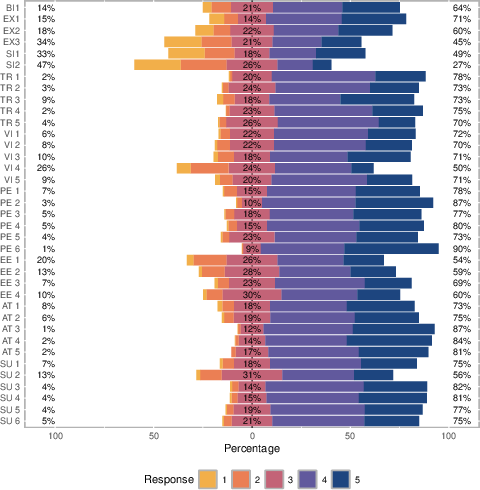
Figure 1: Distribution of the 5-point Likert items, ordered by construct, with a tendency toward positive assessments for TR, VI, and PE.
Correlation Structure: Interdependencies of Psychological Drivers
The analysis of inter-construct relationships revealed a robust, mutually positive correlation structure among the studied variables. In particular, effort expectancy demonstrated the strongest association with behavioral intention (τ^(BI,EE)=0.53), followed by performance expectancy and social influence. Contrary to prior hypotheses and the original preregistration, vigilance also correlated positively with behavioral intention. This suggests that vigilance, operationalized as critical attentiveness rather than skepticism, may identify practitioners more likely to adopt regularization but with heightened scrutiny.
Empirical Kendall’s τ correlation analysis is visualized below.
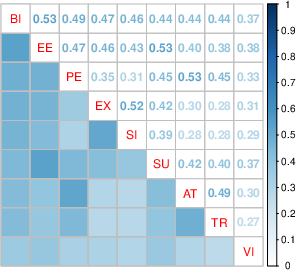
Figure 2: Empirical Kendall's τ correlation matrix among constructs, sorted by strength of relationship with BI.
In demographic analyses, behavioral intention was modestly negatively correlated with age (τ^=−0.16) and showed higher openness among non-male participants.
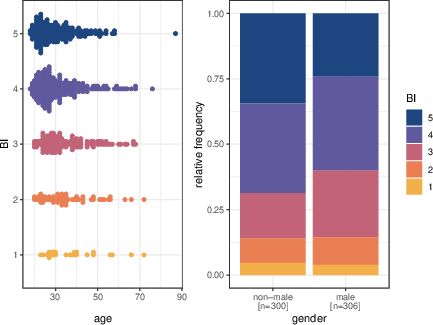
Figure 3: Joint distribution of key demographic variables (age, gender, education, field) with BI.
The Role of Recommendations: Minimal Impact on Adoption Intention
The impact of experimental manipulation (explicit recommendation by peer/expert/journal vs. none) was negligible. Tests comparing recommendation groups to control, using nonparametric rank-based multiple contrast procedures, failed to demonstrate substantive or consistent effects of recommendations on trust, vigilance, or behavioral intention. The only statistically significant difference observed was a decrease in trust in the expert recommendation group compared to control (local p=0.0260), which is weak and not in the hypothesized direction.
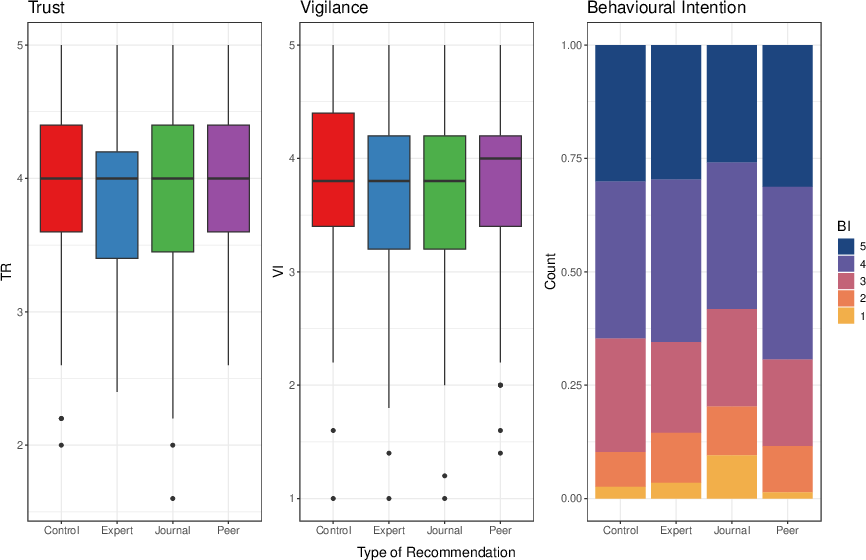
Figure 4: Distribution of TR, VI, and BI scores by recommendation group (Control, Expert, Journal, Peer); medians and spreads are comparable across groups.
Predictive Modeling: Identifying Core Adoption Drivers
A penalized cumulative logit model (lasso-regularized ordinal regression) using cross-validation was employed to identify the most parsimonious set of predictors for BI. The variable selection considered possible confounding due to multicollinearity among UTAUT constructs and psychometric overlap.
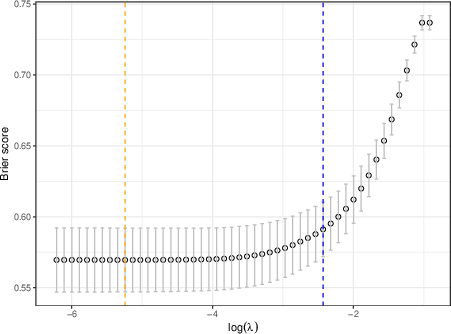
Figure 5: 10-fold CV Brier score for penalized cumulative logit with main effects; optimal λ chosen within 1-SE rule.
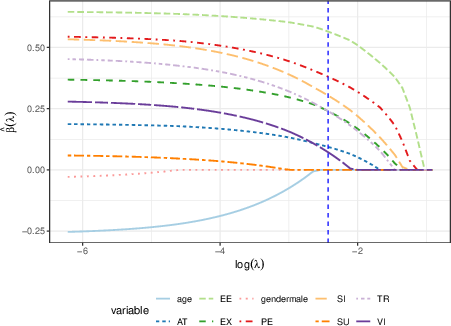
Figure 6: Coefficient regularization paths as a function of the LASSO penalty; the primary contributing predictors are EE, PE, SI, EX, TR, AT, VI.
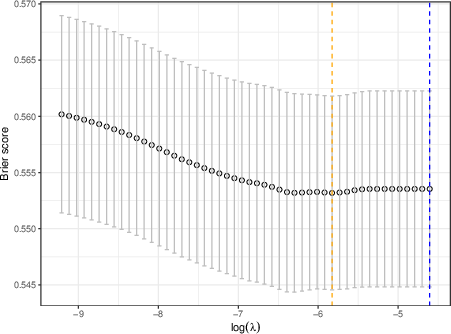
Figure 7: 10-fold CV Brier score including main effects and all pairwise interactions; interaction terms minimally impact predictive accuracy.
The lasso procedure retained seven predictors: Effort Expectancy (β=0.565), Performance Expectancy (β=0.380), Social Influence (β=0.304), Experience (β=0.240), Trust (τ0), Attitude (τ1), and Vigilance (τ2). System Understanding and demographic variables were excluded. No interaction effects between predictors were selected, indicating the dominance of additive main effects over complex dependencies in explaining intention to adopt regularization.
Discussion and Theoretical Implications
The empirical findings contest any strong causal link between explicit recommendations from authorities (journals, experts, peers) and practitioners' intention to utilize regularization. Instead, intention is primarily a function of perceived ease of use, perceived utility, and social-network-driven norms. This aligns with canonical UTAUT postulates but extends them via operationalization in the domain of statistical methodology selection, rather than software or hardware adoption, and contextualizes trust and vigilance as complementary rather than antagonistic.
The non-effect of recommendations indicates that rhetorical or top-down advocacy is insufficient to drive adoption when practical barriers or context-specific incentives are not addressed. This underscores the limited leverage of journal guidelines or expert pronouncements in shaping methodological diffusion, compared to the more potent drivers of collective practice, hands-on usability, and community norms.
The exclusion of System Understanding as a direct predictor (despite its positive pairwise correlations with intention) in the penalized models implies that practical aspects of implementation and ease of use may subsume the effect of deeper method comprehension.
Practical Applications and Future Directions
Practically, these results suggest that initiatives aiming to increase adoption of regularization in statistical practice should focus on enhancing usability—through training, workflow integration, and code-level support—and fostering visible communities of practice, rather than relying on authority-based recommendations. Emphasis on performance expectancy and effort expectation in educational and tool-building contexts will likely be more effective.
Future empirical work should extend these analyses by incorporating behavioral outcome measures (e.g., audit of analysis pipelines) beyond self-reported intention, and by leveraging longitudinal or intervention studies to dissect causal mechanisms in real-world analytic workflows. Moreover, identifying context-specific blockers for particular practitioner subgroups (e.g., clinical/medical vs. social science analysts) could allow for tailored interventions.
Conclusion
The study provides rigorous empirical evidence that the underuse of regularization among statistical practitioners is largely attributable to perceptions regarding effort and utility, as well as social context, rather than insufficient endorsement or recommendations. Adoption lags are therefore best addressed by reducing implementation frictions, evidencing clear performance gains, and cultivating communities where regularization is part of the methodological mainstream.
The results have clear implications for statistical education, methodology advocacy, and software tool design, indicating a shift from authority-driven strategies toward practitioner-centered, usability-focused, network-leveraged interventions.