- The paper shows that lowering search costs increases the set of learned businesses and consumer welfare.
- It demonstrates that enhanced search informativeness can reduce market learning and consumer surplus unless detailed transcripts are used.
- The model integrates endogenous pricing strategies and AI-mediated search dynamics to reveal trade-offs in digital market design.
Agentic Markets and the Equilibrium Effects of Enhanced Consumer Search
Introduction and Motivation
"Agentic Markets: Equilibrium Effects of Improving Consumer Search" (2603.25893) presents a formal analysis of how emerging AI-driven, agent-mediated markets reshape learning, competition, and welfare as the process of consumer search is fundamentally altered. The focus is a sequential model where consumers and businesses operate with the assistance of AI tools that lower search costs and enhance the informativeness of pre-transaction queries—a setting increasingly relevant as platforms such as ChatGPT agents and automated corporate interfaces intermediate customer journeys.
The study addresses how these technological improvements propagate through market-level dynamics, influencing not only individual outcomes but also the long-run aggregation of information, the structure of competition, and platform welfare properties. In contrast to classical models, the interplay between private (idiosyncratic) and public (market-level) knowledge about products/services and the endogenous business pricing response to improved search are central to the analysis.
The paper develops a sequential, two-sided market model featuring m businesses and a continuum of consumers who arrive in rounds. Each consumer faces a satisficing utility function specified by value Vi, a binary fit realization Fij (assessable pre-purchase), and a binary quality realization qij (revealed post-transaction). Search is costly: inspecting Fij requires paying a fixed cost c, while quality is revealed only upon purchase.
Consumers are modeled as Bayesian with heterogenous private Vi and must decide (given market priors over business types) how to allocate their search budget. The model's search process generalizes Weitzman's Pandora's box [weitzman1978optimal], supporting endogenous, index-based search orders, and back-propagation of learning across consumers via observable feedback. Critically, the market history records both pre-transaction (fit) and post-transaction (quality) signals, enabling collective updating of beliefs.
Over time, the model reaches a steady-state where some businesses are "learned" (their true parameters discovered in the limit by the market) and others are "lost" (no longer considered viable by any consumer). The set of learned businesses and corresponding consumer utility serve as the central analytical objects.
Effects of Reducing Search Costs
The first equilibrium analysis examines the impact of exogenously lowering the search cost c. The main result is that cheaper search unambiguously enlarges the set of learned businesses and increases limit consumer welfare. Concretely, as c decreases, more businesses are explored and individually tailored matches are enabled, reducing the probability of prematurely discarding options due to insufficient information.
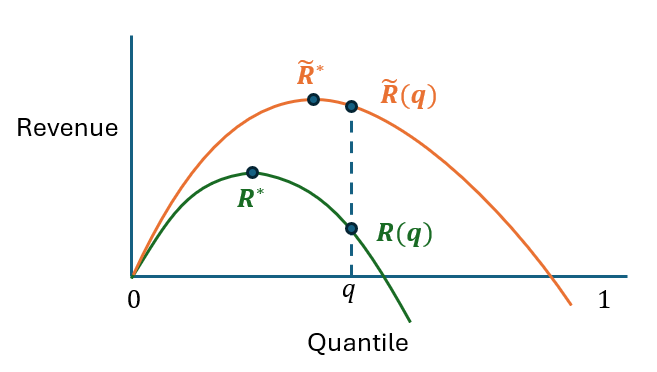
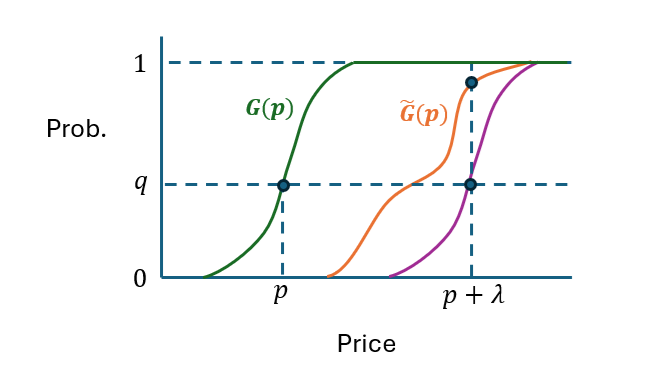
Figure 1: Visualization of the proof that reduced search costs increase canonical consumer and total welfare at equilibrium, via a shift in the monopolist quantile revenue curve and equilibrium price CDFs.
Theoretical analysis in the paper demonstrates that (i) the probability a business is lost is weakly decreasing in c and (ii) the consumer utility converges in probability to the utility under steady-state beliefs, which is monotonic in the size of the learned set. The figure above illustrates this welfare gain: with lower search cost, the relevant revenue and price curves shift, providing both increased opportunities for exploration and altered pricing incentives for businesses.
The analysis then investigates the effects of increasing search informativeness (e.g., richer agentic queries allowing consumers to eliminate non-qualifying options pre-transaction). A key and contradictory finding is that improving the informativeness of pre-purchase search can strictly lower long-run market learning and consumer surplus. The intuition is subtle: as search distinguishes more niche consumer requirements from broadly relevant deficiencies, failures observed during search become increasingly idiosyncratic and less useful for other consumers. Unless the market or platform also observes the "transcript" (i.e., the specific reason a business fails inspection), it cannot discriminate between a business unsuitable for an unusual requirement and one with universally low quality.
Thus, without access to fine-grained transcripts, the market can erroneously treat businesses with broad appeal as unsuitable, reducing exploration and consumer welfare despite every individual consumer being, ex post, better informed.
However, once platforms leverage agentic technology to record and aggregate detailed inspection transcripts, this negative effect is eliminated. The paper proves that with transcript-level observability, increasing search informativeness becomes unambiguously beneficial—transcripts allow the market to differentiate between idiosyncratic and general failures, restoring the socially optimal flow of information.
Endogenous Pricing and Strategic Business Responses
Extending the model to allow businesses to set prices dynamically in response to observed market learning and consumer behavior, the paper provides a characterization of steady-state pricing equilibrium. By exploiting an equivalence to a "transformed" market with distorted consumer preferences (inspired by [choi2018consumer]), the study derives closed-form expressions for symmetric market equilibria and identifies the welfare and competitive implications of search improvements.
With endogenous pricing, lowering search costs continues to increase consumer welfare and total market welfare, but the effect on business revenue depends on the precise composition of the learned set and the equilibrium pricing strategies. Importantly, as richer pre-purchase screening narrows the set of viable businesses per consumer, competition among those businesses weakens; prices rise, and consumer surplus may decrease even as match quality improves. This effect persists even with full transcript observability, driven by the reduced substitutability of businesses once consumers screen on more dimensions.
The paper's nuanced analysis of agentic market dynamics underscores several implications for the design of platforms deploying agent-mediated search and transaction systems:
- Platforms should prioritize recording and sharing granular, transcript-level interaction data to avoid pathologies in market-level learning and welfare.
- Lowering consumer search costs (via automation, agents, or improved interfaces) consistently intensifies competition and improves welfare, suggesting broad platform and regulatory support.
- Enhancing informativeness of agentic search is only unambiguously beneficial if platforms can reliably aggregate and interpret the full context of failed inspections; otherwise, it poses risks to long-term market efficiency.
- Strategic business responses (pricing, investment) interact in complex ways with information flow; platform interventions aimed at consumer welfare must consider impacts on price competition and possible surplus shifts.
- The theoretical framework provides a tractable foundation for exploring heterogeneous agent adoption, partial feedback, and the interaction between dynamic quality investment and rapid learning cycles—future work in these directions is highlighted as both practically and theoretically urgent.
Conclusion
This work formalizes the equilibrium consequences of AI-augmented consumer search in two-sided markets, integrating informational, dynamic, and strategic layers into a unified model. The results reveal that welfare effects of agentic technology hinge critically on the structure of information aggregation and business adaptability, and that welfare-improving search enhancements require commensurate advances in market observability and platform design. These findings provide a blueprint for future empirical, mechanistic, and normative research on agent-mediated digital markets and their regulation (2603.25893).