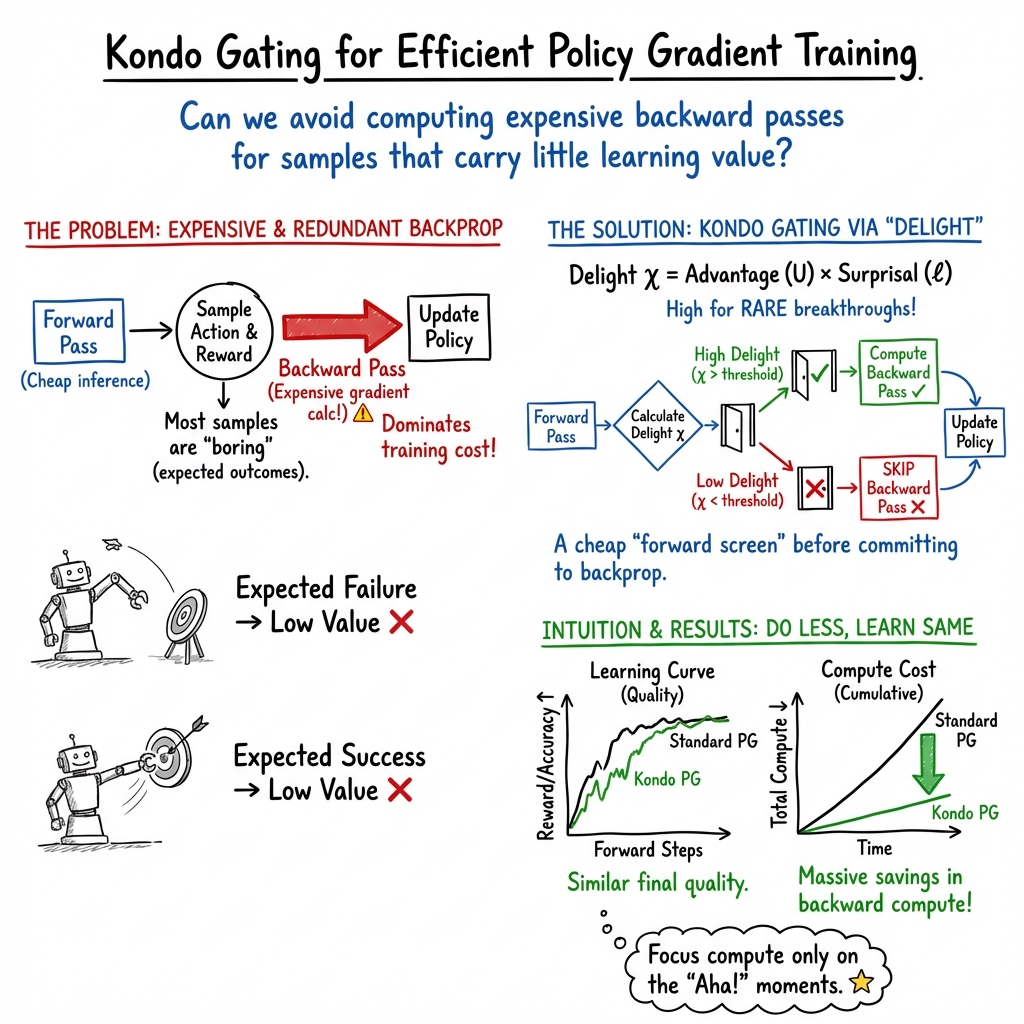
- The paper demonstrates that the Kondo gate uses the product of advantage and surprisal (delight) as a forward-pass signal to selectively perform backward passes, enabling substantial compute savings.
- Empirical results on MNIST contextual bandit and transformer token reversal tasks show that DG-K achieves similar performance to standard methods while reducing compute by up to 6×.
- The method aligns gradient updates with policy improvement while highlighting limitations in high-reward variance scenarios, outlining a clear quality–cost Pareto frontier.
Delight as a Forward-Pass Signal for Efficient Policy Optimization
Introduction
"Does This Gradient Spark Joy?" (2603.20526) addresses the computational inefficiency inherent in standard policy gradient (PG) methods, which allocate backward passes indiscriminately across all samples, regardless of their potential to meaningfully contribute to policy improvement. The paper introduces a novel gating mechanism—termed the Kondo gate—that leverages the delight signal, defined as the product of advantage and surprisal, as a forward-pass measure of a sample's learning utility. This gate adaptively admits only those samples whose expected learning value exceeds a configurable compute threshold, thereby aggressively reducing unnecessary backward passes and tracing an explicit quality–cost Pareto frontier.
The Delightful Gradient and the Kondo Gate
The Delightful Policy Gradient (DG) methodology prioritizes samples by delight, computed as Ut⋅χt, where Ut is the advantage and χt=−logπθ(at∣ht) encodes surprisal. Empirically, this drives learning toward rare, high-value events while suppressing noise from uninformative transitions. However, classical DG still computes a backward pass for every sample.
The Kondo gate implements a stochastic gating decision based on a comparison between computed delight and a dynamically-adjusted price parameter λ. Specifically, a Bernoulli gate with probability σ((delight−λ)/τ) decides per-sample backward computation, where τ is a temperature parameter. Setting λ via quantile statistics allows targeting a fixed fraction ρ of backward passes per batch.
This mechanism instantiates the principle that compute should only be spent "where it sparks joy": samples anticipated, before any gradient computation, to contribute significant policy updates.
Empirical Validation: MNIST Contextual Bandit
The Kondo gate's effectiveness is demonstrated first on the MNIST contextual bandit, parameterized as a two-layer MLP with a softmax over ten actions. At a target gate rate of ρ=0.03, the Kondo-gated DG (DG-K) matches the final validation error achieved by full DG while consuming only ∼3% as many backward passes, yielding two orders of magnitude in backward compute savings without sacrificing sample efficiency.

Figure 1: DG-K nearly matches DG on forward-pass error, significantly outperforming policy gradient.
When surveying a sweep across gate rates, the final error remains invariant for ρ∈[0.01,1.0] in forward-pass space, but the required number of backward passes drops monotonically with ρ.

Figure 2: All gate rates converge to similar error, confirming aggressive gating does not degrade final policy quality.
Further analysis shows DG-K's compute efficiency scales linearly with the backward–forward cost ratio. At realistic ratios (∼4×), DG-K reduces total compute (forward + weighted backward passes) by up to 6× relative to PG. The gate is tolerant to moderate noise in delight estimation, supporting the use of approximate forward pass screening for speculative backward gating in large-scale settings.
Gating Signal Rationalization and Theoretical Analysis
The paper rigorously compares delight gating to simpler alternatives such as advantage-alone, surprisal-alone, and additive mixes (e.g., αU+(1−α)χ). Through theoretical analysis in bandit settings, it is shown that delight is uniquely sign-consistent: its signal aligns gradient updates with policy improvement across policy regimes, whereas additive mixtures require regime-dependent re-tuning and can misrank samples, especially as policy competence increases or the action space grows.

Figure 3: Delight outperforms alternative priority signals in robustness across all backward batch sizes.
A detailed geometric analysis reveals that, under the Kondo gate with λ=0, backward passes are devoted almost exclusively to correct-actions, thus preserving the direction of the expected gradient while eliminating the majority of variance from "perpendicular" noise in the gradient estimate.
A notable limitation is identified: in gambling-pathology regimes where certain actions have very high reward variance (e.g., rare but large positive rewards), delight can misprioritize lucky draws from suboptimal actions as breakthroughs, opening the gate to deleterious updates.
Scaling to sequence problems, token reversal tasks with transformers support the scalability and practical value of the Kondo gate under expensive backward passes. DG-K matches or surpasses DG in both forward-pass learning curves and downstream quality but at a mere slice of the backward-pass cost required by DG or standard baselines such as PPO, PMPO, and REINFORCE.
Figure 4: DG-K matches DG on forward-pass error in token reversal tasks, outperforming policy gradient baselines.
As the vocabulary size M and sequence length H increase (i.e., the learning problem becomes harder and informative updates rarer), the benefit of the Kondo gate becomes even more pronounced. The adaptive variant (λ=0) maintains robust performance across growing M, while fixed-budget gating (ρ=0.03) provides the largest savings but requires retuning as problem complexity scales.

Figure 5: DG-K maintains or exceeds DG's maximal vocabulary size as a function of compute, with gains accentuated for larger M.
Figure 6: DG-K solves longer sequences than DG at dramatically reduced backward-compute budgets; the fixed-budget variant is especially effective.
Implications, Limitations, and Future Directions
This work's main implication is that indiscriminate backward passes in sequence-model training are highly redundant. Selective backward screening using forward-pass delight enables orders-of-magnitude efficiency improvements, particularly as backward passes become relatively more expensive. Robustness to approximate delight enables speculative decoding for training: a cheap, perhaps quantized or distilled, forward pass can effectively screen samples for expensive learning updates.
The primary limitation identified is the presence of high-reward-variance "gambling" regimes, where delight may open the gate for spurious positive updates. Addressing this requires either explicit variance correction or integration with learned reward models.
Future directions include scaling and validating these gains in large-model and RLHF pipelines, developing learned predictors of delight for efficient screening, and dynamically adapting gate schedules in response to changing gradient landscapes.
Conclusion
The Kondo gate offers a principled, implementable mechanism for prioritizing gradient computation in policy optimization. By gating backward passes based on per-sample delight, it traces a cost–quality Pareto frontier and realizes strong empirical compute savings without sacrificing final policy quality. In practical regimes where backward passes dominate cost profiles, aggressive screening can significantly reduce training expenses in both tabular and large-scale sequence-model contexts. The general paradigm—speculative-forward evaluation for selective learning—provides fertile ground for further advances in compute-efficient deep RL and supervised learning.