- The paper demonstrates a quantum-action-based quantization framework that integrates quantum time into QFT.
- It employs a second quantization of QT particles to achieve manifest Lorentz covariance and a symmetric spacetime treatment.
- The approach circumvents limitations in many-body schemes, offering fresh insights for both quantum computing paradigms and quantum gravity.
Quantum Time and Covariant Quantum Field Theory: A Comprehensive Examination
Introduction
The paper "From quantum time to manifestly covariant QFT: On the need for a quantum-action-based quantization" (2602.23625) explores the integration of quantum time concepts into Quantum Field Theory (QFT) to achieve manifest Lorentz covariance at the Hilbert space level. The authors employ a second-quantized approach where the quantum time (QT) particle itself is an elementary entity, which naturally leads to the notion of spacetime field algebras and quantum action. This strategy circumvents the usual inconsistencies found in many-body constructions by adopting a quantum-action framework tied to spacetime formulations of quantum mechanics (SQM).
From Quantum Time to Quantum Field Theory
In traditional quantum mechanics, time is an external parameter, leading to an asymmetry with spatial variables—a discordance with relativity, which treats time and space symmetrically. The paper revives the Page and Wootters (PaW) mechanism, where time is treated as a quantum degree of freedom, providing a framework to make Lorentz covariance explicit. This reformulation is applied to QFT to address the hidden nature of covariance in standard formulations.
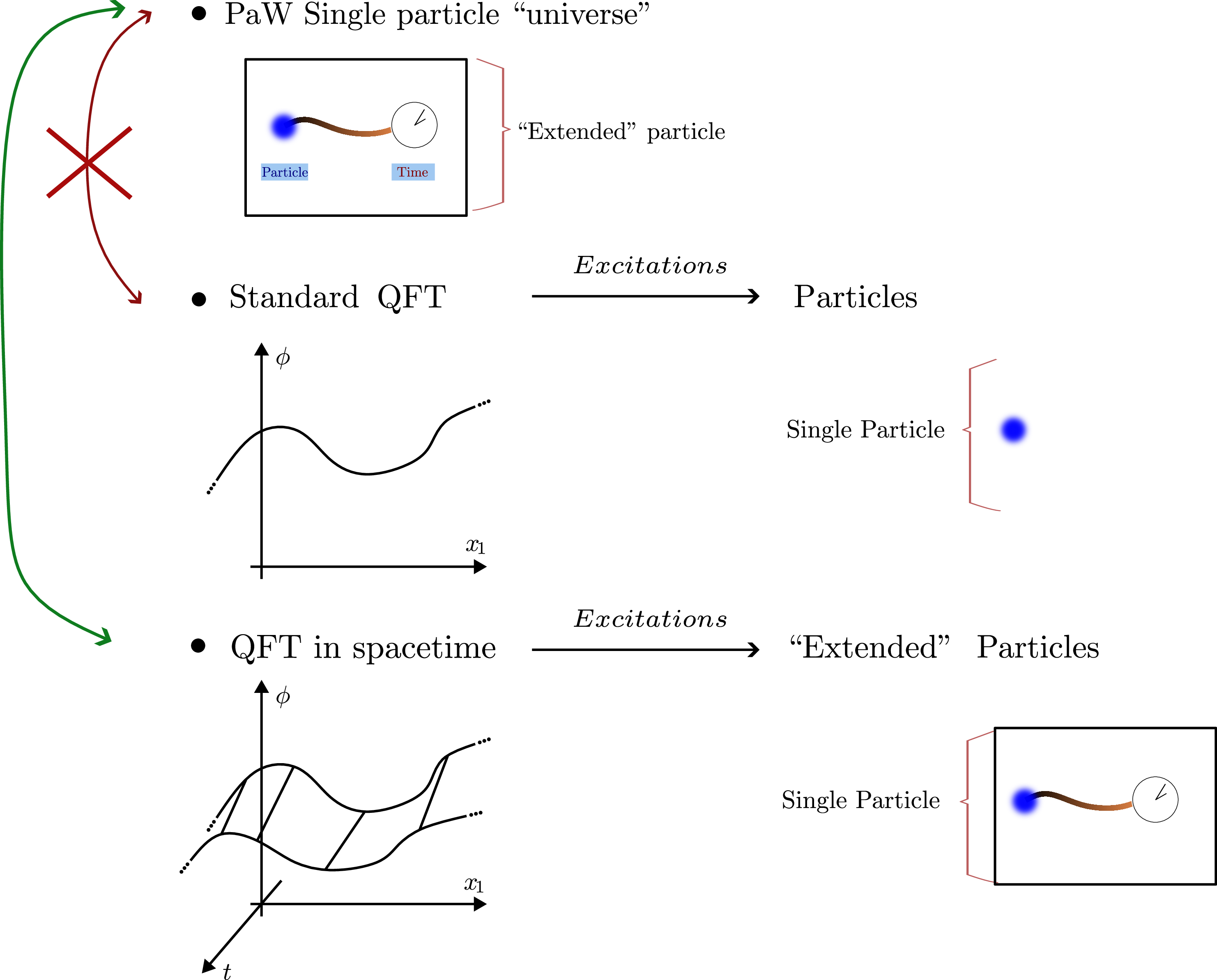
Figure 1: Scheme illustrating the QT scheme of a particle and its relation to standard QFT particles, highlighting the novelty in space and time treatment.
The manuscript proposes a new Fock space composed of QT particles, inherently leading to a symmetric treatment of space and time. In this extended second quantization, the spacetime algebra involves field operators admitting equal footing for space and time indices, contrary to standard QFT where equal-time commutators break this symmetry. A significant outcome is the introduction of a quantum action, operatorially equivalent to the classical action in phase space, which governs the dynamics of fields and inherently retains Lorentz invariance.
Limitations and No-Go Theorem
An exploration of naive extensions of QT to many-body systems reveals intrinsic limitations, primarily due to the lack of a consistent many-body scheme. The authors present a no-go theorem, showing that Dirac quantization of the spacetime classical mechanics (SCM) inevitably collapses back to standard QFT, obscuring explicit covariance. This arises from incompatible second-class constraints, necessitating a quantum action-based approach that preserves manifest symmetry.
Quantum-Action-Based Quantization
By recasting quantum mechanics in terms of the exponential of the action, the authors circumvent the issue of second-class constraints. This redefinition allows for a geometrically explicit treatment of time translations in the quantum setting and naturally aligns with the conditioning approach found in QT models. The result is a formulation where expectation values respect the symmetries and constraints of the theory, providing a robust foundation for both free and interacting QFTs.
Implications and Future Directions
This work significantly impacts our understanding of quantum mechanics' foundational framework, suggesting that manifest covariance in quantum theories might require rethinking the conventional state-based formalism. The potential relation to quantum computing paradigms, such as those involving SWAP operators, highlights the interdisciplinary nature of the approach. As quantum technology progresses, this formalism could inspire novel computational methods and provide profound insights into the nature of spacetime in quantum gravity contexts.
Conclusion
The pursuit of a fundamentally symmetric quantum field theory, respecting the dual nature of space and time, challenges existing paradigms and suggests a necessary shift towards quantum-action perspectives. This paper lays the groundwork for further exploration into quantum symmetries, promising advancements in both theoretical physics and practical computational frameworks.