- The paper formulates a QFT-based framework for time-of-arrival on a ring via POVM construction, integrating quantum temporal probabilities with detector physics.
- It employs a rigorous scalar field quantization in compact (1+1)-dimensional spacetime to reveal precise quantum clock behavior and the limits of semiclassical approximations.
- The study shows that rotational effects and entanglement induce measurable phase shifts and noise, impacting the accuracy and synchronization of relativistic quantum clocks.
Time-of-Arrival in Quantum Field Theory on a Ring: Relativistic Quantum Clocks and Non-Inertial Effects
The paper addresses the time-of-arrival (ToA) problem for relativistic particles confined to a ring geometry, introducing an operational framework based on Quantum Temporal Probabilities (QTP) within Quantum Field Theory (QFT). Unlike in unbounded geometries, where a particle reaches the detector once, the compact topology enables multiple attempts per revolution, necessitating a field-theoretic treatment of the detector interaction. The key construction is a suite of Positive-Operator-Valued Measures (POVMs) for ToA, derived from QFT correlation functions, fully incorporating detector physics and its influence on temporal measurement outcomes.
Central to the analysis is the separation between quantum mechanical time evolution and macroscopic time variables associated with measurements. The QTP formalism treats detection times as random variables and incorporates them as spacetime coordinates in the detector's worldline, contrasting older approaches where the measurement instant is fixed a priori.
Scalar Field Quantization and POVM Construction
The authors present a rigorous quantization procedure for scalar fields in a (1+1)-dimensional cylindrical spacetime, R×S1. The single-particle Hilbert space is L2(S1,rdφ); modes are labeled by discrete angular momentum m, and all detection probabilities are constructed as sums over these modes.
Detection probabilities depend on the field-detector coupling via a kernel function R(x), whose Fourier transform determines the absorption coefficient and localization operator. The latter encapsulates the position spread of the measurement outcome, with its Wigner-Weyl transform bounding localization and defining the irreducible uncertainty inherent to temporal measurement. For maximum localization, the detector kernel becomes exponential in momentum, and the POVM reduces to the Leon-Kijowski form for relativistic ToA on the line.
Periodicity, Quantum Clocks, and Temporal Regimes
The periodic nature of the detection signal in a ring provides a physical realization of a quantum clock. For ensembles of identically prepared particles, the ToA distribution exhibits sharp peaks corresponding to repeated passages, each defining a "tick" of the clock. The operation of the clock is directly tied to the quantum wavepacket structure, its periodicity determined by the ring radius and mean momentum.
The paper identifies two key time scales: the semiclassical regime governed by Tq, where the Gaussian approximation to wavepacket dynamics holds, and the recurrence time Trec, where quantum revivals appear due to the discrete spectrum (Figure 1).
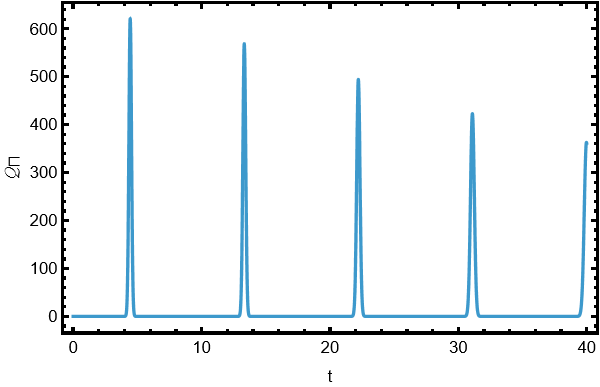
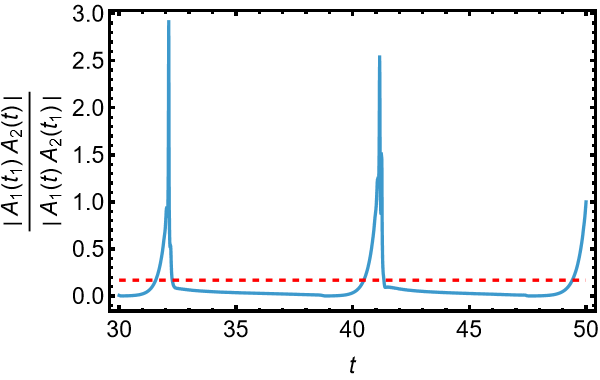
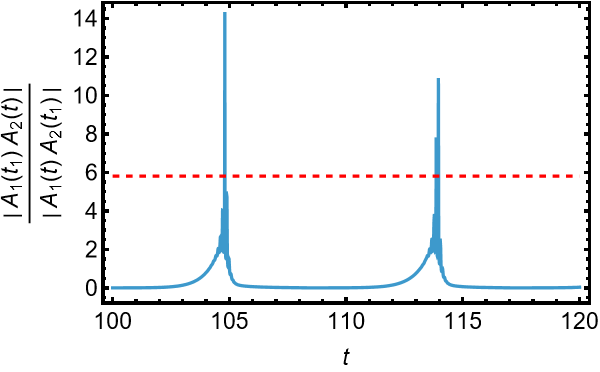
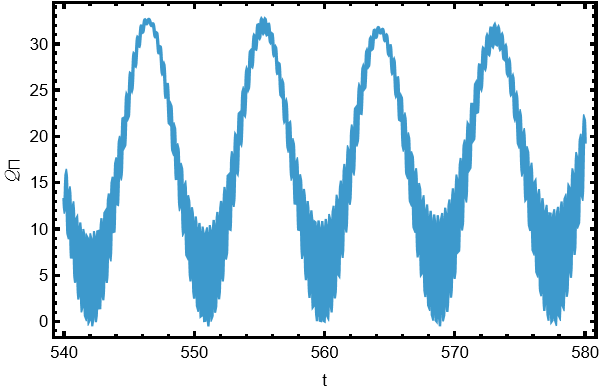
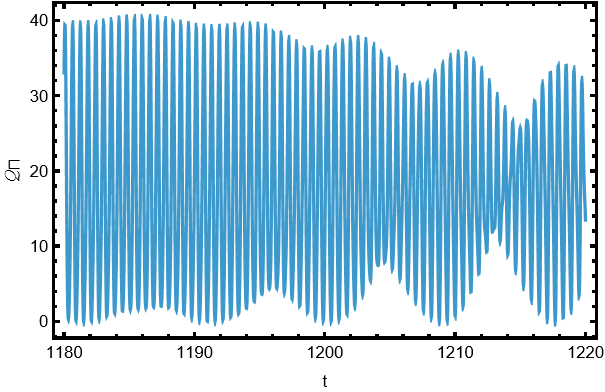
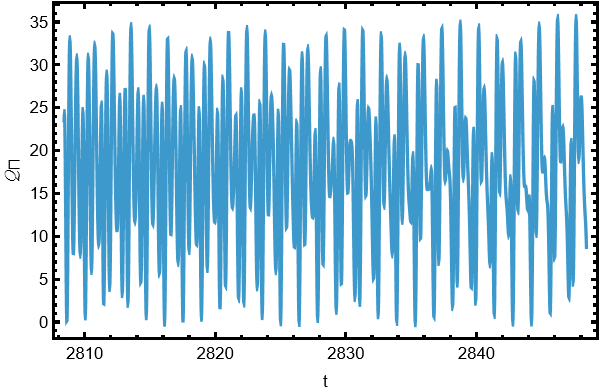
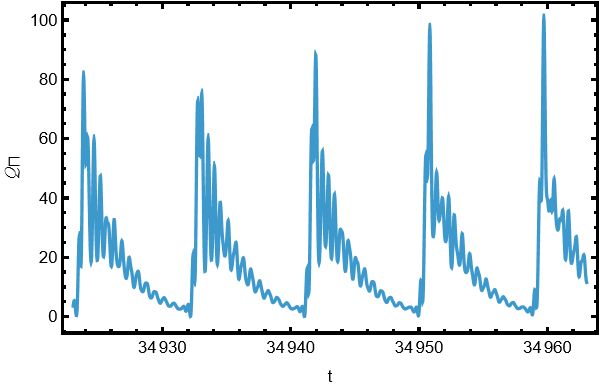
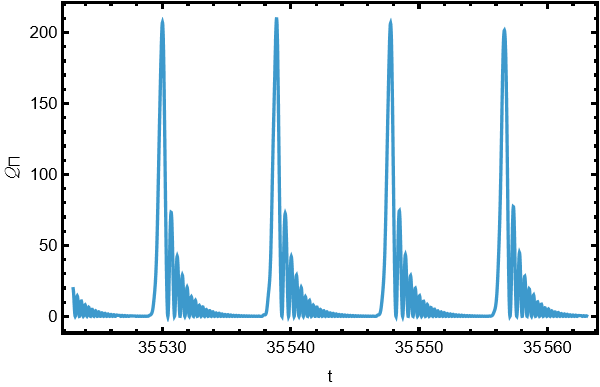
Figure 1: Semiclassical regime, t≃0.07Tq; coherent Q-symbol structure for ToA on a ring.
Beyond Tq, interference between winding number sectors leads to breakdown of the semiclassical approximation, and clock accuracy degrades rapidly. For massless fields and maximal localization, the tick intervals remain unaffected by dispersion, maximizing clock accuracy across intervals. For massive fields, the spread increases with time, setting practical limits for quantum timekeeping.
Rotational Effects and the Rotational Unruh Phenomenon
The work extends ToA formalism to rings rotating at angular velocity ΩD. In the rotating frame, the mode energies shift by mΩD, affecting both detection signal and background noise. The rotational Unruh effect manifests as an increase in vacuum-induced detection noise, quantified by
L2(S1,rdφ)0
with divergence as L2(S1,rdφ)1 (Figure 2).
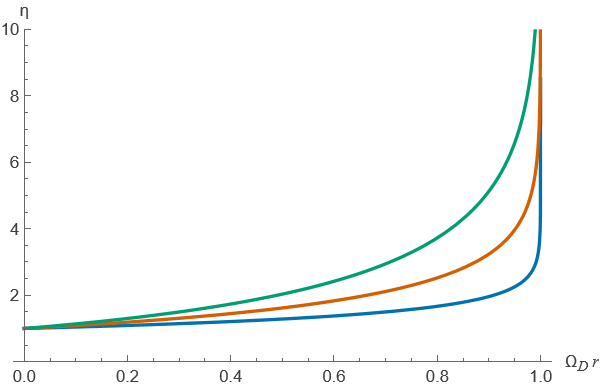
Figure 2: Normalized rotation-induced noise L2(S1,rdφ)2 as a function of L2(S1,rdφ)3 and detector localization parameter L2(S1,rdφ)4.
Clock signals experience rotational phase shifts analogous to the quantum Sagnac effect, producing interference between oppositely propagating modes, detectable in the periodic structure of ToA distributions.
Multi-time Measurements and Entanglement-Induced Temporal Correlations
The paper analyzes joint ToA statistics for multiple detectors and multi-particle states. The QTP formalism enables computation of joint probabilities involving L2(S1,rdφ)5 detectors, where each detection event can be localized independently, and correlations are encoded in L2(S1,rdφ)6-particle density matrices and high-order field correlation functions.
Violation of measurement independence—akin to classical locality constraints—appears for superpositions and entangled states, particularly in the massive case. The analysis shows that, for combined coherent and orthogonal states, both Jensen and Cauchy-Schwarz inequalities for measurement independence are violated for specific parameter ranges, evidencing non-classical temporal correlations (Figure 3).
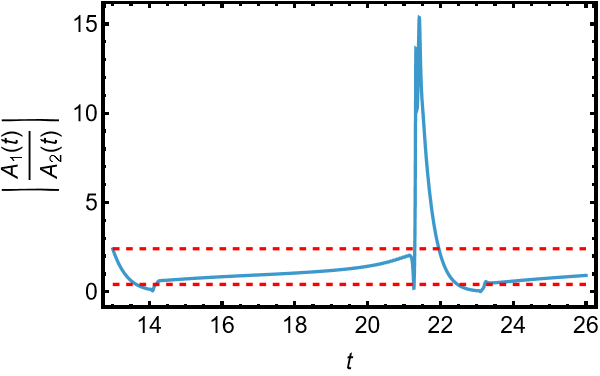
Figure 3: Violation of measurement independence for massive particles with superposed momenta and detection times.
Such violations have implications for quantum clock synchronization and relativistic quantum information, indicating that entanglement and superposition fundamentally alter temporal correlations in operationally defined clocks.
Implications and Future Directions
The explicit derivation of ToA POVMs from QFT for ring geometries demonstrates the capacity for operationally precise relativistic quantum clock modeling. Practical implications include:
- Quantum metrology: The construction enables proposal and analysis of quantum clocks sensitive to spacetime structure, useful in relativistic and gravitational settings.
- Rotating frame detection: The ring topology and rotational regime allow detailed investigation of non-inertial QFT effects, including rotational Unruh noise and quantum Sagnac phases.
- Quantum information in QFT: Multi-time measurement schemes clarify the impact of entanglement and correlations on clock readings, a gateway to relativistic quantum communication and synchronization.
Theoretically, the results provide a benchmark for compact QFT measurement theory, with extension avenues toward curved spacetimes, strong gravity, and generalized clock models. The paper establishes the ring as a minimal, analytically tractable laboratory for studying QFT-based clocks, measurement-induced correlations, and non-inertial quantum phenomena.
Conclusion
This work formulates a comprehensive QFT-based solution to the ToA problem for relativistic particles on a ring, synthesizing operational quantum measurement theory, explicit POVM construction, and analytic and numerical exploration of periodic detection signals and rotational effects. The resulting quantum clock model provides an ideal testbed for probing the local structure of spacetime and the effects of quantum coherence, entanglement, and non-inertial motion. Future research may extend these methods to curved backgrounds, more complex detector models, and interrogate the operational boundaries of quantum timekeeping in the relativistic regime.