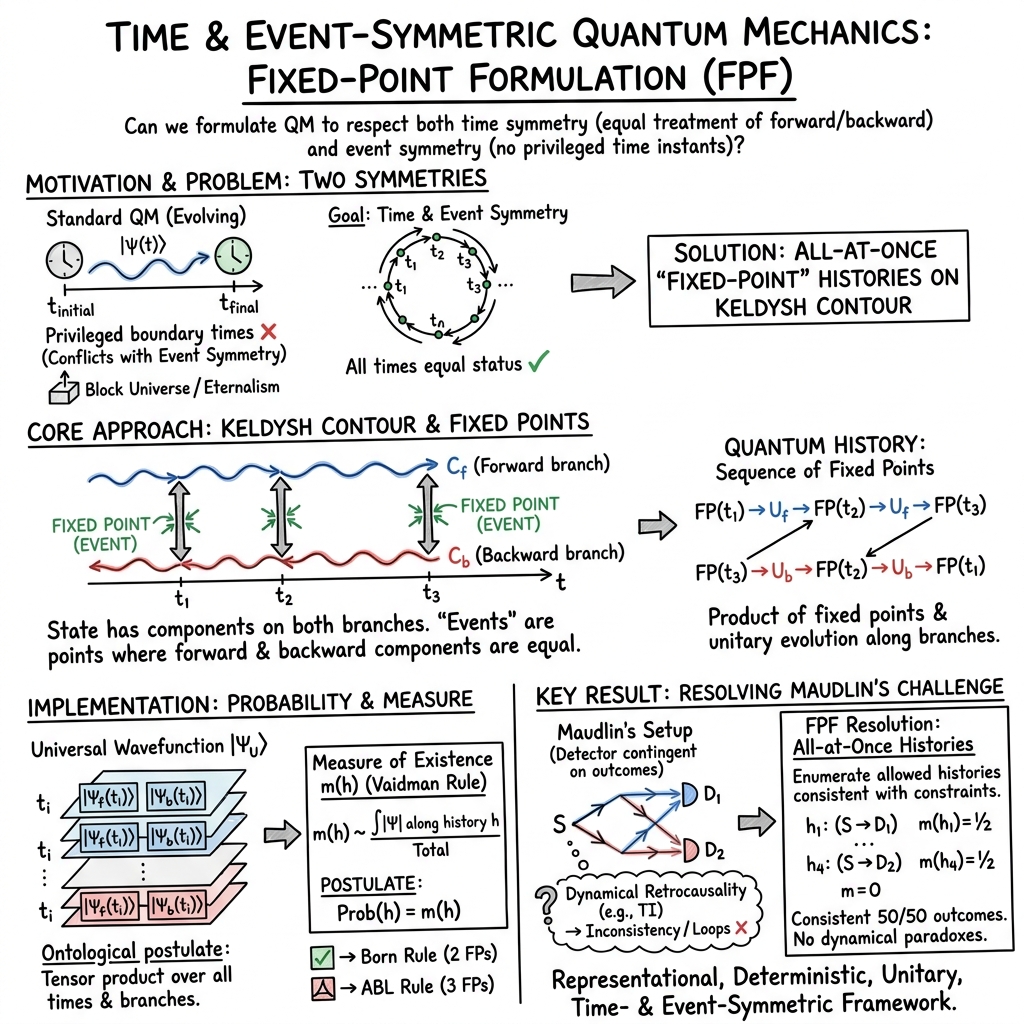
- The paper introduces a novel Fixed-Point Formulation that integrates event symmetry into quantum theories.
- It critiques traditional time-symmetric models by highlighting limitations in addressing retrocausality and causal loops.
- The proposed framework offers a deterministic view of quantum histories and opens up new avenues for unification with quantum gravity.
Time and Event Symmetry in Quantum Mechanics
Introduction
The paper "Time and Event Symmetry in Quantum Mechanics" (2312.13524) addresses the nuanced distinctions between temporal symmetries in quantum mechanics, specifically distinguishing between time symmetry, which considers equivalent opposite time orientations, and event symmetry, which holds all temporal instances equivalent in the context of a sequence of events. The authors argue that standard time-symmetric interpretations fail to incorporate event symmetry, which has significant implications for the foundational concepts in quantum mechanics.
Temporal Symmetries and Their Challenges
In quantum mechanics, time is typically treated as a monotonically increasing parameter, aligning more closely with observer experiences rather than relativistic eternalist views. This discrepancy has led to an ongoing focus on time symmetry, which considers directional equivalence of temporal evolution. The paper, however, spotlights the underexplored event symmetry—a principle suggesting no ontologically preferred moment of time, drawing heavily from the geometrical spacetime paradigms of relativity which imply no absolute temporal ordering for distributed events.
Time-Symmetric Approaches in Quantum Mechanics
The paper highlights historical and recent advancements in time-symmetric quantum mechanics:
- Two-State Vector Formalism (TSVF): Initially proposed to describe quantum measurements using bidirectional time evolution, incorporating both retrodictive and predictive elements.
- Keldysh Formalism: Emerging in the arena of quantum statistical mechanics, employing dual time propagation for nonequilibrium systems.
Both frameworks have contributed significantly to theoretical constructs like weak measurement theory and quantum transport but face conceptual challenges when considered as representations rather than mere calculational aids.
Event Symmetry in Quantum Models
The authors critically evaluate existing frameworks, noting their failure to embody event symmetry authentically. They propose an innovative approach using a Fixed-Point Formulation (FPF) on a Keldysh contour, advocating for a model where quantum histories are constructed without preferential initial or final states.
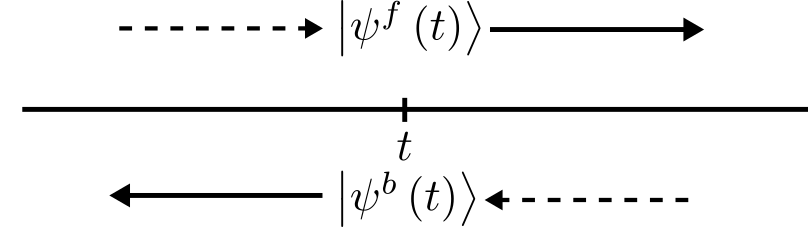
Figure 1: A single fixed point on the Keldysh contour.
In this proposed framework:
- Fixed Points: Serve as events with no preferential time, mediating between forward and backward states.
- Quantum Histories: Constructed as sequences of such fixed points, reflecting an atemporal view akin to Everett’s many-worlds interpretation.
This reformulation aims to resolve conceptual paradoxes in time-symmetric interpretations by offering a symmetrical and deterministic model inherently free from temporal bias.
Addressing Maudlin's Challenge
Maudlin’s critique of retrocausal models, especially the transactional interpretation's susceptibility to causal loops, is addressed with the FPF framework. By viewing fixed points as constraints rather than dynamic causal sequences, the FPF intuitively satisfies Maudlin’s requirements without succumbing to classical inconsistencies.
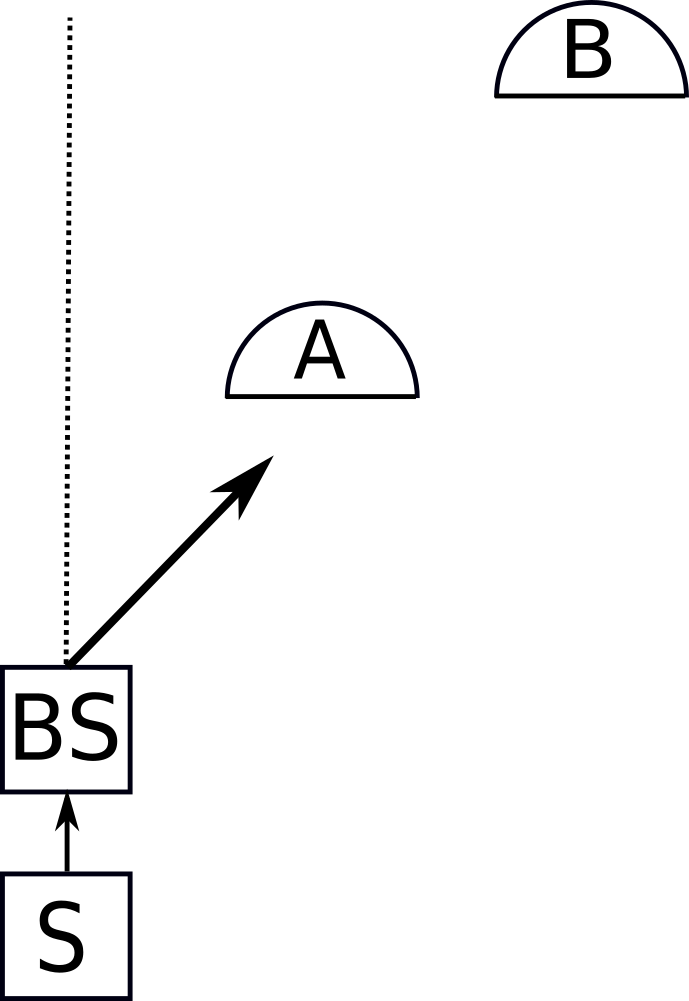
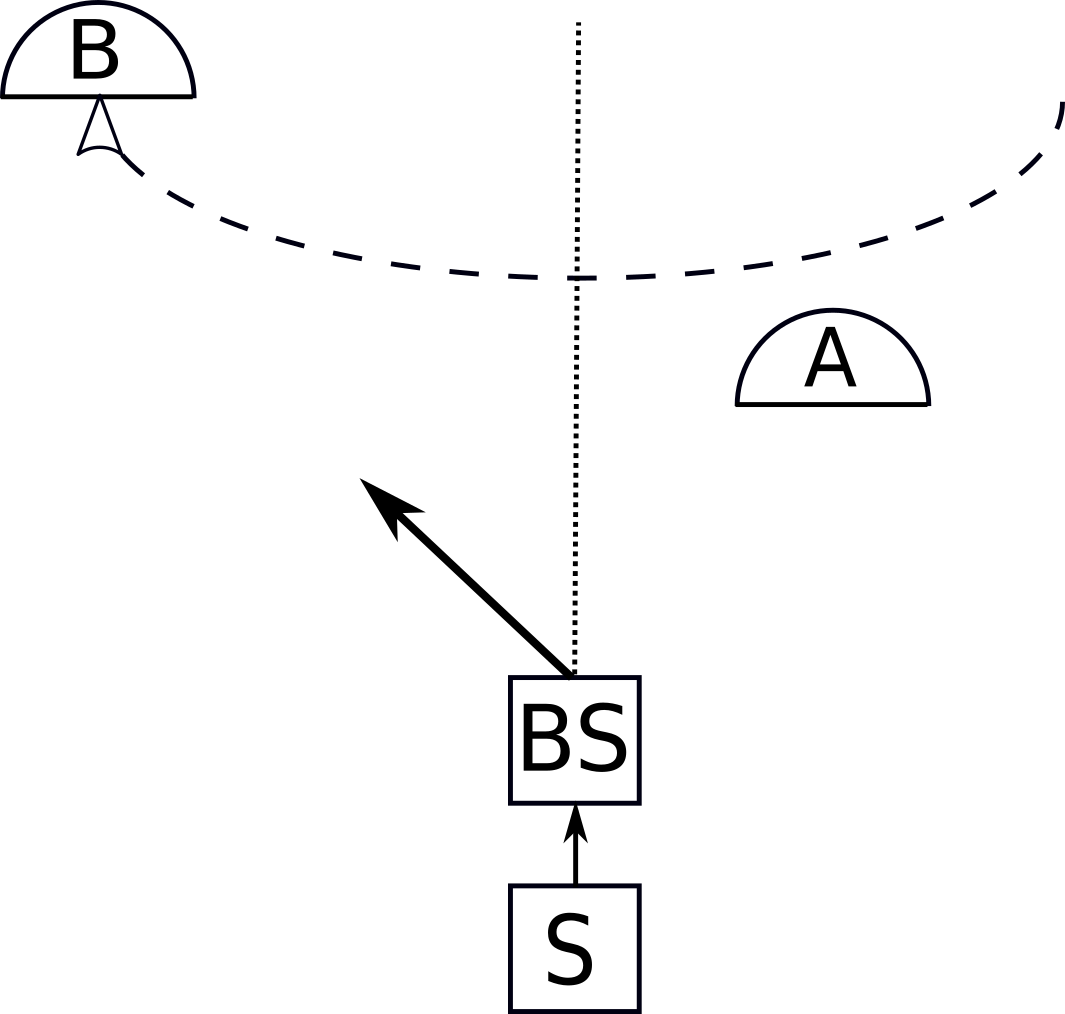
Figure 2: Schematic of the setup in Maudlin's challenge.
Event Symmetry: Implications and Future Directions
By integrating event symmetry, the research provides a path to reconcile quantum mechanics with an event-based ontological perspective, suggesting potential implications for theories involving unification and quantum gravity. Future work may extend these principles to covariant models, exploring further unification prospects.
Conclusion
The exploration of event symmetry in this paper marks a pivotal endeavor to deepen our grasp of quantum mechanics’ temporal foundations. Integrating both time and event symmetries within a holistic framework fosters a richer, more consistent interpretation of quantum phenomena, offering fresh insights into longstanding debates and paving the way for novel theoretical advancements in quantum theory.