Keep it SymPL: Symbolic Projective Layout for Allocentric Spatial Reasoning in Vision-Language Models
Abstract: Perspective-aware spatial reasoning involves understanding spatial relationships from specific viewpoints-either egocentric (observer-centered) or allocentric (object-centered). While vision-LLMs (VLMs) perform well in egocentric settings, their performance deteriorates when reasoning from allocentric viewpoints, where spatial relations must be inferred from the perspective of objects within the scene. In this study, we address this underexplored challenge by introducing Symbolic Projective Layout (SymPL), a framework that reformulates allocentric reasoning into symbolic-layout forms that VLMs inherently handle well. By leveraging four key factors-projection, abstraction, bipartition, and localization-SymPL converts allocentric questions into structured symbolic-layout representations. Extensive experiments demonstrate that this reformulation substantially improves performance in both allocentric and egocentric tasks, enhances robustness under visual illusions and multi-view scenarios, and that each component contributes critically to these gains. These results show that SymPL provides an effective and principled approach for addressing complex perspective-aware spatial reasoning.

Paper Prompts
Sign up for free to create and run prompts on this paper using GPT-5.
Top Community Prompts
Explain it Like I'm 14
What this paper is about
This paper explains “SymPL,” a way to help AI systems that look at pictures and read text (called vision–LLMs, or VLMs) understand where things are in space. SymPL stands for Symbolic Projective Layout. The main idea is simple: instead of making the AI reason directly on busy, real photos, the system first turns a scene into a clean, easy-to-read diagram made of dots and colored regions, drawn from a helpful viewpoint. This makes spatial questions like “Is the dog to the left of the cat from the woman’s point of view?” much easier for the AI to answer.
Two important words:
- Egocentric: from someone’s personal viewpoint (like “from my eyes”).
- Allocentric: map-like, from an outside, fixed viewpoint (like a floor plan).
SymPL is designed especially to improve allocentric spatial reasoning, which many AIs find hard.
What questions the researchers asked
They wanted to know:
- Can we make VLMs better at understanding where objects are, especially from different viewpoints?
- Which simple steps help the most: choosing a good viewpoint (“projection”), simplifying objects into symbols (“abstraction”), splitting space into clear parts (“bipartition”), and color-coding regions to locate objects (“localization”)?
- Do these steps work across different AI models and in tricky cases, like visual illusions or multiple camera views of the same scene?
How they did it
First, here’s what a VLM is: a model that can “see” images and “talk” about them. VLMs are good with words and pictures but often struggle with “left/right,” “in front/behind,” or “who can see what” when the scene is complex.
SymPL is a pipeline with practical steps:
1) Finding the right objects in the image
- The system uses an object detector to draw rectangles (bounding boxes) around possible matches, not just the single most confident one. It keeps the top 5 candidates and slightly enlarges each box to include a bit of context.
- It then asks the VLM to pick which cropped picture best matches the named object (for example, the “dog”). This “second opinion” often avoids picking the wrong thing.
Think of it like circling the top 5 “dogs” in a picture, then asking a friend to point to the best one.
2) Estimating where objects are in 3D
- A depth predictor estimates how far each pixel is from the camera, like a distance map.
- Using the bounding box and the depth map, the system converts pixels into 3D points (this is called “unprojecting,” like turning a flat photo back into a rough 3D shape).
- It groups depth values into bins (like sorting marbles by size) and picks the most common bin to avoid outliers, then takes the median as the object’s distance.
- If the camera settings are off, the depth axis (z) can be stretched or squashed. They detect this and adjust the z-values so the 3D positions are more balanced.
3) Turning the scene into a simple diagram
This is the heart of SymPL and includes four key ingredients:
- Projection: pick the best viewpoint to show the relation clearly. Example: to judge left/right, a top-down or side view that separates left vs. right clearly is best. To judge above/below, a front view is better.
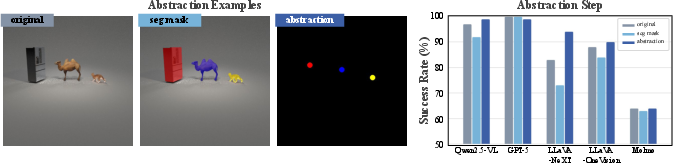
- Abstraction: replace photos of objects with simple symbols (like colored dots and arrows). This removes distracting textures and lighting so the model focuses on where things are, not what they look like.
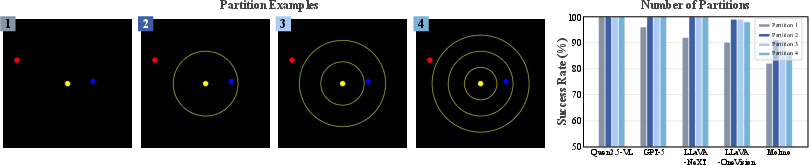
- Bipartition: split the space into two large regions that match the question (left vs. right, near vs. far, visible vs. not, etc.). This gives the model a clean “either/or” choice.
- Localization: color-code the regions (for example, yellow vs. black) and ask the model: “Which dot is in the yellow area?” or “Is the blue dot in yellow or black?”
These diagrams act like clear, step-by-step math problems instead of messy word problems.
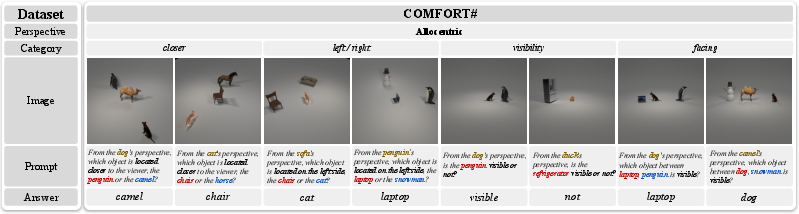
4) Datasets and tests
They tested SymPL on both simulated and real-image datasets that ask spatial questions. The datasets cover:
- Left vs. right, above vs. below
- Closer vs. farther
- Front vs. behind
- Visibility (can X see Y?)
- Facing (which way is someone looking?)
They also built special sets:
- Visual illusions (where a farther object is drawn larger to trick your eyes)
- Multi-view scenes (same scene from many camera angles) to test if answers stay consistent.
They used several well-known VLMs (like Qwen2.5-VL, LLaVA variants, Molmo, and GPT-5) and ran careful comparisons to see which SymPL steps helped most.
What they found and why it matters
Here are the main results, explained simply:
- Picking the right viewpoint helps a lot. Performance improves when the camera is positioned so the relation you care about is easiest to see. For example, for above/below, facing the objects from the front works best; for left/right, a top or side view works best.
- Abstraction beats raw photos. Replacing objects with simple dots often improves accuracy, because the AI pays attention to positions, not distracting details.
- Splitting the space helps. Dividing the image into two regions (like left vs. right) makes decisions clearer for the model. Two or three partitions worked best; too many can start to confuse things.
- Keep localization simple. When asking “Which region is the dot in?” using fewer colored regions is better. More colors make it harder.
- Combining all four steps is the winner. When they applied projection, abstraction, bipartition, and localization together, accuracy rose dramatically and often reached near-perfect results on the symbolic layouts.
- Works across different models. The gains weren’t tied to just one VLM; other models also improved significantly.
- Handles tricky cases. SymPL improved reasoning in visual illusion scenes and made answers more consistent across different camera views of the same scene.
In short: clear diagrams + the right viewpoint + simple choices = much better spatial understanding.
What this means going forward
SymPL shows that many spatial “failures” in today’s AIs aren’t because they can never reason about space, but because the input is noisy and the question is presented in a confusing way. By:
- choosing a helpful viewpoint,
- simplifying visuals into symbols,
- splitting space into clear halves,
- and asking clean, targeted questions,
we can make VLMs much more reliable at spatial tasks.
This matters for:
- Robots and drones that must navigate and manipulate objects safely,
- Augmented reality apps that need to understand where things are,
- Assistive tools that describe scenes to users,
- Any system that must answer “where” and “who sees what” questions correctly.
The big takeaway: sometimes, the smartest move is to clean up the problem first. Turning complex scenes into simple, symbolic diagrams can unlock strong spatial reasoning in AI—today, with the models we already have.
Knowledge Gaps
Knowledge gaps, limitations, and open questions
Below is a single, concrete list of what remains missing, uncertain, or unexplored in the paper’s approach, datasets, and evaluations. Each point is phrased to guide actionable future work.
- Depth and intrinsics reliability: The pipeline hinges on monocular depth and predicted intrinsics from DepthPro; the accuracy, bias, and failure modes across camera types, FOVs, and scene categories are not quantified, nor is their impact on downstream spatial decisions.
- Heuristic z-axis correction: The ad hoc z-scaling fix (threshold=10, global scaling factor) is unvalidated—no sensitivity analysis, ablations on the threshold/scale choice, or assessment of when it helps vs. harms (e.g., wide-angle lenses, thin structures, sloped terrains).
- Object orientation estimation: “Facing” relations require object/viewer orientation, but the method for estimating orientations in real images is not described (despite citing Orient Anything). How orientations are derived and how errors affect “facing” predictions remain open.
- Visibility/occlusion modeling: The symbolic layouts reduce objects to dots, discarding size and shape. How occlusions and visibility are computed from 3D data (and how dot abstraction encodes occluders) is unspecified, leaving uncertainty about handling partial occlusions or large occluders.
- Error propagation across stages: There is no end-to-end analysis of how detection errors, depth noise, intrinsic misestimation, and category/perspective misclassification jointly affect final answers.
- Detection step robustness: The GroundingDINO+VLM crop selection (top-n=5, margin=30) is heuristic. There is no evaluation of detection recall/precision, sensitivity to n and margin, or coverage when scenes have >5 candidate instances, heavy clutter, or fine-grained categories (e.g., “person wearing a hat”).
- Depth filtering choices: The 20-bin histogram, bin mode selection, and 0.12 ratio filtering lack justification and sensitivity studies; robustness to multi-modal depth distributions, thin/sparse masks, and reflective/transparent surfaces is unknown.
- Viewpoint projection policy: While ablations show certain viewpoints help (orthogonal to the relation plane), the operational rule used at inference (how the projection is chosen per relation, how mixed or compound relations are handled) is not fully specified or compared to alternatives.
- Real-world generalization: Most strong gains are shown on synthetic Blender scenes; the breadth and difficulty of real-world evaluation is limited (subsets of 3DSRBench and COCOSPATIAL), leaving questions about performance in cluttered, occlusion-heavy, and long-tail real imagery.
- Multi-view consistency results: COMFORT Multi is introduced to test cross-view consistency, but quantitative results, consistency metrics, and error analyses are absent.
- Illusion scenarios: COMFORT VI uses size–distance illusions with spheres; there is no evidence that SymPL handles broader classes of visual illusions (e.g., texture-, lighting-, or context-induced illusions) or complex object geometries.
- Category mapping validity: 3DSRBench’s “front/behind” was relabeled to “visible/not,” but the semantic equivalence and annotation validity of this remapping are not validated by human studies or alternative ground-truths.
- Egocentric vs. allocentric alignment: It is unclear how reliably the system transforms coordinates into the reference viewer’s frame across datasets, especially when the reference is the camera vs. an object, or when language cues are ambiguous.
- Reference perspective extraction: The “Reference Viewer Selection” step’s accuracy is not reported; handling of pronouns, coreference, nested clauses, and ambiguous perspective cues remains untested.
- Category determination step: Forcing categories via options (“visibility / left_right / facing / closer / above_below / front_behind”) may bias performance; robustness to broader linguistic expressions (e.g., “nearer,” “to the port side,” “diagonally ahead”) is not evaluated.
- Symbolic layout bias: Setting 5 reaches 100%, suggesting the task may become trivial pattern matching. There is no control for lexical/color biases (e.g., swapping color labels, randomizing palette, grayscale/texture encodings), nor adversarial symbolic layouts to ensure genuine spatial reasoning.
- Partition and color encoding: Results depend on color-coded bipartitions; generalization to different visual encodings (texture/hatching/shape cues), color-blind-friendly schemes, or grayscale images is not tested.
- Scaling with object count: Experiments focus on 2–3 objects; it is unknown how symbolic layouts and the pipeline scale to scenes with many objects, multiple identical instances, and multi-hop relations (“A left of B and closer than C”).
- Richer spatial relations: Only a small set of relations (left/right, above/below, closer, front/behind, visibility, facing) is covered; topological (“inside,” “touching”), angular (“at ~45°”), metric (“within 0.5 m”), and relational compositions remain unexplored.
- Compound and chained queries: The pipeline’s handling of multi-clause or compositional questions (“Which cup is left of the plate that is in front of the vase?”) is not demonstrated.
- Robustness to language variance: Performance under paraphrases, long prompts, or noisy user inputs (typos, synonyms, multilingual queries) is not reported.
- Calibration and units: Claims of metric depth are made, but no calibration checks, unit consistency tests, or cross-camera validation are provided to ensure “closer” is reliably computed in metric terms.
- Runtime and resource costs: There is no analysis of computational overhead and latency for running GroundingDINO, DepthPro, multiple VLM calls, and symbolic rendering, nor comparisons to alternative pipelines.
- Fairness of detector–reasoner coupling: Using the same or similar VLM family for detection disambiguation and reasoning may entangle errors/priors; baselines isolating detector-only or non-VLM-assisted detection are not reported.
- Determinism and reproducibility: Some ablations were run on different GPU models; possible nondeterminism, seeds, and variance across hardware are not quantified, and it is unclear whether code/datasets will be released for replication.
- COCOSPATIAL reformulation: The conversion to egocentric left/right and above/below using 2D boxes sidesteps perspective and depth; how these 2D heuristics align with the proposed 3D symbolic approach is not clarified.
- Failure case analysis: The paper lacks qualitative/quantitative analyses of typical failure modes (e.g., small/overlapping objects, strong occlusions, reflective surfaces, crowded scenes), making it hard to target future improvements.
Practical Applications
Based on the SymPL framework’s findings and methods—symbolic projective layout, viewpoint selection (projection), object abstraction, bipartition/localization cues, and a stepwise prompting pipeline that is model-agnostic—below are practical applications that translate directly to real-world workflows or can inform longer-term productization.
Immediate Applications
The following can be deployed today by integrating SymPL as a preprocessing/postprocessing module around existing VLMs and off-the-shelf perception tools (e.g., GroundingDINO, DepthPro).
- VLM-powered spatial QA that “just works” on relative positions
- Sector: software/AI, accessibility, education
- Use case: Improve image question-answering for queries like “Is the cup left of the laptop from the child’s perspective?” by converting to a symbolic 2D layout with colored partitions, then asking a simplified question that VLMs answer reliably.
- Tools/workflow: GroundingDINO (top-n crop + VLM selection), DepthPro for rough 3D, SymPL prompts (entity extraction, perspective selection, category determination), symbolic canvas generation.
- Assumptions/dependencies: Monocular depth and intrinsics estimates are approximate; performance degrades with severe occlusion, clutter, or missed detections; latency depends on VLM and detectors.
- Image search and tagging with spatial-relation filters
- Sector: media/search, e-commerce
- Use case: Auto-tag and retrieve images with attributes like “dog left of couch,” “person facing camera,” or “object A visible to viewer B.”
- Tools/workflow: Batch-run SymPL to annotate left/right, above/below, facing, visibility across photos; store tags for retrieval.
- Assumptions/dependencies: Requires consistent detection of object categories; open-vocabulary detection may hallucinate rare classes.
- Assembly/production line layout checks
- Sector: manufacturing/quality control
- Use case: Verify simple relational constraints (e.g., gasket to the left of valve; label facing outward; indicator visible) with camera snapshots.
- Tools/workflow: SymPL pipeline runs on inspection frames; rules engine flags violations based on allocentric relations.
- Assumptions/dependencies: Lighting and reflections can affect detection; DepthPro scale errors mitigated by z-axis correction but not fully metric.
- AR and mobile assistive prompts for spatial queries
- Sector: AR/VR, accessibility
- Use case: Phone-based assistant answers “Is the red folder behind the monitor from my colleague’s perspective?” for low-vision users or office tasks.
- Tools/workflow: On-device or edge inference with SymPL; prompt templates embedded into app logic.
- Assumptions/dependencies: Real-time performance may need model distillation or smaller VLMs; moving objects reduce reliability.
- Security/surveillance snapshot reasoning
- Sector: security, facilities management
- Use case: Answer “Is the person facing the exit?” or “Is the backpack behind the pillar from the guard’s perspective?” on still frames or sampled video.
- Tools/workflow: SymPL applied to keyframes; alerting based on visibility and facing categories.
- Assumptions/dependencies: Orientation estimates are coarse without explicit pose models; frequent re-detection needed in dynamic scenes.
- Fast, lightweight scene graphs from single images
- Sector: analytics, content understanding
- Use case: Extract relational edges (left/right, above/below, facing/visible) for downstream analytics or captioning.
- Tools/workflow: Use SymPL’s symbolic layout to produce relation triples for scene graphs.
- Assumptions/dependencies: Not metric-accurate; best for coarse relational graphs, not precise CAD.
- Benchmarking and internal eval of spatial reasoning
- Sector: academia, AI product QA
- Use case: Adopt COMFORT#, COMFORT VI, COMFORT Multi protocols to measure allocentric and multi-view consistency; integrate with VLMEvalKit.
- Tools/workflow: Run-house models through published pipelines; track gains from abstraction, bipartition, and viewpoint choices.
- Assumptions/dependencies: Synthetic benchmarks may not cover all real-world edge cases; complement with in-domain data.
- Rendering and UI guidance using viewpoint principles
- Sector: visualization/graphics, UX
- Use case: Render product or CAD scenes from the viewpoint orthogonal to the relation plane (e.g., top view for left/right) to clarify spatial relations.
- Tools/workflow: Apply SymPL’s projection insight to camera placement heuristics in UIs and documentation.
- Assumptions/dependencies: Requires access to scene/camera controls; mostly beneficial for clarity, not automation.
Long-Term Applications
These opportunities benefit from further research, robust 3D perception, temporal consistency, and tighter integration with embodied systems.
- Embodied agents with robust allocentric reasoning
- Sector: robotics, multi-agent systems
- Use case: Robots follow human instructions with third-person references (“place the blue bin to the left of the red cart from the supervisor’s viewpoint”) and maintain cross-view consistency.
- Tools/workflow: Replace monocular depth with SLAM/multi-view depth; fuse symbolic layout with a scene graph memory.
- Assumptions/dependencies: Requires reliable tracking across time, better pose/orientation estimation, and low-latency pipelines.
- Autonomous driving scene understanding beyond ego-frames
- Sector: transportation/autonomy
- Use case: Reason about “car A left of car B from pedestrian’s viewpoint,” “pedestrian facing traffic,” or “object visible from crossing guard’s position.”
- Tools/workflow: Multi-sensor fusion, real-time symbolic overlays; consistency checks with map priors.
- Assumptions/dependencies: Must handle dynamic actors at high FPS; monocular-only approach insufficient; safety-critical validation needed.
- Social HRI (human-robot interaction) with facing/visibility awareness
- Sector: service robots, retail, hospitality
- Use case: Robots infer which human an agent is facing, whether an item is visible to a user, and align instructions with the human’s frame of reference.
- Tools/workflow: Couple SymPL reasoning with human pose estimation and gaze/heading models.
- Assumptions/dependencies: Accurate and privacy-preserving human orientation sensing; robust disambiguation in crowds.
- AR navigation with egocentric–allocentric conversion
- Sector: AR/VR, mapping
- Use case: Convert user-spoken directions into overlays that remain consistent across viewpoints and devices (“the exit is to the left of the fountain from the concierge’s perspective”).
- Tools/workflow: Persistent 3D maps; cross-device registration; SymPL-based symbolic constraints for UI.
- Assumptions/dependencies: Requires reliable localization and shared frames across users/environments.
- Scalable 3D scene graph construction and memory
- Sector: software/AI infrastructure
- Use case: Build long-term, object-centric scene memories with symbolic relations (left/right/behind/facing/visible) to support reasoning and retrieval.
- Tools/workflow: Integrate SymPL’s symbolic layouts with learned 3D representations (e.g., NeRFs, TSDFs).
- Assumptions/dependencies: Needs persistent IDs across sessions; uncertain relations must be modeled probabilistically.
- Formal verification layers for robotic task safety
- Sector: industrial robotics, safety
- Use case: Before executing motions, verify “no object in front of gripper,” “target visible from tool camera,” or “label facing outward,” using a symbolic check.
- Tools/workflow: Couple motion planning with a SymPL-style symbolic certifier.
- Assumptions/dependencies: Must ensure certifier accuracy in clutter; integrate with tactile/3D sensors for fail-safes.
- OR logistics and instrument layout checks
- Sector: healthcare
- Use case: Confirm relative placement and visibility of instruments and supplies from nurse/surgeon vantage points.
- Tools/workflow: Sterile-room-compatible cameras; privacy-safe on-prem inference; symbolic-checklists.
- Assumptions/dependencies: High precision and reliability; clinical validation and regulatory approval required.
- Infrastructure inspection via drones
- Sector: energy/utilities
- Use case: Verify “valve A behind pump B relative to pipeline C,” or check orientation of gauges from specified vantage points.
- Tools/workflow: Drone imagery + SymPL symbolic checks; multi-view capture for robustness.
- Assumptions/dependencies: Requires precise georegistration and multi-view reasoning; environmental variability (glare, weather).
- Standards and policy for spatial reasoning evaluation
- Sector: policy, procurement, standards bodies
- Use case: Define minimum spatial reasoning capabilities (allocentric consistency, perspective-taking) in AI procurement specs; adopt standardized tests (e.g., COMFORT Multi).
- Tools/workflow: Publish open benchmarks and protocols; certify model performance via symbolic-layout tests.
- Assumptions/dependencies: Community consensus on tasks/metrics; updates for evolving model capabilities.
Cross-cutting note: SymPL demonstrated model-agnostic gains (e.g., with Qwen2.5-VL and GPT-5). In practice, teams can wrap current VLMs with SymPL’s five-step prompting and symbolic-canvas generation to immediately improve spatial reasoning, while planning upgrades (sensor fusion, real-time constraints, robust 3D) for long-term deployments.
Glossary
- Abstraction: Representing objects with simplified symbols to reduce visual complexity and focus on spatial relations. "we observed that, for most models, the reasoning performance on abstraction images tended to be higher."
- Ablation study: An experimental analysis where components are systematically added or removed to measure their impact on performance. "The qualitative results of the ablation study for the closer category."
- Allocentric spatial reasoning: Reasoning about spatial relationships in a scene independent of the observer’s viewpoint. "We evaluated spatial reasoning abilities, including allocentric spatial reasoning, using five processed datasets: COMFORT#, 3DSRBench, COCOSPATIAL, COMFORT VI, and COMFORT Multi."
- Azimuth: The horizontal angle around a vertical axis in spherical coordinates, used to specify camera/viewpoint rotation around the scene. "varying the camera azimuth by and the polar angle by "
- Bipartition: Dividing an image or space into two regions to provide structure that aids spatial reasoning. "Following the ablation conducted in the bipartition step, we further analyzed how the number of color-coded regions affected reasoning performance on the localization question"
- Blender-based simulation environment: A synthetic data generation setup built with the Blender graphics software to render controlled 3D scenes. "We built the dataset in a Blender-based simulation environment"
- Bounding box: A rectangular region that encloses an object in an image, used for detection and cropping. "we expanded the bounding box by a fixed in all directions before cropping the image."
- Depth map: An image where each pixel encodes the distance from the camera to the scene point, used to infer 3D structure. "we used the bounding box from GroundingDINO and the depth map predicted by DepthPro~\cite{fm_depthpro}."
- DepthPro: A monocular depth estimation method used to predict depth maps and camera intrinsics. "we used the bounding box from GroundingDINO and the depth map predicted by DepthPro~\cite{fm_depthpro}."
- Egocentric spatial reasoning: Reasoning about spatial relations relative to the observer’s own viewpoint. "This issue was particularly critical in egocentric spatial reasoning"
- GroundingDINO: An open-set object detection model used to detect objects and produce bounding boxes. "we used GroundingDINO~\cite{fm_groundingdino} to obtain 2D bounding boxes."
- Intrinsic parameters: Camera-specific parameters (e.g., focal length, principal point) that govern the mapping from 3D rays to image pixels. "using the intrinsic parameters predicted by DepthPro"
- Localization: Determining the region or area in which an object resides within a structured layout or partitioned space. "when answering the localization problem, VLMs performed better when the image was divided into fewer color-coded regions."
- Point cloud: A set of 3D points representing the geometry of objects or scenes reconstructed from depth data. "we unprojected each pixel coordinate within the mask into 3D space to generate a 3D point cloud."
- Polar angle: The vertical/elevation angle in spherical coordinates that specifies the camera’s tilt relative to the vertical axis. "varying the camera azimuth by and the polar angle by "
- Projection: The process of mapping 3D points onto a 2D image plane from a given viewpoint. "This issue was particularly critical in egocentric spatial reasoning, where the raw values were directly used for projection."
- Reference viewer: The designated entity (e.g., person or camera) whose perspective defines directions like left/right in the scene. "the reference viewer was positioned at the center"
- Segmentation mask: A pixel-level annotation that delineates object regions in an image. "the segmentation masks commonly used for visual prompting."
- Spherical coordinate system: A 3D coordinate system defined by radius, azimuth, and polar angle, used to parameterize camera viewpoints. "on a spherical coordinate system centered at the scene"
- Symbolic-layout: An abstract 2D depiction using simple symbols (e.g., dots and colored regions) to encode spatial relations for reasoning. "eventually reached 100\% in Setting 5 (symbolic-layout question)."
- Unproject: To convert a pixel location and its depth into a 3D coordinate using camera intrinsics. "we unprojected each pixel coordinate within the mask into 3D space"
- Vision-LLM (VLM): A multimodal model that jointly processes visual inputs and text to perform tasks like detection and reasoning. "we prompted the VLM to identify the image that best matched the target object"
- VLMEvalKit: A toolkit for evaluating vision-LLMs on standardized datasets and protocols. "All experiments were conducted using the evaluation toolkit provided by VLMEvalKit~\cite{eval_vlmevalkit}."
- Z-axis scale: A measure of overall depth magnitude used to detect and correct disproportionate scaling along the camera’s depth axis. "We first computed a -axis scale as the mean absolute value of the estimated 3D positions of all objects."
Collections
Sign up for free to add this paper to one or more collections.