- The paper introduces a Riemannian gradient descent approach that ensures precise ground state preparation by leveraging Hamiltonian structure and initial state overlaps.
- The methodology employs numerical experiments on 1D Ising chains, revealing linear scaling for nearest-neighbor couplings and quadratic scaling for all-to-all interactions.
- Practical implementations on IBM quantum hardware using Trotterization and qDRIFT-inspired protocols validate RGD’s convergence and feasibility for near-term quantum computing.
Riemannian Gradient Descent-Based Quantum Algorithms for Ground State Preparation
Introduction
This paper explores the development of Riemannian gradient descent (RGD)-based quantum algorithms tailored for the task of preparing ground states with precision guarantees. The research highlights the complex relationship between the Hamiltonian structure and the number of RGD steps required to achieve desired quantum states, specifically considering factors such as spectral gap, overlap with initial states, and precision targets. Numerical experiments on 1D Ising chains reveal different scaling behaviors depending on coupling schemes—linear for nearest-neighbor interactions versus quadratic for all-to-all couplings. The introduction of RGD approximations, achieved by randomly projecting the Riemannian gradient into polynomially-sized subspaces, is shown to significantly influence the convergence speed, dependent on the subspace size. Furthermore, practical implementations leveraging Trotterization and quantum stochastic drift protocols are tested on IBM's quantum hardware, providing insights into the adaptability of such algorithms in real quantum systems.
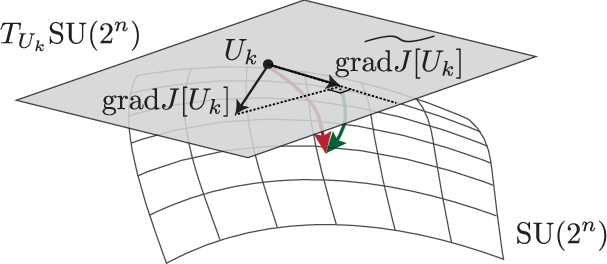
Figure 1: Schematic representation of the Riemannian gradient gradJ[Uk] at a point Uk.
Riemannian Gradient Flows for Ground State Problems
RGD is derived from Riemannian gradient flows, defined as differential equations situated on the unitary group. The primary focus is on the expectation value of a Hamiltonian, formulating the cost function J[U(t)]. The instantiation of RGD through the discretized solution leads to significant improvements in preparing ground states, contingent on characteristics such as the overlap between initial and ground states, spectral gap considerations, and the precision required.
Convergence Behavior
Significant numerical evidence demonstrates that the RGD steps scale linearly with spins for a 1D Ising model with nearest-neighbor interactions, whereas complete graph configurations exhibit quadratic scaling. This variation underscores the profound impact of the problem structure on the RGD's convergence speed, providing a robust framework for analyzing ground state complexities.
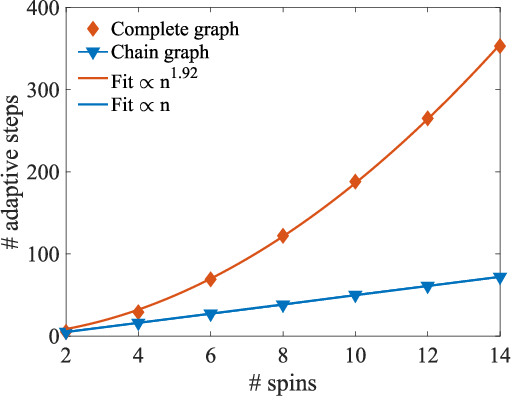
Figure 2: Number of adaptive steps required to prepare the ground state using RGD for a 1D chain and complete graph, indicating linear and quadratic scaling, respectively.
Approximating the Riemannian Gradient
To efficiently implement RGD updates on quantum devices, the study proposes approximating the Riemannian gradient by projecting it into polynomial-sized subspaces spanned by selected Pauli operators. Despite losing exactness due to approximation, the method retains almost sure convergence guarantees through strategic random projections each step, yielding notable convergence speed improvements.
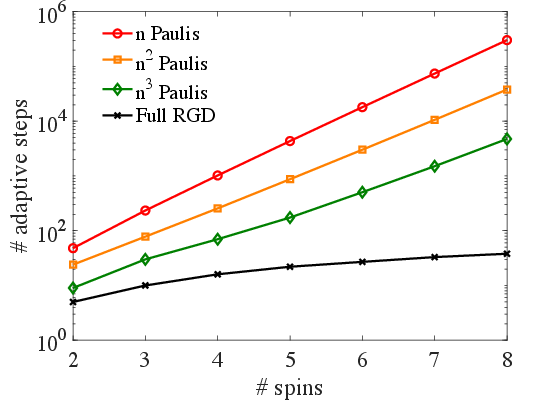
Figure 3: Number of adaptive steps for different Riemannian gradient approximations as a function of system size.
Quantum Device Implementations
For real-world applicability, implementing RGD efficiently on quantum hardware is achieved via two main techniques: Trotterization and a qDRIFT-inspired protocol. Trotterization systematically decomposes the unitary evolution into feasible operations, while qDRIFT reduces circuit depth by randomly selecting Pauli operators, maintaining average behavior correctness.
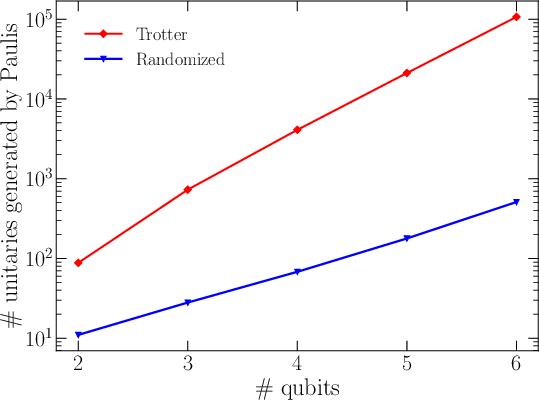
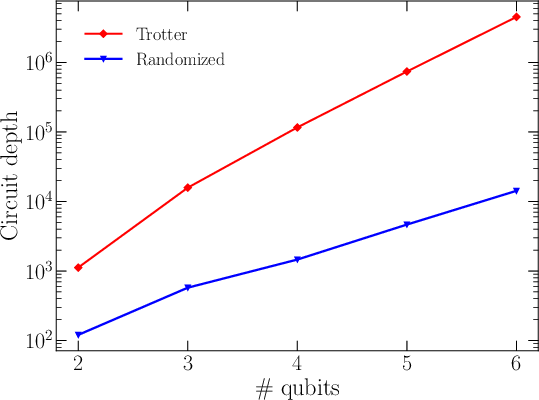
Figure 4: Performance comparison of Trotter-based and qDRIFT-inspired implementations for simulating RGD.
Conclusion
The paper presents a systematic exploration of Riemannian gradient descent methodologies for quantum ground state preparation, revealing significant dependencies on Hamiltonian structures and highlighting the trade-offs between approximation scalability and circuit depth. The experimental outcomes and simulated tests on IBM's quantum devices indicate potential avenues for further enhancement and optimization of RGD-based quantum algorithms, emphasizing their feasibility for near-term quantum computing applications. Future work may focus on refining these techniques to broaden their applicability to larger, more complex systems and enhancing their robustness against hardware decoherences.