- The paper introduces QLLG dynamics that exponentially suppress excited-state amplitudes while preserving the density matrix's norm and positivity.
- It derives rigorous convergence bounds exhibiting linear scaling in system size and an inverse relationship with the spectral gap.
- Numerical simulations on Heisenberg spin chains confirm the method’s efficiency and robustness even near spectral gap closures.
Ground-State Selection via Nonlinear Quantum Dissipation
Introduction
This work rigorously explores quantum ground-state preparation by leveraging nonlinear, physically realizable quantum dissipation. The study builds upon the recently proposed quantum Landau–Lifshitz–Gilbert (QLLG) dynamics, which generalizes the classical LLG equations to quantum many-body evolution. Unlike prior numerical-only techniques such as imaginary-time projection, QLLG produces a real-time nonlinear flow that exponentially suppresses excited-state amplitudes while preserving the norm and positivity of the density matrix. The paper provides a formal analytic framework for the QLLG mechanism, deriving explicit convergence bounds for complex interacting spin systems, and confirms these analysis with numerically exact simulations on Heisenberg spin chains.
The QLLG equation for the density matrix ρ,
ρ˙=ℏi[ρ,H]+iκ[ρ,ρ˙],
introduces a dimensionless damping parameter κ>0 which modulates between pure unitary (Schrödinger) evolution and a nonlinear dissipative process. The additional nonlinear term is constructed such that the energy expectation Tr(Hρ) monotonically decreases unless ρ is diagonal in the eigenbasis of H. Analytical calculations establish that for κ<1/4, energy dissipation is guaranteed, and the evolution halts when all commutators vanish, i.e., when ρ projects onto the eigenspace of the lowest-energy accessible state.
QLLG dynamics for a pure initial state is described by a non-unitary evolution with a non-Hermitian effective Hamiltonian
Heff=1+κ21−iκH,
enabling direct exponential suppression of all excited energy eigenstates while retaining physically meaningful real-time dynamics.
Convergence to the Ground State
For an initial pure state ∣ψ0⟩ with overlap ρ˙=ℏi[ρ,H]+iκ[ρ,ρ˙],0 with the ground-state manifold, the QLLG flow leads to exponential decay of all excited-state components:
ρ˙=ℏi[ρ,H]+iκ[ρ,ρ˙],1
where ρ˙=ℏi[ρ,H]+iκ[ρ,ρ˙],2 is the spectral gap. For systems with Hilbert space dimension ρ˙=ℏi[ρ,H]+iκ[ρ,ρ˙],3, the typical ρ˙=ℏi[ρ,H]+iκ[ρ,ρ˙],4, and therefore, the convergence time to a target error ρ˙=ℏi[ρ,H]+iκ[ρ,ρ˙],5 scales as
ρ˙=ℏi[ρ,H]+iκ[ρ,ρ˙],6
Hence, the QLLG method is provably linearly scaling in system size and inversely with gap, a substantial improvement relative to general quantum eigensolvers that often exhibit suboptimal scaling due to entanglement growth and spectral complexity.
An additional utility of QLLG evolution is selective eigenstate preparation: if the initial state lacks support on the ground-state manifold, the flow targets the lowest-lying eigenstate present in the initial state. Targeting of specific excited states is thus enabled by appropriate state seeding.
Numerical Evaluation on Heisenberg Spin Chains
The analytic predictions are tested on a ρ˙=ℏi[ρ,H]+iκ[ρ,ρ˙],7 site Heisenberg chain (nearest-neighbor coupling ρ˙=ℏi[ρ,H]+iκ[ρ,ρ˙],8 and Zeeman field ρ˙=ℏi[ρ,H]+iκ[ρ,ρ˙],9) with QLLG parameters κ>00. Random initial states, constructed from normalized complex Gaussian vectors, are evolved using the Euler method applied to the pure-state QLLG ordinary differential equation.
Simulation outcomes are compared to exact numerical diagonalization.
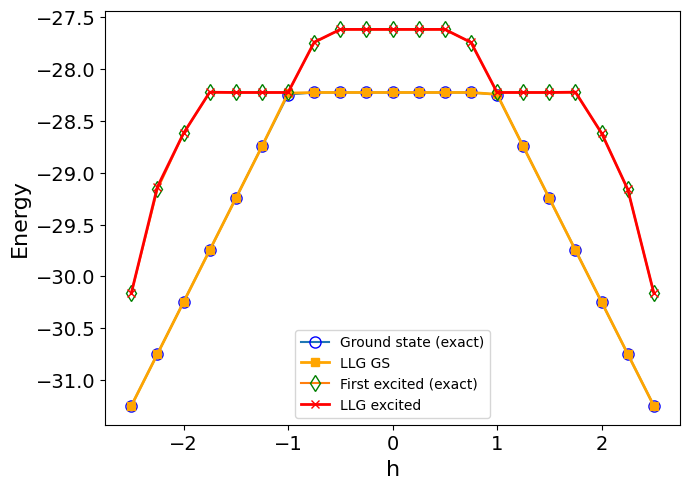
Figure 1: Exact and QLLG simulated energies for ground and first excited states demonstrate close alignment over Zeeman field κ>01.
The energy convergence for both ground and first excited state initially seeded is in excellent agreement across the parameter range, with the QLLG solution consistently matching the exact ground state.
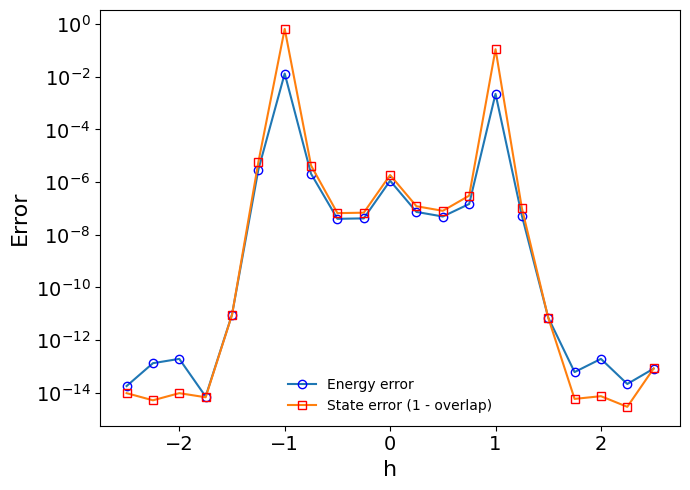
Figure 2: The energy error (absolute energy difference) and infidelity (1-minus-square-overlap) between exact and QLLG ground states, as functions of field strength κ>02.
Energy errors as well as state infidelity remain on the order of numerical precision, except in the immediate vicinity of ground-state level crossings, where the spectral gap closes. These points exhibit slow convergence, as expected from the analytic scaling with κ>03.
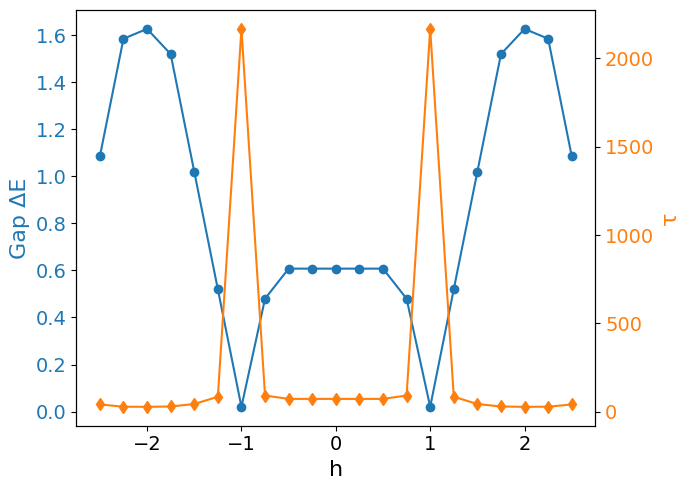
Figure 3: Spectral gap κ>04 and QLLG convergence time κ>05 as functions of magnetic field κ>06; the closing of the gap near critical points correlates with spiking convergence times.
Analyzing the spectral gap and corresponding convergence times confirms the direct inverse relationship with κ>07. As the system approaches a critical point (gap closing), κ>08 diverges, quantifying a fundamental efficiency limitation that is algorithm-independent.
Implications for Quantum Optimization and Control
The results position QLLG as a scalable and physically realizable mechanism for ground-state preparation in interacting quantum systems. Key differences from established techniques include:
- Physical implementability: Unlike imaginary-time flows, QLLG describes an actual real-time process, suitable for quantum simulators or engineered dissipative quantum matter systems.
- Robustness to initial conditions: Any typical random state, even in large Hilbert spaces, suffices for convergence due to statistical support on the ground-state manifold.
- Eigenspace selection: QLLG provides a pathway to prepare not only the unique ground state but also excited eigenstates of arbitrary energy provided proper overlap is engineered.
Potential applications include quantum simulation (e.g., cold atoms, magnetic molecular systems, rare-earth adatom lattices, and general open quantum matter), quantum optimization, and as preprocessing for quantum variational eigensolvers. While algorithmic enhancements for numerical solution exist, the universal inverse gap/linear size scaling for convergence is a fundamental limitation set by the formalism.
Conclusion
This study gives a comprehensive analytic and numerical validation of ground-state selection via the QLLG nonlinear quantum dissipative flow. The approach exhibits favorable scaling and fidelity characteristics, providing a viable experimental protocol for preparing many-body quantum ground states and low-energy eigenstates in various physical platforms. These findings motivate further exploration of nonlinear quantum dissipation for efficient quantum state engineering, quantum control, and combinatorial optimization, particularly in systems where traditional methods are computationally or experimentally infeasible.

