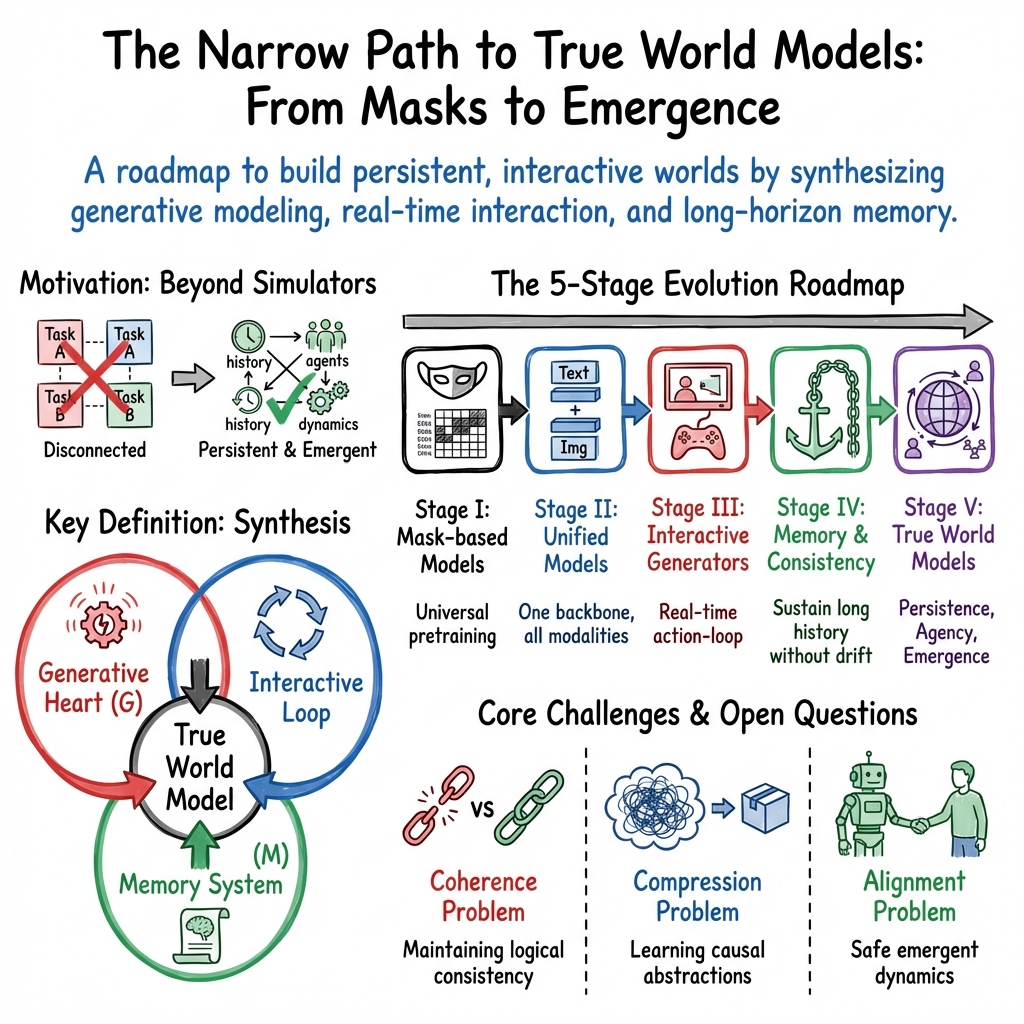
- The paper presents a guided framework detailing the evolution of world models from mask-based embeddings to fully interactive, autonomous AI systems.
- It outlines a five-stage progression focusing on unified modalities, interactive generative loops, and persistent memory integration.
- The methodology combines masking, generative loops, and memory architectures to address challenges in coherence and scalability.
From Masks to Worlds: A Hitchhiker's Guide to World Models
Introduction
The paper, titled "From Masks to Worlds: A Hitchhiker's Guide to World Models" (2510.20668), offers a comprehensive exploration of the evolution and integration of world models within the domain of artificial intelligence. It does not serve as a conventional survey but rather provides a guided framework for the creation of world models by outlining a narrowed path from early developments to the envisioned future of autonomous and interactive world systems.
The Evolutionary Trajectory
The exploration begins with a historical assessment where the concept of world models has been fragmented into various implementations, ranging from environment simulators in reinforcement learning to agents performing planning within learned models. However, a true world model differentiates itself through the seamless integration of a generative heart, interactive loops, and persistent memory, synthesizing over five distinct evolutionary stages.
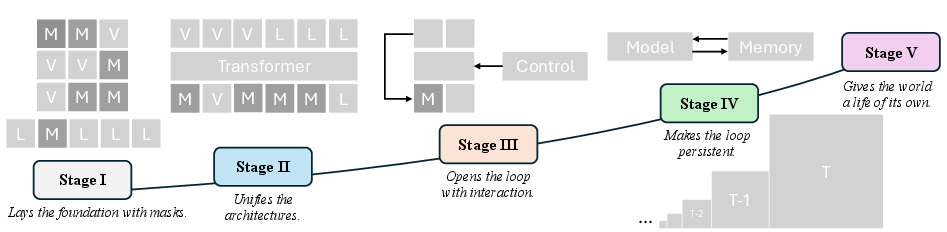
Figure 1: The evolution of world models across five stages.
Stage I: Mask-based Models
The initial phase, Stage I, marks the advent of mask-based models where the heart of model training involves masking and subsequent infilling to learn representations across different modalities. This approach, spearheaded by BERT and its successors, established a foundational universal paradigm that transcended language, vision, and even audio, reinforcing the paradigm of masked modeling as a cornerstone of multi-modal representation learning.
Stage II: Unified Models
Progressing to Stage II, models began to converge towards unified architectures that processed and generated across multiple modalities via a single paradigm. A significant leap was achieved via autoregressive LLMs initiated by GPT frameworks and extended to multi-modal models prioritizing either language or visual representations. This unified approach achieved cross-modal transfer capabilities but faced challenges in real-time interactions, thus necessitating further advancements.
Stage III: Interactive Generative Models
Stage III introduced interactive generative models, transforming static generators into systems capable of participating in a closed action-perception loop. This transition was exemplified by models such as AI Dungeon, where LLMs fuel dynamically generated interactive narratives, highlighting the potential for real-time adaptability in generative systems.
Memory and Consistency
Stage IV centralized around endowing models with coherent and consistent memory systems to maintain long-horizon coherence in generated worlds. This step involves leveraging both externalized memory techniques and intrinsic architectural adjustments to extend context spans, finally propelling towards models that can encode persistent states and logical consistencies over extensive temporal horizons.
The Architecture of True World Models
A true world model operates by merging its three essential subsystems: the generative core (G), the interactive looping frameworks (F, C), and its comprehensive memory architecture (M).
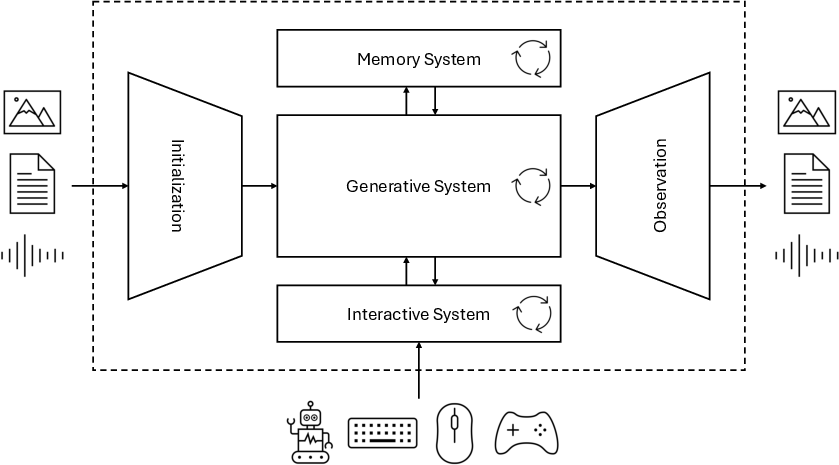
Figure 2: The architecture of a true world model.
Achieving such models involves challenges such as ensuring coherence in self-generated realities, maintaining scalable memory states, and aligning emergent multi-agent interactions within the modeled environment.
Conclusion
The culmination of these efforts is Stage V, where world models evolve into autonomous systems with persistence, agency, and emergence. The essence of world models therefore transcends simulation, transitioning toward tools for nuanced understanding of complex systems. The paper identifies significant challenges ahead, such as those of coherence, compression, and alignment, posing them as critical frontiers for future research.
In conclusion, the evolutionary roadmap detailed herein not only traces the development of world models but also sets a distinctive path towards an envisioned future where AI systems function as living, interactive ecosystems. It challenges researchers to look beyond static benchmark tasks and embrace the broader implications of creating computational ecosystems that mirror the intricacies of the real world.