- The paper demonstrates that AI coaching (Trucey) effectively reduces negotiation fear while traditional static resources better boost psychological empowerment.
- Experimental results show that the handbook significantly improved self-efficacy and empowerment, highlighting usability advantages over AI systems.
- User feedback reveals a trade-off where adaptive AI scaffolding lowers anxiety but may curtail creative negotiation strategies.
Evaluating the Efficacy of AI Coaching for Workplace Negotiation Preparedness
Introduction and Motivation
The paper investigates the effectiveness of AI-driven coaching for workplace negotiations, focusing on both tactical and psychological preparedness. While negotiation research has traditionally emphasized strategies and communication, psychological barriers—such as fear, anxiety, and low self-efficacy—are often the primary impediments to successful negotiation, especially in hierarchical workplace contexts. The study addresses a critical gap: whether AI-based, theory-driven coaching can meaningfully reduce these psychological barriers and improve negotiation readiness, compared to generic AI chatbots and traditional static resources.
System Design: Trucey
The authors introduce Trucey, an AI-powered negotiation coach grounded in Brett’s negotiation model and implemented via few-shot learning on GPT-4.1. Trucey operationalizes negotiation theory through four core mechanisms:
- Situational Calibration: Contextualizes advice to the user’s specific scenario.
- Role-based Simulation: Embodies the counterpart’s personality for realistic rehearsal.
- Contextual Layering: Delivers information incrementally to manage cognitive load.
- Iterative Response Alignment: Adapts feedback based on user input and reflection.
The interaction workflow is structured into five stages: scenario assignment, personality calibration, theory-guided advice, role-based rehearsal, and iterative feedback.
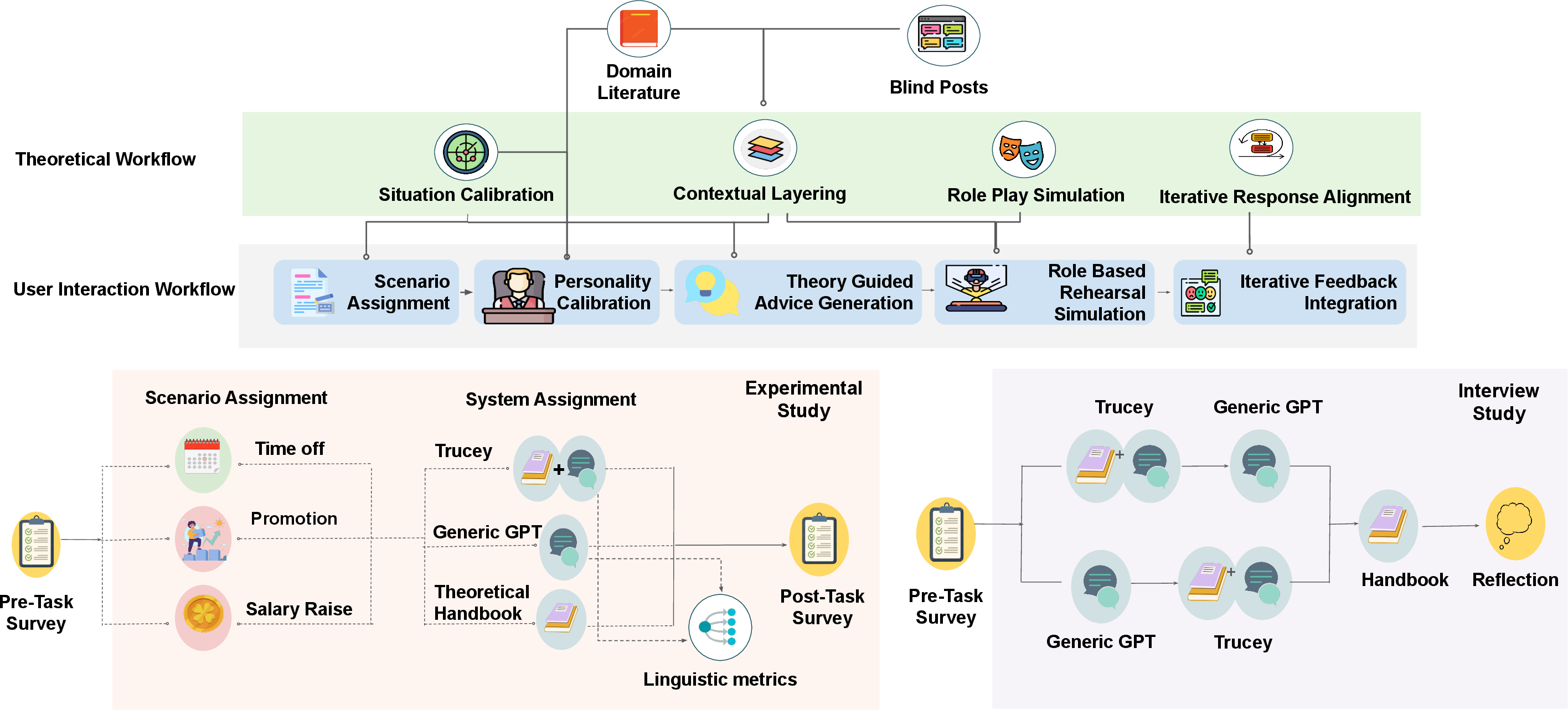
Figure 1: A schematic overview of Trucey and the experimental study design, illustrating the integration of negotiation theory, user interaction workflow, and evaluation methodology.
The technical implementation leverages GPT-4.1 via OpenAI’s API, a Streamlit frontend, and a SQL backend for logging and configuration. Personality calibration is achieved by mapping user assessments to vector embeddings, enabling Trucey to simulate supervisor archetypes and tailor both advice and roleplay.
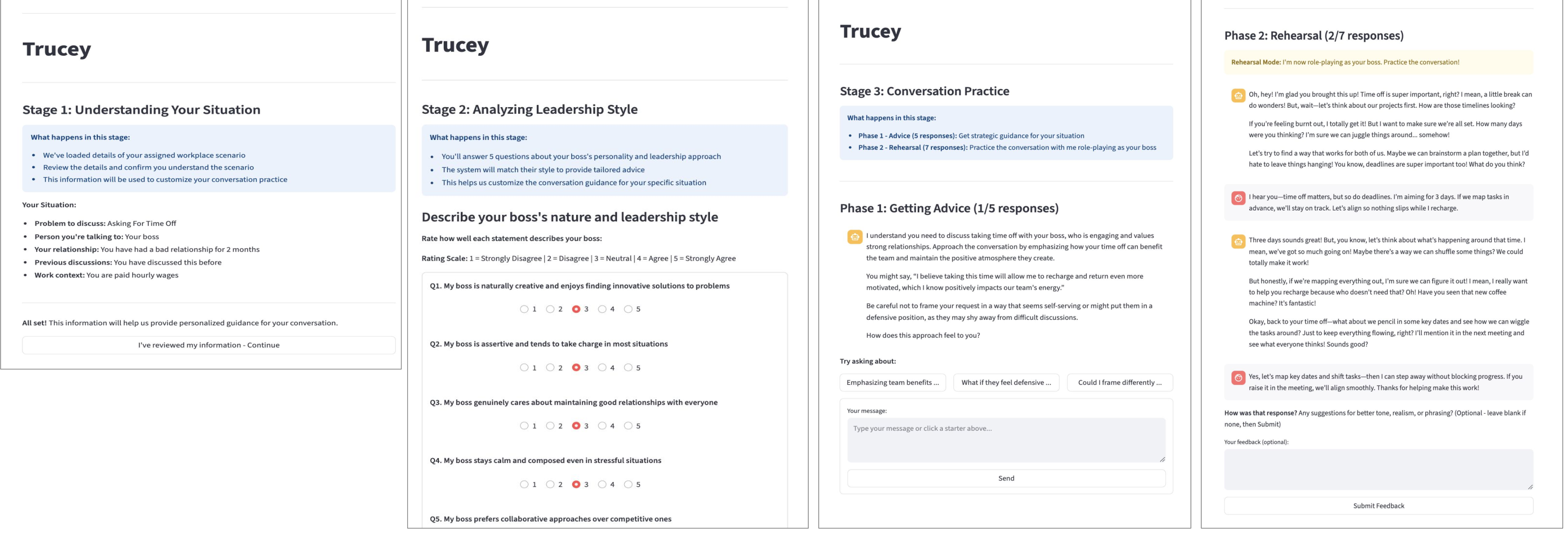
Figure 2: Example screenshots of Trucey, demonstrating scenario assignment, personality calibration, and interactive rehearsal stages.
Experimental Methodology
A pre-registered, between-subjects experiment (N=267) compared three conditions:
- Trucey: Theory-driven, interactive AI coach.
- ChatGPT: Generic AI chatbot (GPT-4.5), no negotiation-specific scaffolding.
- Handbook: Static, theory-based negotiation resource.
Participants completed pre- and post-task surveys measuring organizational self-efficacy, psychological empowerment, negotiation fear, and willingness to initiate negotiation. A qualitative interview study (N=15) further explored user perceptions, autonomy, and cognitive load.
Quantitative Results
Psychological Outcomes
- Self-Efficacy: Handbook yielded the largest improvement (Δ=+0.58), Trucey a marginal increase (Δ=+0.05), and ChatGPT a decrease (Δ=−0.19).
- Psychological Empowerment: Handbook outperformed both AIs (Δ=+0.26 vs. Trucey/ChatGPT Δ=+0.04), with a statistically significant medium effect size (d=−0.40 for Trucey vs. Handbook).
- Negotiation Fear: Trucey achieved the strongest reduction (Δ=−0.19), while ChatGPT increased fear (Δ=+0.14) and Handbook had a smaller reduction (Δ=−0.10).
- Willingness to Initiate: All conditions improved willingness, with negligible differences.
Contradictory to prevailing assumptions, the static Handbook outperformed both AI systems in usability and empowerment, despite Trucey’s superior performance in fear reduction.
Linguistic and Lexico-Semantic Analysis
- Trucey produced responses that were less verbose, more readable, less repetitive, and less formal than ChatGPT.
- Empathy: ChatGPT responses were more empathetic, while Trucey was more persuasive but less empathetic, likely due to its adversarial simulation design.
- Theory Integration: Trucey’s language more closely aligned with collaborative and strategic negotiation elements, while ChatGPT’s outputs were more generic and balanced.
Regression modeling revealed that Trucey’s structured, theory-driven guidance improved self-efficacy and empowerment for users employing stepwise strategies, but could undermine confidence in creative or integrative negotiation approaches due to the incremental, scaffolded delivery.
Qualitative Insights
Three dominant themes emerged from the interviews:
- Informational Autonomy: Users prioritized control over information access and preferred comprehensive, reviewable resources (Handbook) over interactive, system-driven workflows.
- Cognitive Load Management: Under stress, participants favored condensed, skimmable content and found AI’s incremental delivery burdensome, especially when anxious or time-constrained.
- Rehearsal Acceptance Divide: Some users valued AI-mediated rehearsal for exposure and fear reduction, but others fundamentally rejected it, citing lack of authenticity and inability to simulate real-world unpredictability.
These findings indicate that user acceptance of AI coaching is highly contingent on context, autonomy needs, and perceptions of authenticity.
Implications and Future Directions
Theoretical and Practical Implications
- Situated Utility of AI: The value of AI coaching is not universal; it is maximized when aligned with user autonomy, cognitive load, and psychological state.
- Preparation Paradox: Theory-driven AI can reduce fear through structured exposure but may constrain creative confidence, highlighting a trade-off between scaffolding and flexibility.
- Hybrid Design: The results motivate hybrid systems that combine the comprehensive, reviewable structure of handbooks with the adaptive, rehearsal capabilities of AI.
Design Recommendations
- Support for Autonomy: AI systems should enable direct access to comprehensive resources and allow users to control the depth and sequencing of information.
- Adaptive Scaffolding: Systems should dynamically adjust information delivery based on user stress, time constraints, and learning preferences.
- Holistic Preparation: Integrate tactical, psychological, and reflective components, including post-rehearsal debriefs and emotion regulation strategies.
- Authenticity and Transfer: Address the limitations of AI simulation fidelity, possibly through hybrid human-AI rehearsal or more sophisticated adversarial modeling.
Methodological and Policy Considerations
- Prompt Engineering: Embedding social theory and user context in prompts is a cost-effective alternative to model retraining for domain adaptation.
- Bias and Equity: AI negotiation tools must be calibrated for diverse cultural and organizational contexts to avoid reinforcing dominant communication norms or marginalizing underrepresented groups.
- Organizational Integration: AI coaching should be positioned as a user-facing empowerment tool, not merely a productivity enhancer for management.
Conclusion
The study provides robust empirical evidence that theory-driven AI coaching can reduce psychological barriers to workplace negotiation, particularly fear, but does not universally outperform traditional resources in usability or empowerment. The findings challenge assumptions of AI superiority and underscore the importance of user autonomy, cognitive load management, and authenticity in the design of AI-mediated workplace technologies. Future research should explore hybrid systems, adaptive scaffolding, and real-world deployment in diverse organizational contexts to optimize both tactical and psychological negotiation preparedness.

