- The paper details a multi-epoch NIR survey designed to overcome Gaia’s limitations in high-extinction regions.
- It utilizes wide, deep, and control subsurveys to achieve high-precision astrometry and robust proper motion measurements (~1 mas/yr).
- The survey enhances extinction mapping and IMF studies by delivering high-resolution imaging over 650 deg² and 1.15 million images.
Introduction and Motivation
VISIONS represents a major effort to provide a comprehensive near-infrared (NIR) imaging survey of the five nearest active star-forming molecular cloud complexes: Chamaeleon, Corona Australis, Lupus, Ophiuchus, and Orion. Leveraging the VISTA telescope and its VIRCAM instrument, the survey delivers multi-epoch imaging in J, H, and KS bands, systematically targeting regions within 500 pc of the Solar System. VISIONS is specifically designed to complement Gaia, addressing the well-known limitations of Gaia in regions of high extinction and for intrinsically faint, low-mass objects, by probing stellar and substellar populations otherwise inaccessible in the optical.
Figure 1: Ongoing star formation in L1688, L1709, and L1689 in Ophiuchus, highlighting the structured interplay between young stellar objects and the surrounding molecular clouds.
The rationale for the survey is driven by the outstanding problems in star formation research: the lack of a predictive, quantitative theory of the stellar initial mass function, the formation and dispersal processes of embedded clusters, and the intricacies of YSO evolution and feedback. By releasing a high-angular resolution NIR dataset, VISIONS establishes a legacy archive with a structure paralleling 2MASS but at substantially improved depth and spatial resolution, optimized for the detailed characterization of the southern star formation complex population.
Survey Architecture and Observational Strategy
VISIONS spans ∼650 deg2 with ∼1.15 million images and a total on-sky integration of 49.4 hours. The survey strategy is structured around three linked subsurveys:
- Wide: Shallow, six-epoch coverage optimized for measuring proper motions over large areas and multi-year baselines, using the H-band.
- Deep: High-sensitivity, multi-filter (JHKS) observations targeting areas of high extinction to access deeply embedded young objects and background sources for extinction mapping.
- Control: Multi-filter imaging of low-extinction regions at similar Galactic coordinates for statistical comparison and contaminant population modeling.
Figure 2: Morphologies and features in Lupus, Chamaeleon, and Corona Australis, with examples of reflection cavities, embedded protostars, and clustered star formation geometry.
VISIONS maximizes synergy with the VISTA Hemisphere Survey (VHS), which provides temporal baselines of >10 yrs in some regions, enhancing proper motion precision, and supplies complementary J and KS imaging across the survey footprint. The wide field imaging is executed in a tiled manner, with each area revisited at optimal intervals for astrometry, and the deep and control programs are scheduled to match extinction and Galactic structure requirements.
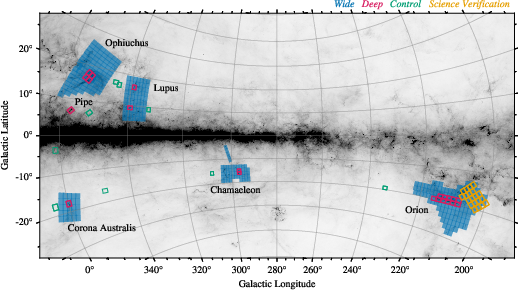
Figure 3: Spatial distribution of observed regions overlaid on Planck 857 GHz, showing wide (blue), deep (red), and control (green) survey components.
Data Processing and Quality Control
Critical to VISIONS is the adoption of a dedicated image processing pipeline that circumvents the recognized limitations of the standard CASU system (bilinear resampling, extinction-corrected photometry, systematics in color transfer). The custom pipeline prioritizes PSF fidelity, minimal image resampling artifacts, and consistent calibration onto the 2MASS photometric system, with Gaia DR3 astrometry as a global reference frame. Typical positional errors are ∼10 mas and photometric errors for bright sources are ∼5 mmag.
Key Scientific Goals
Precise Astrometry in Obscured and Embedded Stellar Populations
VISIONS enables high-precision (∼1 mas/yr) proper motions for samples down to H∼16 mag, extending to the substellar regime and including sources deeply embedded in cloud interiors. The NIR-based approach overcomes the strong bias against high-extinction and faint objects inherent in Gaia, offering, for instance, complete kinematic datasets for the Orion, Ophiuchus, and Lupus embedded populations.
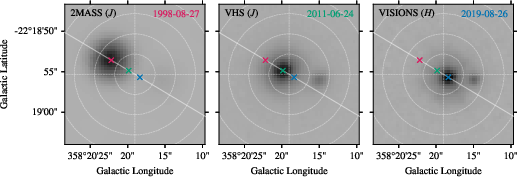
Figure 4: Multi-epoch imaging of a high proper motion star, demonstrating improved astrometric tracking by integrating 2MASS, VHS, and VISIONS epochs.
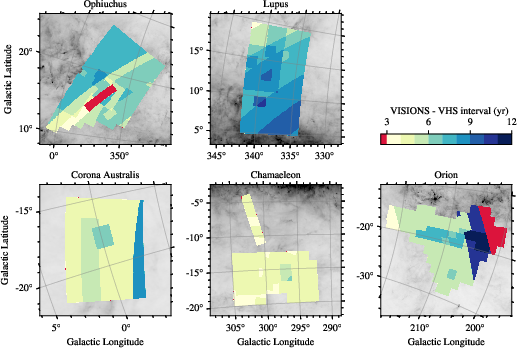
Figure 5: Available proper motion time baselines across the surveyed fields, illustrating the non-uniform, region-dependent baselines crucial for astrometric accuracy assessment.
Combined with VHS and historical data (e.g., 2MASS), the survey yields time baselines sufficient for sub-km/s velocity precisions at typical distances. This opens rigorous exploration of internal cluster kinematics, dynamical ejection phenomena, and feedback-driven gas dispersal signatures.
YSO Identification, Multiplicity, and Cluster Demographics
The overall sensitivity of VISIONS allows for YSO identification down to masses of ∼0.01 M⊙ in the nearest clouds, complementing the census from optical, X-ray, and mid-IR regimes. Improved PSF handling bolsters morphological classification, binary system resolution, and the disentangling of nebular and circumstellar structures.
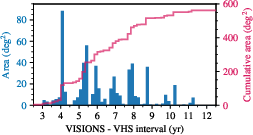
Figure 6: Histogram of maximum available time intervals for astrometric baselines, quantifying spatial and temporal astrometric completeness of the VISIONS-VHS composite dataset.
Unbiased Census of Embedded Cluster Membership, IMF Shape, and Free-Floating Planets
VISIONS is positioned to provide the most complete sample of young substellar and planetary-mass objects in nearby clusters, critical for robust initial mass function (IMF) measurements at low masses. The survey infrastructure supports the identification of wide cluster binaries, mass segregation signatures, and kinematic outliers likely resulting from cluster dynamical processes.
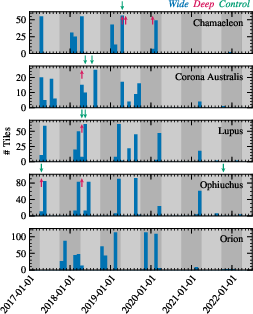
Figure 7: Survey execution timeline across target complexes, showing cadence for the wide, deep, and control surveys, as well as operational interruptions.
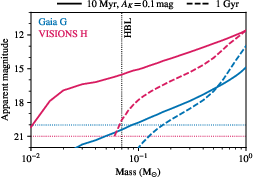
Figure 8: Apparent Gaia-G and VISIONS-H magnitudes as a function of object mass at 400 pc, compared to their respective detection limits and the hydrogen burning threshold.
VISIONS's capability at the substellar limit enables tests of IMF universality, environmental dependence at the low-mass end, and the rare, free-floating planetary-mass population.
High-Resolution Mapping of Extinction, Dense Core Structure, and the ISM
VISIONS deep observations increase the density of background sources for extinction mapping by ∼ an order of magnitude over previous surveys (e.g., 2MASS, Gaia), especially in regions of AK>0.5 mag. This enables construction of extinction maps at resolutions of ∼10"–$60"$, free from biases due to dust temperature or molecular depletion.
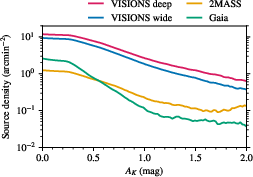
Figure 9: Source density as a function of extinction in Orion A for VISIONS, Gaia, and 2MASS, highlighting VISIONS's superior completeness across all AK.
The improvement supports not only better characterizations of dense core mass functions, but also more accurate 3D maps of dust in highly extincted regions, fundamental for anchoring ISM structure studies.
Investigation of the NIR Extinction Law and Dust Properties
By combining NIR extinction maps with (sub-)mm and FIR dust emission (e.g., Planck, Herschel), VISIONS allows for empirical constraints on the uniformity of the NIR extinction law, the ratio of NIR to sub-mm opacities, and local variations in the spectral index β. The survey's isolation from significant background confusion improves the reliability of such measurements.
Implications and Future Prospects
VISIONS provides the most extensive NIR time-domain and deep imaging dataset for southern star forming regions. It establishes a critical foundation for:
- Connecting Gaia’s astrometric frame to embedded, optically invisible populations,
- Delivering proper motion-selected samples for chemical, kinematic, and dynamical follow-up with future high-resolution spectroscopic facilities,
- Advancing understanding of cluster formation and dispersal, the universality (or not) of the IMF, and feedback-dominated cluster evolution,
- Serving as a definitive reference field for JWST and future ELT deep imaging programs targeting YSOs, embedded clusters, and their environments.
The legacy character of the dataset, once fully released, ensures that VISIONS will serve as a foundational resource for the star formation, IMF, and Galactic structure communities in tandem with upcoming deep and high-resolution surveys.
Conclusion
VISIONS fundamentally expands the discovery space for Galactic star formation research by providing a high-fidelity, multi-epoch, NIR imaging atlas of the nearest star-forming regions. Its strategic design circumvents traditional optical limitations, addresses crucial questions regarding star and cluster formation, and facilitates a wide range of research avenues from the structure of molecular clouds to the census of the local low-mass stellar and substellar populations. The careful survey architecture, advanced data processing, and comprehensive data releases position VISIONS as an indispensable resource for the astrophysical community for the coming decades.
Citation: "VISIONS: The VISTA Star Formation Atlas -- I. Survey overview" (2303.08831)