- The paper introduces the VVV survey’s novel near-IR dataset, achieving unprecedented depth and coverage of the Galactic bulge and inner disk.
- It details innovative calibration methods, reddening mitigation strategies, and automated classification techniques for variable stars.
- Early results reveal new star clusters, variable stars, and refined Galactic structure mapping despite observational challenges.
The Vista Variables in the Via Lactea (VVV) ESO Public Survey: Status and Early Results
Survey Overview and Objectives
The Vista Variables in the Vía Láctea (VVV) Survey is a near-infrared variability survey targeting the Galactic bulge and adjacent inner disk, utilizing the 4m VISTA telescope at ESO with its wide-field VIRCAM mosaic. This survey covers 520 deg2 in the ZYJHKS bands, yielding nearly 109 point sources and anticipating detection of ∼106 variable stars. The project is designed to address core open questions in Galactic structure, stellar populations, and variability in highly extincted and crowded central Milky Way regions.
The VVV data substantially deepen the photometric reach compared to 2MASS and UKIDSS-GPS by over four and one magnitude(s), respectively, into high-extinction fields. One major scientific aim is constructing a precise three-dimensional map of the Galactic bulge by leveraging RR Lyrae variables as standard candles in the near-IR, where period-luminosity relations are tighter and extinction effects are minimized. The survey also facilitates discovery of previously hidden globular clusters, open clusters, and associations.
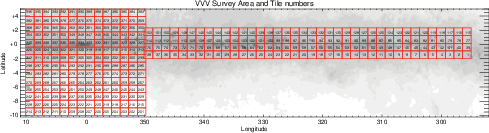
Figure 1: The VVV Survey footprint in Galactic coordinates, demonstrating extensive coverage of the bulge and inner disk, overlaid on a differential extinction map (AV).
Observational Strategy, Pipeline, and Data Quality
Observations are conducted in service mode, maximizing uniformity and quality. Optimal first-year seeing ($0.8''$ for JHKS, $1''$ for ZY) and deep imaging underpin the resultant data products. The VVV data processing pipeline at CASU implements advanced calibration strategies, including per-section zero point calculation and improved aperture corrections for crowded fields.
Substantial pipeline upgrades (v1.1) have improved photometric uniformity and the treatment of spatially and temporally variable PSFs across the VIRCAM focal plane. These enhancements are critical for reliable photometry in regions of severe crowding and variable extinction.
Despite observational setbacks due to unanticipated degradation in VISTA mirror coatings—which led to incomplete ZY observations and less coverage for bulge variability in the first year—the survey has already delivered scientifically valuable datasets across much of its planned footprint.
Variable Star Science and Light Curve Extraction
Although the initial variability cadence was suboptimal, science verification fields provided time-series data. This has enabled the extraction of light curves for known variables, including RR Lyrae and eclipsing binaries. The survey's observing strategy, based on repeated "pawprints" and "tiles," facilitates averaging and artifact rejection for time-series analysis.
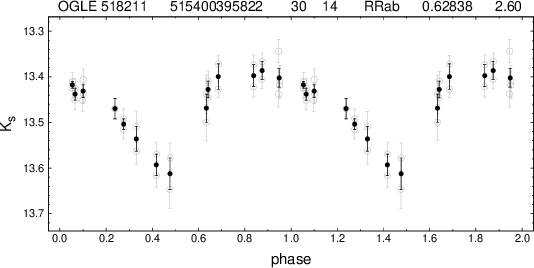
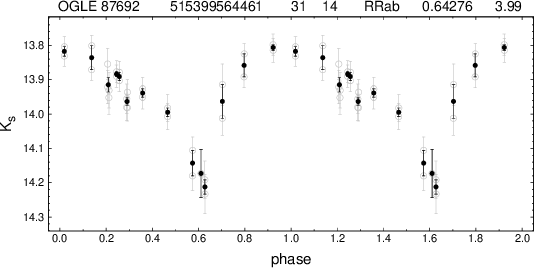
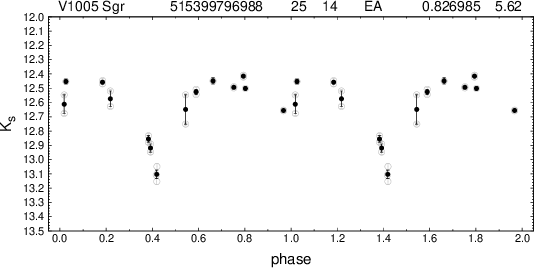
Figure 2: Light curves in KS for two ab-type RR Lyrae stars and a detached eclipsing binary illustrate the temporal sampling, photometric precision, and variability detection pipeline.
An explicit quantitative measure—ratio d of global to internal rms scatter—is used to prioritize variable star candidates algorithmically. This method exploits the VISTA observational pattern to construct robust feature vectors for downstream classification.
Discovery and Characterization of New Clusters
The VVV dataset is used for newly identifying hidden globular and open clusters via deep, high-resolution near-IR imaging. Discovery and subsequent analysis of VVV CL001, located near UKS 1, provides a proof of concept for this capability.
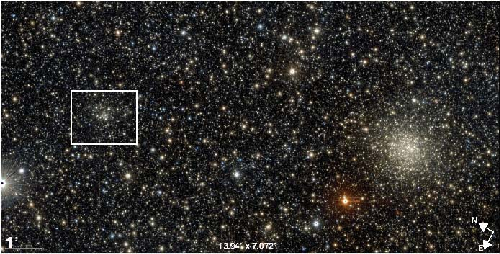
Figure 3: Discovery image (JHK composite) of the new globular cluster VVV CL001 near UKS 1, highlighting the resolving power and depth of VVV.
The survey yields unprecedented CMDs for known and new clusters, facilitating population studies and determination of cluster parameters, even in highly extincted bulge and disk regions. Case studies include metal-rich (NGC 6440) and metal-poor (NGC 6626, M22) clusters.
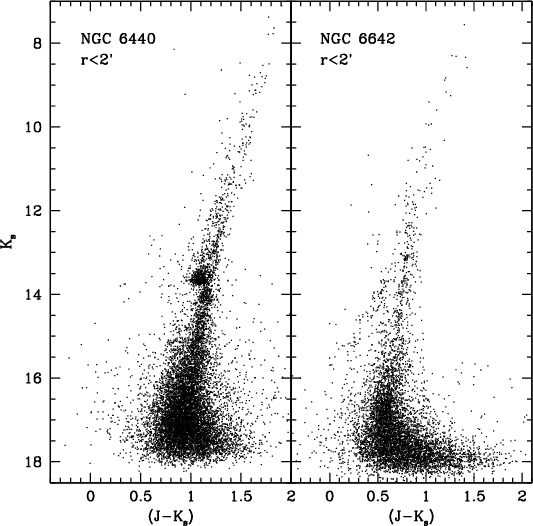
Figure 4: Near-IR color-magnitude diagrams for the inner regions of NGC 6440 and NGC 6626, representative of the diverse metallicities accessible to VVV.
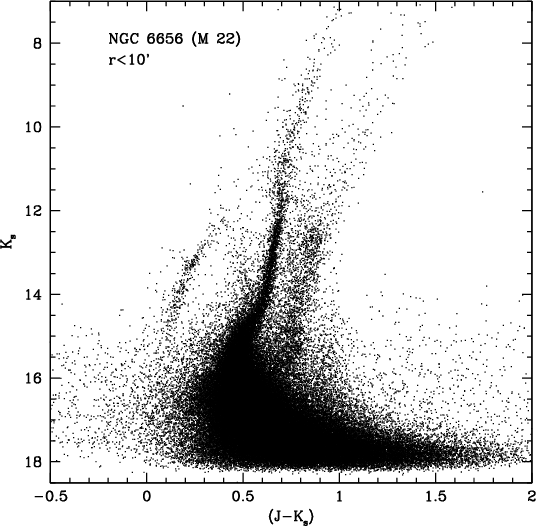
Figure 5: CMD of M22, showcasing the non-uniform blue horizontal branch and overlaying bulge populations.
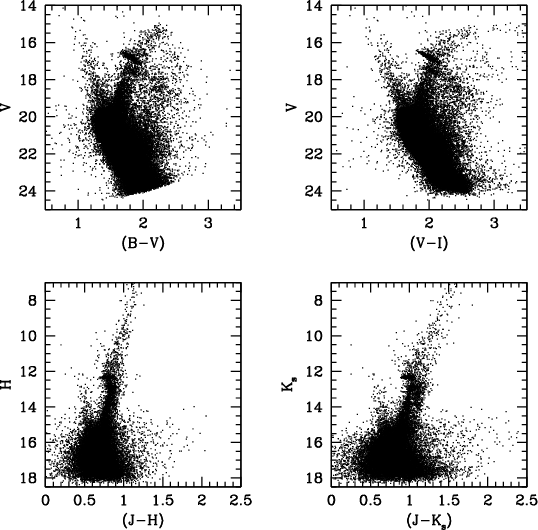
Figure 6: Comparison of optical (ACS@HST, IMACS@Magellan) and VVV NIR CMDs for NGC 6553 reveals the considerable reduction in extinction effects in the NIR, enhancing the clarity of cluster features.
The improved field of view and depth allow for studies extending to and beyond tidal radii, enabling investigation of cluster structure, differential reddening, and field decontamination procedures essential for robust cluster parameter estimation.
Open Cluster and Association Census
The identification of 96 new open cluster candidates in early data underscores the transformative impact of VVV's spatial resolution and sensitivity. The majority are compact, highly reddened, and young (<5 Myr), and only emerge in the NIR bands.
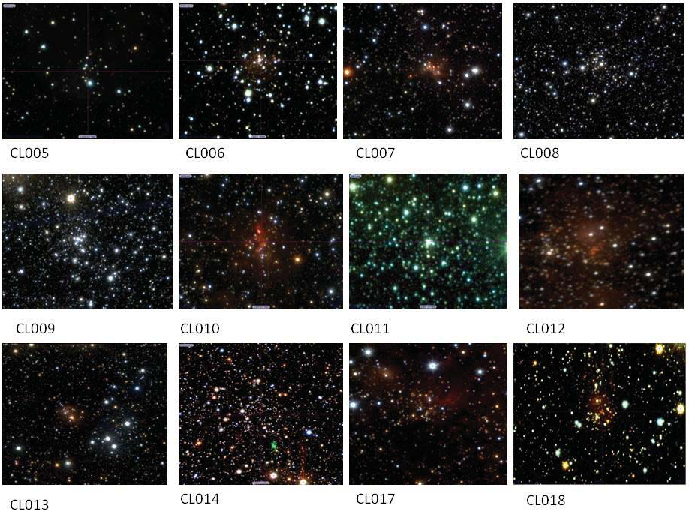
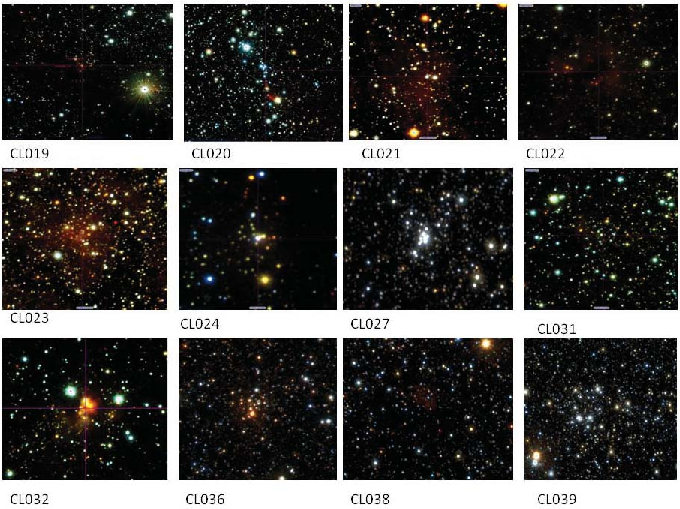
Figure 7: JHKS composite images of newly identified open cluster candidates; coordinates are detailed in Borissova et al. (2011).
Comparison with 2MASS imagery demonstrates the critical role of VVV's resolution for embedded association detection.
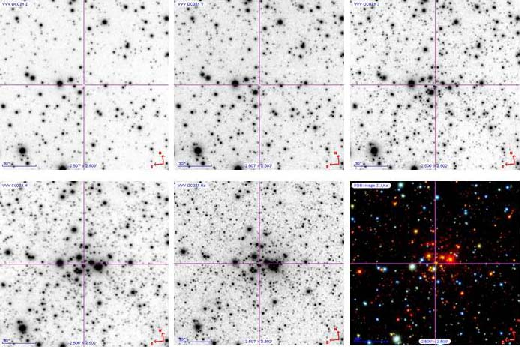
Figure 8: ZYJHKS filter and true-color composites for VVV CL036; cluster visibility is contingent on near-IR bandpasses.
The project employs sophisticated field star decontamination algorithms, yielding surfacedensity maps that isolate cluster populations effectively.
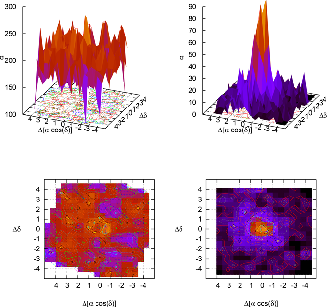
Figure 9: Stellar surface density maps for VVV CL036, before and after field star statistical decontamination.
Reddening-Free Indices and Extinction Mitigation
Despite reduced extinction in the NIR, severe differential reddening can distort cluster CMDs (e.g., Terzan 4).
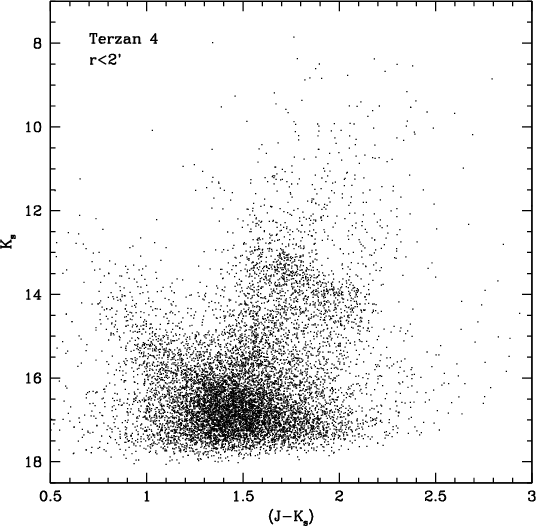
Figure 10: CMD of Terzan 4, illustrating persistent differential extinction effects even in the IR.
The VVV survey introduces new sets of reddening-free pseudo-magnitudes (mi) and pseudo-colors (ci), constructed via filter-specific extinction ratios and color-excess relations, to mitigate differential reddening distortions in parameter estimation.
Application to Terzan 4 evidences substantial sequence tightening and improved parameter space separation when using these indices.
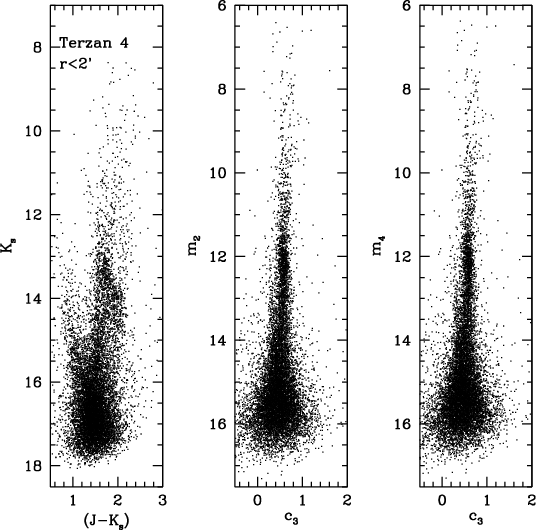
Figure 11: CMDs using reddening-free m2, m4, and c3 indices for Terzan 4, showing enhanced clarity relative to raw data.
Empirically, the utility of these indices is constrained by the precision of internal photometry and the adopted extinction law (R=3.09). Errors in calibration or misestimation of R can propagate and degrade the discriminative power of these indices.
VVV Templates Project: Toward Automated Variability Classification
The scope of VVV's variable star catalog (∼106 objects) mandates automated classification via supervised machine learning, for which large, high-quality template sets are essential. The templates project is an extensive campaign to build, from scratch, NIR light-curve libraries across diverse variability classes, leveraging multiple international IR facilities dedicated to this purpose.
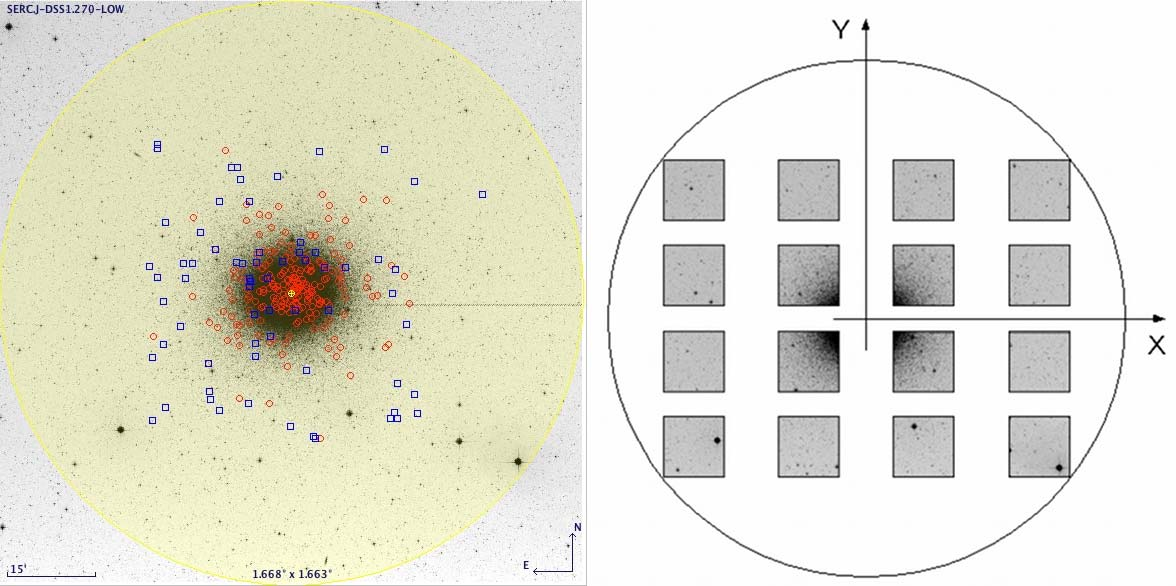
Figure 12: Distribution of known RR Lyrae and eclipsing binaries in ω Cen, overlaid on VIRCAM's detector array, as targeted in the template light curve acquisition campaign.
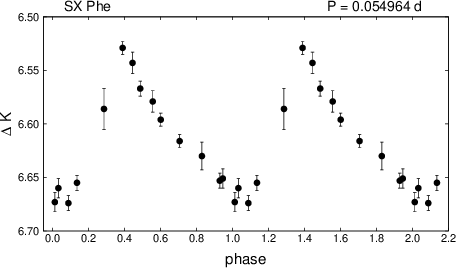
Figure 13: High-cadence K-band light curve for SX~Phe, highlighting achievable amplitude precision in the NIR.
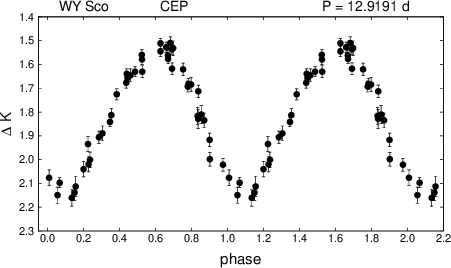
Figure 14: K-band light curve for the classical Cepheid WY~Sco, exemplifying template data quality necessary for machine learning.
Considering current limitations in the number of available near-IR templates, the project explicitly investigates active learning algorithms that maximize informational content per template and minimize labeling cost, in line with state-of-the-art methodology for "few-label" sample-efficient learning.
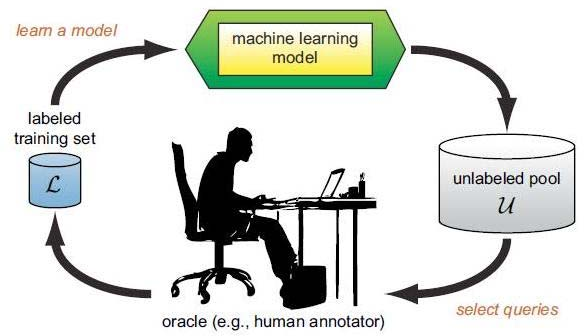
Figure 15: Schematic of pool-based active learning cycle, which iteratively queries for the most informative template stars to optimize classifier performance with minimal labeled data.
Implications and Future Directions
The VVV survey's deep, wide-field, multi-epoch NIR datasets are already redefining the state of the art in Milky Way structural, stellar, and variable star studies. The introduction of robust, empirically motivated reddening-free indices and field decontamination methods provides a basis for extracting reliable astrophysical parameters from high-extinction fields. The scale and depth of cluster discoveries, combined with a substantial increase in variable star catalogs, are likely to drive re-evaluation of bulge and inner-disk formation scenarios, cluster evolution, and extinction mapping.
The methodological development within the VVV Templates Project anticipates a paradigm shift to fully-automated, machine-learning-based pipeline processing for time-domain NIR surveys. Application and refinement of active learning for template acquisition have implications beyond astronomy, in high-throughput classification tasks with expensive labeling. Future releases of the VVV data will enable large-scale cross-survey synergy, data-driven model calibration, and ultimately a more complete understanding of the time-variable Galactic ecosystem.
Conclusion
The VVV ESO Public Survey constitutes a transformative advance for Galactic science in the near-IR, facilitating variable star, star cluster, and Galactic structure studies with unprecedented depth, precision, and area. The deployment of novel pipeline processing, reddening minimization strategies, systematic cluster searches, and a dedicated templates campaign will enable both immediate advances in understanding and set a methodological blueprint for future large-scale, machine learning-driven sky surveys.
(1105.1119)