- The paper pioneers high-cadence time-domain spectroscopy to overcome snapshot observation limits and directly map dynamic stellar phenomena.
- It details a dual-mode observational strategy using integral field and multi-object spectroscopy to capture kinematics and chemical evolution over multiple timescales.
- By acquiring time-resolved data, the study aims to establish unbiased accretion statistics and trace the link between episodic accretion and magnetic-driven ejections.
Time-Domain Spectroscopic Studies of Young Stellar Object Variability: Pathways to a Dynamical Understanding of Stellar Evolution
Introduction
The paper "Toward the time-domain spectroscopic study of the dynamic life of stars: from accretion to magnetic activity" (2512.12453) confronts the fundamental limitations in the understanding of star and planet formation derived from static or sparsely-sampled observations. It outlines a compelling case for long-term, high-cadence, multi-resolution spectroscopic monitoring of young stellar objects (YSOs) and associated environments. By explicitly advocating for an ESO next-generation facility optimized for time-domain spectroscopy, the authors lay out a cohesive strategy to directly observe and disentangle dynamic stellar phenomena across hierarchies of scale—thereby providing a blueprint to empirically map processes dictating stellar mass assembly, disk evolution, angular momentum transport, and the interplay with planet formation.
Motivation and Scientific Context
Star and planet formation unfolds across six orders of spatial magnitude—spanning molecular clouds, filaments, clumps, to protoplanetary disks and individual stars—and timescales extending from minutes (magnetospheric events, flares) to millions of years (cloud collapse and assembly). Most observables are intrinsically time-variable, as accretion, ejection, disk winds, jets, and magnetic reconnection imprint their signatures as stochastic and periodic processes operating on distinct but overlapping domains.
However, contemporary knowledge remains fundamentally hindered by reliance on snapshot observations. This leads to potential bias and incomplete physical inferences, as specific measured states cannot accurately capture true statistical variability or rare but pivotal events. For instance, measurements of accretion rates, jet velocities, or flare frequencies derived from single-epoch data may substantially misestimate underlying rates and distributions, obscuring causal mechanisms underlying disk evolution and early planet assembly.
Photometric time-domain surveys such as LSST and Gaia [gaiadr3], while transformative for cataloging photometric variability and discovering transients, lack the spectral resolution required to deconvolve the physical processes driving observed signals. Only time-resolved spectroscopy can directly probe kinematics, excitation conditions, and the chemical and dynamical evolution shaping YSO systems.
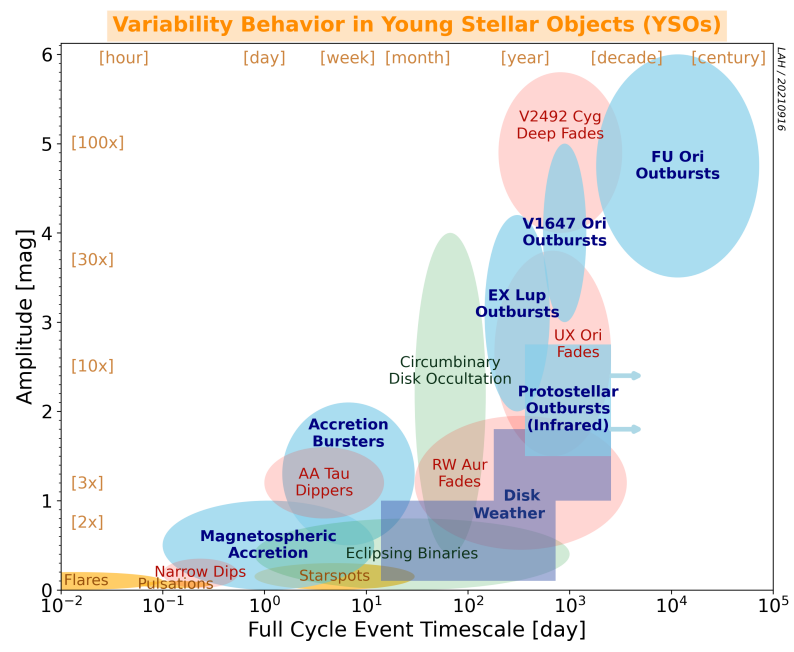
Figure 1: Amplitude versus timescale for different YSO variability types, delineating the necessity for spectroscopic probes on manifold cadences and dynamic regimes.
Facility and Observational Strategy
The authors propose a large-aperture ESO spectroscopic facility capable of both integral field spectroscopy (IFS) and multi-object spectroscopy (MOS) at high (R∼40,000) and low (R∼4,000) resolving powers. This dual-mode approach is essential to:
- Deliver wide-field IFS to spatially resolve kinematic and chemical structures in filamentary inflows and nascent clusters at parsec scales.
- Enable MOS to monitor thousands of YSOs in crowded star-forming regions, tracking spectral variability with cadences from nightly to annual/decadal baselines.
- Capture rapid events (magnetic flares, CMEs, accretion/ejection bursts) with high-cadence, velocity-resolved time-series.
- Provide temporal coverage to systematically map variability amplitudes, line profile morphologies, and excitation diagnostics across a statistically significant population for robust inference of underlying processes.
Such a facility would uniquely transcend the current state-of-the-art by connecting processes as diverse as large-scale filamentary inflow kinematics, envelope and jet evolution, disk accretion and winds, and small-scale explosive magnetic phenomena.
Scientific Themes and Key Probes
The advocated monitoring program addresses critical, unresolved questions across the hierarchical chain of stellar assembly and early evolution:
- Large-scale inflow tracing: Low-resolution IFS maps velocity fields and turbulence dissipation in molecular filaments, linking variations with embedded protostar activity.
- Envelope/jet/outflow evolution: Moderate to high-res MOS enables time-resolved quantification of jet velocities, forbidden and permitted line emission, and episodic mass-loss, providing direct tests of time-variable disk-wind and magnetospheric coupling [a_siciliaaguilar2020b].
- Disk accretion and magnetic activity: High-cadence monitoring of emission and absorption lines (e.g., H I, He I, Ca II, [O I], CO bands) identifies and characterizes classical accretion flickering [duy_cuong_nguyen2009a], transitions between accretion states [bayo2012], and signatures of reconnection-driven flares [barrado2002a]. Multi-component line fitting resolves contributions from funnel flows, disk winds, and accretion shocks.
- Short-timescale explosive events: Dedicated campaigns with high temporal sampling directly capture line-profile evolution during flares, CMEs, and accretion bursts, constraining energetics, launching mechanisms, and feedback on disk chemistry and planet-forming environments [a_kospal2011b, a_siciliaaguilar2012, m_audard2014, christopher_m_johnskrull_2007a].
Implications and Prospects
By capturing the time-domain spectroscopic behavior of YSOs in both statistical and detailed kinematic fashion, this project would produce the first dynamical, multi-scale atlas of star and disk evolution—a foundational empirical resource for calibrating theoretical models of star formation, disk evolution, and planet formation under realistic, time-variable boundary conditions.
Key implications include:
- Unbiased statistics of accretion and mass-loss rates: Disentangling age and mass dependencies, environmental influences, and observational selection effects.
- Direct mapping of the accretion–ejection connection: Empirically testing causal links between episodic accretion events and associated jet or CME launching, essential for jet-launching paradigms.
- Kinematic studies of dynamical feedback: Tracing turbulence, shock excitation, and feedback flows in the star-forming environment.
- Planet formation and disk chemistry: Quantifying how variable stellar activity impacts disk ionization, chemistry, and the habitability outcomes for forming planets.
- Angular momentum evolution: Resolving the mechanisms and timescales for angular momentum redistribution from disk to star, with direct consequences for stellar spin-down scenarios.
Future Directions
The multi-cadence, high-multiplex, homogeneous coverage enabled by the proposed facility would create a reference archive for time-domain calibration. It would anchor the physical interpretation of future photometric variability surveys—providing the necessary spectroscopic context for forthcoming LSST and Gaia time-domain harvests. The resulting data would enable cross-correlation with high-cadence photometric, radio, X-ray, and sub-mm programs, providing a holistic, panchromatic view of stellar and planetary system assembly.
Conclusion
This white paper (2512.12453) delineates a strategic roadmap for time-domain spectroscopic surveys of YSOs, leveraging next-generation instrumentation to transcend the limitations of current observatories. By systematically capturing the dynamical evolution of stellar birth and early activity across all pertinent spatial and temporal scales, such a facility would underpin a quantitative, causally-informed understanding of star and planet formation and constitute an indispensable legacy dataset for stellar astrophysics.