- The paper presents hierarchical clustering analysis of young stellar populations in the SMC, revealing scale-free, turbulence-driven structures.
- The paper derives precise proper motions for ~700,000 stars, identifying localized kinematic substructures linked to tidal interactions.
- The paper reconstructs the spatial and temporal star formation history, demonstrating significant age-dependent shifts in stellar distributions.
Near-Infrared VISTA Observations of the Small Magellanic Cloud
Introduction
The VISTA survey of the Magellanic Clouds system (VMC) provides an extensive, high-resolution, and multi-epoch near-infrared dataset probing the Small Magellanic Cloud (SMC) at an unprecedented scale and sensitivity. The campaign, encompassing ∼170 deg2 with VIRCAM on the VISTA telescope, enables detailed analysis of stellar populations, kinematics, and the star formation history (SFH) of the SMC. The present work synthesizes recent VMC results concerning hierarchical star formation structures, proper motions, and the spatiotemporal evolution of the SMC's SFH (1810.01214).
Hierarchical Clustering of Young Stellar Populations
A comprehensive analysis of upper main sequence stars (<250 Myr) in the SMC reveals 556 distinct stellar overdensities at 15 significance levels, identified using a color-magnitude-based selection that incorporates metallicity, extinction, and line-of-sight depth variations. The morphological characterization of these overdensities yields a perimeter–area dimension Dp=1.44±0.02, indicative of irregular, turbulence-driven structures analogous to those seen in the interstellar medium. The hierarchical organization is evident, with large-scale associations subdividing into increasingly compact groupings at higher significance—direct evidence for scale-free clustering.
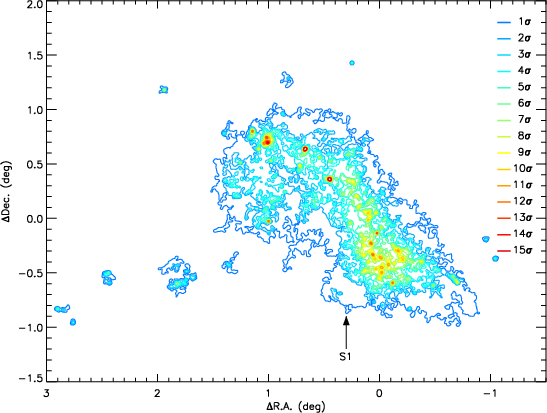
Figure 1: Boundaries of all identified young stellar structures, with colors representing detection significance, mapped across the SMC.
These results substantiate the central role of supersonic turbulence in star formation across multiple physical scales.
Proper Motions and Kinematics
Proper-motion measurements were derived from Ks-band VMC data spanning four tiles, utilizing the reflex motions of ∼33,000 background galaxies with respect to ∼700,000 SMC stars. The median systemic proper motion, (μαcosδ,μδ)=(1.087,−1.187) mas yr−1, aligns with external measurements, with systematic errors of $0.192$ and $0.008$ mas yr−1, and a random error of $0.003$ mas yr−1. Residual proper-motion maps reveal localized kinematic substructures—in particular, coherent velocity features in the southeast and central regions. These anomalies are attributed to past tidal interactions: the southeastern gradient aligns with the Wing and Bridge, while central deviations may correspond to the Counter-Bridge structure.
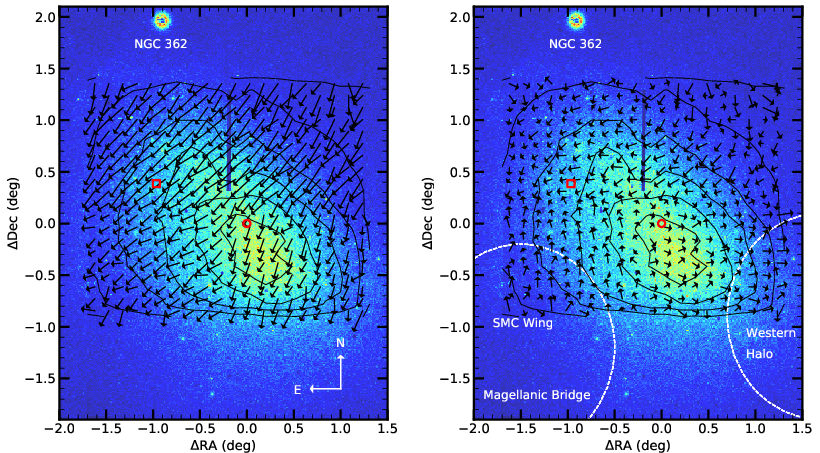
Figure 2: Proper-motion vector field overlaid on the stellar density map of the SMC, highlighting systemic flow and velocity residuals after subtraction of the median SMC motion.
This fine-scale kinematic mapping enhances constraints on recent dynamical evolution and the impact of tidal stripping in the SMC-LMC system.
The VMC dataset permits a granular reconstruction of the SFH for the central ∼24 deg2 of the SMC via color-magnitude diagram modeling. Analysis across 14 age bins in spatial subregions ($0.143$ deg2 each) demonstrates significant temporal and spatial variations. At young ages (logt=7.4, ∼12 Myr), star formation is confined to the Bar and Wing; separation between these features diminishes with age. The northwestern edge, prominent at intermediate ages (logt=8.3, ∼200 Myr), likely traces interactions with the LMC. In contrast, the oldest stellar populations (logt=9.7, ∼5 Gyr) exhibit a more azimuthally symmetric distribution. The total stellar mass produced over the SMC's lifetime is estimated at (5.31±0.05)×108 M⊙.
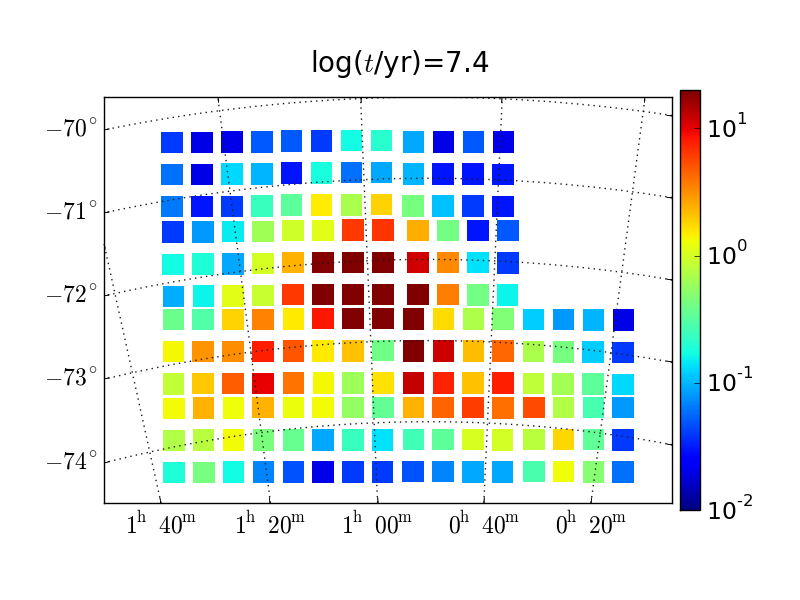
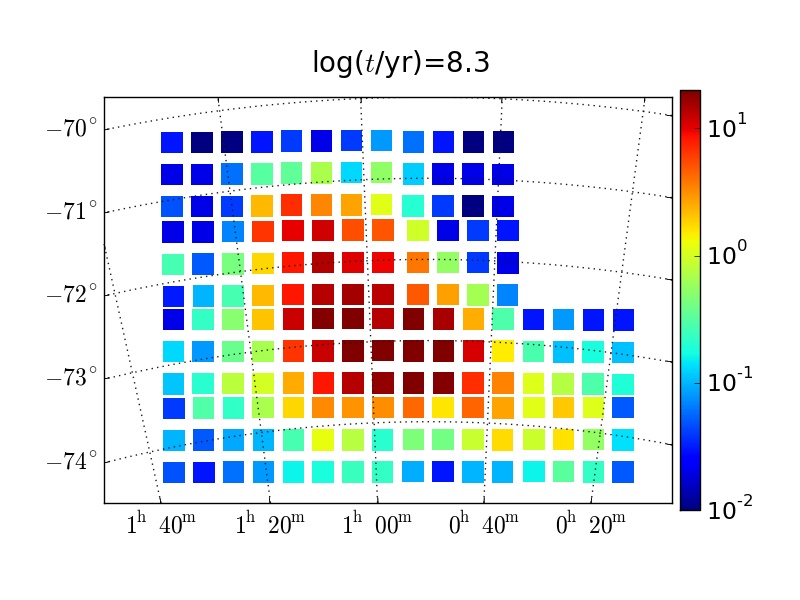
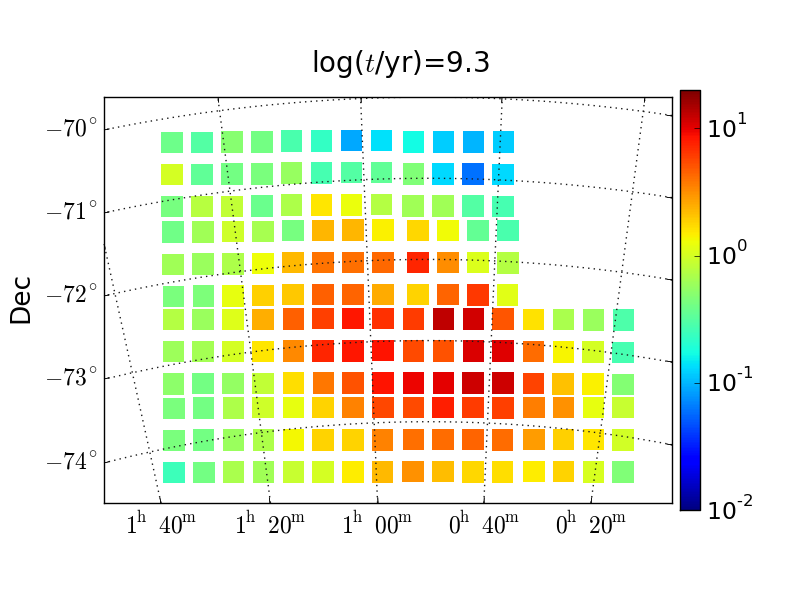
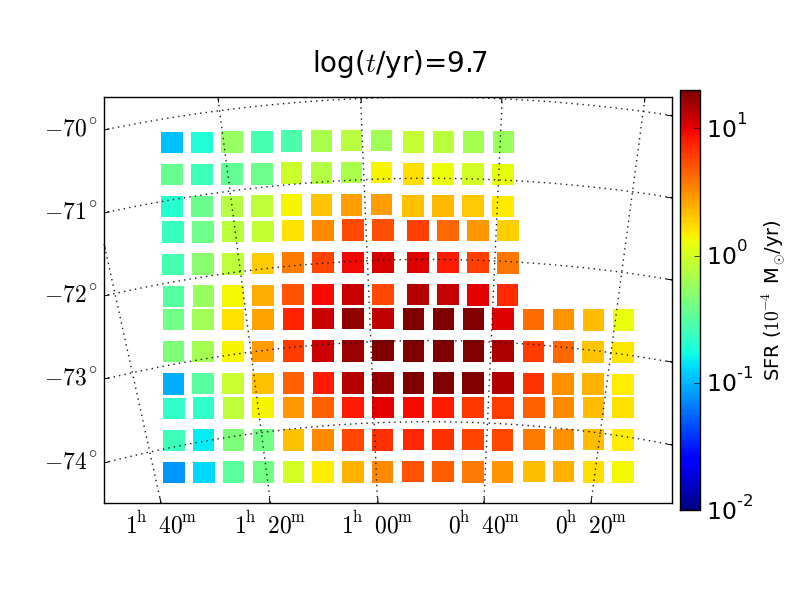
Figure 3: Star formation rate maps as a function of age, displaying shifting and evolving spatial patterns of star formation activity across the SMC.
Such temporal mapping elucidates the interplay between interactions, gas dynamics, and star formation across multiple SMC substructures.
Implications and Outlook
The VMC survey's mapping and analysis framework advances the understanding of dwarf galaxy evolution, specifically in environments subject to strong tidal perturbation. The characterization of hierarchical clustering in young populations solidifies the role of turbulent ISM physics in mediating star formation on all scales. Proper-motion field decomposition identifies complex kinematic signatures directly linked to dynamical interactions with the LMC, refining models of SMC mass loss and structure. The resolved SFH maps enable direct investigation into the timing and propagation of interaction-induced starbursts, the development of substructures, and the diffusion of the stellar component over cosmological timescales.
The forthcoming expansion of SMC analyses to its periphery, as well as analogous studies of the LMC, represent both practical and theoretical advancements. The improved understanding of stellar and gaseous feedback, dynamical heating, and cluster dissolution will inform future chemo-dynamical and hydrodynamical simulations. Moreover, integration of multi-wavelength datasets and advanced astrometric reductions promises further gains in precision and scope for resolved stellar population studies.
Conclusion
The near-infrared VMC survey has yielded a comprehensive dataset for the SMC, enabling robust, multi-faceted studies of its star formation, kinematics, and structural evolution. The resulting insights into hierarchical stellar clustering, internal kinematic complexity, and detailed SFH provide a benchmark for models of dwarf galaxy evolution under strong environmental influence. Continued exploitation of VMC data and its extension to the full Magellanic system will further constrain the physical processes responsible for forming and shaping low-mass galaxies.