- The paper introduces a difficulty prior in RL fine-tuning to improve model performance and overcome flat reward schedules.
- It employs Group Relative Policy Optimization (GRPO) and curated moderate-difficulty samples to stabilize training gradients.
- Experiments on benchmarks like Geometry3K show enhanced data efficiency and improved multimodal reasoning accuracy.
Unlocking the Potential of Difficulty Prior in RL-based Multimodal Reasoning
Introduction
The paper investigates the incorporation of difficulty prior into the reinforcement learning (RL) fine-tuning process for enhancing multimodal reasoning capabilities. The study addresses three significant limitations in current RL-based finetuning methodologies: mixed-difficulty corpora, flat reward schedules, and an absence of difficulty awareness. By tackling these issues, the paper aims to improve model performance across various multimodal reasoning benchmarks.
Methodology
Reinforcement Learning Fine-Tuning
The paper employs Group Relative Policy Optimization (GRPO) for RL fine-tuning. In GRPO, a LLM is optimized based on a scalar reward signal, utilizing a group-based advantage estimation approach. This method eliminates the need for a value network, enhancing training stability and efficiency.
Offline Data Curation
The offline data curation process involves selecting prompts of moderate difficulty, removing those that are too easy or too hard. This strategy ensures that training focuses on samples that provide meaningful gradients, thereby stabilizing GRPO gradients and avoiding computational waste.
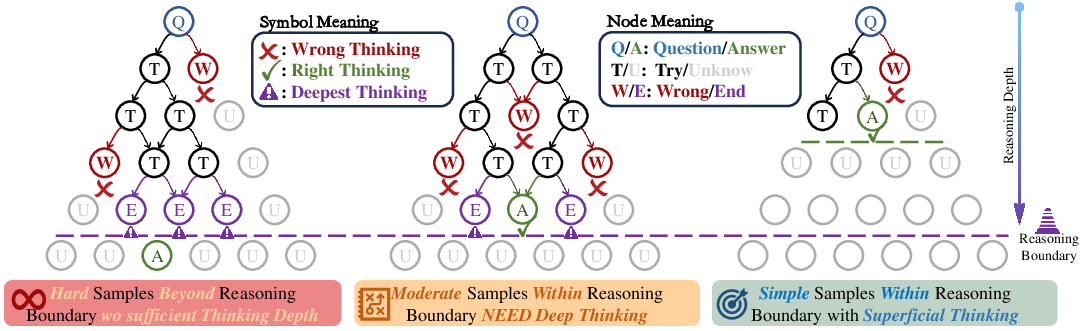
Figure 1: Demonstration of the samples with three difficulty levels, and relation with reasoning boundary and thinking depth: Hard samples lie beyond the reasoning boundary and cannot be answered correctly even after multiple attempts. Moderate samples reside within the reasoning boundary and require deep thinking to arrive at the correct answer. Simple samples stay within the reasoning boundary and can be answered correctly with only shallow or superficial thinking.
Online Advantage Differentiation
During RL fine-tuning, the method calculates a group-wise empirical accuracy to serve as a difficulty proxy, allowing the model to re-weight advantages adaptively. This ensures that correct answers to challenging problems receive stronger gradients, enhancing learning signals for meaningful training.
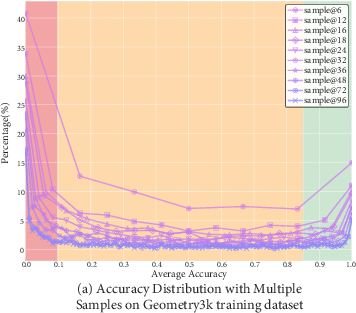
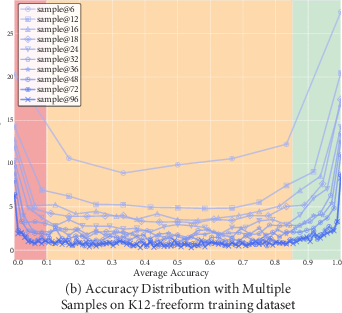
Figure 2: U-Shaped Accuracy Distribution of Model Predictions Across Diverse Sampling Sizes: A comprehensive visual representation of the accuracy distribution across multiple samples from the base model on the Geometry3K and K12-freeform-2.1K datasets.
Implementation
The methodology was tested using datasets like Geometry3K and K12-freeform-2.1K. Multiple sampling rounds estimated accuracy distribution, identifying a U-shaped pattern in difficulty, which guided the data curation process. The advantage differentiation employed several re-weighting functions, including exponential-decay and inverse-proportional functions, to align reward scaling with problem difficulty effectively.
Experiments
The paper conducts comprehensive experiments across multimodal mathematical reasoning benchmarks, showing superior performance compared to other RL, SFT-, or SFT+RL-based models. The data efficiency of the proposed method is notable, achieving excellent results with a significantly smaller dataset.
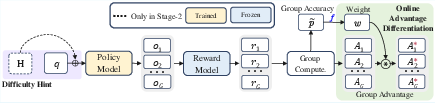
Figure 3: Overall training pipeline for two stages.
Conclusion
The paper demonstrates that modeling difficulty prior in RL-based fine-tuning can significantly enhance multimodal reasoning abilities. By addressing limitations in current methodologies, the proposed approach offers a pathway to more efficient and effective training, suggesting promising future research directions in integrating difficulty awareness into learning models.

